Yes, certain rocks really do grow. The most famous examples are the Trovants of Costesti, Romania. They are porous, sandstone-cored boulders that swell after heavy rains, when water dissolves the calcium carbonate cement they contain, causing pressure inside the rock to push the sand grains outward. Growth is glacially slow (around 4–5 cm every 1,000 years), but enough that locals once believed the rocks were alive and gave birth to smaller stones. The boulders range from a few centimeters to 15 feet across and probably first formed about 6 million years ago.
During heavy rain showers, the calcium carbonate crystals from sandstone react with the minerals in water, causing a reaction to occur inside. This reaction causes pressure to build up inside the rock, which causes them to become larger or grow.
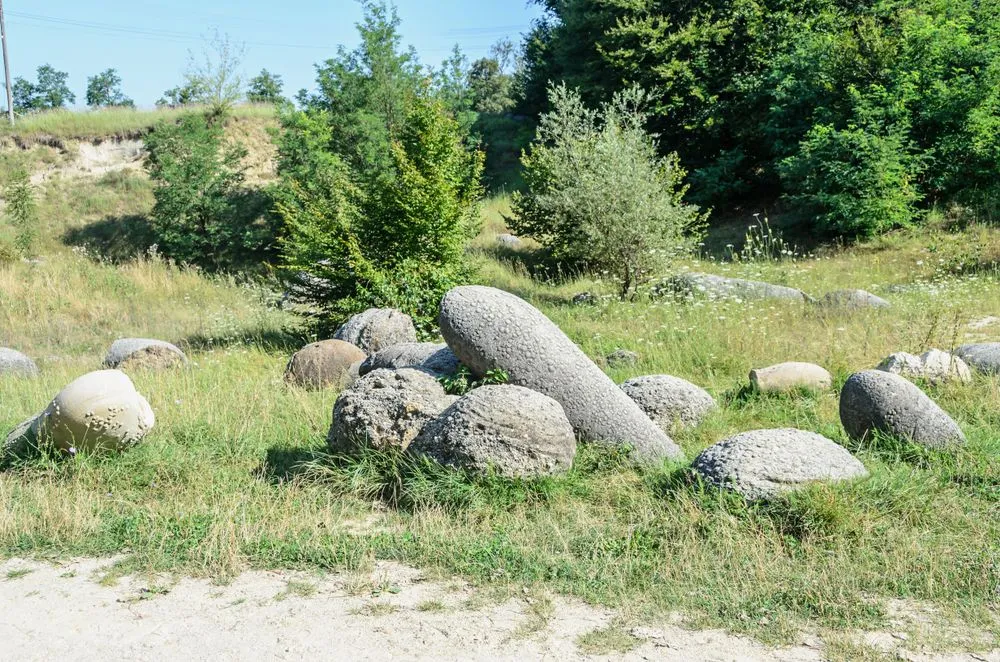
Have you ever walked into a forest and had the eerie feeling that everything around you was alive and watching your every move? Do the rocks even suddenly start following you?
Well, if you were in the tiny village of Costesti, Romania, the villagers wouldn’t think you were crazy.
Meet the Trovants, the mysterious growing rocks of Romania that seem to be alive!
Are They Alive?
First of all, let’s settle this big question. Trovants are a geological manifestation and a marvelous creation of nature, but just like any other rock, Trovants aren’t alive.
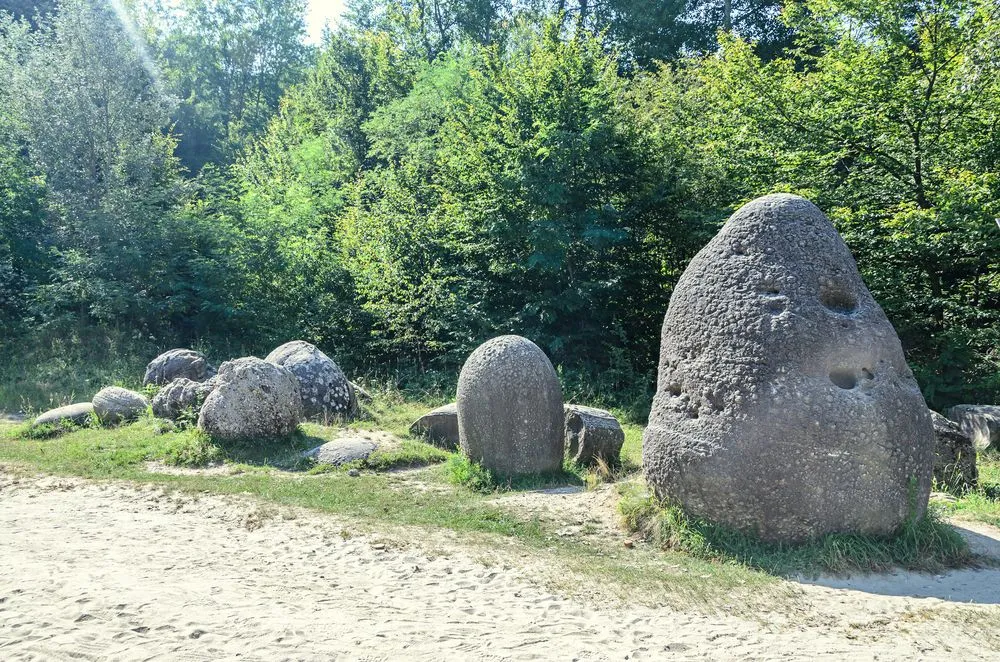
They are usually round, oval or cylindrical rocks with smooth and edgeless surfaces. This is probably why they seem so unlike the rocks that we usually see. Their smooth surface is also what likens them to living creatures, with some rocks possessing what looks like a face!
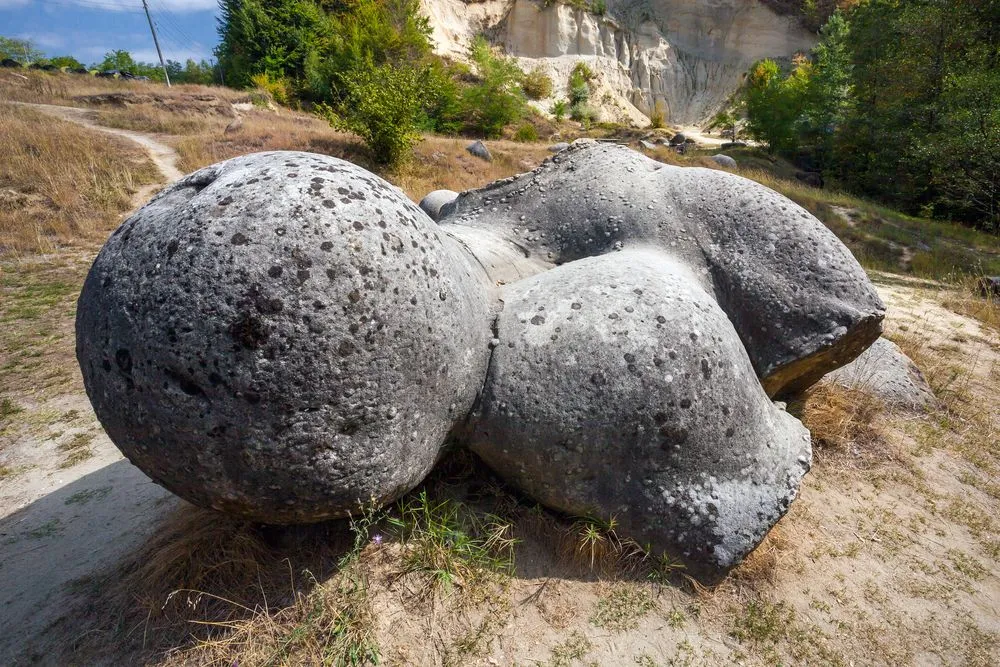
They can vary from as small as a few inches, weighing only a few grams and small enough to fit in your palm, to as large as 15 feet, weighing many tons and resembling large stone giants.
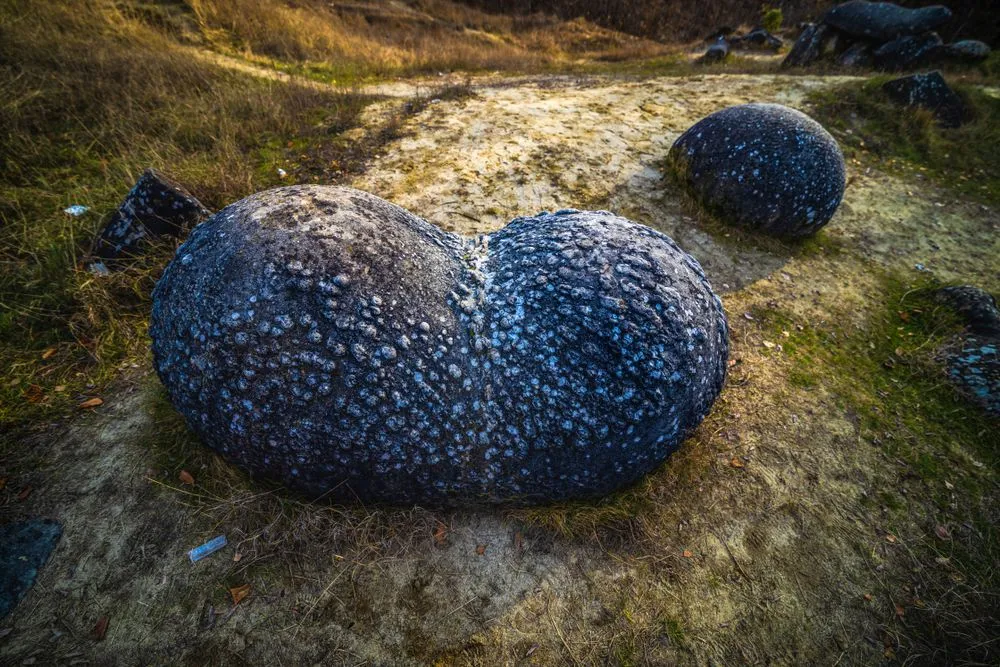
However, the most interesting aspect of these rocks is that they appear to grow, move and even multiply! The locals believed that the rocks gave birth to tiny baby rocks around them, which eventually grew up! Before science did what it does best, these rocks were considered to be alive.
Can These Rocks Grow?
Trovants are largely made of calcium carbonate crystals from the sandstone around them. During heavy rains, these crystals react with the minerals in nearby water and other existing rocks. This reaction causes pressure to build up inside the rock. Since the sandstone composition is quite porous, the spaces in between the sandstone pieces further enlarge due to this pressure, causing them to “grow”.
However, one must note that the reaction and the pressure resulting from it all happen at a painfully slow pace. In other words, it would be futile to regularly measure a trovant’s size, like your mom would mark your height on a wall.
Do They Move?
Heavy rains are the answer to that too. Trovants can appear to move because of their slow growth. What some people mistook as the rocks growing, others mistook as movement. This happens when the entire rock evenly enlarges, which is rare. The rocks might also move due to the loosening of the sand beneath them.
However, the formation of Trovants happens at a deposition rate of about 4-5 cm every 1000 years. Clearly, no single person has lived long enough to see a single Trovant ‘move,’ so we can confidently chalk this down to the folklore revolving around them.
Do They Give Birth?
In the past, scientists incorrectly explained this phenomenon by calling the Trovants concretions.
Concretions are a type of rock containing a nucleus of either a pebble, leaf or smaller stone surrounded by depositions. These depositions could be sandstone, grit or various other minerals that get washed along by the river. Over time, they sediment or ‘cement’ on the nucleus. Experts believed that heavy rains caused some of this cement to secrete, enabling the rocks to “give birth” to smaller rocks.
However, the International Geological Congress in Oslo, in 2008, uprooted this existing idea of Trovants. They also had a different explanation for the apparent reproduction patterns of Trovants.
The Revelation
At the conference, scientists declared that Trovants are not concretions. They had two reasons to support this claim. Firstly, the trovants, when cut, don’t have a nucleus. The inside is the same as the outside. There is something poetic about their ingenuity, don’t you think? Secondly, there is no difference between the mineral content of the rock and the sand around it. Concretions would have a plethora of different minerals forming layers around them over time. Trovants don’t possess these characteristics.
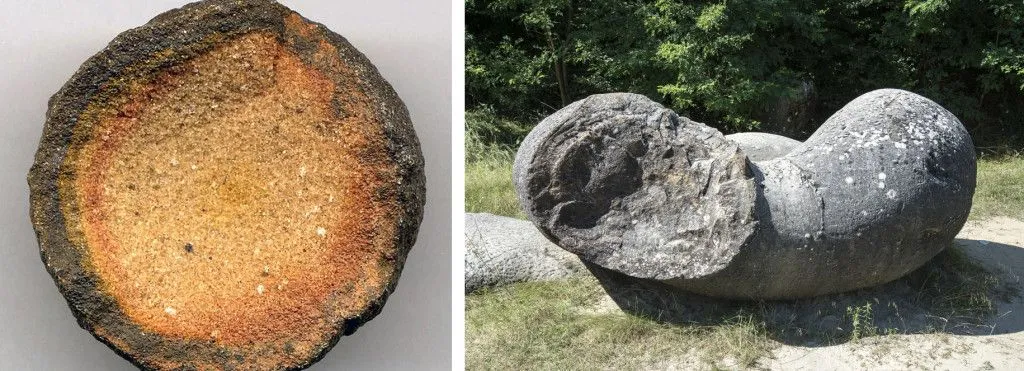
Researchers hypothesized that the minerals carried by a prehistoric river, along with the sandy sediments in the range, formed a solution (mainly of calcium carbonate). Various natural forces worked together and acted on this solution to form these structures. These forces included gravitational forces and the seismic shocks from earthquakes that happened around that era. The surface tension between the particles also contributes to the formation of these beautiful structures.
Coming to the reproduction capacity of these rocks. The reactions that happen inside the rocks may not take place evenly over the entire surface. It occurs in some small parts or pockets, causing the rocks to grow only in that particular area. Sometimes they separate and form as smaller rocks attached to the main one, or even fall off entirely, making them look like baby rocks next to the big mama rock!
How Old Are They?
Interestingly, cutting into one of these Trovants will show concentric rings, much like what you would see inside a tree trunk. Thus, it was thought that one could predict the age of these stones by counting the rings. Unfortunately, this wasn’t true. It is impossible to tell the age of a Trovant from its rings. The significance of the rings is still unknown.
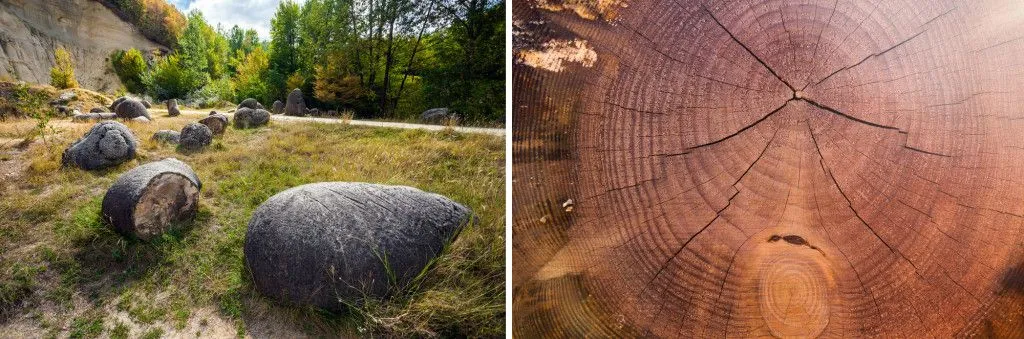
However, what we do know is that the seismic shocks that were largely responsible for forming these structures happened roughly 6 million years ago. So, in terms of the age of these rocks, they were here well before humans entered the picture.
Do Other Rocks Grow Too?
Trovants are the headline act, but they aren’t the only rocks that quietly get bigger over time. Wander into almost any limestone cave and you’ll find stalactites hanging from the ceiling and stalagmites rising from the floor, and both of them are growing as you read this. Rainwater trickling through the rock above picks up dissolved carbon dioxide and calcium carbonate. When a droplet finally hangs off the cave roof and loses its carbon dioxide to the air, it leaves behind the thinnest ring of solid calcite, and the next drop adds another, and another.

It’s a painfully slow drip. An average stalactite lengthens by only about 0.13 mm a year, and even the fastest, fed by a steady, mineral-rich supply, manage roughly 3 mm a year. That’s the geological equivalent of watching paint dry, then waiting a century for the next coat.
For real patience, though, head to the bottom of the sea. Scattered across the deep ocean floor are manganese nodules, potato-shaped lumps of iron and manganese minerals that build up in concentric layers around a tiny nucleus, often a shark tooth or a scrap of shell. They grow so slowly that a nodule just 15 cm across can be roughly 15 million years old, adding no more than about 10 mm every million years. Just like the trovants, none of this is biology. It’s simply minerals settling out of water, one microscopic layer at a time.
So Are Rocks Actually Living Things?
We settled early on that trovants aren’t alive, but it’s worth asking what “alive” even means, because a rock that swells and sprouts smaller rocks is doing a decent impression of something living. Biologists don’t decide this by vibes; they run through a checklist. According to NASA’s astrobiology researchers, a living thing is built from cells, takes in and uses energy (metabolism), grows and develops, reproduces by passing on genetic information, keeps its insides stable (homeostasis), responds to its surroundings, and, over generations, evolves.
Hold a trovant up to that list and it fails almost every line. It has no cells and no DNA. It doesn’t eat, breathe or burn fuel to power itself; its “growth” is just calcium carbonate precipitating out of rainwater, not tissue being built by living machinery. When it “gives birth,” the baby stone is a broken-off lump of the same mineral, not a genetic copy of a parent. And it certainly isn’t evolving. So by the biologist’s scorecard, a rock scores a clean zero.
The genuinely blurry cases sit elsewhere, with things like viruses, which hover on the boundary between chemistry and life. A trovant never gets close to that line. It’s a beautiful, slow-motion piece of geology, and firmly, reassuringly, non-living.
A Final Word
These scientific explanations may have shot down some of the quirky stories circulating around Trovants, but that hasn’t held them back. You can find them in some of your favorite movies, like the cute stone trolls in Frozen or the scary stone giants in other fantasy movies. Trovants are so popular that they were once considered to be dinosaurs, plant fossils and even visitors from outer space!
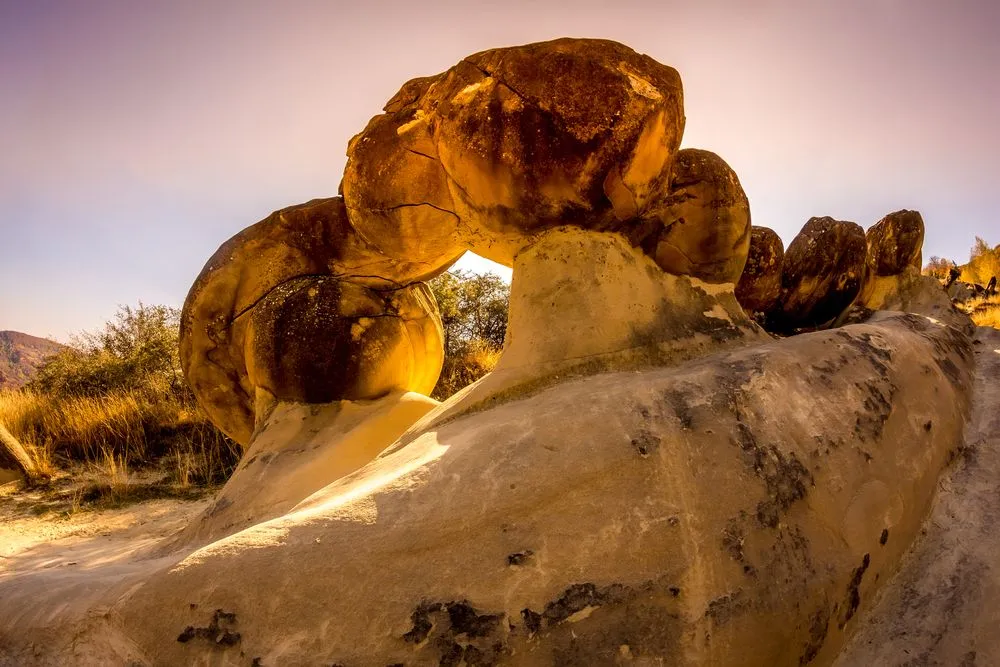
There are about 20 different sites where these stones can be found in Romania, including the quaint village of Costesti. They have a museum dedicated to them (the Muzeul Trovanților in Costesti, Vâlcea County), established in 2004 as a Romanian protected geological reserve and managed by the Kogayon Association. Basically, vampires and Gothic churches aren’t the only things you can associate Romania with from now on, as the country boasts living stone giants too!
References (click to expand)
- Solheim, A., & Bjørlykke, A. (2008, March 1). The 33rd International Geological Congress, Oslo 2008. Episodes. International Union of Geological Sciences.
- Murgoci, G. M. (1905, November). Tertiary Formations of Oltenia with Regard to Salt, Petroleum, and Mineral Springs. The Journal of Geology. University of Chicago Press.
- Hill, K. J., & Winter, E. R. S. (1956, October). Thermal Dissociation Pressure of Calcium Carbonate. The Journal of Physical Chemistry. American Chemical Society (ACS).
- What are the characteristics of life? - NASA Astrobiology.
- Geologic Formations - Carlsbad Caverns National Park (U.S. National Park Service).
- Stalactite - Wikipedia.
- Manganese Nodules - GEOMAR Helmholtz Centre for Ocean Research Kiel.