The ocean's false bottom is real, but it isn't the seafloor. It's a dense layer of small fish and other animals about 300-500 meters (980-1,640 feet) down, called the Deep Scattering Layer (DSL). Their gas-filled swim bladders reflect SONAR like solid ground. At night the fish rise to feed on plankton, so the "bottom" seems to climb toward the surface.
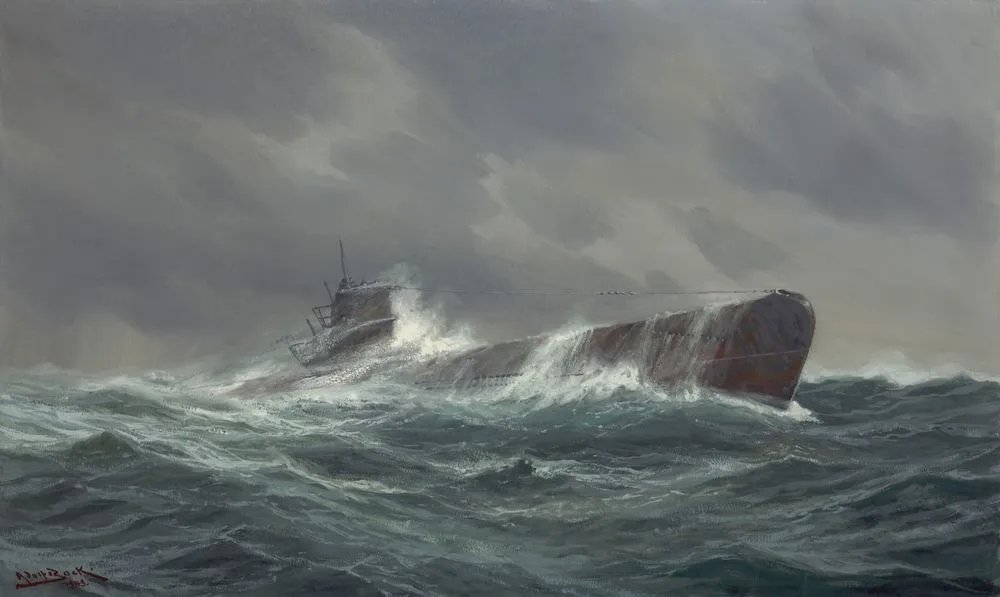
During World War II, scientists around the world were experimenting with new technology to help them win the war. Among such crucial inventions and innovations, such as the computer and the first atomic bomb, was SONAR.
SONAR had previously been used during World War I, and was especially useful for anti-submarine warfare.
However, scientists working on improving the technology spotted something strange during their tests; the ocean floor was much shallower than expected, only a few hundred meters from the surface. Even stranger was that the ocean floor appeared to come up to the surface at night. What was going on here? And what did it reveal about what happens at the bottom of the ocean?
First, we have to learn how SONAR works.
What Is SONAR?
SONAR is the short form of “SOund NAvigation and Ranging”. This is a system created to help sailors and scientists find objects underwater.
This technique is performed by emitting a pulse of sound. This pulse hits objects and then gets reflected. The time between sending out the wave and receiving its echo allows us to determine the distance between the objects. Using this, we can create a map of objects and the landscape surrounding the ship. You can read about SONAR more in this article here.
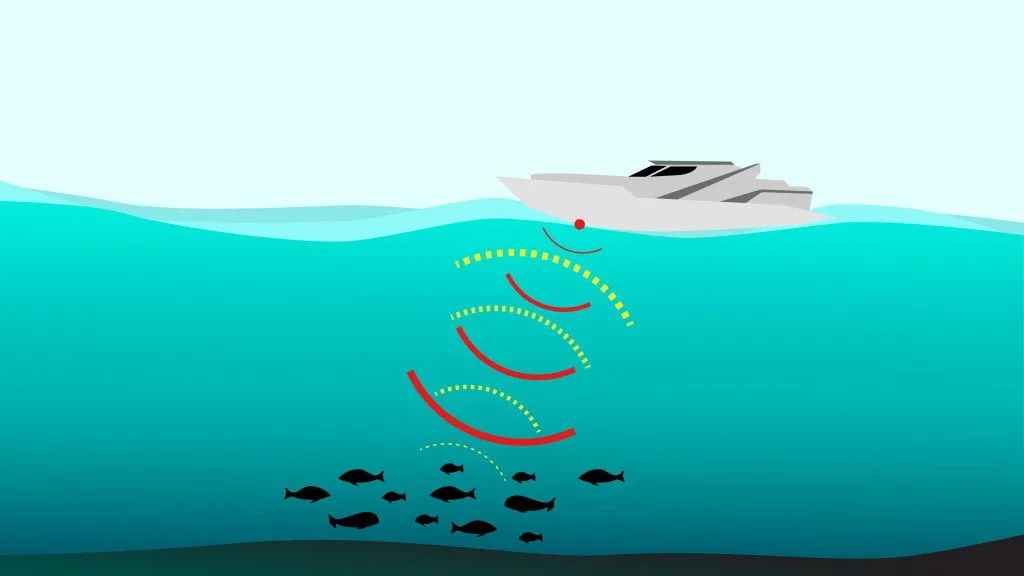
During World War II, SONAR helped sailors detect submarines, and today we use it to map the ocean floor and find shipwrecks.
SONAR isn’t useful only for humans; animals use it too. Dolphins and whales rely on it to locate food. When they emit these sounds, the pulses hit all sorts of objects, including their next meal (fish). When the sound is reflected back, the whales can tell where the fish are. In those war-torn days of research, something similar was happening with the technology on ships.
An Ocean Floor Made Of Fish
The strange observations of a shallow ocean floor that gets shallower at night was not the actual ocean floor at all, but rather a thick layer of fish. Scientists named this layer the Deep Scattering Layer (DSL).
The DSL is composed of various sea creatures, but these are not just any regular sea creatures. These creatures evolved to live 300-500 meters (980-1,640 feet) below the surface of the sea. This is a region of very high pressure and low light. This gives rise to fascinating creatures, such as the lantern fish, which alone may account for as much as 65% of all deep-sea fish biomass.
So why does a layer of small fish trick SONAR into reading like a solid seafloor? The secret is the swim bladder, a gas-filled sac many fish use to control their buoyancy. That pocket of gas reflects sound far more strongly than the surrounding water or the soft bodies of the animals. Pack millions of these gas-filled fish into one band of the ocean and their combined echo bounces back like a wall, which is exactly why early operators thought they had found the bottom.
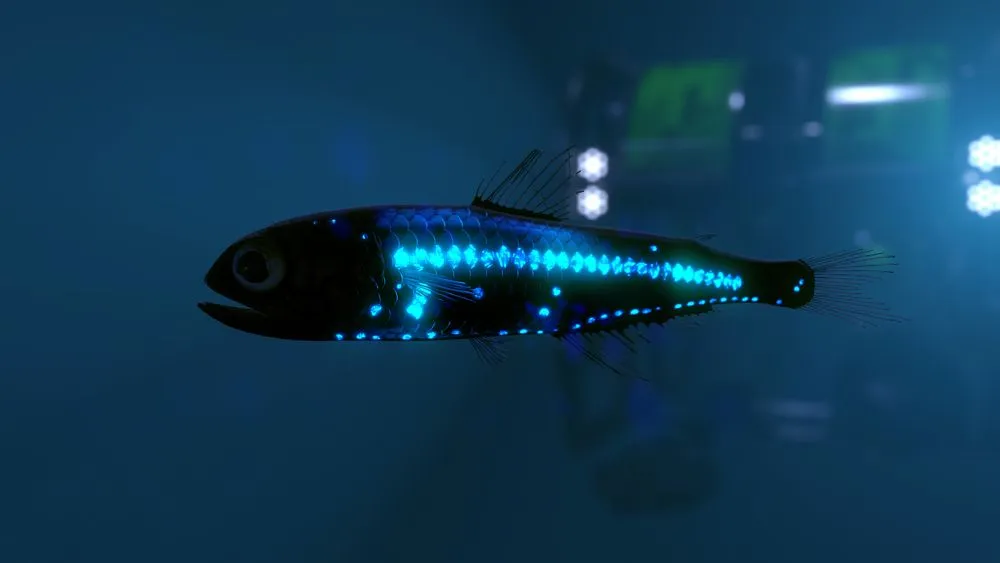
These fish evolved glowing bodies because they live where no light can reach, but why would they live in such a place to begin with? Precisely because it’s dark! Where there is no light, predators can’t spot them, but doesn’t glowing defeat that purpose?
There is a range of theories explaining why these fish glow in the dark. Depending on the type of fish, explanations vary from attracting prey to communicating with their own kind. Surprisingly, the most important reason is camouflage. Lantern fish carry their light-producing organs (called photophores) on their bellies, and they tune that glow to match the faint sunlight filtering down from above. To a predator looking up from the deep, the fish’s silhouette simply vanishes against the brighter water. Biologists call this trick counter-illumination.
However, there’s still one thing that doesn’t fully make sense. Scientists observed the DSL coming nearer to the surface at night. Why would it do that?
Moving To The Surface
If the darkness keeps them safe, it also keeps them hungry. Since there’s no light, there’s very little food in that zone.
In any ecosystem, the food chain starts with a primary producer. These are organisms that convert light, water and other compounds into food. On land, primary producers are plants, from big trees to tiny blades of grass. In the sea, primary producers can be bigger plants, like seaweed, but most of the primary producers are actually microscopic.
These microscopic creatures are called phytoplankton, and they float near the surface. Like all other plants, they also need sunlight to make food, so they must stay near the surface.
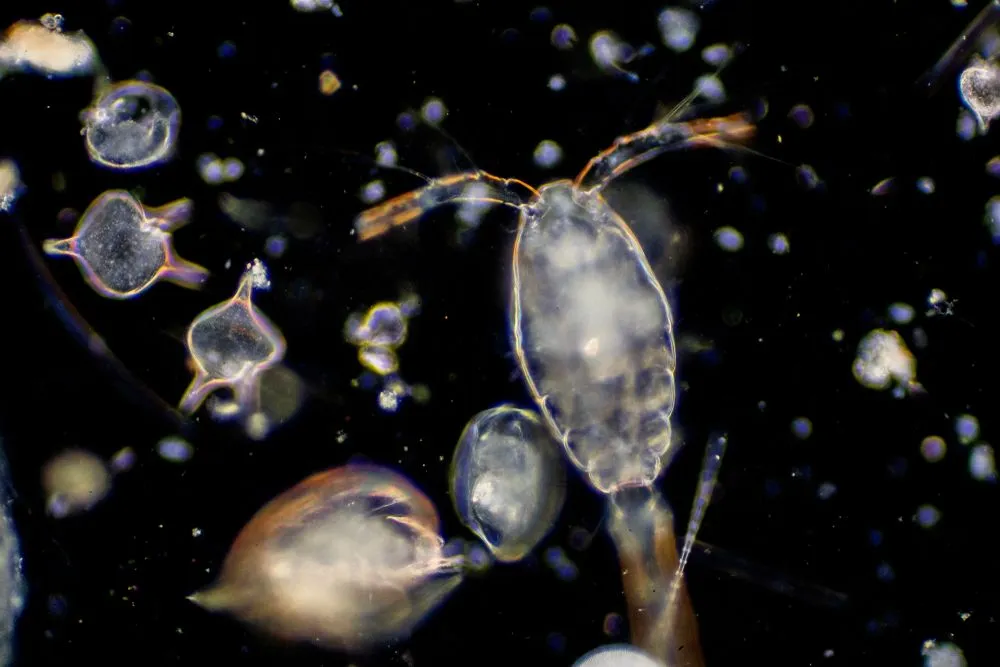
The fish in the DSL live far from the surface of the water, but only when it’s bright outside. When it becomes dark, the fish that feed on plankton swim up to the surface for their evening meal. As the sun starts to rise again, these fish retreat back to the safety of the deep and dark ocean.
Since there is a daily migration across the vertical plane (from deep to shallow and vice-versa), scientists call this movement Diel Vertical Migration (DVM).
Which Creatures Make Up The Ocean’s False Bottom?
Lanternfish get most of the credit, but they don’t build the false bottom alone. The Deep Scattering Layer is really a crowded community of small, deep-water animals, and several of them carry the gas-filled structures that bounce SONAR back so convincingly.

Swimming alongside the lanternfish are bristlemouths (genus Cyclothone), tiny fish that are thought to be the most abundant vertebrates on the planet, with population estimates running into the quadrillions. Like lanternfish, many bristlemouths keep a gas-filled swim bladder, so they too reflect sound strongly. Crowd enough of them together and their echoes add to the wall of noise coming back from the deep.
The layer doesn’t stop at fish, though. Shoals of krill and other small crustaceans drift through it, along with squid and gelatinous animals such as siphonophores, some of which stay afloat using a gas-filled bubble of their own that scatters sound just like a swim bladder. Not every resident is a strong reflector, however. As some bristlemouths grow and sink deeper, they gradually swap the gas in their swim bladder for fatty tissue, which makes them almost transparent to SONAR. The false bottom, in other words, is less a single species and more a living, mixed-up echo made by millions of gas-bearing bodies at once.
What Lies Beneath The False Bottom?
If the false bottom sits just 300-500 meters (980-1,640 feet) down, where is the real one? A long way further. The average depth of the ocean is about 3,682 meters (12,080 feet), so the Deep Scattering Layer floats barely a tenth of the way to the true seafloor.

The false bottom lives in the mesopelagic, or “twilight”, zone, where only a trace of sunlight filters through. Sink past roughly 1,000 meters (3,300 feet) and even that last glow is gone. This is the bathypelagic zone, better known as the “midnight zone”, a band of permanently black water that runs down to about 4,000 meters (13,100 feet). With no sunlight, there is no photosynthesis here, so nothing grows; everything living this deep depends on scraps drifting down from above.
Below the midnight zone the ocean keeps going. The abyssal zone stretches from around 4,000 to 6,000 meters (13,100 to 19,700 feet), and in the deep trenches the hadal zone plunges further still, all the way to the bottom of the Challenger Deep in the Mariana Trench at roughly 10,935 meters (35,876 feet). So what actually lies beneath the false bottom is simply more ocean, growing colder and darker, before you finally reach the muddy sediment of the genuine seafloor. The false bottom is really a false ceiling, hiding these deeper worlds from a ship’s SONAR.
Could A Megalodon Be Hiding Below The False Bottom?
The mystery of a “floor” that isn’t really there has fed one of the internet’s favorite sea monsters: the idea that Otodus megalodon, the giant shark made famous by films like The Meg, is still cruising some warm, hidden pocket far below. It’s a thrilling thought, but the science doesn’t support it. Megalodon went extinct roughly 3.6 million years ago.

Even setting the fossil record aside, the deep sea is the wrong place to hide a shark the size of a bus. Megalodon appears to have been partly warm-bodied and enormous, which means it had to eat a huge amount of prey to fuel itself. The scattered small fish and invertebrates of the deep couldn’t begin to feed such a giant. Studies of where megalodon lived also suggest it favored warmer waters and steered clear of the cold, and the deep ocean is relentlessly cold.
There’s a simpler problem too. The largest predatory shark that ever lived could not live unnoticed. An apex predator on that scale would leave a trail of evidence, from carcasses to bite marks to reliable sightings, and none of that exists. The false bottom is a trick of sound made by finger-length animals, not a warm, secret world roomy enough to shelter a 15-meter (50-foot) shark. The only megalodons left are the fossilized teeth in museum drawers.
Conclusion
The DSL is extremely important to marine ecosystems. Most marine creatures reside in this area and play an important part in their food chains. Even their migration is important. DVM gives time for the phytoplankton to reproduce and helps replenish their populations, ensuring that the food source is never fully depleted.
Because the animals in the DSL live so deep and only come up to feed, it’s very difficult to study them. What are their reproductive behaviors? What other interesting behaviors do they get up to for the rest of the day? There’s still much to learn about this part of the ocean, and much to figure out regarding how to learn about it!
References (click to expand)
- What is the deep scattering layer? - NOAA Ocean Exploration. The Office of Ocean Exploration Research
- Sonar: NOAA Office of Ocean Exploration and Research. The Office of Ocean Exploration Research
- (2009) A Brief History of Active Sonar - DTIC. apps.dtic.mil
- Akamatsu, T. (2008). Cetacean Bioacoustics with Emphasis on Recording and Monitoring. Handbook of Signal Processing in Acoustics. Springer New York.
- Barham, E. G. (1966, March 18). Deep Scattering Layer Migration and Composition: Observations from a Diving Saucer. Science. American Association for the Advancement of Science (AAAS).
- What is vertical migration of zooplankton and why does it .... The Office of Ocean Exploration Research
- Swimbladder properties of Cyclothone spp. in the northeast Atlantic Ocean and the Western Mediterranean Sea - Frontiers in Marine Science
- Cyclothone - Wikipedia
- How deep is the ocean? - NOAA National Ocean Service
- Midnight Zone - Woods Hole Oceanographic Institution
- Is megalodon still alive? - Natural History Museum
- Could an ancient megashark still lurk in the deep seas? - Popular Science