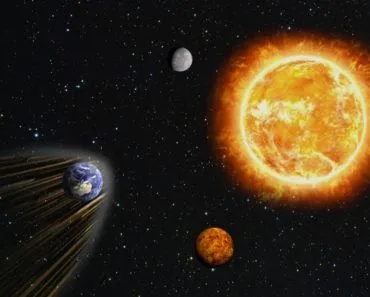
A flip of Earth's magnetic poles is not the apocalypse Hollywood likes to imagine. The reversal itself takes thousands of years (recent estimates for the last one are 20,000–30,000 years), during which the magnetic field weakens but does not vanish. The biggest effects would be more solar radiation reaching the upper atmosphere, more disruption to satellites and power grids, and serious navigation problems for migratory animals that rely on magnetic cues. Humans on the ground, however, would be largely protected by the atmosphere. The last reversal was about 780,000 years ago.
Whenever there’s any talk about (hypothetical) dramatic changes in Earth’s equilibrium, especially from a geological standpoint, such as how would Earth fare without oxygen for only 5 seconds, what if the core cooled down, or if the planet stopped rotating altogether, more often than not, the end result would usually come out as some sort of terrible apocalypse.
Well, here we are again, talking about yet another geological change in terms of Earth’s magnetic field: what would happen in the event of Earth’s magnetic field reversing, such as if the North pole and South pole flipped? Before we get to that, let’s clear up what the poles actually are, since there’s more than one kind.
What And Where Are The North And South Poles?
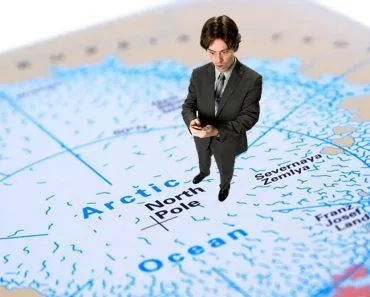
Earth spins like a top around an invisible line called its rotation axis. The two points where that axis pokes through the surface are the geographic poles. The North Pole sits at the very top, at a latitude of 90° North; the South Pole sits at the very bottom, at 90° South. Every line of longitude on the globe meets at these two points, so standing exactly on the North Pole, every direction you face is south.

Geographically, the two poles could hardly be more different. The North Pole lies in the middle of the Arctic Ocean, on a constantly shifting raft of floating sea ice with no land beneath it, which is why you can’t plant a permanent marker there. The South Pole, by contrast, sits on the solid rock of Antarctica, buried under an ice sheet roughly 2,700 m (about 9,000 ft) thick. Because the poles are fixed by Earth’s rotation, they don’t budge except for a tiny wobble of a few metres per year, so when people ask “where is the North and South Pole?”, the honest answer is: exactly at the top and bottom of the spin axis, and they stay put.
North Pole vs South Pole: What's The Difference?
The biggest practical difference between the two poles is temperature, and the South Pole wins the contest for colder by a wide margin. According to NASA, summer at the North Pole hovers around 0 °C (32 °F) and winter sits near −40 °C (−40 °F). The South Pole is brutally colder: roughly −28 °C (−18 °F) in summer and about −60 °C (−76 °F) in winter.

Why the gap? It comes down to land versus sea. The North Pole floats on Arctic Ocean ice that rides barely above sea level, and the seawater underneath acts as a giant heat reservoir, releasing stored warmth into the frigid air. The South Pole sits atop the high Antarctic ice sheet at about 2,835 m (9,301 ft) above sea level, where the thin, dry air loses heat fast, and there’s no ocean below to soften the cold. Air also cools with altitude, so the elevated South Pole starts out at a disadvantage.
The wildlife is split just as cleanly. Polar bears live only in the Arctic, around the North Pole, while penguins live only in the Southern Hemisphere, with several species in and around Antarctica. The two never meet in the wild, a separation that traces back to how each group evolved on opposite ends of the planet. If you’d like to know more, we’ve covered whether it’s possible to live in Antarctica all year round.
Geographic Poles vs Magnetic Poles: What's The Difference?
Here’s the twist that confuses a lot of people: the geographic poles and the magnetic poles are not the same thing. The geographic poles are fixed by Earth’s rotation axis. The magnetic poles are where Earth’s magnetic field points straight down into the ground, and a compass needle chases the magnetic north pole, not the geographic one.

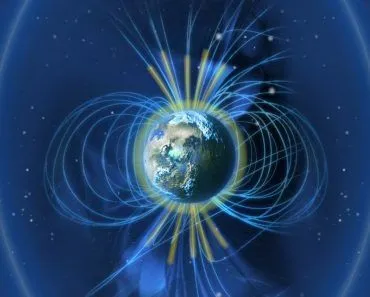
The two are offset because Earth’s magnetic field behaves roughly like a bar magnet tilted about 9° away from the rotation axis. Unlike the rock-steady geographic poles, the magnetic poles wander. According to NOAA, the North Magnetic Pole has been drifting out of the Canadian Arctic toward Siberia for decades; its 2025 position is around 85.8° N, 139.3° E, sitting a few degrees of latitude away from the true geographic North Pole. When this article asks what would happen if “the poles flipped,” it’s really the magnetic poles we’re talking about, which can swap places over thousands of years. The geographic poles, set by the spin of the planet, don’t flip on any human timescale. The rest of this article is about that magnetic reversal, and it’s driven by what causes Earth’s magnetic field in the first place.
Could Such A Reversal Even Occur In The First Place?
Yes, it definitely could! As it turns out, Earth has already experienced a number of ‘pole reversals’ in the past.

Yes, geological records show that there have been hundreds of pole reversals since Earth was first formed. It turns out that Earth’s magnetic field has shifted between periods of ‘reverse polarity’ (when the direction of the field was opposite to what it is now) and ‘normal polarity’ (when the direction of the field was the same as it is now). Such periods in the geological history of Earth are called ‘chrons’.
And yes, the reversal of Earth’s magnetic poles can still occur. In fact, pole reversals naturally occur every 450,000 years or so, on average. The last reversal occurred around 780,000 years ago during the Stone Age, when man was still learning a thing or two about making fire.

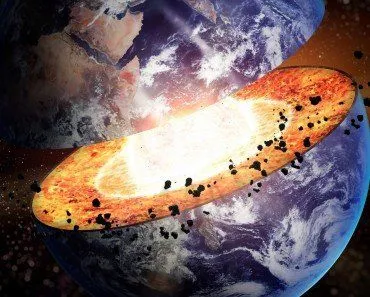
The process, spread out over many thousands of years (recent estimates for the last flip suggest roughly 20,000–30,000 years), does change the polarity of Earth’s magnetic field. Given that the magnetic field of the planet originates from the core, the process of field reversal also originates there. It starts when patches of iron atoms become aligned in opposite directions. When the number of such reverse-aligned atoms gets too high, they dominate the core, causing the overall magnetic field of the planet to reverse.
What If The Magnetic Poles Actually Flipped?
According to Jean-Pierre Valet, who conducts research on geomagnetic reversals at the Institute of Earth Physics in Paris, the most dramatic impact of a magnetic pole reversal would be seen in the form of a diminished magnetic field of the planet. When the field is undergoing a reversal, essentially assuming the opposite polarity, it takes a certain amount of time to completely realign in the opposite direction. As with any geological process, the reversal of our planet’s magnetic field is not an immediate shift, but rather a slow, gradual event.
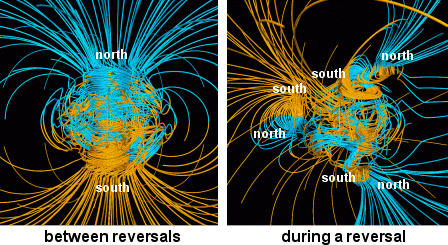
It’s during this transition that the magnetic field would be the weakest and would therefore be the toughest for Earth’s inhabitants to bear.
Effects On Earth
Earth’s strong magnetic field shields the planet from powerful, harmful radiation, such as Coronal Mass Ejections, or CMEs, which occur from time to time on the Sun and sometimes race directly towards our planet. We would be far more vulnerable to such emissions if we lacked a strong magnetic field.
Multiple holes in the ozone layer would form rapidly in Earth’s atmosphere as highly charged particles released from the Sun during these solar flares would bombard the planet. These holes, although not permanent, would dramatically increase the likelihood of diseases caused by harmful solar radiation, such as skin cancer.
Species that rely on magnetic fields for navigation, including whales, migratory birds, turtles and bees, would be dealt a serious blow during such a reversal.

What About Human Extinction?
Although many unwanted and unexpected effects may result from geomagnetic reversal, it’s unlikely that it would cause a global apocalypse. According to Monika Korte, the scientific director of the Niemegk Geomagnetic Observatory at GFZ Potsdam in Germany, “Even if the field becomes very weak, at the Earth’s surface, we are shielded from radiation by the atmosphere. Similarly as we cannot see or feel the presence of the geomagnetic field now, we most likely would not notice any significant change from a reversal.”

Geophysicists all over the world have begun to observe a downward trend in the strength of Earth’s magnetic field, indicating that we may already be in the early stages of our next reversal! All the causes and effects pertaining to geomagnetic reversal hypothesized by researchers are, at the end of the day, hypotheses. As of now, we don’t really know for sure what would prevent a field reversal or protect us from any of its ill effects. In other words, go ahead and make your plans for sea voyages without the fear of your compass needle suddenly pointing towards Antarctica.
References (click to expand)
- Geomagnetic reversal - Wikipedia. Wikipedia
- What would happen if the magnetic field of the Earth suddenly .... IMAGE
- What If Earth's Magnetic Poles Flip? Live Science
- Earth's magnetic field could flip within a human lifetime. UC Berkeley
- DeMets, C., Gordon, R. G., Argus, D. F., & Stein, S. (1994, October 1). Effect of recent revisions to the geomagnetic reversal time scale on estimates of current plate motions. Geophysical Research Letters. American Geophysical Union (AGU).
- Which Pole Is Colder? NASA Science
- Why is the South Pole colder than the North Pole? Scientific American
- Polar Opposites: the Arctic and Antarctic. NOAA Climate.gov
- NSF Amundsen-Scott South Pole Station. U.S. National Science Foundation
- Wandering of the Geomagnetic Poles. NOAA NCEI