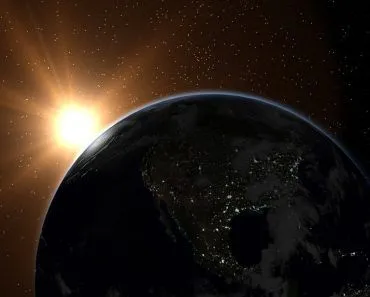
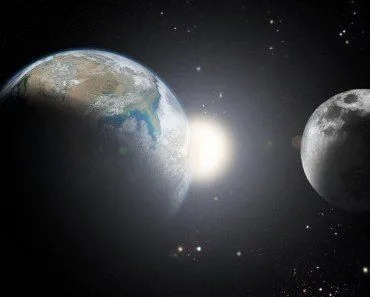
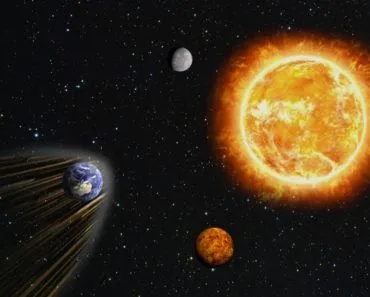
If Earth's core cooled down, the geodynamo in the liquid outer core would shut off and the planet's magnetic field would fade. With no magnetic shield, the solar wind would steadily strip away the atmosphere and oceans, turning Earth into a cold, irradiated, geologically dead world (much like Mars).
With all the talk about climate change and global warming, the mood has been decidedly tense concerning the fate of the planet in the coming 100 years or so. The fact is, many parts of the planet are already facing drastic changes in their climate. Earth’s general temperature is increasing, which is yet another worry. With all this tension surrounding Earth’s climate and temperature rise, most people wish that everything would just cool down.
In case you didn’t know already, the hottest place on Earth is its core, located at the very center of the planet. So, given all of our concerns about climate change and its effects, what would happen if the core suddenly decided to turn off its heat antennas and cool down?
The Core
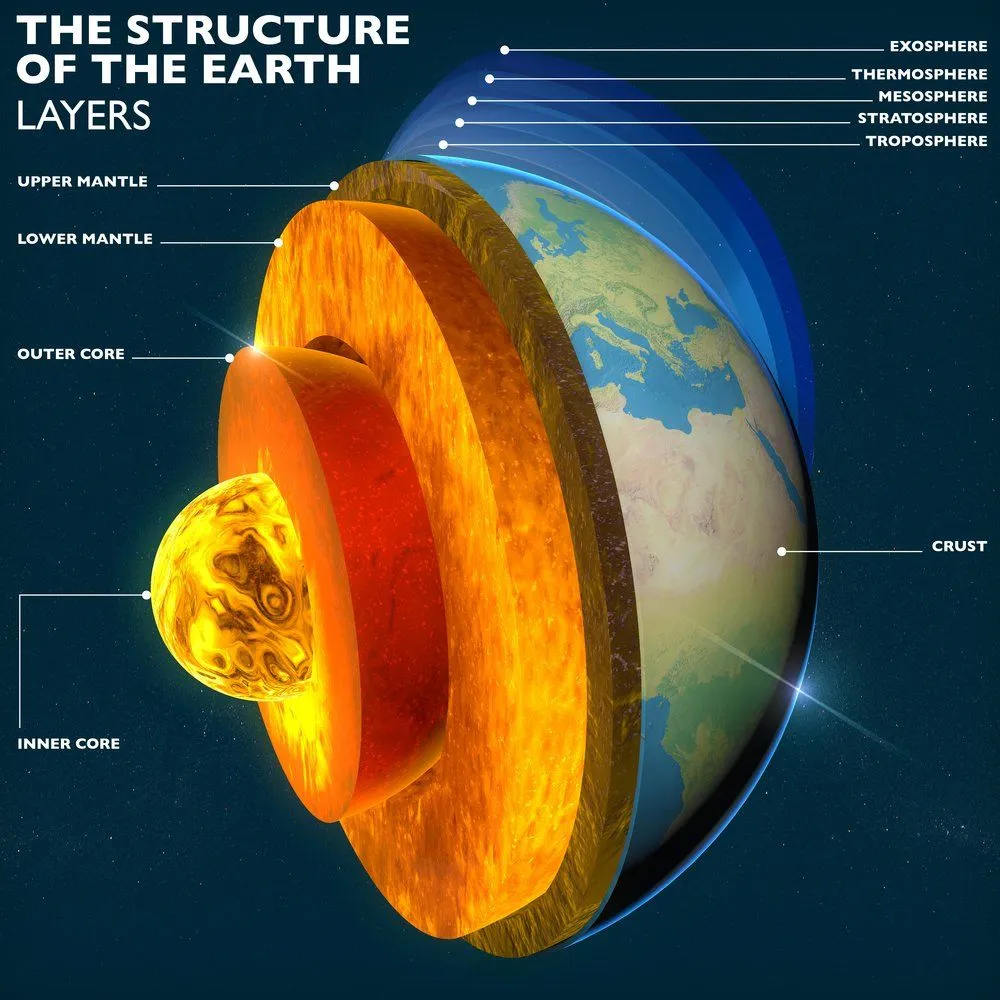
Apart from being the name of a sci-fi flick released in 2003, “the core” is the innermost part of the Earth. Seismological studies show that it actually has two parts: a solid inner core with a radius of about 1,221 kilometers (roughly 759 miles), and a liquid outer core that surrounds it and extends out to about 3,485 kilometers from Earth's center. Both layers are dominated by iron, alloyed with about 5 to 10 percent nickel and a smaller fraction of lighter elements like silicon, oxygen, and sulfur, which is why the whole region is often labelled with the shorthand “NiFe” (Ni for nickel, Fe for iron). The core is incredibly dense, but the gravity story isn't what you might think. Gravity doesn't simply get stronger the deeper you go. It actually peaks at around 10.7 m/s² at the boundary between the outer core and the mantle (only about nine percent more than what you feel at the surface), and then drops off, falling all the way to zero at the geometric center of the planet, where the mass of Earth pulls equally on you from every direction. The core's eye-watering temperatures (the inner core is estimated at roughly 5,200 to 5,400 °C, or about 9,400 to 9,800 °F) aren't really maintained by friction either. They are leftover heat from Earth's violent formation 4.5 billion years ago, kept topped up by the decay of radioactive isotopes in the mantle and by the slow crystallization of new iron onto the inner core.
What If The Core Cooled Down?
This is one of those things that definitely piques the collective curiosity of the planet, but you definitely don’t want it to happen! The core of our planet performs a number of functions that are essential to sustain life on Earth. All of those vital functions would be disrupted if the core were to cool down.
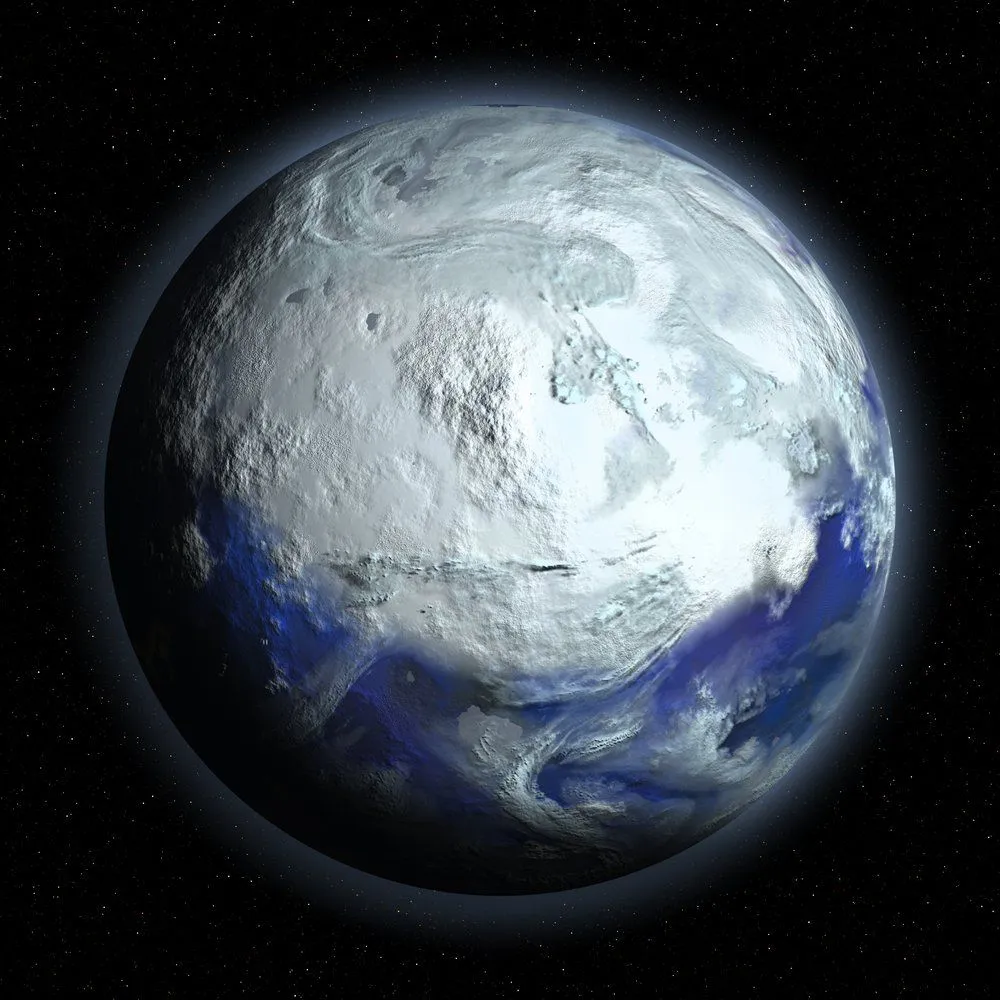
Let me be clear from the very beginning: a cooled core would mean a cooled, and basically dead, planet. That pretty much sums up the ultimate consequences, but for the sake of scientific knowledge, let’s look at the specific effects that would be caused by a cooling of Earth’s core.
The first big change wouldn't be in our power sockets, by the way. Geothermal energy supplies less than 1 percent of global electricity (the rest comes from coal, gas, nuclear, hydro, solar, and wind, none of which need a hot core to function), so the lights wouldn't suddenly go out. The first big change would be in the sky above you. Earth's protective magnetic field, the one that bends compass needles and lights up the auroras, isn't generated by the inner core directly. It's generated by the churning, electrically conductive iron of the liquid outer core, in a process called the geodynamo. Convection currents in that molten iron, twisted by Earth's rotation, act like a giant self-sustaining electromagnet. Let the core cool past a certain point and that convection stops. No convection means no geodynamo, and no geodynamo means no global magnetic field.
That's where things get genuinely apocalyptic. The magnetic field is what deflects the solar wind, a relentless stream of charged particles flowing out of the Sun at over a million miles per hour. With the shield down, those particles would slam directly into the top of the atmosphere and sputter it away, atom by atom, into space. This isn't speculation, it's exactly what NASA's MAVEN orbiter has observed happening at Mars, which lost its own magnetic field roughly 4 billion years ago when its core cooled. Today, Mars is bleeding atmosphere into space at about 100 grams every second, and the planet that may once have had rivers and oceans is now a dry, freezing desert with an atmosphere less than 1 percent the density of ours.
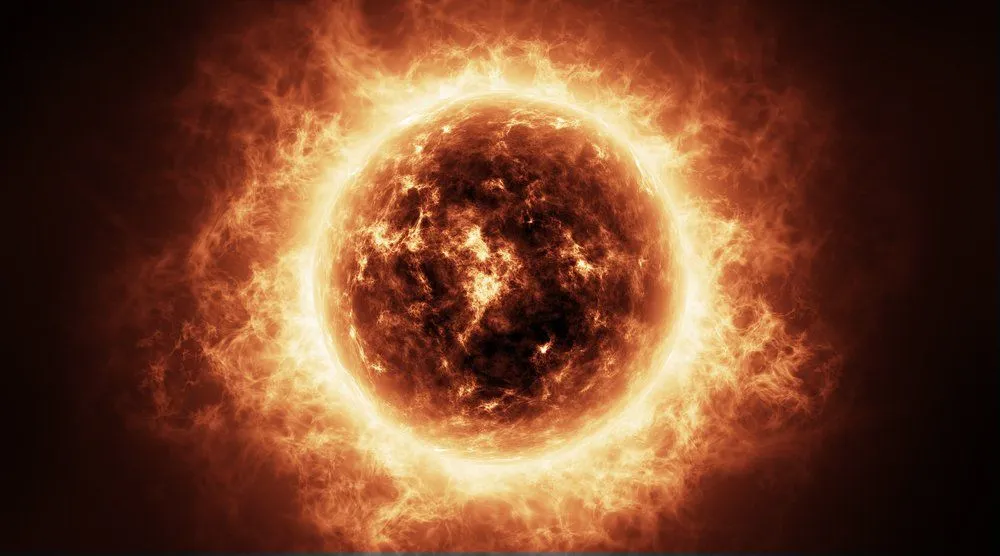
For us, the same sputtering process would dry up the oceans and the atmosphere over hundreds of millions of years. In the meantime, with no field to deflect them, high-energy cosmic rays and solar particles would reach the surface directly, sharply raising radiation doses and cancer risk for anything still living, and shredding the ozone layer that currently filters out the Sun’s ultraviolet. The cooling wouldn’t stop with the magnetic field either. The same heat that drives the geodynamo also drives mantle convection, and mantle convection drives plate tectonics. A cooled core would eventually shut that down too, freezing the slow recycling of crust that fuels volcanoes, earthquakes, mountain-building, and the carbon cycle that keeps the climate stable. The planet would gradually settle into a single, dead crust, much like Mars again.
There are a number of hypothetical questions that intrigue many minds, particularly when it comes to potential solutions for global warming or climate change. This particular idea lies in the same category, but it should always remain a hypothesis, as the reality of this occurring on our planet would be completely disastrous.
Is Earth's Core Actually Cooling Down Right Now?
Here is the reassuring part: the doomsday version above is a thought experiment, but a very gentle version of it is genuinely underway. Earth's core has been cooling ever since the planet formed about 4.5 billion years ago. Most of that internal heat is primordial heat left over from Earth's violent birth, and it is topped up by the slow radioactive decay of uranium, thorium, and potassium scattered through the mantle. That decay keeps adding warmth and slows the cooling to a crawl.

And it really is a crawl. As the liquid outer core sheds heat into the mantle, iron at its inner edge freezes solid and welds onto the solid inner core, which grows in radius by only about a millimeter a year. The inner core is a surprisingly young feature, too. By reading the strength of Earth's ancient magnetic field frozen into old rocks, a 2015 study led by Andy Biggin concluded that the inner core first began to freeze out only 1 to 1.5 billion years ago.
So will the core ever fully cool? Not on any timescale worth losing sleep over. At a millimeter a year, the outer core would need billions more years to freeze solid, and the Sun will run out of fuel first. In roughly 5 billion years it will swell into a red giant and scorch the planet long before the geodynamo winks out. Every human generation you can picture will feel the same magnetic field we do.
What Would Happen To The Mantle's Convection Currents If The Core Cooled?
This is the detail a lot of readers actually come looking for, and it turns on one simple rule: convection needs a temperature difference. The mantle is heated from below by the core and cooled from above at the surface. Rock near the bottom gets hot, turns buoyant, and rises; rock near the top gives up its heat, turns dense, and sinks. The result is a set of slow, churning loops (picture soup simmering in a pot on a stove) that we call convection currents.

Two heat supplies keep those loops turning: the core feeding warmth in from below, and the radioactive decay of elements inside the mantle itself. Take away a cooling core and you switch off the burner under the pot. The temperature contrast that drives the churn weakens, so the convection currents slow down and eventually stall. The mantle's own radioactivity would keep it stirring feebly for a while, but with nothing like the vigor it has today.
Why does that matter so much? Because those convection currents are the conveyor belt beneath plate tectonics. Stall them and you freeze the drifting of continents, the spreading of the seafloor, and the mountain-building, volcanoes, and earthquakes that ride along with it. The surface would slowly set into one still, unbroken shell, exactly the fate we see on Mars.
References (click to expand)
- Inside the Earth - This Dynamic Earth. U.S. Geological Survey.
- NASA Mission Reveals Speed of Solar Wind Stripping Martian Atmosphere. NASA.
- A fully liquid Earth's core also generates a magnetic field. ETH Zurich (2025).
- Earth's core is melting and freezing. ScienceDaily.
- What happens to the magma inside the earth once it is brought to the surface? UC Santa Barbara ScienceLine.
- Earth's internal heat. Understanding Global Change, University of California, Berkeley.
- The Engine that Drives Earth. Woods Hole Oceanographic Institution.
- Biggin, A. J. et al. Palaeomagnetic field intensity variations suggest Mesoproterozoic inner-core nucleation. Nature (2015).
- Is Earth's core cooling, and what would happen if it did? BBC Science Focus.