Table of Contents (click to expand)
A weeping apple tree grows its branches outward and downward instead of upright. Cornell researchers traced this to a single mutation in the gene MdLAZY1A: one nucleotide change swaps a leucine for a proline, disrupting how the shoot senses gravity. Growers prize the trait because downward branches bear more flowers and fruit, which is normally achieved by tying branches down by hand.
Most plants grow upright. The roots grow downwards, towards gravity, while the stems grow upwards, away from the ground. The branches tend to grow upwards at an angle. This plant growth response to gravity is called gravitropism. The roots display positive gravitropism and the shoots display negative gravitropism.
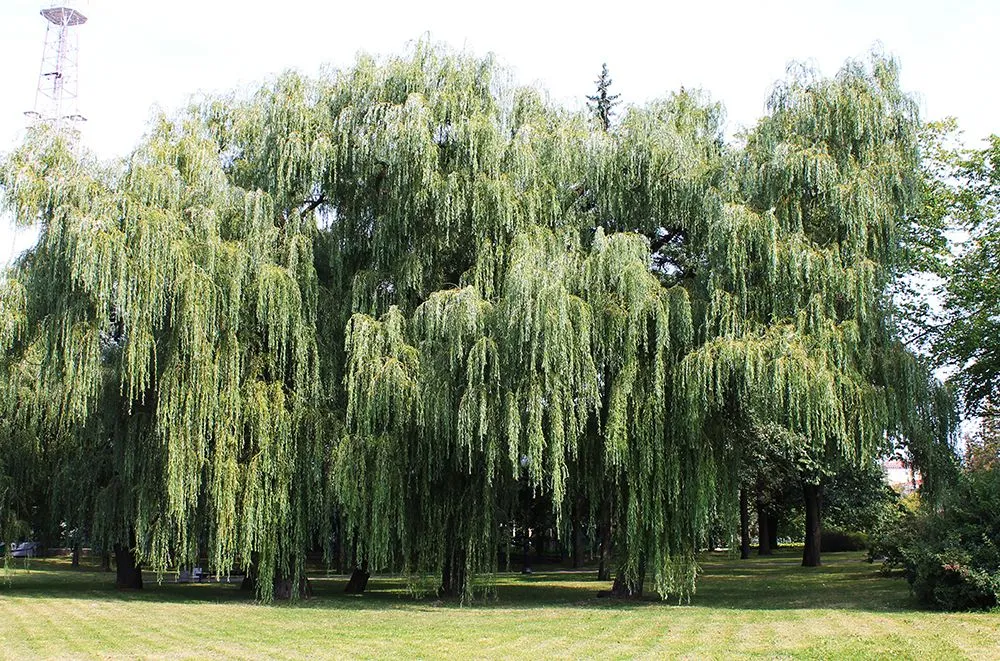
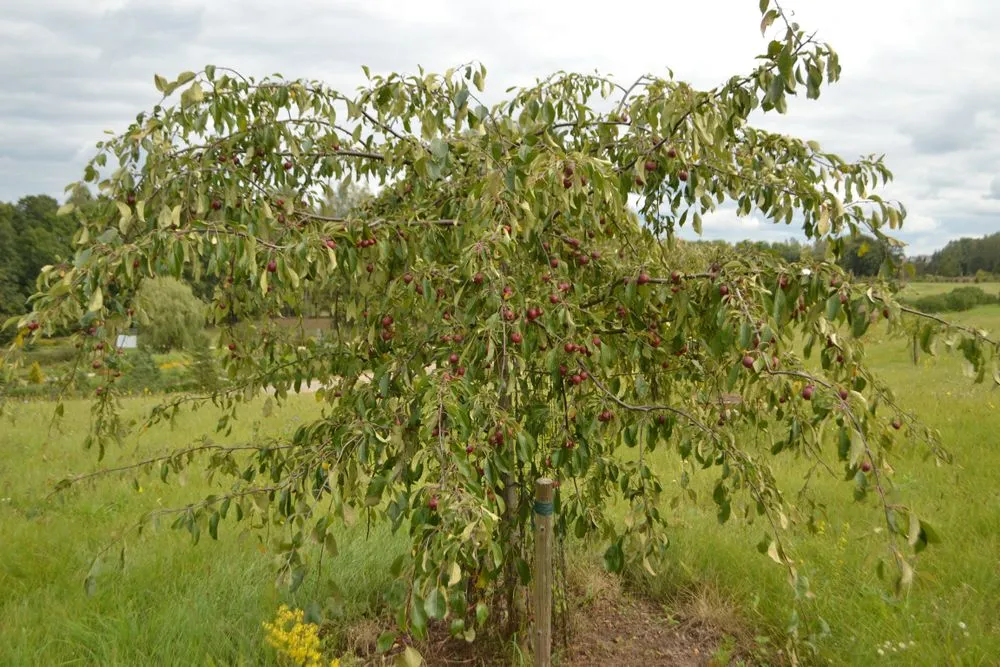
If you are familiar with ‘weeping willows,’ then you know what this kind of weeping trait looks like. Basically, instead of growing upwards, the branches of a weeping tree grow downwards. Although this trait is not common in cultivated apple varieties, it can be found in some ornamental crab apple trees.
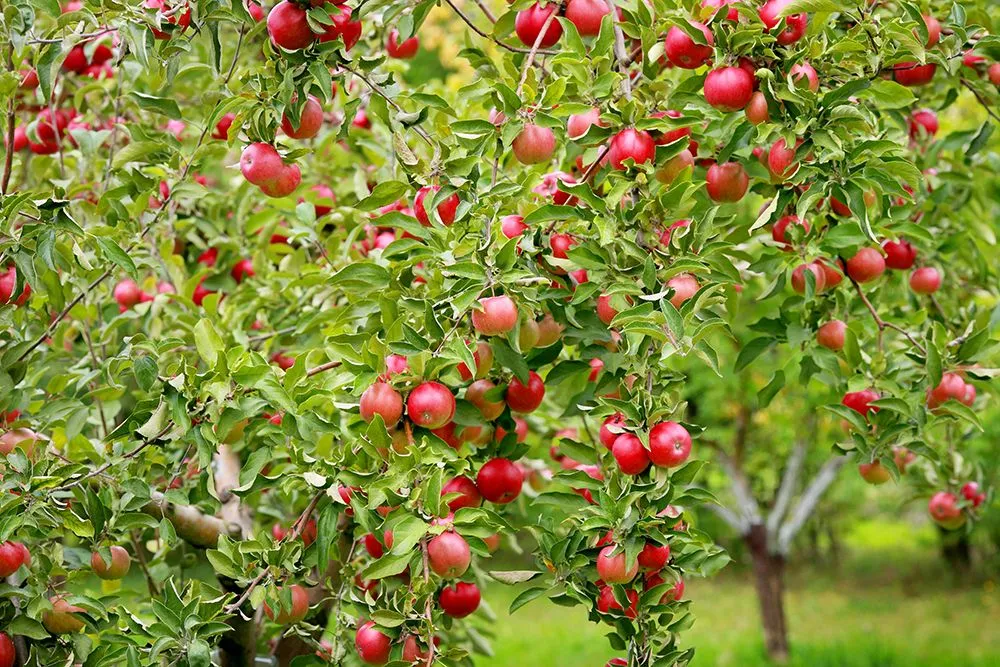
Weeping Trait In Apples
Plant architecture is the way a plant grows and sets out its branches. This critically influences how the plant allocates its resources: nutrients and energy. Resource allocation, in turn, determines whether the plant continues to grow vegetatively, or begins to flower and fruit. When the plant allocates its resources to flowering and fruiting, it affects the farmer’s yield.
Apple trees naturally grow their branches upwards, unlike weeping willow trees, but to get apple trees to flower and fruit more than they normally would, apple growers train the branches to grow downwards. They manually tie the branches to train the branches of young apple trees to grow downward at 90-120 degrees angle from the main trunk. This downward growth leads to the apple trees allocating more resources towards bearing flowers and fruits, which consequently increases yield.
However, this method of training branches is labor intensive, and adds to the cost of production. If apple trees could be ‘designed’ to naturally grow branches downwards, growers would benefit in terms of higher yield with lower labor costs. Such a trait is rare among commercially grown apples, but can be found among their wild relatives.
“Designing” Weeping Apple Trees
Cultivated apples (Malus domestica) belong to the family Rosaceae, along with other important fruit crops like cherries, peaches, and almonds. The genus Malus also includes several species of crab apples. One report estimates that there are 1000 different varieties of crab apples. Crab apples are usually not edible, and are mostly used as ornamental plants. They are also an important source of useful traits that can be used by apple breeders to improve cultivated apple varieties.
On rare occasions, some apple species will naturally grow their branches downwards. This kind of tree architecture with downward branches is called the ‘weeping’ phenotype. Most commercial apple varieties would benefit if the branches had this ‘weeping’ characteristic, as that would save on labor costs.
Scientists at Cornell University, USA, identified a gene in apples that they called the ‘weeping gene’ because it is responsible for the weeping phenotype in apples. It has also been called the ‘lazy gene’. The gene was designated MdLAZY1A. Here, ‘Md’ stands for Malus domestica, the scientific name for apples. This gene is one of the factors that regulate how the branches of a tree grow in response to gravity.
All apple trees have some form of this ‘weeping gene,’ but the gene variant that exists in most apple varieties does not result in the weeping phenotype. Researchers determined that when a single nucleotide within the gene changes, leading to an amino acid change from leucine to proline, the change manifests itself with the weeping phenotype, wherein the branches are more spread out and grow downwards. This change must happen in a specific region of the gene to bring about such a drastic change in the gene’s function.
How Did They Determine The Function Of The Weeping Gene?
The researchers crossed a weeping-type apple with a non-weeping type apple and screened over 1,000 of their offspring. They separated the offspring into two groups, weeping and non-weeping, and used gene sequencing methods to compare the sequences of the two types. This helped them narrow down the candidate gene responsible for the weeping tree type and identify the gene variant associated with the weeping architecture. However, they still needed to confirm the function of this candidate gene.
They designed a transgenic apple, using the standard upright variety Royal Gala, that expressed the weeping version of the gene (with the amino acid change). The resulting apple tree had branches growing downwards, thus confirming that this variant leads to the weeping form.
Next, they took the experiment in the opposite direction. Using a technology called RNAi, they silenced the regular copies of the weeping gene in the same upright Royal Gala apple. With the gene switched off, those trees grew wider, more spread-out, downward-pointing branches, sliding toward the weeping form. Together, the two experiments showed that MdLAZY1A is the gene calling the shots: ramp up the mutant version and you get weeping, dial down the normal version and the branches start to weep all the same.
Conclusion
The ‘weeping gene’ or ‘lazy gene’ has been identified in other crops as well, including rice, maize and peach, where it plays a similar role, meaning that mutations in this gene lead to alterations in the gravitropic responses of the plants. However, scientists still do not know exactly how the weeping phenotype leads to increased fruit production. The discovery that just one nucleotide change leading to a single amino acid substitution can result in the weeping architecture has important implications for apple breeders and growers. Gene-editing technologies, such as CRISPR/Cas9, can potentially be used to develop cultivated apple varieties that will naturally have their branches growing downwards, without the need for labor-intensive manual training of branches.
References (click to expand)
- Dougherty, L., Borejsza-Wysocka, E., Miaule, A., Wang, P., Zheng, D., Jansen, M., … Xu, K. (2023, July 3). A single amino acid substitution in MdLAZY1A dominantly impairs shoot gravitropism in Malus. Plant Physiology. Oxford University Press (OUP).
- Gene variation makes apple trees 'weep,' improving orchards.
- Gene variation makes apple trees 'weep,' improving orchards. Phys.org (2023).
- Cornell University. (2023, July 20). Gene variation makes apple trees 'weep,' improving orchards. ScienceDaily. Retrieved August 21, 2023 from www.sciencedaily.com/releases/2023/07/230720124905.htm