The Coriolis Effect is what causes hurricanes to spin differently in the Northern and Southern hemispheres. The Coriolis Effect is caused by the Earth’s rotation. As the Earth rotates, air currents in the atmosphere are affected. The Coriolis Effect causes air currents in the Northern hemisphere to rotate in a counter-clockwise direction, and air currents in the Southern hemisphere to rotate in a clockwise direction.
As Earth travels from West to East, air moving from the southern hemisphere to the northern hemisphere gets pushed to the right, causing hurricanes originating in the Northern hemisphere to spin in the counter-clockwise direction. Something similar happens in case of the southern hemisphere.
Hurricanes, cyclones, typhoons – they sound like different beasts, but they are actually the same kind of storm wearing different regional name tags (more on that below). Whatever you call them, all of these natural phenomena have two things in common: they are deadly and they spin like crazy.
Speaking of spin, did you know that hurricanes spin in a counter-clockwise direction in the Northern hemisphere and a clockwise direction in the Southern hemisphere? Well, they do. The question is, why do they have such different behavior in the two hemispheres?
Air Currents In The Two Hemispheres
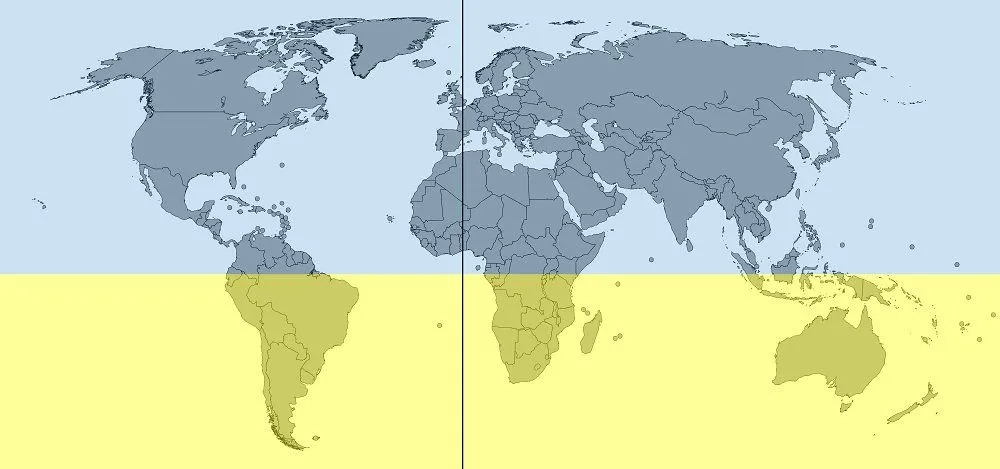
The Northern hemisphere is the part of the Earth that lies north of the Equator, which is an imaginary line dividing the planet into two equal parts; similarly, the Southern hemisphere lies south of the Equator.
The climatic conditions in different parts of these two hemispheres depend upon their position on the planet. For example, places near the Equator generally have a hot climate, whereas regions near the poles (far away from the Equator) are extremely cold.
As a result, air in the polar regions is heavier and tends to fall towards the ground. As a result, it also ends up moving towards the Equator. Similarly, equatorial regions have warmer air that rises up and then moves towards the polar regions. This leads to movement, in a to-and-fro fashion, of natural currents of air that move from areas of high pressures (poles) to areas of low pressure (Equator). If Earth did not rotate as it does, we would have high-speed winds of almost 480 km/h (about 300 mph) gusting from the poles to the Equator and back.
However, Earth does spin, so the movement that these currents take is affected in a certain way. Since Earth is a sphere (well, almost… it’s slightly wider in the middle) that continuously rotates on its axis, the region near the Equator travels a tad bit faster than the regions lying farther away from it, as they have to travel further in the same number of hours, i.e. 24 hours.
This distinction directly impacts the way these air currents travel from the poles to the Equator and back.
The Coriolis Effect Affects The Direction Of Air Currents
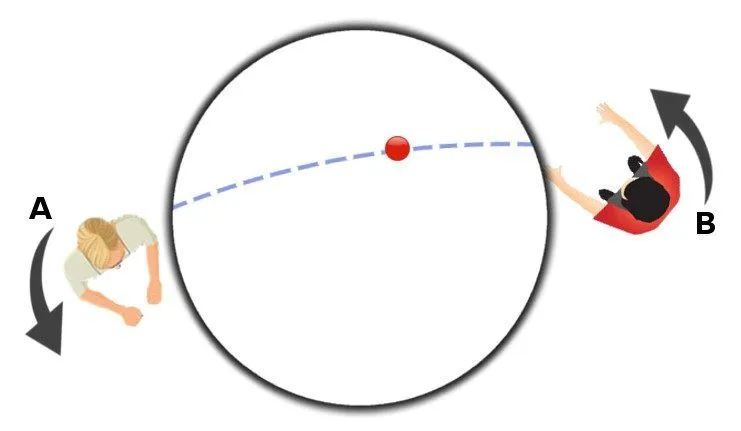
Formulated by French engineer-mathematician Gustave-Gaspard Coriolis, the Coriolis effect is an inertial force that acts on objects in motion with respect to a rotating frame of reference. To understand this better, consider an example of two kids, say Kid A and Kid B, playing a game of catch with a slight twist. As opposed to standing stationary facing each other, these two kids are running along the boundary of an imaginary circle in the counter-clockwise direction, throwing the ball to one another all the while.
However, this small tweak of catching the ball while moving along a circle turns out to be a bad idea, because when Kid A throws, it seems to veer slightly to the right, instead of going straight to Kid B. The game is much more difficult than normal, but since these kids aspire to become physicists, they’ve already figured out that this is happening due to the Coriolis Effect.
The Coriolis Effect has countless manifestations in our lives: soccer players use it in their favor while taking long shots, snipers have to take the direction of wind into account to accurately hit their targets; it also finds a lot of applicability in meteorology, physical geology, oceanography and studies of the dynamics of the atmosphere.
Now, let’s see how it applies in the case of strong wind currents moving across the surface of Earth.
When strong air currents (that result in hurricanes, cyclones etc.) move above the faster-moving equatorial regions, they get ‘pulled’ in the direction of Earth’s spin, thus veering off from an otherwise straight path.
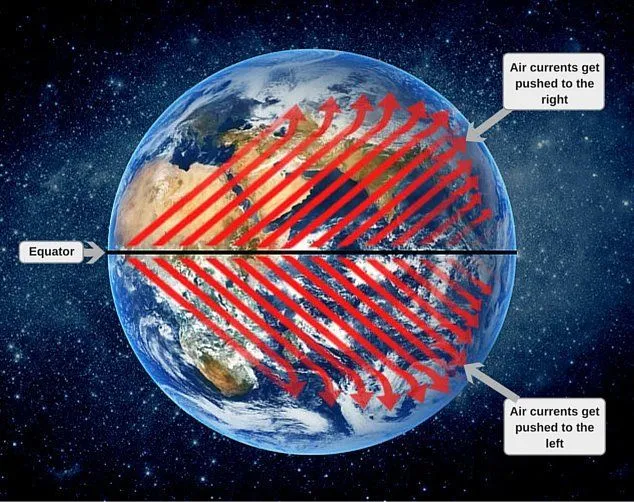
As Earth travels from West to East, air moving from the southern hemisphere to the northern hemisphere gets pushed to the right, causing hurricanes originating in the Northern hemisphere to spin in the counter-clockwise direction. Similarly, the hurricanes in the Southern hemisphere spin in the clockwise direction as the air gets pushed towards the left. You can check out the visual representation of the entire process in this video released by NOVA PBS Official.
So, if you have two friends from different hemispheres arguing over the true direction of hurricanes, enlighten them with this little piece of information and ask them to be a bit more accommodating in their opinions!
Hurricane, Typhoon Or Cyclone: What's The Difference?
Here's a fact that surprises a lot of people: a hurricane, a typhoon, and a cyclone are exactly the same kind of storm. As NOAA puts it bluntly, "hurricanes and typhoons are the same weather phenomenon: tropical cyclones." The only thing that changes is the name, and the name simply depends on where in the world the storm happens to be spinning.

The rule of thumb is purely geographic:
- In the North Atlantic and the Northeast/central Pacific (think Florida, the Gulf of Mexico, Hawaii), we call it a hurricane.
- In the Northwest Pacific (think Japan, the Philippines, China), the very same storm is a typhoon.
- In the South Pacific and the Indian Ocean (think Australia, India, Madagascar), it's simply a tropical cyclone, and a strong one in the North Indian Ocean is a "severe cyclonic storm".
The science underneath is identical everywhere. A swirling tropical system earns a name once its maximum sustained winds reach 63 km/h (39 mph), at which point it becomes a tropical storm. If it strengthens until those winds hit 119 km/h (74 mph), it graduates to hurricane, typhoon or severe tropical cyclone status, depending on the ocean it's churning through. So the "difference" between a hurricane and a typhoon isn't strength or fury at all; it's just a passport stamp.
Why Don't Hurricanes Form At The Equator?
If the Coriolis effect is the engine that makes these storms spin, you might expect the warm, soggy band right along the Equator to be hurricane central. After all, the sea there is plenty hot enough. Yet hurricanes almost never form there, and that's because of the very same Coriolis effect we've been talking about.
The catch is that the Coriolis force isn't constant across the planet. It is strongest near the poles and fades to zero right at the Equator. As the Hong Kong Observatory explains, "tropical cyclones are difficult to form over a region within 5 degrees of latitude from the Equator because the Coriolis force there is too small to generate a vortex." Without that gentle sideways nudge, in-rushing air just flows straight into a low-pressure center and fills it in, rather than coiling up into the organized spiral a hurricane needs. NOAA's hurricane FAQ puts it the same way: "the force is greatest at the poles and zero at the equator, so the storm must be at least 300 miles from the equator in order for the Coriolis force to create the spin."

This is why most tropical cyclones get going somewhere between about 5 and 20 degrees of latitude, well clear of the Equator, and why a hurricane has never been recorded crossing that line. There is one celebrated exception: Typhoon Vamei spun up near Singapore in December 2001 at roughly 1.5 degrees north, barely 150 km (about 95 mi) from the Equator, which makes it the closest tropical cyclone formation on record. It needed a freak alignment of conditions to manage it, and storms like it are reckoned to be a once-in-centuries event. For more on what gets these systems started in the first place, see our piece on what causes a hurricane.
Does The Coriolis Effect Control Which Way Your Sink Drains?
You have almost certainly heard the claim that water spirals down the drain counter-clockwise in the Northern hemisphere and clockwise in the Southern hemisphere, just like a hurricane. It's a wonderfully tidy story. It's also a myth.

The reason comes down to scale. A hurricane is hundreds of kilometers across and lasts for days, so it has plenty of room and time for the Coriolis effect's feeble nudge to build up into a dramatic spin. Your sink does not. NOAA states plainly that the Coriolis force "is too tiny to affect rotation in, for example, water that is going down the drains of sinks and toilets." Penn State's well-known "Bad Coriolis" page makes the same point: a sink can complete a rotation in a few seconds, giving it a swirl rate roughly ten thousand times faster than Earth's, so Earth's rotation simply gets drowned out.
What actually sets the direction is the leftover motion of the water and the shape of the basin. As that Penn State page notes, "the direction of rotation of a draining sink is determined by the way it was filled, or by vortices introduced while washing," and a toilet's swirl is dictated by how the jets squirt water under the rim. That's why you can find sinks draining both ways in the same hemisphere, the same house, even the same bathroom. The Coriolis effect is a heavyweight at the scale of storms and ocean currents, but at the scale of your bathtub it's a complete pushover.
References (click to expand)
- Why do hurricanes go counterclockwise in the northern hemisphere? - littleshop.physics.colostate.edu
- Hurricane FAQ - NOAA/AOML - www.aoml.noaa.gov
- Bad Coriolis. The Pennsylvania State University
- What is the difference between a hurricane, a cyclone, and a typhoon? - NOAA National Ocean Service
- What is a hurricane, typhoon, or tropical cyclone? - NOAA/AOML Hurricane Research Division
- Why do tropical cyclones always form more than 5 degrees of latitude away from the Equator? - Hong Kong Observatory
- Hurricane Research Division Frequently Asked Questions - NOAA/AOML