The Spacecraft Cemetery is a nickname for a remote stretch of the South Pacific Ocean, roughly 2,600 km (1,600 mi) east of New Zealand and centered on Point Nemo, the spot in the ocean farthest from any land, where broken satellites and spaceships litter the ocean floor.
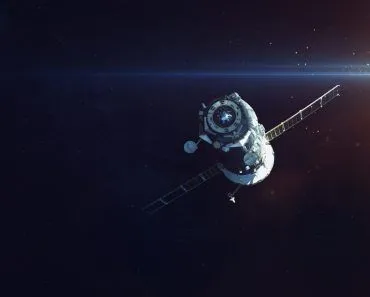
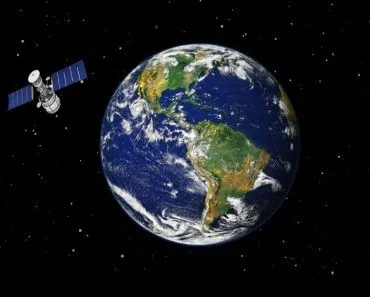
At the time of writing this article, there are more than a thousand artificial satellites orbiting the planet at different heights (and inclinations) above Earth. Furthermore, these are just the operational ones! If you also consider dead satellites and medium-sized objects that revolve around our planet, you would have yourself a significantly larger figure to deal with.
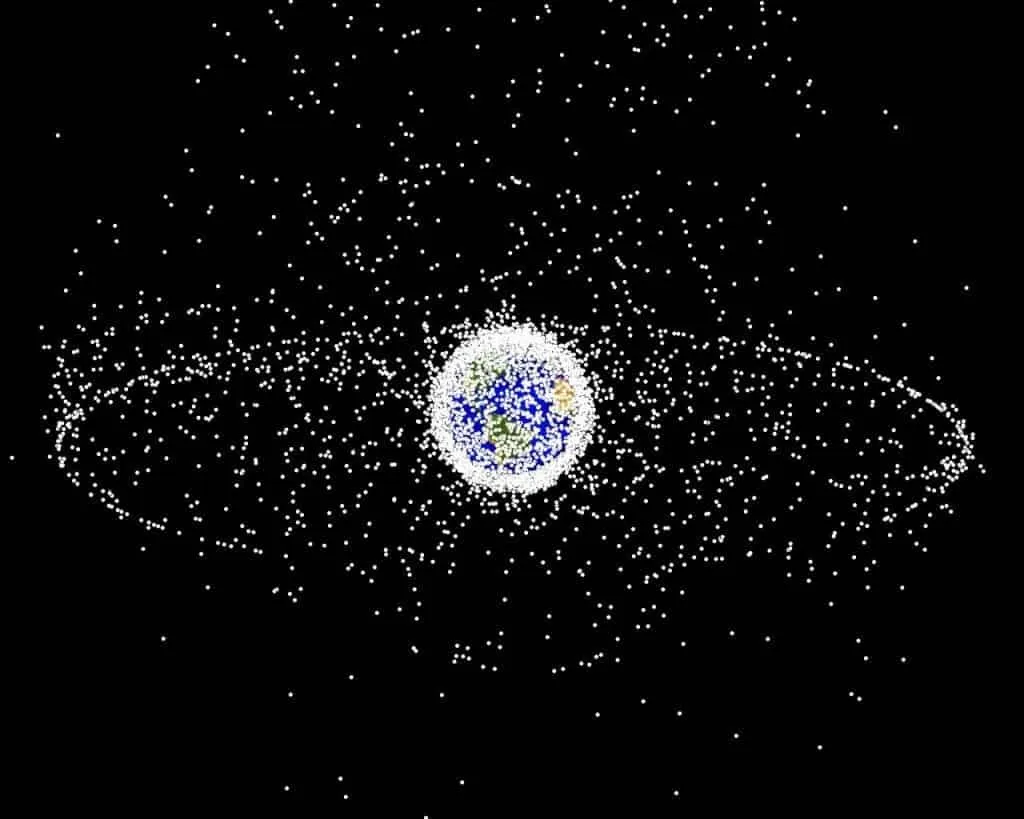
The thing about artificial satellites is that, just like any other man-made machine, they also have a definite lifetime, i.e., they become inoperative after a certain amount of time. The average lifetime of these satellites may vary from a few years to more than 15 years, depending on their respective mission requirements and a number of other factors, like fuel availability, budget etc.
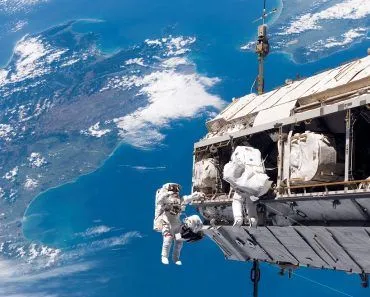
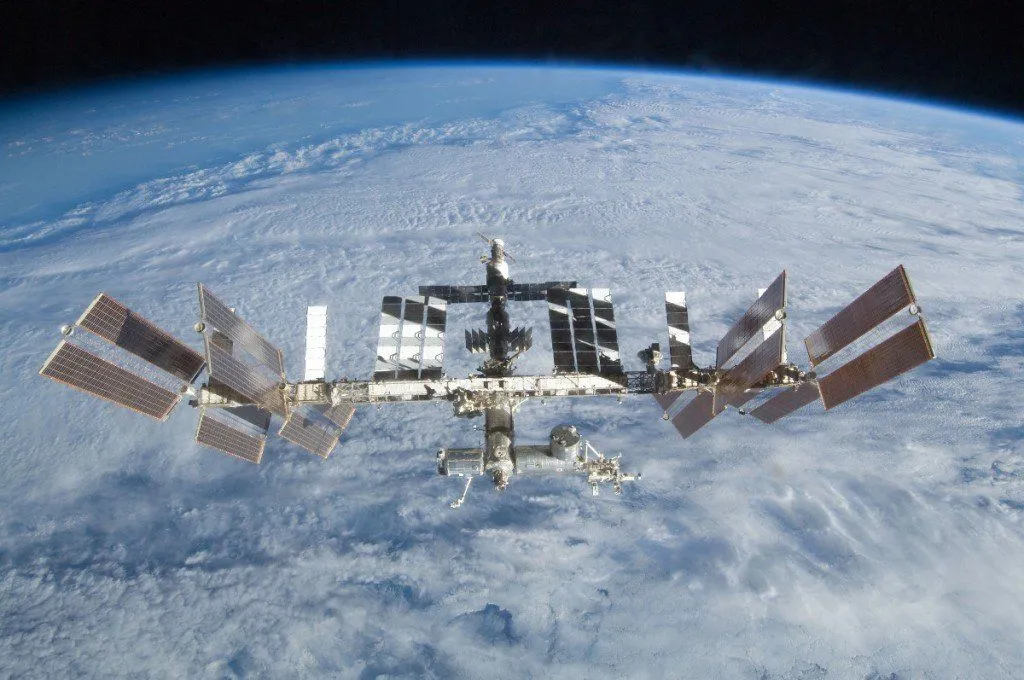
The International Space Station, the biggest and most expensive artificial satellite ever built, for instance, has completed more than 18 years in space at the time of writing this article.
However, as mentioned earlier, there are now thousands of satellites that circle Earth, and all of these are located at different altitudes above the ground. The ones that are very, very high up, like geostationary satellites (which maintain an altitude of slightly over 36,000 km), are given a nudge and transferred to a higher orbit (nearly 300 kilometers above their original orbit) where they continue revolving around our planet for a couple of centuries, effectively staying out of the way of operative satellites.
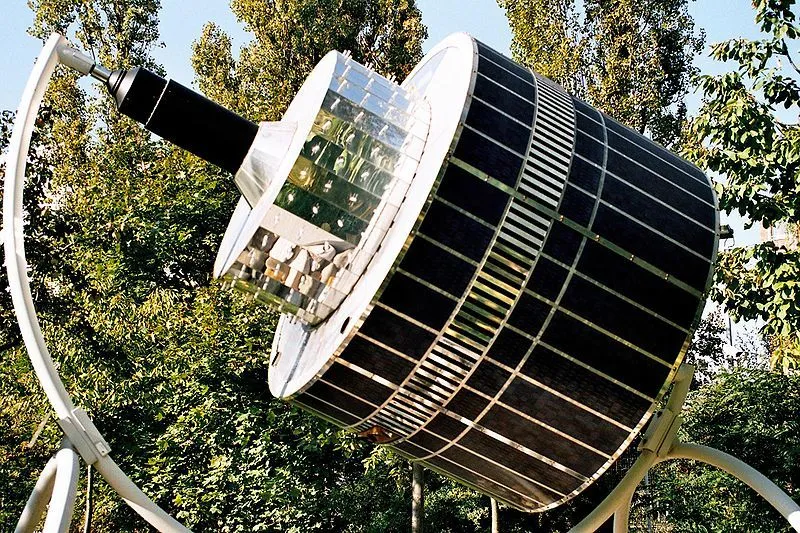
But what happens when a satellite orbiting close to Earth dies or becomes inoperative? Unlike geostationary satellites, you obviously cannot push them higher up, as that would take a tremendous amount of fuel.
Well, there are two ways (quite similar to each other) to get rid of dead satellites orbiting close to the ground. First, if the satellite in question is not too large, it could simply be slowed down so that it de-orbits and naturally begins to fall towards Earth, but burns up in the searing heat of the atmosphere. Note that it still takes more than 20 years for a satellite to fall and burn up in this way.
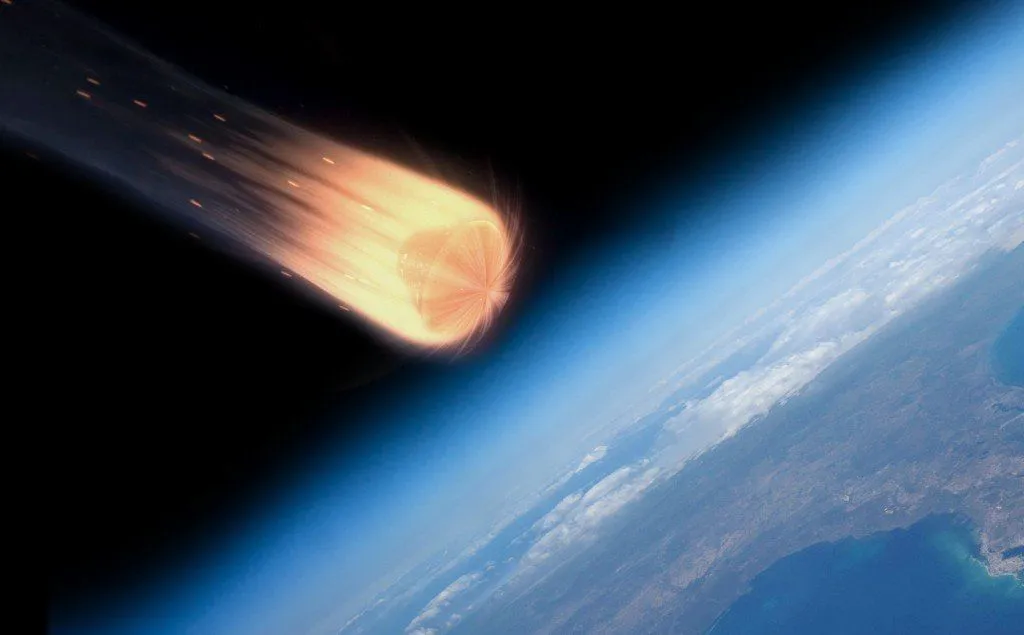
Furthermore, as you can imagine, a lot of research and analysis goes into deciding whether a satellite should be allowed to naturally re-enter the atmosphere, because if it does not burn up completely in the atmosphere, it could pose a huge safety risk. The operators of the satellite, therefore, must prove that the probability of injury or property damage is less than 1 in 10,000 if a dead satellite is slowed down and allowed to fall on its own over a period of a couple of decades.
However, if the chances come out to be more than 1 in 10,000, which usually happens in the case of large satellites (as they might not burn up completely during re-entry), then a ‘controlled de-orbit’ is required – a technique that deposits the dead satellite in a ‘graveyard’ on Earth.
What Is The Spacecraft Cemetery?
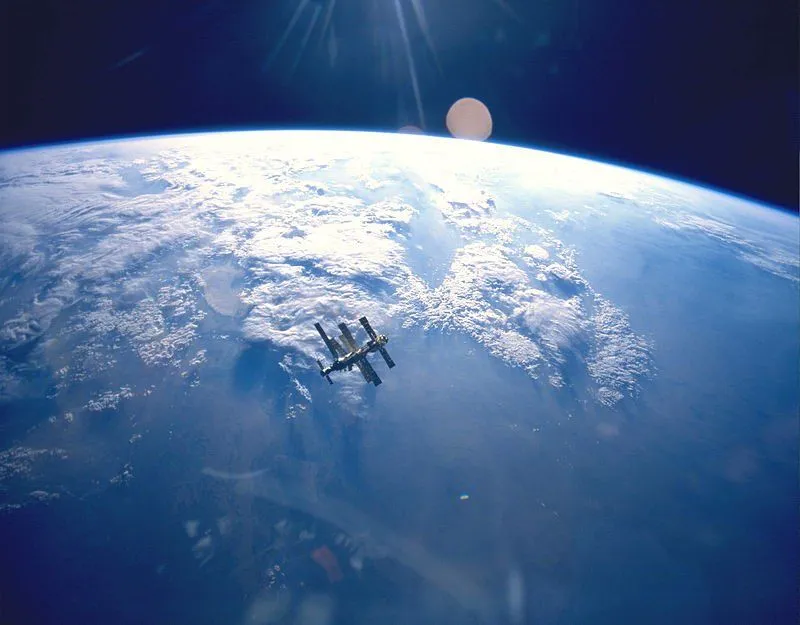
The title ‘Spacecraft Cemetery’ itself does not leave much need for explanation. As the name signifies, it is a place, more specifically, a spacecraft graveyard on Earth where satellites are “dropped” at the end of their operational lives. Also referred to as the ‘satellite graveyard’, it is the final resting place of more than 150 dead spaceships, including 6 Russian Salyut space stations and the Mir space station, 5 of the ESA’s Automated Transfer Vehicles, 4 of Japan’s HTV cargo craft and 145 autonomous Russian supply ships (Source).
Where Is The Satellite Cemetery Located?
The satellite cemetery is the nickname of a specific area in the South Pacific Ocean, roughly 2,600 km (1,600 mi) east of New Zealand, where broken satellites and spaceships litter the ocean floor. It’s particularly conducive to act as a ‘watery grave’ for partially-burnt satellite debris that fall blisteringly fast towards Earth, because it’s very remotely located, in the sense that the nearest shores are a long, long way off (thousands of kilometers).
Secondly, the shipping traffic in this part of the Pacific ocean is relatively light, so the chances of loss of life or property is extremely minimal in this region.
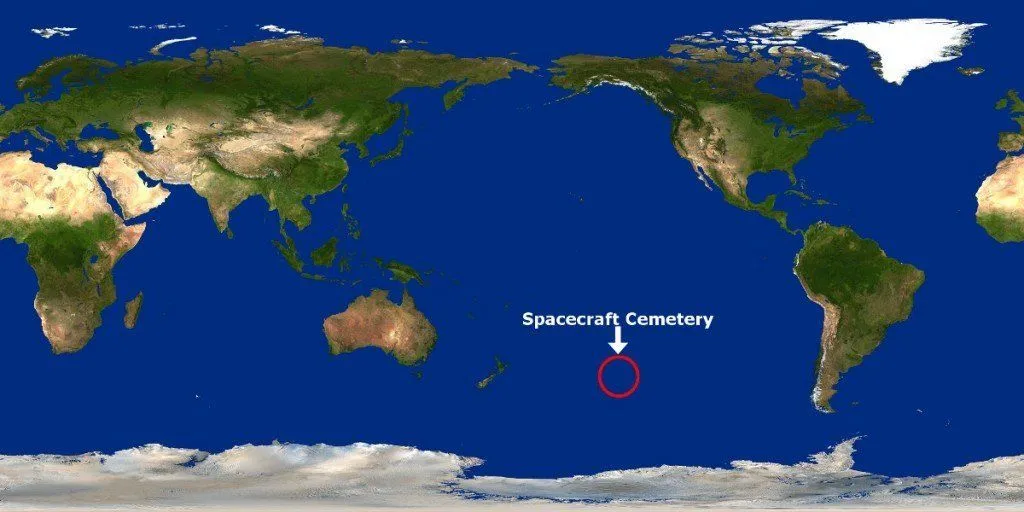
Satellites (those flying close to Earth) that become redundant after fulfilling their mission requirements are made to undertake a controlled de-orbit maneuver so that they fall precisely in this predetermined region of the Pacific Ocean and rest there at the bottom of the ocean alongside their other fallen comrades; not in one piece though, as they sustain heavy structural damage while tearing through the protective blanket of Earth’s atmosphere at staggeringly high speeds.
Thus, they usually end up in their final resting place in the form of plenty of partially burnt pieces – the only ‘mortal’ remains of things that used to be glorious space machines!
Where Exactly Is Point Nemo?
If you want a precise pin on the map rather than a vague “somewhere in the Pacific”, the spacecraft cemetery is centered on a spot called Point Nemo, formally known as the oceanic pole of inaccessibility. It sits at roughly 48°52.6′S, 123°23.6′W, in the empty water about halfway between New Zealand and southern Chile. As the name hints, “Nemo” is Latin for “no one”, and it’s also a nod to Captain Nemo, the reclusive submarine captain from Jules Verne’s Twenty Thousand Leagues Under the Sea.

What makes this exact point special is that it is the place in the world’s oceans that lies farthest from any dry land. The three nearest scraps of land are each about 2,688 km (1,670 mi) away: Ducie Island in the Pitcairn group to the north, Motu Nui (a tiny islet near Easter Island) to the northeast, and Maher Island off the coast of Antarctica to the south. None of them has a permanent human population. Point Nemo wasn’t stumbled upon by a sailor either; a Croatian-Canadian survey engineer named Hrvoje Lukatela pinpointed it in 1992 by running the geometry on a computer that accounted for the Earth’s actual ellipsoidal shape.
Here’s the detail that really drives home how isolated it is: there are no regular shipping lanes nearby, so on many days the closest human beings to Point Nemo aren’t anyone on a boat or an island. They’re the astronauts aboard the International Space Station, passing roughly 400 km overhead, more than six times nearer than the nearest coastline. That remoteness, plus the sparse marine traffic, is exactly why space agencies chose it as the planet’s dumping ground for dying spacecraft.
Will The International Space Station End Up In The Spacecraft Cemetery?
Yes, it will, and it is set to become the largest object ever to make the trip. The International Space Station has a mass of around 430 metric tonnes (about 950,000 lb) and spans roughly the area of an American football field, which is far too big to simply slow down and let tumble out of orbit on its own. An uncontrolled re-entry of something that size could scatter surviving debris across a huge, unpredictable footprint, so the station needs to be steered down deliberately and aimed straight at Point Nemo.

The station’s partner agencies have committed to operating it through 2030, after which it is due to be brought down in a controlled, fiery plunge. To pull this off, NASA selected SpaceX in 2024 to build a purpose-built U.S. Deorbit Vehicle, a kind of giant space tug, under a contract with a total potential value of $843 million. Once the final crew has departed, this vehicle will dock with the station, fire its thrusters to push the orbit lower, and guide the whole structure into the atmosphere over the South Pacific.
Most of the ISS will burn up during re-entry, but the densest, most heat-resistant pieces are expected to survive and splash down near Point Nemo. When that day comes, the station will settle onto the seabed alongside Mir, the Salyut stations and the hundreds of supply ships that went before it, the most spectacular tenant the spacecraft cemetery has ever received.
References (click to expand)
- Spacecraft cemetery. Wikipedia
- Mir - Wikipedia. Wikipedia
- Graveyard Orbits and the Satellite Afterlife | NESDIS - NOAA. The National Environmental Satellite, Data, and Information Service
- The End is Mir | Science Mission Directorate. The National Aeronautics and Space Administration
- Where is Point Nemo? National Ocean Service, NOAA
- Oceanic pole of inaccessibility (Point Nemo). Encyclopaedia Britannica
- NASA Selects International Space Station U.S. Deorbit Vehicle. The National Aeronautics and Space Administration
- Point Nemo: the most remote place on Earth. BBC Sky at Night Magazine