Table of Contents (click to expand)
NASA crashed Cassini into Saturn on September 15, 2017 because the spacecraft was nearly out of fuel. Rather than risk an uncontrolled crash that could contaminate the potentially life-bearing moons Enceladus or Titan with hardy Earth microbes, mission planners deliberately steered Cassini into Saturn's atmosphere, where it burned up.
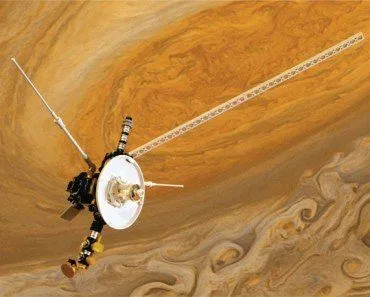
The Cassini-Huygens mission (Cassini for short) was one of the most ambitious space exploration missions ever launched. NASA ran it in collaboration with ESA and the Italian Space Agency (ASI). The mission objective was to study Saturn, its moons and its rings in detail.
The expedition got its name in honor of two scientists, Giovanni Domenico Cassini and Christiaan Huygens. Cassini found several of Saturn's moons (Iapetus in 1671, Rhea in 1672, and Tethys and Dione in 1684). Additionally, in 1675, he discovered the "Cassini Division", the narrow gap that separates Saturn's rings into two parts. Christiaan Huygens, for his part, discovered Titan, Saturn's largest moon, in 1655.
Why Explore Saturn?
Two main parts made up the spacecraft: the Saturn orbiter (Cassini) and the Huygens probe. Cassini was sent to collect data about Saturn and its moons, whereas the Huygens probe was tasked to study the surface of Titan.
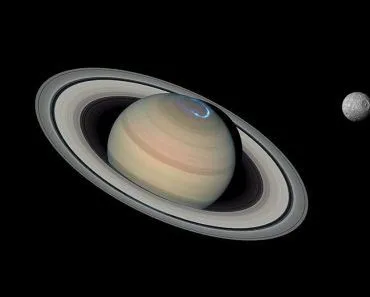
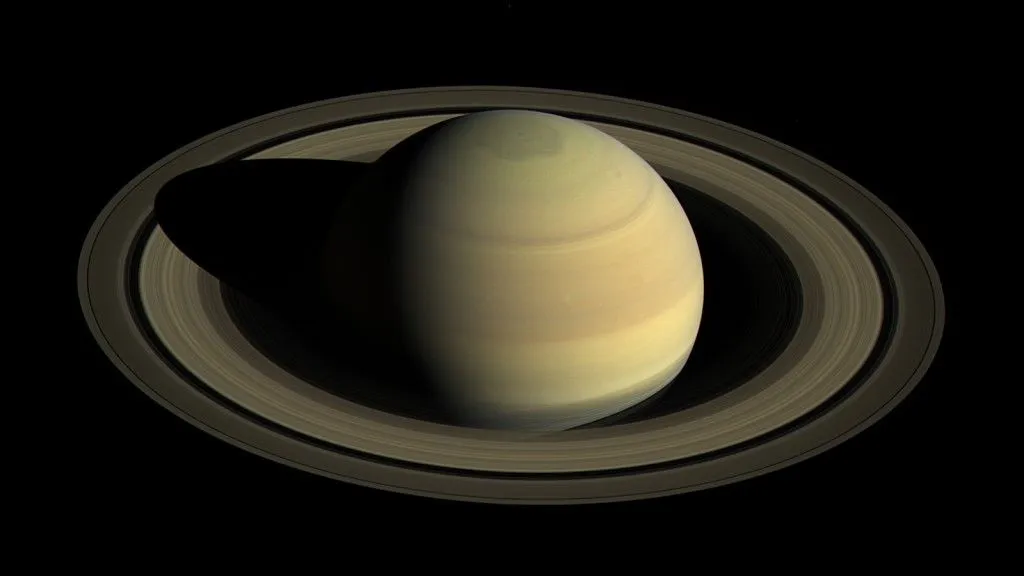
Of all the planets in the Solar System, Saturn is perhaps the most elegant and mysterious. It has intrigued scientists for decades, even centuries. According to Laplace's theory of cosmogony, it represents an accurate picture of an early stage in the formation of the Solar System. However, this is not the only reason people around the world are fascinated by Saturn. Scientists were looking for answers to other questions too. How did Saturn get its rings? Why are the rings colored? What causes its subtle self-luminescence? Does it have more moons?
The Huygens probe was designed to study the chemical reactions occurring in Titan’s atmosphere, which is rich with nitrogen. Additionally, it would also examine whether there are oceans on Titan. Most importantly, it would investigate whether pre-biotic molecules exist on Titan. In other words, it was sent to discover whether life could exist on Titan.
What Did Cassini Discover?
Cassini reached Saturn in 2004 and orbited it for 13 years. During this period, a string of remarkable discoveries were made that left scientists in awe. Ironically, it was these discoveries that sealed the fate of one of the most daring missions ever.
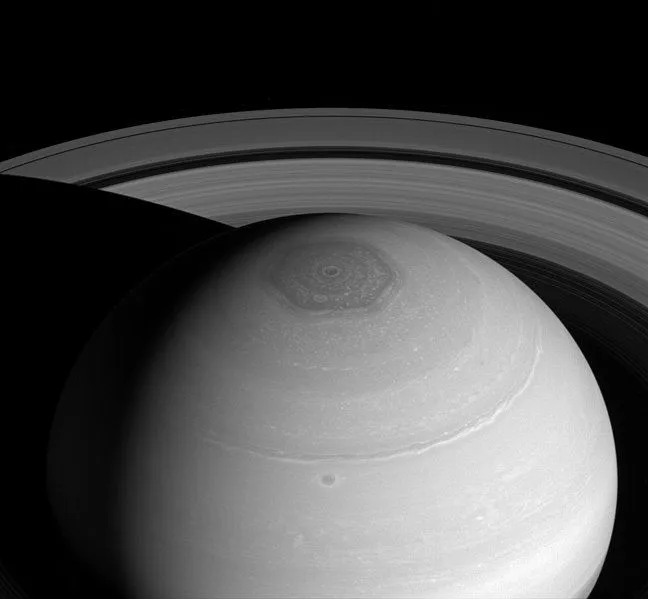
Cassini was supposed to explore Saturn for four years, but with extra fuel left, it earned two mission extensions that stretched its tour to 13 years. Over those years, it completed dozens of moon flybys that provided scientists with fascinating glimpses into the Saturnian system. Cassini also made it possible for scientists to witness phenomena that had never been observed before. These included the possible birth of a new moon, the discovery of several previously unknown moons, and giant hurricanes swirling at both of the planet’s poles.
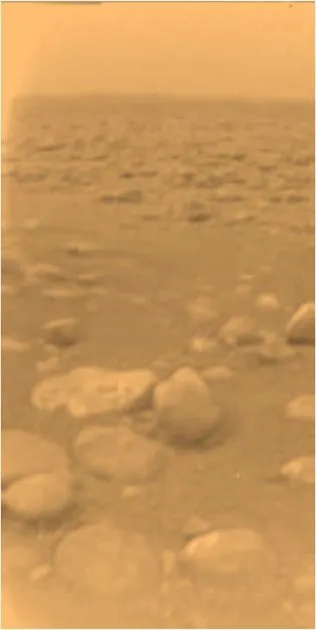
The Huygens probe landed on Titan’s surface in January 2005, and this descent showed us that Titan was remarkably similar to Earth before the evolution of life. It even had methane rain and dry lake beds. Consequently, scientists realized that Titan’s atmosphere contained a variety of molecules, some of the most complex in the Solar System. As a result, it was deemed likely for pre-biotic chemical reactions to take place on and near the surface of Titan.
Over its 13-year mission period, Cassini sent reams of data back to Earth, but one of the most intriguing discoveries involved one of Saturn’s moons: Enceladus.
What Made Enceladus Special?
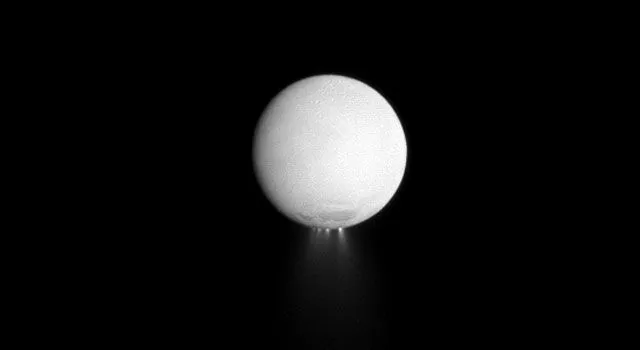
Enceladus is a tiny icy moon of Saturn and is one of the brightest bodies in the solar system. During a flyby of Enceladus in 2005, the Cassini team discovered something quite strange: sprays of mist coming off the surface. These jets were observed at the south pole of Enceladus. Now, Enceladus is a tiny moon (just over 500 km, or about 310 miles, across, roughly one-seventh the size of our Moon). More importantly, moons that small are supposed to be cold and dead, but Cassini images revealed heat leaking from the south pole.
Mysterious Jets
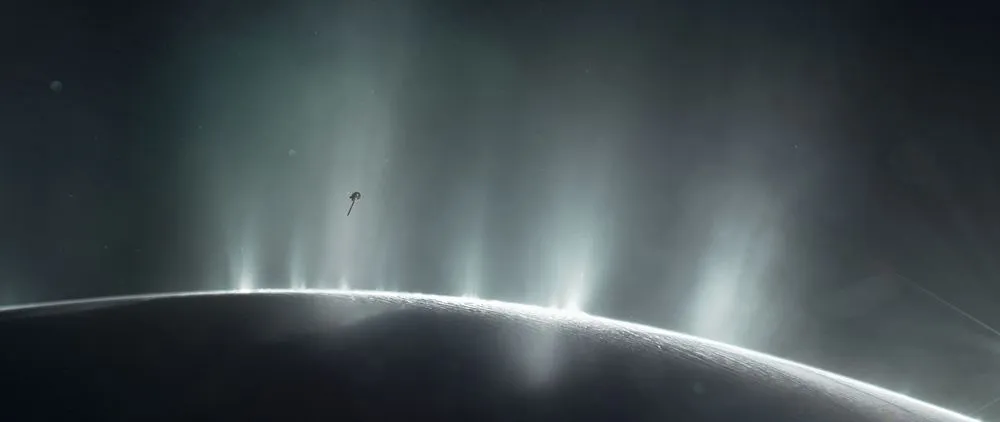
The mysterious jets and heat made the scientists want to return to Enceladus for a closer look. This decision led to a significant change in Cassini’s route map. In July 2005, Cassini went back to Enceladus. This time, it was seven times closer to the surface than on the first flyby. Images from Cassini revealed a dozen or more jets erupting more than 200 km (about 120 miles) above the south pole.
Scientists suspected that these contained water and organic compounds. On later passes, Cassini flew right through the plume and even skimmed to within about 25 km (roughly 15 miles) of the surface, finally tasting the jets directly. After these daring passes, Cassini had confirmation. The jets were water vapor laced with simple organic compounds, geysers feeding off a salty ocean hidden beneath the moon’s icy crust. The salinity of this ocean was comparable to that of Earth’s oceans.
Possibility Of Life On Enceladus?
So, Enceladus had water, a source of energy (heat) and organic compounds beneath the surface. These three components are the essential elements required to harbor life. So, if life could exist anywhere in the solar system (other than on Earth), it would be on Enceladus!
Why Did Cassini Crash Into Saturn?
After two mission extensions, Cassini’s fuel reserves were running extremely low. Once the fuel ran out, scientists would no longer have control over the spacecraft’s trajectory, and there was no chance of refueling it.
Cassini discovered pre-biotic molecules, an atmosphere of nitrogen, and lakes of methane on Titan. On Enceladus, it found the three essential components for harboring life: saline water, energy and organic compounds. All these discoveries pointed towards the fact that life could exist elsewhere in the Solar System, especially on these moons of Saturn. The team could have opted to let Cassini continue in orbit around Saturn, but this would have left the spacecraft completely uncontrolled once it ran out of fuel.
An uncontrolled spacecraft could lead to dire consequences. If Cassini were to crash into one of Saturn’s moons, the team would no longer be able to divert it. Additionally, the spacecraft could have microbes from Earth on it (theoretically speaking). If the spacecraft crashed into any of the moons, then any possibility of life evolving on that moon would be impacted significantly.
Such a spacecraft could destroy the pristine environment of Enceladus. It could also contaminate the surface of Titan, meaning that the life that could evolve on these moons would be eradicated. Thus, scientists decided that the safest place for Cassini was inside Saturn itself. Its atmosphere would destroy Cassini, just as Earth’s atmosphere destroys meteorites.
The Grand Finale
Thus, in April 2017, Cassini began the final chapter of its 13 years around Saturn, a phase NASA dubbed the Grand Finale. Over the next five months, Cassini dove through the roughly 2,000-km-wide (1,200-mile-wide) gap between Saturn and its innermost rings. Over the course of 22 such dives, Cassini provided scientists with extraordinary data and never-before-seen images. It improved our knowledge of Saturn exponentially. It also offered answers that had been too risky to obtain earlier in the mission.
Then, on September 15th, 2017, Cassini began its final and fateful dive into Saturn’s atmosphere. It took the help of Titan’s gravity to change its trajectory slightly. It was live-streaming data from eight of its instruments. Here onwards, Cassini’s purpose was to transmit every bit of data that it gathered until the very end. The closer the spacecraft got to Saturn, the more precious the data became.
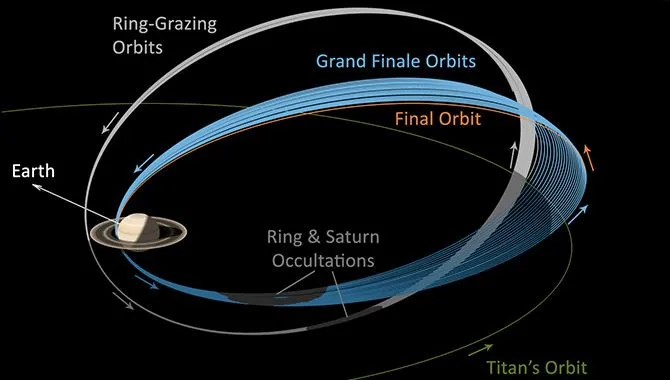
As Cassini entered Saturn’s outer atmosphere, it was traveling at about 123,000 km/h (77,000 mph). As it went deeper, the spacecraft struggled to keep the antenna pointed towards the Earth, and as the atmosphere grew denser, Cassini began to heat up. At about 1,500 km (930 miles) above Saturn’s cloud tops, Cassini began to tumble. It permanently lost contact with Earth. The mission was finally over.
Cassini was no longer sending signals back to Earth, but scientists predicted that right before Saturn consumed it completely, Cassini would have been in a brief state of panic, fighting to keep itself alive. Ultimately, however, Saturn’s heat and dense atmosphere would have blasted the spacecraft apart. Cassini sent tons of scientific data back to Earth over the course of its bold mission. It is data that is unparalleled and precious. It is ironic that the spacecraft, named after the astronomer who spent a significant period of his life studying Saturn, ultimately became a part of the planet itself!
References (click to expand)
- Cassini Mission Overview. NASA Science. The National Aeronautics and Space Administration
- Cassini at Enceladus: A Decade-Plus of Discovery. The National Aeronautics and Space Administration
- Cassini-Huygens Frequently Asked Questions (FAQs) - ESA. The European Space Agency
- Cassini's Grand Finale: Overview. NASA Science. The National Aeronautics and Space Administration
- End of Mission Timeline. NASA Science. The National Aeronautics and Space Administration