The hexagon on top of Saturn is a six-sided jet stream around the planet's north pole, roughly 30,000 km (18,000 mi) wide. Each side is about 14,500 km long, longer than Earth's diameter. Voyager imaged it in 1980-81, Cassini studied it in detail from 2006 to 2017, and a 2020 Harvard simulation traced its origin to deep convection currents below the cloud tops.
The universe is full of patterns and shapes, but sometimes we find shapes in places and forms we certainly don’t expect. That is the case with the hexagonal shape discovered at the north pole of Saturn. Scientists hadn’t expected to see a huge and seemingly perfect hexagonal pattern on top of the ringed planet. As perfect as the shape was, it was (and still is) a bizarre phenomenon.
Let’s take a look at how this beautiful shape was discovered on this gaseous planet and identify the cause behind it.
What Is The Hexagon At Saturn’s North Pole?
The hexagon on top of Saturn is indeed a storm, and it is huge! Each of its six sides is roughly 14,500 km long, about 2,000 km longer than Earth's diameter, and the whole pattern is around 30,000 km (18,000 mi) across. Its depth has been measured at roughly 300 km (190 mi), though a 2020 study argues the underlying flow extends thousands of kilometers deeper. The eye of the central polar cyclone inside the hexagon is about 50 times larger than the eye of a typical Earth hurricane. Color images from Cassini show that the interior shifted from blue to gold between 2012 and 2017, as the northern hemisphere moved into summer and ultraviolet sunlight produced photochemical hazes.
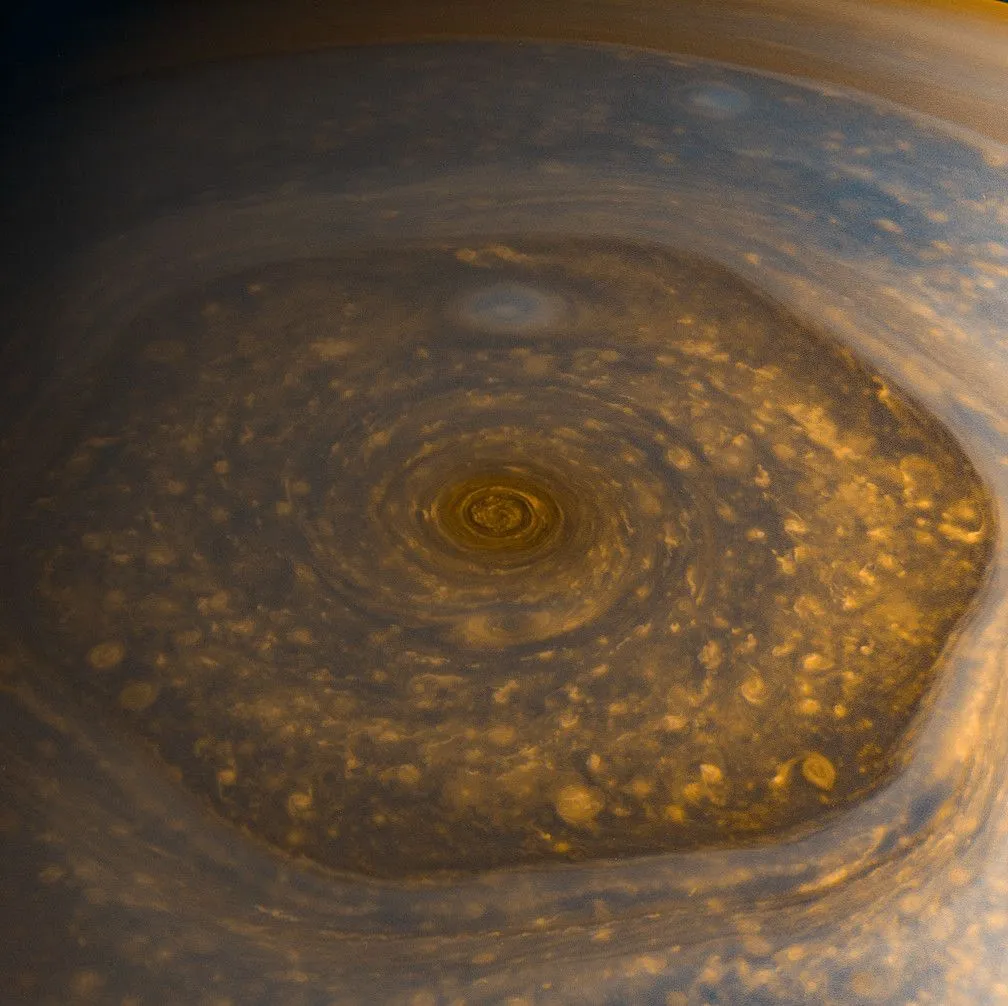
The jet stream that traces the hexagon itself moves at about 320 km/h (200 mph), and winds at higher altitudes in Saturn's upper atmosphere reach roughly 500 km/h (300 mph). Scientists have also spotted several vortices (smaller storm centers) inside the hexagon. Some of these vortices rotate clockwise, others counter-clockwise. The largest is white and is around twice the size of a typical hurricane on Earth.
The hexagon itself is a jet stream that consists of atmospheric gases that scientists have deemed “just a current of air and weather features”.
What is more baffling about the hexagon is that the vortex is at a higher altitude than the clouds of Saturn, meaning that the shape has raised like a huge tower. However, due to the lack of data and unfavorable weather conditions of Saturn, it is difficult to study this phenomenon in more detail.
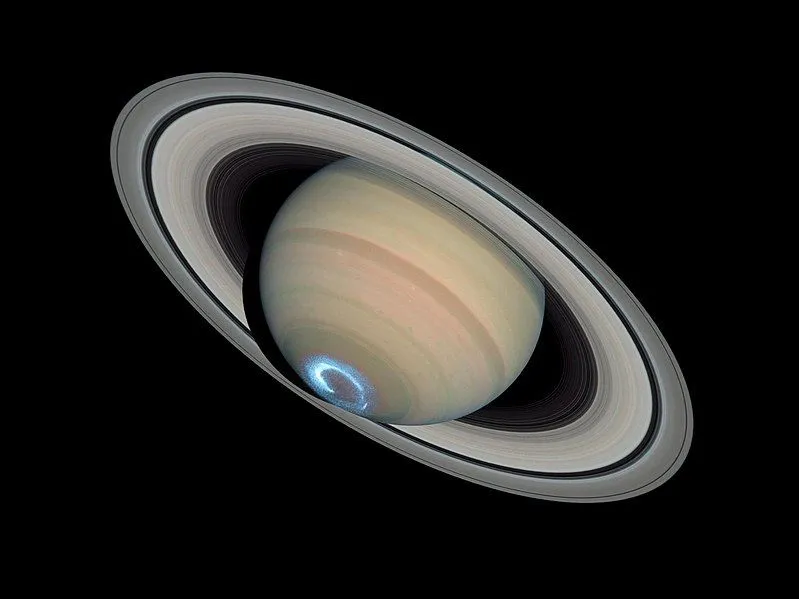
The aurora of Saturn caused by the magnetic field also sits right atop this hexagonal shape, giving it the look of a fire in the shape of a hexagon.
How Was The Hexagon Discovered?
The first glimpses came in 1980 and 1981, when NASA's Voyager 1 and Voyager 2 spacecraft flew past Saturn on their way out of the solar system. Their images baffled the scientific community at the time. (You can further read about how gravity helped Voyager 1 and 2 escape our solar system in our gravitational slingshot explainer.) The full hexagonal pattern wasn't actually recognized until 1988, when David Godfrey re-analyzed the combined Voyager 1 and Voyager 2 image set and pieced together the geometry that the original fly-by glimpses had hidden.
It took scientists a few years to get the picture just right, but then they finally saw it: the perfect hexagon on top of Saturn.
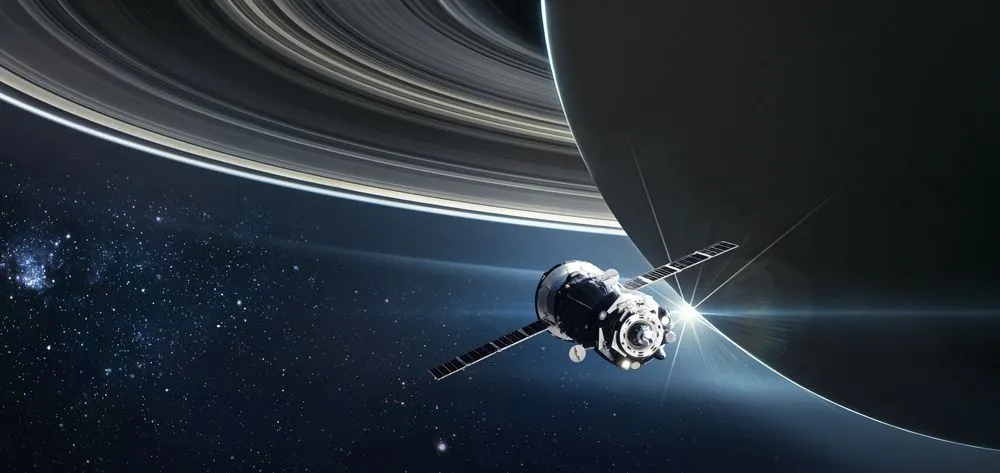
After the first discovery, the hexagon was covered with a sheet of darkness. It was only when sunlight again revealed the six-sided shape that the Cassini spacecraft was able to reveal a series of enchanting images.
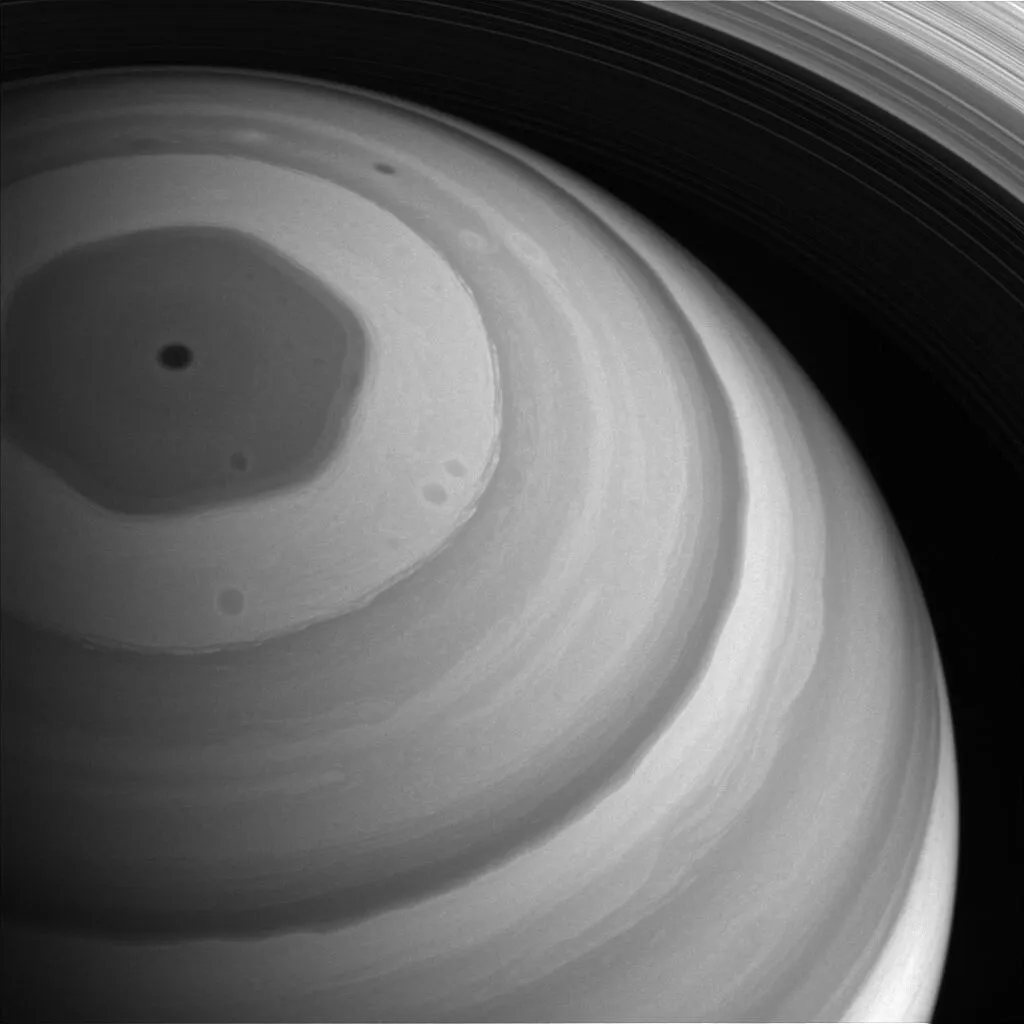
Cassini had only been able to study the shape in infrared while it was covered in darkness, which still confirmed its existence, but the images were not very satisfactory.
When sunlight finally engulfed the northern pole of Saturn, Cassini matched the speed of the planet and was therefore able to produce a video of the hexagonal weather pattern that showed the movement of the hexagonal pattern (a link to the video is in this article’s references).
What Is The Reason Behind The Hexagon?
In 2010, Ana Claudia Barbosa Aguiar and Peter Read at the University of Oxford recreated the pattern in the lab. They reported their results in the journal Icarus and showed that a faster-spinning inner ring inside a slowly rotating tank of water can carve the surrounding fluid into a polygonal shape that depends on the rotation rate.
When the liquid was put in a circular container and rotated at different speeds at its center and peripherals, six-sided patterns like those seen on Saturn were produced in the container. A good number of smaller vortices are also found in the container that interact with each other. It was seen that the boundary changes its shape and takes on a polygonal form because of the spacing of these vortices.
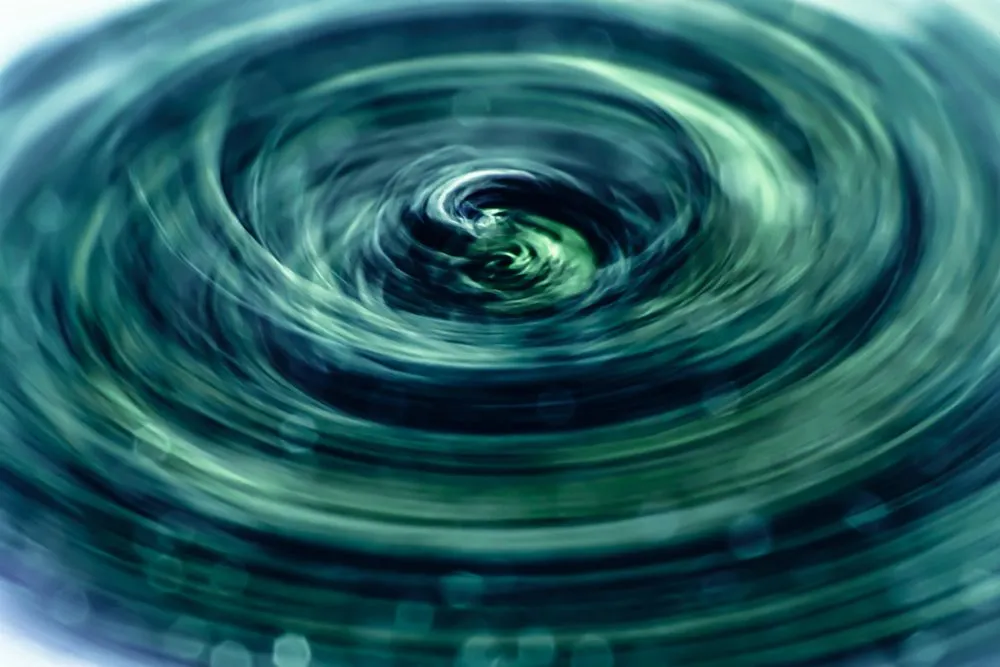
However, these artificially created polygonal shapes are not stable. They need the very specific boundary conditions of speed and viscosity (the characteristic of fluid to seem thick) that are present on the north pole of Saturn.
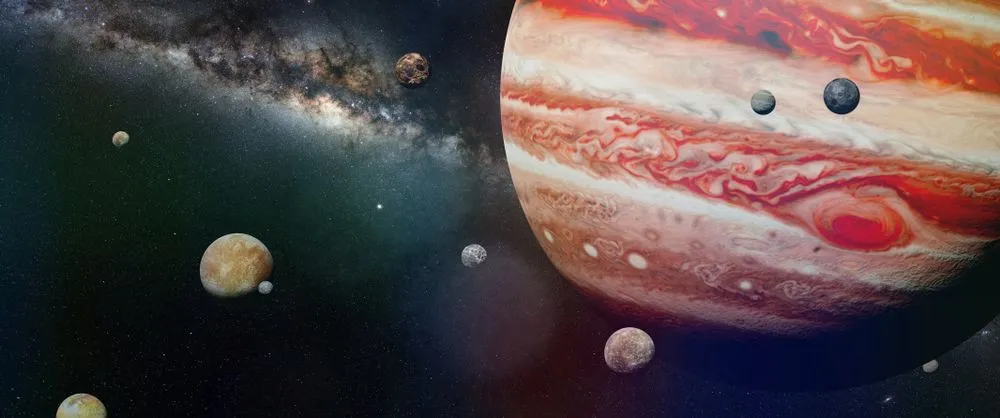
These conditions are rare, so such a phenomenon is not seen on a planet like Jupiter, which is very similar to Saturn.
In more detailed simulations, it was found that such patterns are seen when the winds flowing around the storm are moving in the direction opposite to the storm.
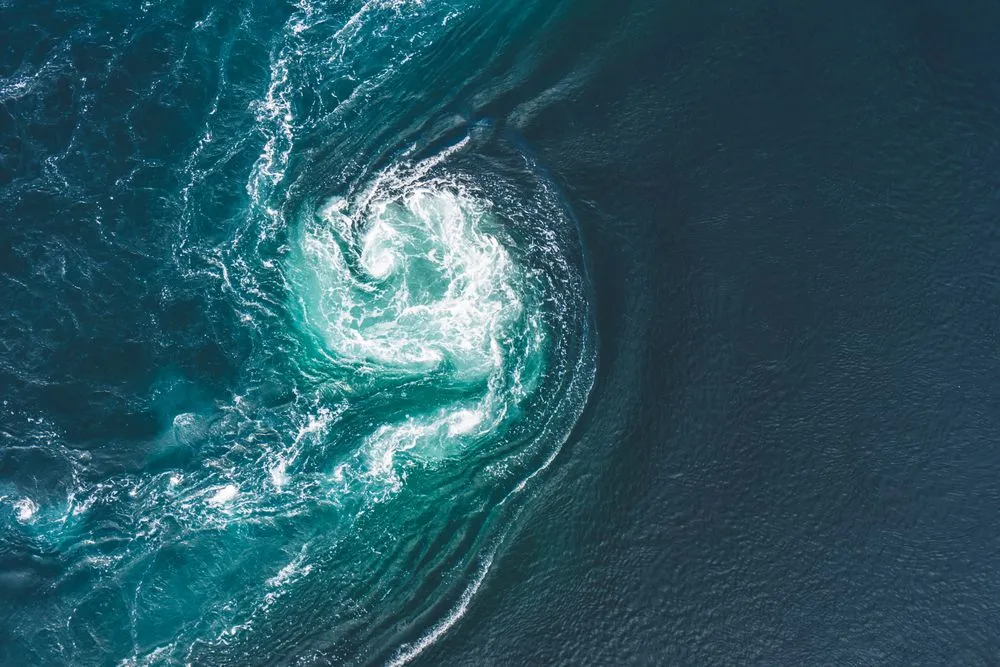
In simpler words, the slower winds (still moving at horrifying speeds of 220 miles an hour) around the storm flowing in the opposite direction form eddies (circular flows of liquid or gases) that act as miniature storms that push the larger storm (which is just a jet stream, as discussed earlier) into wave-like patterns, finally achieving the hexagonal shape.
Does Saturn’s South Pole Have A Storm Too?
The hexagon grabs all the attention, but Saturn’s south pole hides a monster of its own, and it looks nothing like the tidy six-sided pattern up north. When NASA’s Cassini spacecraft imaged the south pole on 11 October 2006, it found a swirling, hurricane-like vortex with something no one had ever seen beyond Earth: a well-defined eye ringed by a wall of towering clouds.

This southern storm is roughly 8,000 km (5,000 mi) across, about two-thirds the diameter of Earth. Its winds race clockwise at around 550 km/h (350 mph), and the clouds forming its eyewall rise 30 to 75 km (20 to 45 mi) above the center, two to five times taller than the tallest thunderstorms on our own planet.
There are a couple of striking differences from a storm here at home. An Earth hurricane wanders across warm ocean water, but Saturn’s vortex is locked in place directly over the pole and has no ocean beneath it at all. So while the north pole wears a neat hexagon, the south pole spins a giant, circular eye. Both are extreme weather, just dressed in very different shapes. Cassini studied both poles up close before its mission ended, as we cover in why Cassini plunged into Saturn.
Does Jupiter Have A Hexagon Too?
Jupiter is Saturn’s giant sibling, so it’s fair to ask whether it hides a hexagon of its own. The short answer is that Jupiter has no single six-sided jet stream like Saturn’s. But that doesn’t mean its poles are dull. When NASA’s Juno spacecraft finally peered straight down at them, it found polygons of a completely different kind.

Instead of one continuous jet stream, Jupiter’s poles are ringed by clusters of separate, distinct cyclones. At the north pole, eight cyclones surround a central one in an eight-sided arrangement (a modified octagon). At the south pole, five cyclones originally circled a central storm in a neat pentagon, until late 2019, when a sixth cyclone muscled its way in and turned the pentagon into a hexagon. Juno’s camera (JunoCam) and its infrared instrument (JIRAM) clocked winds inside these storms at roughly 200 to 350 km/h (125 to 220 mph).
So both giants love geometry, just in different ways. Saturn draws a single hexagon with one river of wind, while Jupiter arranges whole cyclones like beads around each pole. If you’re curious about what lies beneath those storms, we dig into what Jupiter is made of elsewhere.
Is Saturn’s Hexagon Actually A Cube?
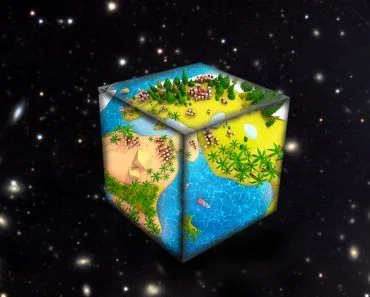
If you go looking online, you’ll quickly run into a stranger claim: that Saturn is hiding a giant black cube at its pole, and the hexagon is just one part of it poking through. It’s a fun story, but there is no cube. As we’ve seen, the hexagon is a flat pattern traced by a jet stream in Saturn’s atmosphere, not a solid object with walls and edges.

So where does the cube idea come from? Geometry plays a neat trick here. If you take an ordinary cube and look at it straight down one of its long diagonals (corner-first, so no single face points at you), its outline becomes a perfect regular hexagon. In other words, a hexagon is exactly the silhouette a cube casts when viewed corner-on, which is why spotting a hexagon can tempt you into imagining a hidden cube behind it.
But a silhouette is not the object that cast it. Saturn’s hexagon is about 30,000 km (18,000 mi) wide and defined entirely by moving air. There are no vertical walls, no three-dimensional corners, and nothing solid down there. The “black cube of Saturn” belongs to symbolism and internet lore, not to astronomy. The real explanation, a jet stream nudged into a standing wave, is strange enough on its own.
Conclusion
As we explore the vast world around us, we tend to find phenomena that leave us with more questions than answers. What we see on the North Pole of Saturn is surely a storm of atmospheric gases in a hexagonal shape, but what is the origin of this exotic incident? We and all the scientists around the world can only try to guess and develop models and theories to explain what we are seeing. However, there is one thing that is certain in this sea of uncertainties: the hexagonal storm of Saturn only adds to the beauty of the most photogenic planet in our solar system.
References (click to expand)
- Saturn's Hexagon in Motion - NASA Solar System Exploration. The National Aeronautics and Space Administration
- Saturn's hexagon could be an enormous tower | Astronomy.com. Astronomy
- Yadav, R. K., & Bloxham, J. (2020, June 8). Deep rotating convection generates the polar hexagon on Saturn. Proceedings of the National Academy of Sciences. Proceedings of the National Academy of Sciences.
- Baines, K. H., Momary, T. W., Fletcher, L. N., Showman, A. P., Roos-Serote, M., Brown, R. H., … Nicholson, P. D. (2009, December). Saturn's north polar cyclone and hexagon at depth revealed by Cassini/VIMS. Planetary and Space Science. Elsevier BV.
- A Vexing Hexagon – NASA Solar System Exploration. The National Aeronautics and Space Administration
- Looking Saturn in the Eye. NASA Science. National Aeronautics and Space Administration.
- Jupiter's Pentagon Turns Hexagon. NASA Jet Propulsion Laboratory (JPL).
- Jupiter's polar polygons: Clusters of cyclones around the poles. British Astronomical Association.
- Isometric projection. Wikipedia.