Table of Contents (click to expand)
If Saturn came close to Earth, it would be catastrophic. Its gravity would fling the Moon out of orbit, strip away part of Saturn's rings, and raise apocalyptic tides. Even from over a million kilometers away, the tidal forces would eventually grow strong enough to tear Earth apart.
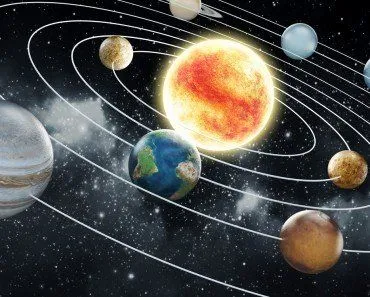
Our solar system is quite a friendly neighborhood, so to speak. Planets revolve around a giant ball of fire alongside each other in complete harmony, smaller natural satellites revolve around their respective ‘guardian’ planets, and no one disturbs the equilibrium. Everyone is content with their own lives in their own segregated orbits.
However, what if one of the eight planets decided to rebel and break this carefully maintained harmony? What if a planet, say Saturn, decided to pay Earth a visit?
Saturn, The Planet
Before we look at how Earth would react to such an uncalled-for visit by its planetary neighbor, let’s peek into the profile of the ringed gas giant.
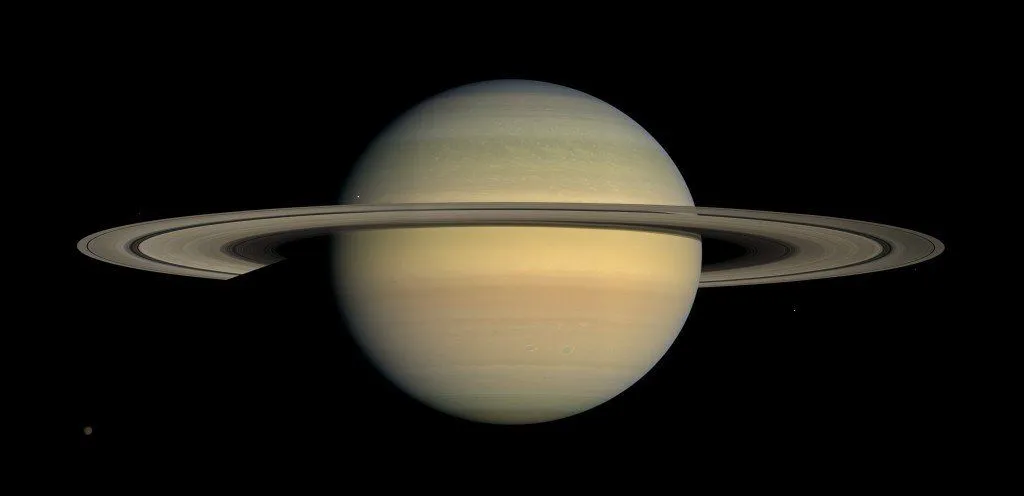
When we think about Saturn, the first thing that comes to mind is its ring system, i.e. the spectacular rings that run around its diameter. Apart from that, Saturn is huge… really huge. In terms of sheer size, it stands second only to Jupiter. Its mean radius (roughly 58,200 km, or 36,200 mi) is almost nine times that of Earth, yet its density is only about one-eighth of our home planet (0.69 g/cm³ versus 5.51 g/cm³). In fact, Saturn is the only planet in the solar system less dense than water, so in theory it would float if you could find a bathtub big enough.
Saturn’s Visit To Earth
If Saturn were to come close to Earth, the consequences would be… well, unsavory. Let’s look at the consequences involved…
For The Moon
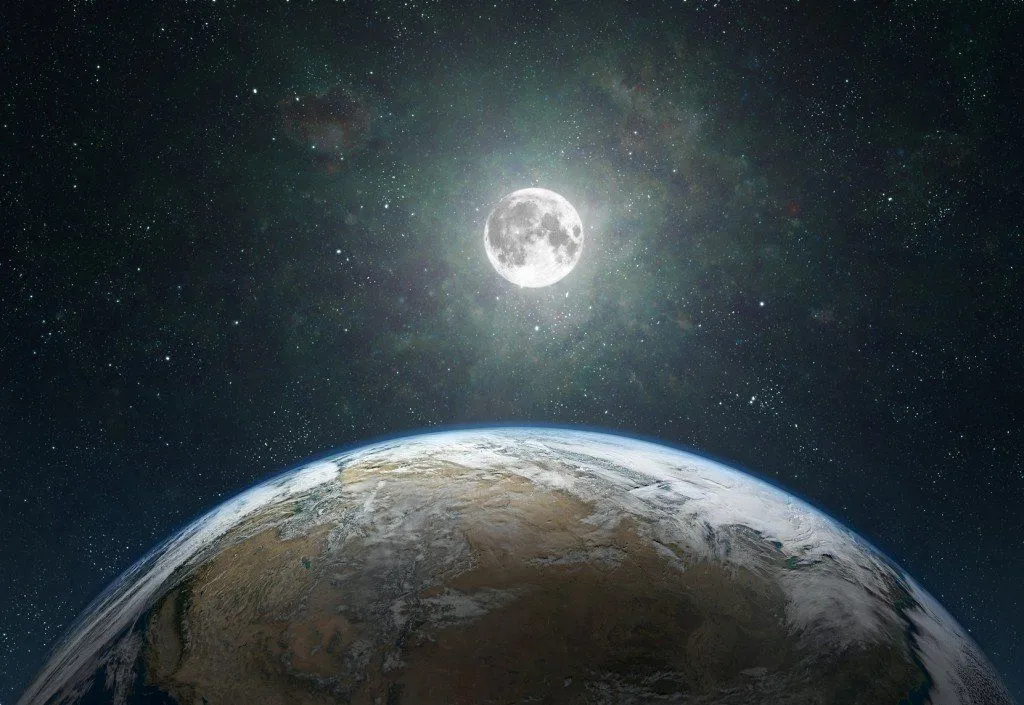
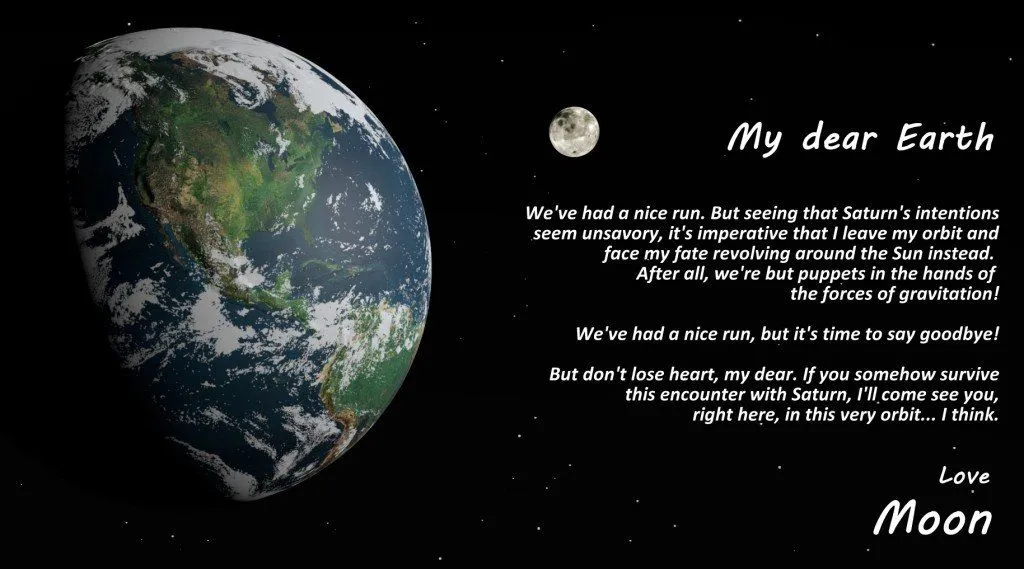
First off, it would be bad news for our beloved moon. In a situation where three celestial bodies – namely Earth, the Moon and Saturn – are involved, the one with the lowest mass would bear the maximum brunt of the encounter. In this particular case, the Moon would be chucked right out of its orbit around Earth. What would follow for the moon can’t be claimed with certainty, but in most cases, it would go into a highly elliptical orbit around the Sun. This, again, is not desirable, as there would be chances of the moon crossing through Earth’s orbit, and in the worst scenario, it would run into Earth.
For Saturn
A significant portion of the iconic rings around Saturn would become history if it were to ever come close to our planet. You see, Saturn’s rings are mostly made up of ice particles, along with a smaller amount of rocky debris and dust. Earth’s gravitational pull would be more than enough to disturb and subsequently obliterate the rings by pulling the constituent particles ‘out’ of the rings. Now, where do you think these ‘pulled-out’ particles would head after being yanked out from their guardian rings…
Bingo!
Still, many of the particles of the ring would continue to orbit Saturn, giving it the appearance of a ‘damaged ring’, as Earth’s gravitational pull isn’t strong enough to completely strip it of those beloved rings.
For Earth
Now for the most important part, what would happen to Earth?
In one word: destruction!
There’s no way that Earth would survive such an encounter with Saturn. A major part of Earth is covered by oceans and tides are caused by the gravitational pull from another closely located and considerably large celestial body. The power and the height that tides rise and fall depends on the size of the celestial body causing them. Right now, it’s primarily the gravitational pull from moon that causes tides.
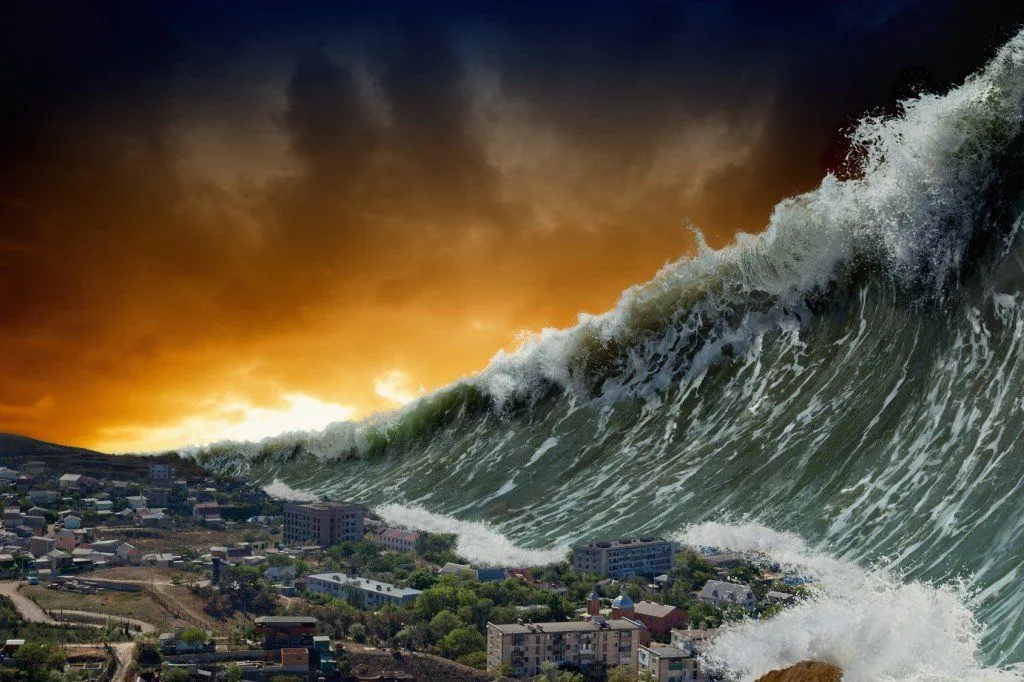
However, if Saturn were to come closer to Earth (after chucking the Moon out of orbit), imagine the scale of ocean tides then. There would be huge… no, apocalyptic tidal waves that would rage all over the planet and destroy everything in their path. After reaching a certain distance from Earth, the tidal force on Earth would be so strong that it would tear our planet apart – literally!
All of this would happen when Saturn was still more than a million kilometers away from Earth! Check out the video below for a more visual description of this hypothetical encounter.
The good thing, though, is that all of this is purely hypothetical. We are good neighbors and will continue to be so in the future. That being said, don’t be too worried about the beautiful ringed gas giant because, as always, it minds its own business.
What Would Happen If Saturn Disappeared (Or Exploded)?
The flip side of a too-close Saturn is a Saturn that suddenly isn’t there at all. It’s a popular thing to wonder about, but the honest answer is reassuringly boring: Earth would barely notice. The reason is simple distance. Saturn sits at an average of 9.5 astronomical units from the Sun, roughly 1.4 billion km (886 million mi) out, and even at its closest pass by Earth it stays more than 1.2 billion km (around 8.5 AU) away. Gravity weakens with the square of distance, so at that range Saturn’s tug on Earth is utterly trivial compared with the Sun’s. Take Saturn away and Earth’s orbit, seasons, and tides carry on as if nothing happened.

The bodies that would feel it are Saturn’s neighbors. As the second most massive planet in the solar system, Saturn nudges the orbits of nearby giants like Jupiter and Uranus. Remove it and those orbits would shift very slightly, while its moons (Saturn has more than 270 confirmed, the most of any planet), suddenly unbound, would coast off on their own paths around the Sun. Over millions of years those small perturbations could ripple outward in hard-to-predict ways, but on any human timescale the inner solar system, Earth included, would stay perfectly stable. An “exploding” Saturn is even less of a worry: there’s no known physical mechanism that could make a gas giant blow up, and any debris would still be over a billion kilometers from us. If you want the broader picture, we cover the general case in what would happen if a planet suddenly disappeared from the solar system.
Does Saturn Protect Earth?
Here’s a question that comes up a lot: does Saturn act as a cosmic bodyguard, swatting away comets and asteroids before they can reach us? You’ve probably heard the same claim made about Jupiter, the so-called “shield” that supposedly soaks up incoming debris. The real story is more interesting, and a lot less tidy.

The “Jupiter as shield” idea actually traces back to a misreading of 1990s simulations. In a 2016 study in the journal Astrobiology, planetary scientist Kevin Grazier ran simulations of tens of thousands of test particles and found that Jupiter is more of a Jekyll and Hyde character: it deflects some objects but also flings others toward the inner solar system, and it helps deliver the water-rich material that life needs. The cleanest takeaway from his work is that no single giant planet is a reliable shield on its own. Where Saturn comes in is as Jupiter’s partner. Follow-up modeling suggested that it takes Jupiter and Saturn working together to efficiently eject small bodies from the solar system; with only one giant present, the simulations leave behind a lingering belt of leftover debris instead. So Saturn isn’t a personal force field standing guard over Earth, but its gravity is part of the long-term dynamical housekeeping that, over billions of years, has helped shape how many asteroids and comets wander through our part of the solar system.
References (click to expand)
- Close encounter: What if Saturn swung by Earth?. Slate
- Saturn: Facts. NASA Science
- Roche limit. Encyclopaedia Britannica
- Grazier, K. R. (2016). Jupiter: Cosmic Jekyll and Hyde. Astrobiology. PubMed.
- Saturn Could Be Defending Earth From Massive Asteroid Impacts. Space.com
- Saturn officially has 128 more moons. Space.com