Table of Contents (click to expand)
- What Are The Different Types Of Planets In Our Solar System?
- Is Each Planet Rocky Or Gas? A Quick Classification
- How Were The Planets In Our Solar System Born?
- What Happened That Made The Rocky Planets Come Closer To The Sun?
- Do All Solar Systems Have Rocky Planets Closer To Their Stars?
- Why Does The Sun Look So Small From The Gas Giants?
- Conclusion
The inner solar system was simply too hot for ices to condense. Inside the so-called "frost line" — at about 3 AU — only metals and silicates could solidify, which is why the four planets nearest the Sun ended up small, dense and rocky. Beyond it, water, methane and ammonia ices were abundant, so cores out there grew huge, captured nebular hydrogen and helium, and ballooned into the gas and ice giants.
Our solar system is a cosmic family. There are members in this family with very different personalities: the small rocky planets that are the kids and love staying close to the Sun; the bigger gas giants who keep their chaos away from the kids; and the icy outer planets who hardly ever come close, but love it all the same.
What Are The Different Types Of Planets In Our Solar System?
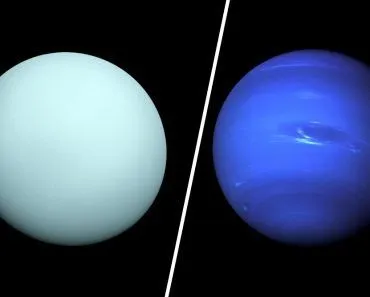
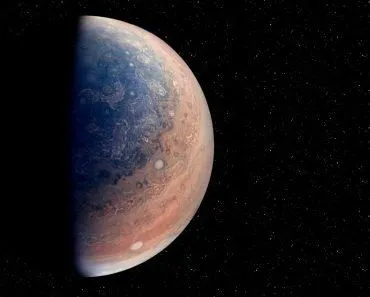
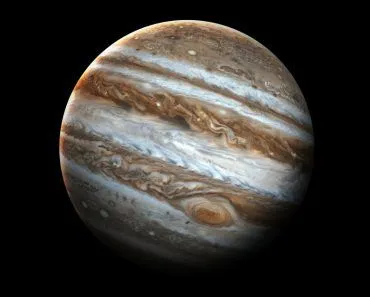
Our eight planets split neatly into two camps. The inner four — Mercury, Venus, Earth and Mars — are terrestrial (rocky) planets: small, dense, made mostly of metal and silicate rock, with thin (or no) atmospheres. The outer four — Jupiter, Saturn, Uranus and Neptune — are giants. Jupiter and Saturn are gas giants, made mostly of hydrogen and helium. Uranus and Neptune are ice giants, with much more water, ammonia and methane in their interiors. The dividing line falls neatly at the asteroid belt, right where things used to be cold enough for ice.
Is Each Planet Rocky Or Gas? A Quick Classification
If you just want a straight answer for one planet, here it is. Astronomers sort the eight planets into three groups by what they are mostly made of. The four nearest the Sun are terrestrial (rocky) planets, with solid surfaces you could in principle stand on. The outer four are giants with no solid surface at all, and they split into two flavors: gas giants and ice giants.

| Planet | Type | Mostly made of |
|---|---|---|
| Mercury | Rocky (terrestrial) | Iron and silicate rock |
| Venus | Rocky (terrestrial) | Iron and silicate rock |
| Earth | Rocky (terrestrial) | Iron and silicate rock |
| Mars | Rocky (terrestrial) | Iron and silicate rock |
| Jupiter | Gas giant | Hydrogen and helium |
| Saturn | Gas giant | Hydrogen and helium |
| Uranus | Ice giant | Water, ammonia and methane over a rock/ice core |
| Neptune | Ice giant | Water, ammonia and methane over a rock/ice core |
The pair that trips people up is Uranus and Neptune. Neither is rocky, but neither is a "pure" gas giant like Jupiter either. NASA classifies them as ice giants: beneath their hydrogen and helium atmospheres lies a deep, hot mantle of water, ammonia and methane. The word "ice" is a little misleading here, because that material is a dense, scorching fluid rather than the cold solid ice you scrape off a windscreen. So the quick answers are: Mercury, Venus, Earth and Mars are rocky; Jupiter and Saturn are gas giants; Uranus and Neptune are ice giants.
How Were The Planets In Our Solar System Born?
Roughly 4.6 billion years ago, a vast cloud of gas and dust — the solar nebula — collapsed under its own gravity. Most of the material rushed to the centre and ignited as the Sun; the leftovers settled into a flat, spinning protoplanetary disc. Inside that disc, dust grains stuck to each other (literally, electrostatically) and built up into pebbles, then boulders, then kilometre-sized planetesimals. Planetesimals collided and merged into protoplanets. Many more than eight bodies formed; the survivors are the eight we see today, scarred by giant impacts like the one that probably gave Earth its Moon.
What Happened That Made The Rocky Planets Form Closer To The Sun?
It wasn't that gas was blown off the rocky planets — the rocky planets never had thick H/He envelopes to begin with. The real culprit is something astronomers call the frost line (or snow line) of the early solar nebula.
Near the young Sun, temperatures in the disc were a few hundred degrees Celsius — way too hot for water, ammonia, methane and CO₂ to freeze out as solid grains. Only stubborn, high-melting-point stuff like iron, nickel and silicates could condense. So the planetesimals in the inner solar system were built from a thin supply of metal and rock, which is why the four inner planets ended up small (Mars and Mercury are tiny compared to Earth) and rocky.
Past the frost line — at roughly 3 AU, in the modern asteroid belt — the disc was finally cold enough for ices to crystallise. Suddenly there was far more solid material lying around: rock and metal plus a buffet of frozen water, ammonia and methane. Cores out there bulked up much faster, and once a core reached about 10 Earth masses it had enough gravity to start vacuuming up the hydrogen and helium gas that still filled the disc. That runaway growth turned Jupiter and Saturn into gas giants. Uranus and Neptune started the same way but reached the gas-grabbing stage later, ending up with much smaller H/He envelopes and a higher fraction of ice — hence "ice giants."
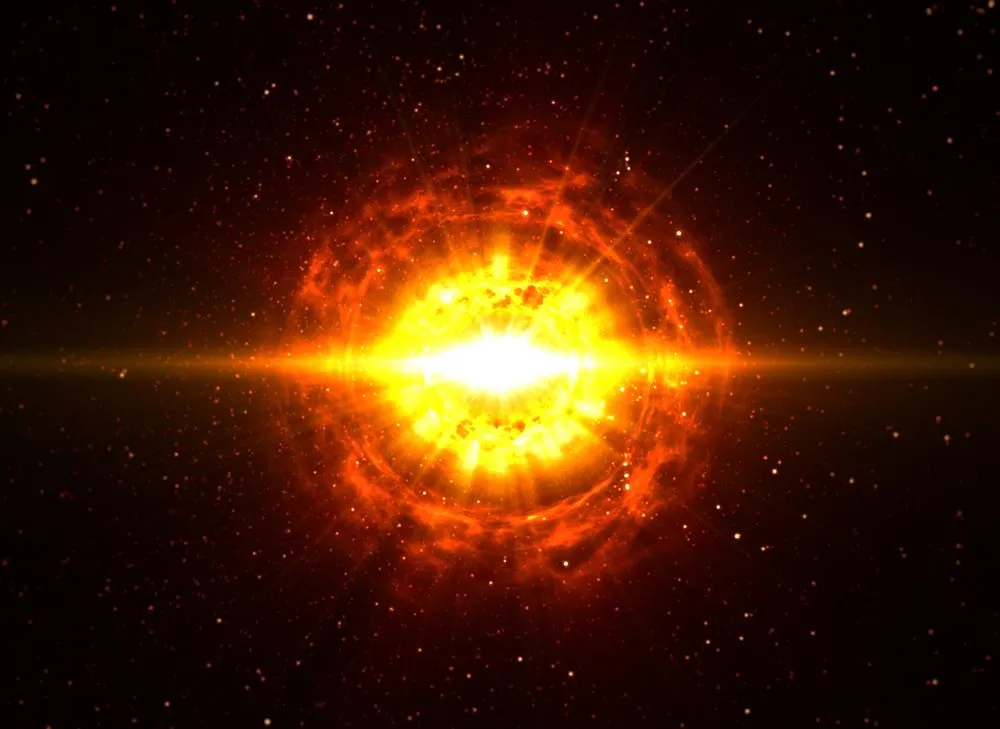
Roughly 3 to 10 million years in, the Sun went through its temperamental T Tauri phase, blasting out a fierce stellar wind. That wind did clear out leftover gas and dust from the inner solar system — but by then the rocky planets had already finished forming. The T Tauri wind is why the inner planets couldn't bulk up any more, not why they're rocky.
Do All Solar Systems Have Rocky Planets Closer To Their Stars?
So is this the pattern we see everywhere? Do other planetary systems out in the galaxy keep rocky planets close to the star and gas giants far away, the way our solar system does?
The answer is no — and surprisingly so.
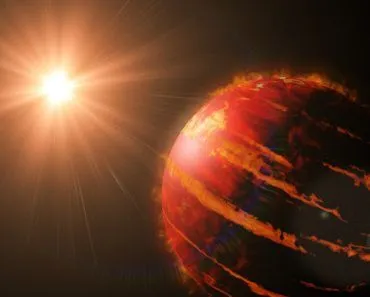
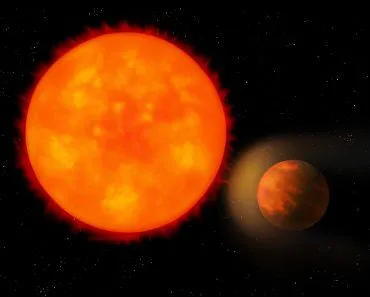
The first exoplanet ever confirmed around a Sun-like star, 51 Pegasi b (discovered in 1995), is a "hot Jupiter": a gas giant roughly half the mass of Jupiter orbiting its star in just 4.2 days, much closer than Mercury is to the Sun. Hundreds of similar hot Jupiters have since been catalogued, completely upending the assumption that giants must live far from their stars. The leading explanation is planetary migration — giants form beyond their frost line, then spiral inward through interactions with the gas disc or other planets. Jupiter itself may have wandered inward and back out in our own solar system, a scenario known as the Grand Tack.
The flip side is also out there. The famous TRAPPIST-1 system, discovered in 2017, packs seven Earth-sized rocky planets into orbits tighter than Mercury’s. So "rocky inside, gas giants outside" is not a universal law of nature — it’s just one outcome among many that the laws of planet formation can produce.
Why Does The Sun Look So Small From The Gas Giants?
Because the giants orbit so far out, the Sun shrinks to a brilliant dot in their skies. Apparent size is just a matter of distance: the further away something is, the smaller it looks, and an object's angular diameter scales as one over its distance. From Earth, at 1 astronomical unit (AU), the Sun spans about 0.5°, the same modest patch of sky as the full Moon. Move outward and that disc collapses.
Jupiter sits about 5.2 AU from the Sun, so the solar disc there is only about 0.1° across, a fifth of what we see from home. By Saturn (9.5 AU) it is down to roughly 0.056°; at Uranus (19 AU) about 0.028°; and from Neptune (30 AU) the Sun is a mere 0.018° wide, around one-thirtieth of its apparent diameter from Earth. To a Neptunian observer the Sun would look less like a disc and more like an intensely bright star.
Brightness drops even faster, as the square of distance. Out at Neptune's 30 AU the Sun delivers only about 1/900th of the sunlight that reaches Earth. That sounds feeble, yet the Sun is so luminous to begin with that high noon on Neptune is still far brighter than a moonlit night here. Distance, not any dimming of the Sun itself, is why our star looks tiny from the outer solar system.
Conclusion
The answer to why the rocky planets are closer to the Sun lies 4.6 billion years in the past, baked into the temperature gradient of the original solar nebula. Inside the frost line it was too hot for water, ammonia and methane to freeze, so only metals and silicates could clump together — and those raw materials were too scarce to build anything bigger than Earth. Beyond the frost line, abundant ices let huge cores form, gather hydrogen and helium, and balloon into the giants. The other planetary systems we’ve found tell us this arrangement isn’t inevitable — but ours produced a small, rocky Earth in the habitable zone, and that’s a stroke of luck we can be grateful for.

References (click to expand)
- The Terrestrial Planets - NASA Solar System Exploration. The National Aeronautics and Space Administration
- Gas Giant | Planet Types – Exoplanet Exploration. The National Aeronautics and Space Administration
- Why do astronomers call Uranus and Neptune ice giants?. Astronomy
- The Outer Planets: How Planets Form. The Laboratory for Atmospheric and Space Physics
- Our Solar System: Planets. NASA Science
- The Sun and Transits as Seen From the Planets. Royal Astronomical Society of Canada, Calgary Centre