A ventifact is a rock shaped, pitted, grooved or polished by wind-driven sand or ice crystals. They form in flat, arid landscapes such as deserts, where there is a steady supply of sand and persistent wind blowing from roughly the same direction. Ventifacts range from single hand-sized stones to large outcrops; a three-faced one is called a dreikanter.
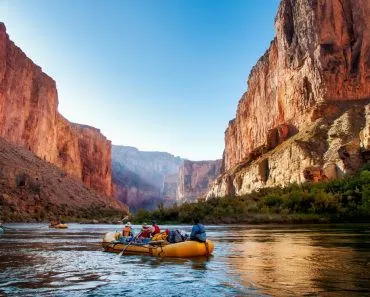
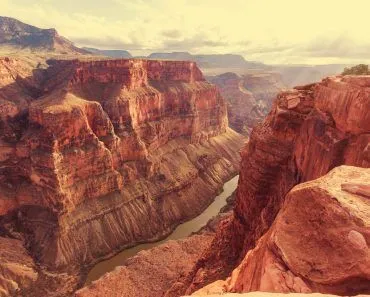
If you’ve spent a decent amount of time exploring the natural world, you understand that change takes time. Geologic scales can be hard to comprehend for humans whose lifetimes rarely exceed a single century. Imagine looking down into the Grand Canyon, which the Colorado River carved millimeter by millimeter over the last five to six million years (cutting through rock layers far older still), simply by the steady flow of water.
Yes, the natural forces of the world have changed our planet in countless ways, from earthquakes and floods that can shape the landscape overnight to the glacially slow forces that carve mountains, canyons, valleys and the topography of the ocean floor. But what about natural forces working on a much smaller scale, perhaps even on a single piece of rock?
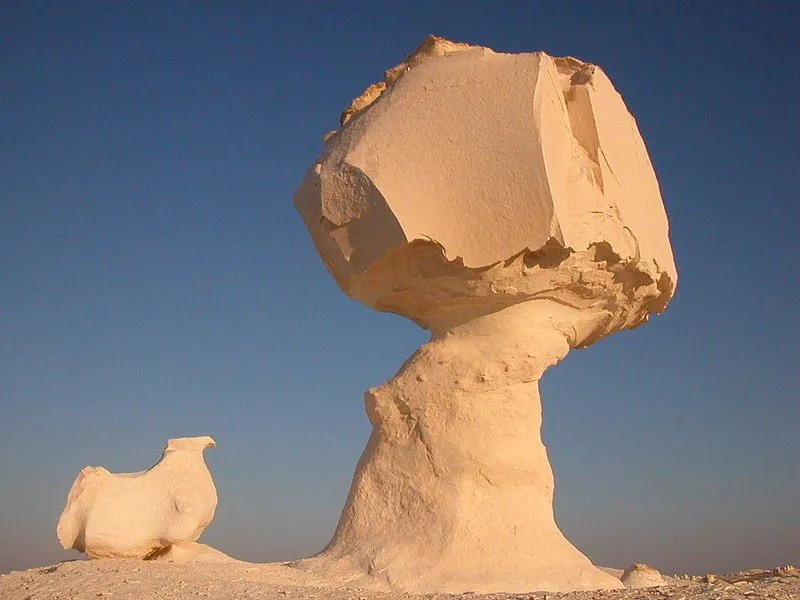
This particular natural phenomenon has stumped and mystified people around the world for generations: rock formations that appear to be carved with intention, too perfect to be shaped by anything other than humans... or perhaps aliens!
As cool as it would be to discover alien life through their aesthetic reshaping of our environment, these rock formations do have a name, ventifacts, as well as a fascinating story to tell.
What’s A Ventifact?
When simply defined, a ventifact is any piece of rock that has been shaped, pitted, grooved or striated by sand or ice crystals blown by the wind. In fact, the Latin roots of “ventifact” (ventus, wind, plus factum, something made) translate to roughly “made by wind”. Such formations, both large and small, are usually found in relatively flat or arid expanses of land, where there is a moderate amount of sand or blowing snow, but not an overabundance.
Ventifacts come in all shapes and sizes, from large rocky outcroppings that resemble mushrooms or surreal statues, to single stones you can pick up in your hand. When a stone stays in the same place for decades, centuries, or even millennia, the movement of the wind will gradually shape the various facets or sides of the rock. The most important prerequisite for the development of these rock formations is persistent wind that generally moves in the same direction, and has a ready supply of an abrasive material (i.e., sand) to carry along with it.

What many people are so mystified by about ventifacts, particularly larger formations in deserts or other barren environments, is the often “top-heavy” appearance. As the image above shows, the rock seems to be worn down more at the bottom than at the top. As mentioned above, having an adequate supply of abrasive material is essential for the formation of ventifacts, but remember, sand and ice crystals do have some weight to them. As these materials are blown across a tundra or a desert landscape, the wind will bounce them along the ground, but they aren’t perpetually swirling in the air. Most windblown sand and ice bounces along the ground in a process called saltation, which keeps the bulk of the wind’s abrasive load close to the surface. As a result, most wind erosion happens within a meter or two (roughly 3 to 7 feet) of the ground.
For rock formations that are significantly taller than that, the lower portions will be worn away sooner by the frictional forces of the sand or ice crystals, leaving the “top-heavy” appearance to these rocks.
How Does A Ventifact Form, And How Long Does It Take?
Picture a stone sitting on an exposed beach or a stretch of open desert, with the same wind hammering it day after day. Most of the carving isn’t done by fine dust, but by sand grains that are too heavy for the wind to hold aloft. Instead, these grains roll along, get a bit of lift, and hop a short distance before settling again. When one of them strikes a rock in its path, it hits hard enough to leave a minute star-shaped fracture, much like the chip a stray pebble leaves on a car windshield, and a microscopic shard of rock flakes away. After countless impacts, the side facing the wind becomes flattened, smoothed and polished.

That flattened, wind-facing surface is called a facet. Hard, fine-grained rocks such as basalt tend to develop clean, flat facets, while softer rocks such as sandstone are more likely to erode into pits, flutes and grooves. If strong winds blow from more than one direction, a stone can end up with two or three facets that meet along sharp ridges. The stone doesn’t even need to stay put. When wind eddies scour out the ground on its sheltered side, the unsupported stone can roll over and expose a fresh face to the blast, which probably explains the rare ventifacts with as many as twenty facets. Nature, it seems, occasionally dabbles in gem cutting.
So, how long does all this take? It depends on the strength and duration of the wind, the supply of sand and the hardness of the rock. In the storms of Nova Scotia, ventifacts have been known to form in only ten years, but in most climates the process probably takes millennia. In the Dry Valleys of Antarctica, where winds often exceed 100 km/h (62 mph), wind-tunnel experiments showed that ventifacts can form within a few decades or, at most, a few centuries, with yearly abrasion averaging a few millimeters. Interestingly, the same study cautioned that the importance of ice crystals as an abrasive shouldn’t be overestimated, even in that frozen landscape.
What Secrets Do Ventifacts Hold?
Aside from their somewhat mysterious appearance, ventifacts can also tell about the history of a certain area, particularly on ventifacts with more than one facet. The specificities of the process go beyond the scope of this article, but reading the striations and angles on the stone faces can give some indication of paleo-wind patterns, which provides clues to weather and climate changes in the past.
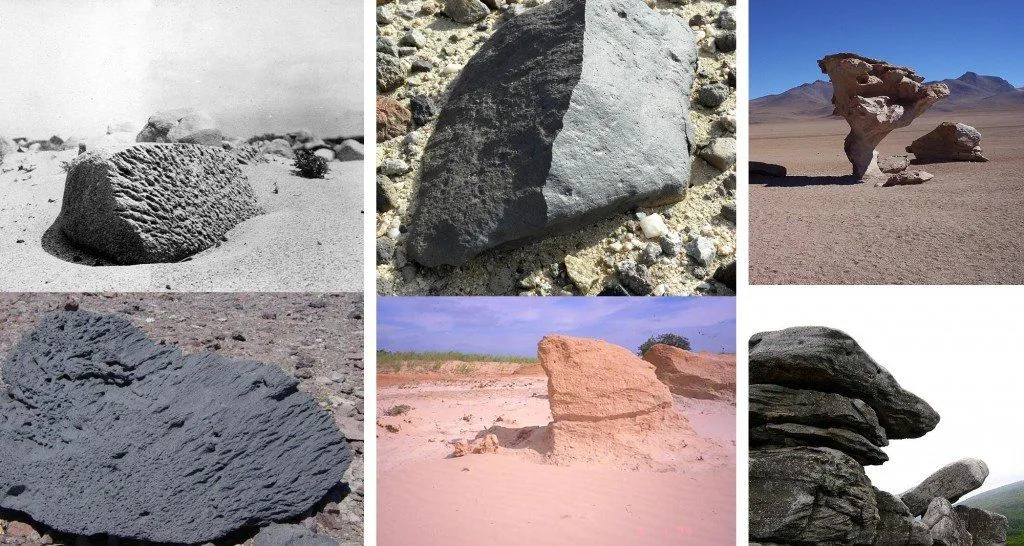
Not all ventifacts are massive rocky mushrooms or bizarre shapes on exposed hillsides; some are simply large stones partially buried in the earth, unmoved for millennia. Ventifacts are often classified by how many wind-cut faces they carry: an einkanter has one facet, a zweikanter has two, and a dreikanter (from the German drei, three, and kanter, edges) has three. Dreikanters are especially common, with three exposed sides clearly shaped by the wind while a fourth side often stays buried in the earth.
There can be different textures to ventifacts, depending on the materials involved, the severity of the wind, the duration of formation, and various other factors. When a grain of sand smashes into a softer sedimentary rock face, it forms a tiny impact crater, and will often stay there. Over time, as wind continues to blow over the facet, it begins to move the piece of sand, wiggling it in place until it begins to dig out a small hole around itself. Decades or centuries later, those minuscule impact craters will have taken on a pockmarked appearance. This can help researchers study the types of rock the sand came from, and where. Different compositions of rock tend to have different textural patterns, another interesting and aesthetically pleasing element of ventifacts. Some boast undulating patterns like a washboard, while others have long tubes or flutes carved out over centuries by a few windblown grains of sand!
At the top of this article, it was mentioned that sand isn’t the only culprit in the formation of ventifacts. We tend to picture ice as soft, melting snowflakes, so it seems an unlikely tool for carving rock. But in bitterly cold settings, around -30 to -40 °C (-22 to -40 °F), wind-driven snow and ice grains stay hard and brittle, and a strong, steady wind can drive them against exposed stone. Geologists generally treat ice as a secondary, debated abrasive compared with sand, yet in the barren reaches of Antarctica, such as the Dry Valleys of Victoria Land, whole fields of ventifacts have been found carved largely by the wind, and they help researchers study climate patterns and wind directions of the past.
Finally, ventifacts aren’t even restricted to our home planet; similarly shaped and textured rocks blanket parts of Mars, and they have posed a real threat to NASA rovers. In 2022, NASA’s Curiosity rover had to reroute around a field of jagged, wind-sharpened ventifacts (nicknamed “gator-back” rocks) to protect its already battered aluminum wheels. These facets were honed to a razor’s edge by the Martian wind over millions of years! Just like they do on Earth, these martian ventifacts act like weathervanes for past wind and weather patterns on the red planet.

How Are Ventifacts Different From Yardangs?
If you’ve studied desert landforms in a geography class, you’ve probably seen ventifacts and yardangs mentioned in the same breath. Both are products of wind erosion, and both form where strong winds blow mostly from a single direction, but they work on very different scales.
A ventifact is an individual rock or outcrop that has been cut, and sometimes polished, by wind-blown grains. Ventifacts are too small to be seen from orbit; on Mars, for example, they are best studied up close by landers and rovers. A yardang, on the other hand, is an entire landform. It is a streamlined ridge carved into soft, poorly consolidated rock or sediment, often one of many in a field of alternating ridges and furrows that run essentially parallel to the dominant wind. Yardangs can be up to tens of meters high and kilometers long. The feature was first described by the Swedish explorer Sven Hedin from Turkestan in Central Asia.

Yardangs are shaped by abrasion from wind-driven sand and dust, working alongside deflation, which is the wind’s removal of loose, fine-grained particles. Given enough time and soft enough ground, the results can be enormous. In the southern Lut desert of Iran, the wind has scoured an area of unconsolidated silt roughly 150 km by 70 km (93 by 43 miles) into long, streamlined whalebacks whose crests stand as much as 200 meters (656 feet) above the troughs between them. Closer to home for many readers, yardangs also occur in the Mojave Desert of California, and similar ridges streak parts of Mars, where criss-crossing patterns reveal that winds blew from different directions in different eras.
A handy rule of thumb? If you could pick it up (or at least walk around it in a minute), it’s probably a ventifact. If you need a map to explore it, you’re likely looking at a yardang.
A Final Word
While the scientific significance of ventifacts isn’t widely applicable to many fields, they are a spectacle to see in person, and a good reminder that our world is used to small, incremental changes. The drastic shifts currently being made to the planet, driven by mankind’s need for resources, are unlike anything we’ve ever seen before. Ventifacts serve as a testament to history, and a subtle warning for the future!
References (click to expand)
- Knight, J. (2008, January). The environmental significance of ventifacts: A critical review. Earth-Science Reviews. Elsevier BV.
- Sols 3417-3418: A View Filled With Ventifacts. NASA Science.
- Ventifacts: sandblast from the past. New Zealand Geographic.
- Ventifact | Wind-eroded, Sand-sculpted. Encyclopaedia Britannica.
- Eolian Processes. U.S. Geological Survey.
- Ventifact - Wikipedia. Wikipedia
- Yardangs and Ventifacts. Mars Education, Arizona State University.
- Yardang. Encyclopaedia Britannica.
- Twidale, C. R. (1968). Yardang. In: Geomorphology. Encyclopedia of Earth Science. Springer.
- Formation and rate of formation of ventifacts in Victoria Land, Antarctica. Polar Geography and Geology.