Table of Contents (click to expand)
Water evaporates at room temperature because of the Maxwell-Boltzmann distribution of molecular energies. Even at low average temperatures, some surface molecules have enough energy to escape into the air. Factors like humidity, wind, and surface area affect the rate of evaporation. This process also causes evaporative cooling, which is why sweating cools the body.
In school, we were taught that water changes from liquid to vapor when it boils, which requires a high temperature called the boiling point. For water, this point is 100°C at standard atmospheric pressure (it can be lower at higher altitudes).
But we have all seen that puddles evaporate when the skies clear after rain, even when the temperature is not near 100°C. This is because water can also change from liquid to vapor during evaporation, which happens at much lower temperatures.
The reason for this lies in the physical and chemical properties of water molecules and the bonds they form with each other, known as intermolecular bonds.
Water And Its Covalent Bonding
A water molecule is composed of two hydrogen atoms attached to one Oxygen atom. The sharing of electrons forms the bonds between the O and H atoms. These bonds are called covalent bonds. Every element tends to attain the energetically lowest state (i.e., the most stable state) by losing or gaining electrons to reach the nearest noble gas configuration.
Imagine a water molecule as a family, where oxygen is the parent, and the two hydrogen atoms are the children. The bond that holds the family together is like the bond between oxygen and the hydrogens, which we call covalent bonds because the atoms share their electrons, much like siblings sharing toys.
Now, let’s talk about why these elements decided to bond in the first place.
Each element wants to be in its happiest and most relaxed state. You can think of this as trying to get the perfect sleep at night. Not too little, not too much, but just right.
For elements, this perfect state is called the noble gas configuration, which is like their ultimate goal in life. They either lose or gain electrons to reach this goal, much like we lose unnecessary stress or gain more rest to reach our perfect rest.
Water is a molecule that consists of one Oxygen atom and two Hydrogen atoms. Oxygen requires two electrons to complete its outermost shell, while Hydrogen needs one. By sharing electrons, Oxygen and Hydrogen atoms can form a molecule of water, i.e., H2O.
Oxygen’s high electronegativity enables it to attract electrons towards itself, forming a partial negative charge on the Oxygen atom. Similarly, a partial positive charge develops on the Hydrogen atoms.
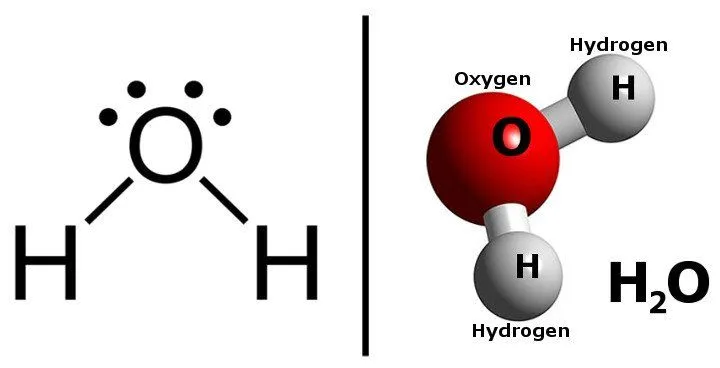
Due to the molecule’s geometry, positive and negative charges are separated between the Hydrogen and Oxygen atoms.
When two water molecules are nearby, a weak hydrogen bond can form between the partially negative Oxygen atom of one molecule and the partially positive Hydrogen atom of the other. This bond exists between two different molecules and is classified as an intermolecular bond. Hydrogen bonds are weak, requiring less energy to break, which is why water remains a liquid at room temperature.
Temperature And Molecular Energy
Temperature is a measure of the average kinetic energy possessed by a molecule. However, not all molecules in a liquid have the same energy. Their energies follow a statistical spread known as the Maxwell-Boltzmann distribution. This means that even at a relatively low average temperature, a small fraction of molecules possess kinetic energies far above the average. These high-energy molecules are the ones capable of escaping the liquid surface.
The higher the temperature, the greater the average energy, and the larger the fraction of molecules with enough energy to escape. For a liquid to change phase to vapor, two forces must be overcome.
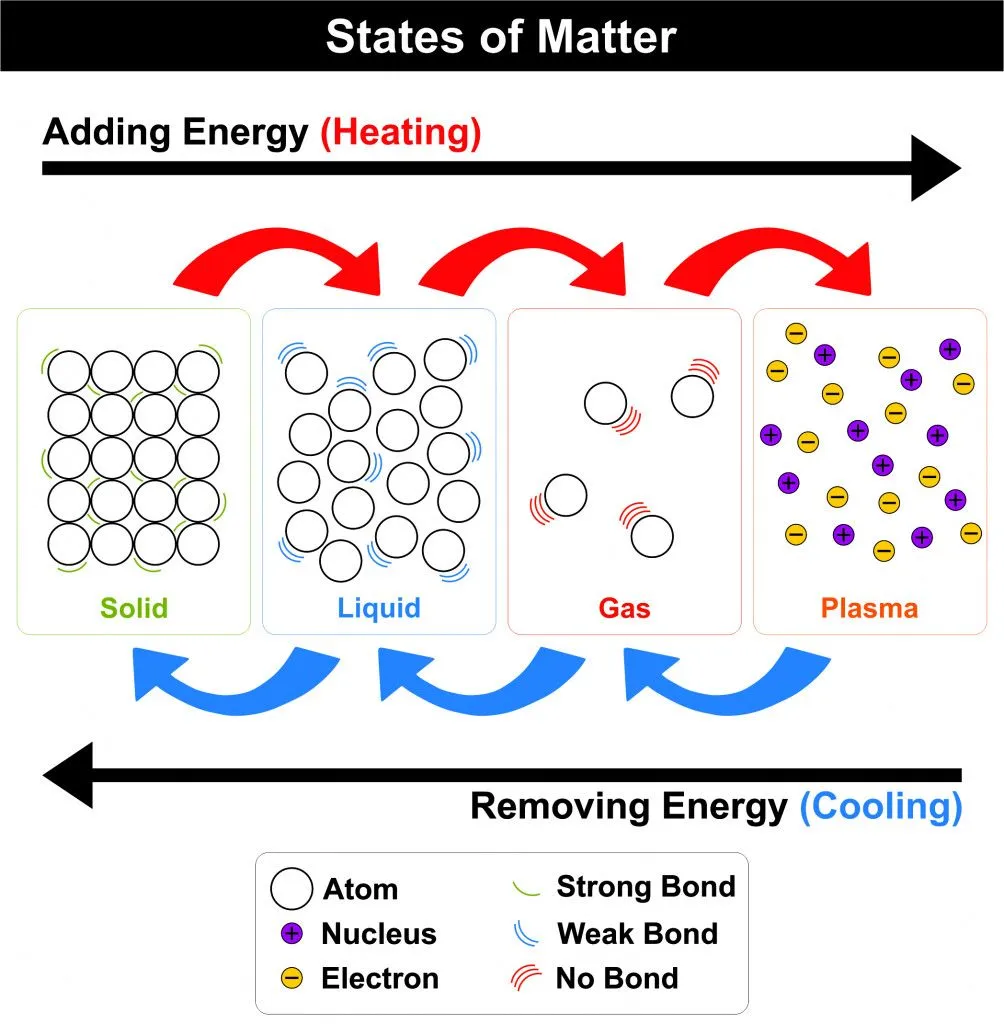
The first is the intermolecular attraction from nearby molecules, called cohesive forces. The second is the downward pressure exerted by the atmosphere. When a liquid changes phase to vapor, its molecules have acquired sufficient kinetic energy to overcome all the intermolecular forces and also overcome the downward pressure exerted by the atmosphere around it.
Humidity
The amount of water vapor present in the atmosphere is called humidity. The atmosphere can hold only a fixed amount of water vapor at any given temperature. The greater the temperature, the greater the amount of water vapor in the atmosphere. The concentration of water vapor in the atmosphere has an upper limit beyond which no water vapor can be held.
Evaporation At Room Temperature
Assume that water is spread thinly on a table.
The topmost layer of molecules experiences attractive intermolecular forces only from the bottom and sides, while those within the bulk of the liquid experience intermolecular attraction from all directions. This means that the top layer experiences less net intermolecular forces than those within the bulk.
Because of the Maxwell-Boltzmann distribution of molecular energies, some molecules at the top layer possess sufficient kinetic energy to overcome the weak intermolecular forces (hydrogen bonds) and escape into the atmosphere, even at room temperature. Sunlight and other heat sources can speed up this process, but evaporation occurs even in the dark or indoors, as long as the air is not fully saturated with water vapor.
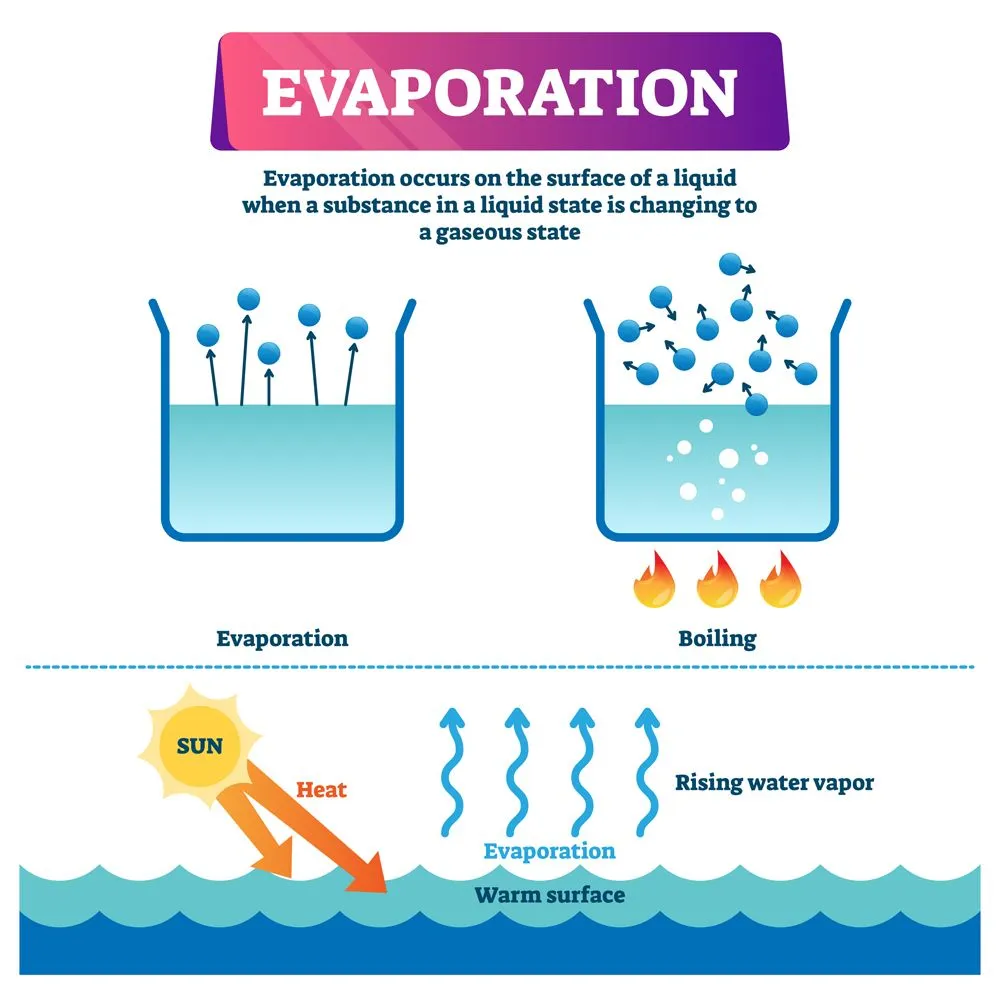
Lower humidity makes it easier for the liquid to evaporate. As evaporation continues, the concentration of water vapor in the atmosphere increases. When the atmosphere reaches a critical threshold, no more water vapor can be held and becomes saturated. Evaporation continues if the saturation state hasn’t been reached.
Wind also plays an important role. Air movement carries away water vapor from above the liquid surface, preventing the air from becoming saturated and allowing evaporation to continue. Similarly, a larger surface area exposes more molecules to the air, increasing the rate of evaporation.
When the fastest molecules escape the liquid, they carry away more than their share of kinetic energy. This lowers the average energy of the remaining molecules, causing the liquid to cool down. This phenomenon is called evaporative cooling and is the reason why sweating cools your body and why you feel cold when stepping out of a swimming pool.
Therefore, a combination of the Maxwell-Boltzmann distribution of molecular energies, humidity, wind, and surface area determines how quickly water evaporates at any given temperature.
What Temperature Does Water Evaporate At?
Here is the part that trips most people up: there is no single magic number. Boiling has a fixed temperature (100°C, or 212°F, at sea level), but evaporation does not. Liquid water evaporates at every temperature above its freezing point, and even solid ice slowly turns straight to vapor through a process called sublimation. A glass of water left out at 20°C (68°F) will eventually empty itself, and so will a puddle on a near-freezing morning, only more slowly.

The quantity that really controls the show is vapor pressure, the pressure the escaping molecules exert as they push into the air above the liquid. The warmer the water, the higher its vapor pressure: about 2.3 kPa (17.5 mmHg) at 20°C (68°F), roughly 3.2 kPa (23.8 mmHg) at 25°C (77°F), and a full 101.3 kPa (760 mmHg) at 100°C (212°F). As long as that vapor pressure is higher than the partial pressure of water vapor already in the surrounding air, molecules keep leaving. Evaporation only stops when the air is fully saturated.
Boiling, then, is just the special case where the vapor pressure finally catches up with the atmospheric pressure pressing down on the liquid, so vapor bubbles can form throughout the water rather than only escaping from the surface. So the honest answer to "what temperature does water evaporate at?" is: pretty much any temperature, and faster the warmer it gets. That is also why water can boil at a lower temperature on a mountain, where the atmospheric pressure to overcome is smaller.
So Is The Water Vapor Around You Actually Hotter Than 100°C?
We already saw why a puddle can shed molecules well below 100°C (212°F): a lucky few sit on the hot tail of the Maxwell-Boltzmann distribution, carrying enough kinetic energy to break free of their neighbors' hydrogen bonds. That raises an odd question. If escaping a room-temperature puddle takes boiling-level energy, is the water vapor floating around your kitchen secretly scorching hot?
No, and the reason is timing. That escaping molecule really does carry above-average kinetic energy for the instant it tears free of the liquid surface. But the moment it is airborne, it is not alone. Air at room temperature and normal atmospheric pressure is a shooting gallery: a typical molecule travels only about 10-7 meters (roughly 100 nanometers) before it hits a neighbor, and gets struck again roughly every 10-10 seconds, on the order of ten billion collisions per second. Each collision redistributes kinetic energy a little differently, and within a few nanoseconds the newcomer's extra energy has been passed along, diluted, and shared across billions of ordinary air molecules already moving at everyday speeds.
That is really the whole answer: temperature is not a property any single molecule can have. It is a statistical description of how energy is spread across an enormous population of molecules once they have had time to collide and settle into equilibrium. "How fast was this one molecule moving the instant it left the puddle" and "what temperature is the air in this room" are two different questions, measured on two very different scales, one particle versus trillions of them. Because those collisions happen so fast, the water vapor drifting past your face reads exactly the same temperature as the room on any thermometer you point at it.
More precisely, molecular dynamics research by Nagata, Usui, and Bonn found that a lone molecule rarely escapes on its own energy alone. The exit is usually a coordinated recoil among three or more hydrogen-bonded water molecules at the surface, timed so that the recoil flings just one of them free. Either way, whatever extra energy leaves with it is smoothed away within nanoseconds, long before it could ever register as a temperature.
Is Evaporation A Physical Or Chemical Change?
Evaporation is a physical change, not a chemical one. When a puddle dries or a kettle steams, the water molecules themselves are not rearranged or destroyed. Each H2O molecule that leaves the surface is exactly the same H2O molecule it was before; only its physical state has changed, from a tightly packed liquid to a free-roaming gas.
The acid test for a chemical change is whether a brand-new substance with different properties has been created. Burning wood is chemical: you cannot easily turn the ash and smoke back into a log. Evaporation fails that test in both directions. No new substance forms, and the change is completely reversible. Cool that water vapor down again and the molecules slow, the hydrogen bonds re-form, and you are back to ordinary liquid water through condensation. Breaking those weak intermolecular hydrogen bonds takes energy, but it does not break the strong covalent bonds inside each molecule, which is exactly why the substance survives the journey unchanged. The same logic applies whether the water is evaporating from a puddle, a lake, or a damp towel.
Where Does The Water Go After It Evaporates?
The escaped molecules do not simply vanish; they join the air as invisible water vapor and become part of the planet's vast water cycle. Because warm air rises, this vapor drifts upward, and as it climbs into cooler altitudes the molecules lose energy, slow down, and condense onto tiny dust and salt particles. Billions of those droplets together are what we see as clouds. When the droplets grow heavy enough, they fall back to Earth as rain, snow, or hail, completing the loop.

The scale of this is enormous. According to the U.S. Geological Survey, about 90% of the moisture in the atmosphere comes from water evaporating off oceans, seas, lakes, and rivers, with most of the rest released by plants through transpiration. The oceans do most of the heavy lifting, since they cover more than 70% of Earth's surface. Interestingly, only around 10% of the water that evaporates from the oceans is carried over land and falls there as precipitation; the rest rains straight back down onto the sea. So the water drying off your driveway is not gone at all. It is briefly on loan to the sky before returning somewhere else as rain. Once it does fall, surplus rainfall that does not soak into the ground or evaporate again becomes part of the humidity and surface flow that keep the cycle turning.
Last Updated By: Abhishek Jain
References (click to expand)
- Macleod, D. B. (1925). The kinetic theory of evaporation. Transactions of the Faraday Society. Royal Society of Chemistry (RSC).
- Allen, L. C. (1994, January 20). Chemistry and electronegativity. International Journal of Quantum Chemistry. Wiley.
- Saturated Vapor Pressure.
- 7.3: Hydrogen-Bonding and Water.
- electronegativity.
- Kinetic Temperature, Thermal Energy.
- Vapor Pressure. Chemistry LibreTexts.
- Evaporation and the Water Cycle. U.S. Geological Survey.
- The Atmosphere and the Water Cycle. U.S. Geological Survey.
- 2.13: Water - Heat of Vaporization. Biology LibreTexts.
- Vapour pressure of water. Wikipedia.
- Mean Free Path and Collision Time. Boston University Physics 211 course notes.
- Gas Temperature. NASA Glenn Research Center, Beginner's Guide to Aeronautics.
- Nagata, Y., Usui, K., Bonn, M. (2015). Molecular Mechanism of Water Evaporation. Physical Review Letters.