Three seminal experiments proved, without doubt, that DNA was the genetic material, and not proteins. These experiments were the Griffith experiment, Avery, MacLeod, and McCarty Experiment, and finally the Hershey-Chase Experiment.
DNA is the fundamental component of our being. The human body is merely the carrier for this genetic material, passing it down from generation to generation. Our purpose is to ensure the survival of the species. Humans are to DNA like a fruit is to a seed. We are just an outer covering to ensure the safe passage and protection of the source code of our existence through time. Makes you feel pretty useless, doesn’t it?
However, that’s not what I want you to focus on. The main focus is, how did we discover that DNA is the carrier of information? How did we determine that it wasn’t something else, like proteins? After all, proteins are also present in every cell.
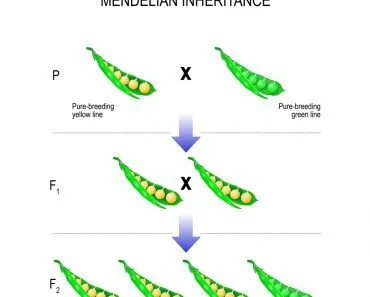
For a long time this debate had been going on. Even after Gregor Mendel formed the 3 laws of inheritance, it wasn’t widely recognized by the scientific community for over 30 years. The reason? There was no concept of DNA or genes being the information carriers! The whole debate was finally put to rest by 3 main experiments carried out by independent researchers, which formed the basis of all our evolutionary and molecular biology studies.
Griffith Experiment
The first step was taken by Frederick Griffith in the year 1928. He was a bacteriologist who focused on epidemiology. Griffith was studying how Streptococcus pneumoniae caused an infection. He was working with 2 strains of the bacteria called the S and R strains. S strain organisms, when cultured in the lab, gave rise to bacterial colonies with a smooth appearance. This was due to a shiny, polysaccharide coat, which is supposed to be their virulence factor. A virulence factor is any quality or factor of a pathogen that helps it in achieving its goal – causing a disease! The other strain was the R strain. This strain gave rise to colonies that didn’t possess the polysaccharide coat, and therefore had a ‘rough’ appearance. Therefore, the S strain was virulent and the R strain was avirulent.
Griffith took 4 mice and injected them with different solutions. The first one was injected with the S strain organisms; the second one was injected with the R strain organisms; the third mouse was injected with heat-killed S strain organisms; and the last one was injected with a mixture of heat-killed S strain and live R strain organisms. The result? The first and fourth mice died due to the infection, while the second and third mice survived. When he extracted the infectious agent from the dead mice, in both cases, he found S strain organisms.
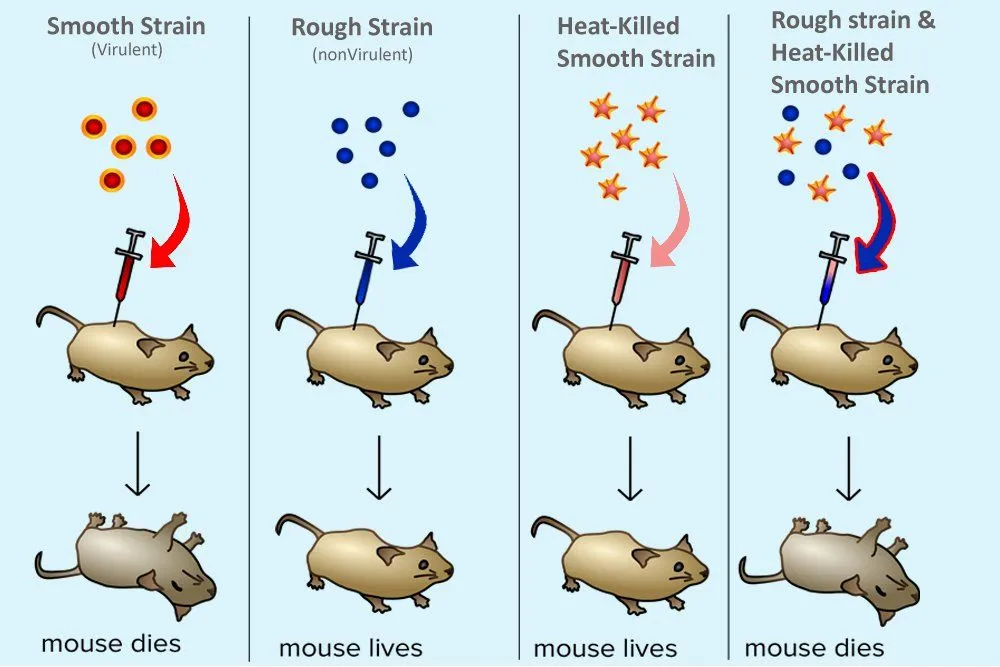
Let’s break it down. The first 2 mice showed that S strain is the virulent strain, while the R strain is avirulent. The third mouse proved that heat-killed S strain organisms cannot cause an infection. Now here is where it gets interesting. The death of the 4th mouse, and the retrieval of live S strain organisms showed that, somehow, the heat-killed S strain organisms had caused the transformation of live R strain organisms to live S strain organisms.
This was called the transformation experiment…not particularly creative in the naming department.
Why Did Scientists Bet On Proteins, Not DNA?
Here is something that trips up a lot of people: for the first half of the 20th century, most biologists were convinced that proteins, not DNA, carried our genetic instructions. Chromosomes are made of both, so why back the wrong horse? The answer comes down to apparent complexity. Proteins are assembled from 20 different amino acids, which can be strung together in a staggering number of combinations. That richness made proteins look like the obvious candidate for storing the enormous variety of information a living thing needs.

DNA, by contrast, looked hopelessly dull. The biochemist Phoebus Levene had shown that DNA was built from just four bases (adenine, thymine, guanine and cytosine), and his measurements suggested those four appeared in roughly equal amounts. This led to the tetranucleotide hypothesis: the idea that DNA was a monotonous chain repeating the same four-nucleotide block over and over. A molecule that simple, the thinking went, could never spell out the specificity of life. So researchers largely set DNA aside and chased proteins instead. The tetranucleotide picture was eventually shown to be wrong, but it shaped the field for decades and is exactly why the experiments that follow were such a shock.
Avery, Macleod And McCarty Experiment
While Griffith’s experiment had provided a surprising result, it wasn’t clear as to what component of the dead S strain bacteria were responsible for the transformation. 16 years later, in 1944, Oswald Avery, Colin Macleod and Maclyn McCarty solved this puzzle.
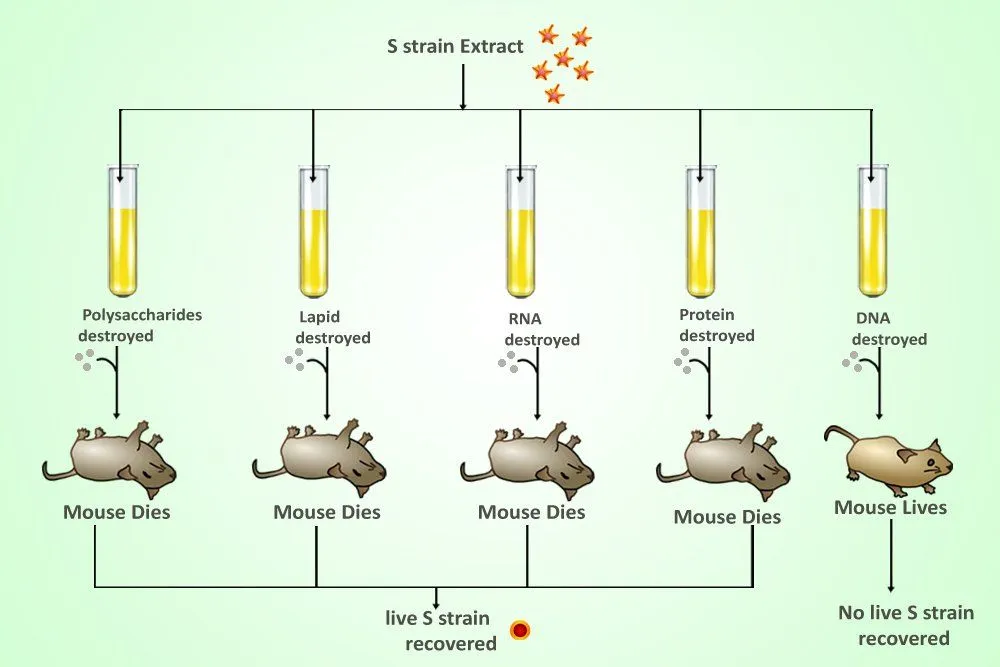
They first extracted and purified the transforming substance from heat-killed S strain bacteria, removing proteins with chloroform and destroying the polysaccharide capsule with enzymes. They then tested the purified extract by treating separate samples with different enzymes: proteases (which destroy proteins), lipase (which destroys lipids), ribonuclease (which destroys RNA), and deoxyribonuclease (which destroys DNA). Each treated sample was then mixed with live R strain bacteria to see if transformation still occurred.
When the extract was treated with proteases, lipase, or ribonuclease, transformation still took place — R strain bacteria were converted into S strain bacteria. However, when the extract was treated with deoxyribonuclease, transformation was completely abolished. This experiment clearly proved that DNA was the transforming principle. When the DNA was destroyed, the extract lost its ability to transform R strain bacteria into S strain ones. Although the polysaccharide coat was a virulence factor, it wasn’t responsible for the transfer of the genetic material.
Why Wasn't Avery's Discovery Immediately Accepted?
You might expect a result this clean to settle the matter overnight. It didn't. Oswald Avery's 1944 paper drew surprisingly modest attention at first, and a stubborn knot of skeptics held out for nearly a decade. Why the resistance?

The loudest objection was about purity. Critics, most prominently Avery's own Rockefeller Institute colleague Alfred Mirsky, argued that the DNA preparation might still carry trace amounts of protein, and that this leftover protein, not the DNA, could be the true transforming agent. Avery himself was famously cautious and acknowledged in the paper that he could not completely rule out some other substance.
Two deeper biases were also at work. Many biologists still clung to the idea that DNA was simply too structurally monotonous to encode the specificity of heredity, so they doubted it on principle. And because bacterial transformation had been shown only in pneumococcus, and not in plants or animals, some dismissed it as a quirk of one microbe rather than a universal rule. That lingering doubt is precisely why a more decisive experiment was still needed, which is where Hershey and Chase come in.
Hershey And Chase Experiment
Even after the compelling evidence provided by the Avery, Macleod and McCarty experiment, there were still a few skeptics out there who weren’t convinced. The debate still raged between proteins and DNA. However, the Hershey – Chase experiment permanently put an end to this long-standing debate.
Alfred Hershey and Martha Chase in 1952, performed an experiment that proved, without a doubt, that DNA was the carrier of information. For their experiment, they employed the use of the bacteriophage T2. A bacteriophage is a virus that only infects bacteria. This particular virus infects Escherichia coli. T2 had a simple structure that consisted of just 2 components – an outer protein casing and the inner DNA. Hershey and Chase took 2 different samples of T2. They grew one sample with 32P, which is the radioactive isotope of phosphorus, and the other sample was grown with 35S, the radioactive isotope of sulphur!
The protein coat has sulphur and no phosphorus, while the DNA material has phosphorus but no sulphur. Thus, the 2 samples were labelled with 2 different radioactive isotopes.
The viruses were then allowed to infect the E. coli. Once the infection was done, the experimental solution was subjected to blending and centrifugation. The former removed the ghost shells, or empty shells of the virus from the body of the bacteria. The latter separated the bacteria from everything else. The bacterial solution and the supernatant were then checked for their radioactivity.
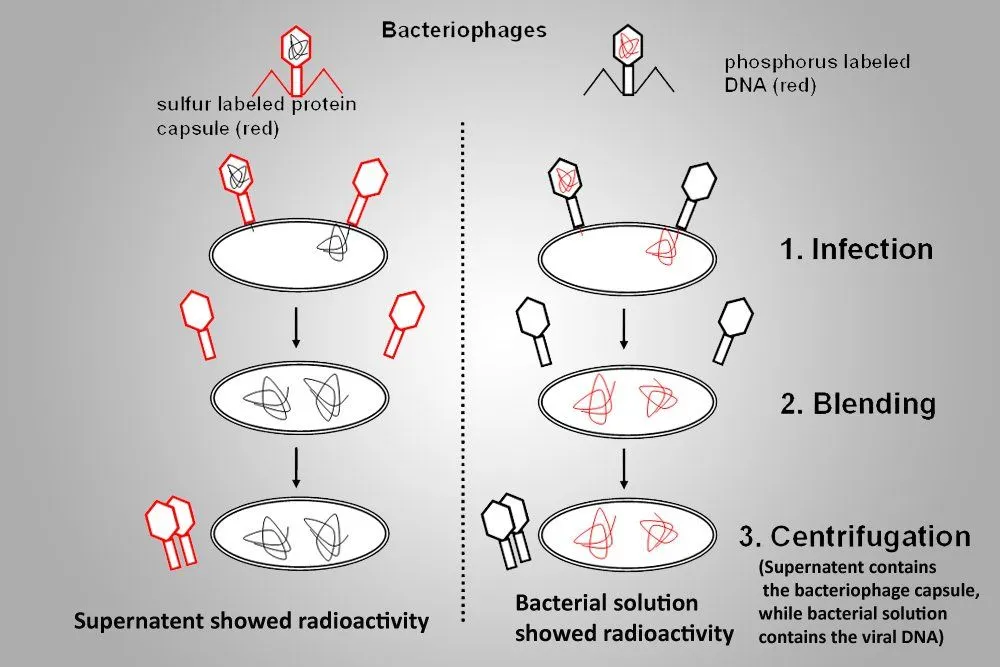
In the first sample, where 32P was used, the bacterial solution showed radioactivity, whereas the supernatant barely had any radioactivity. In the sample where 35S was used, the bacterial solution didn’t show any radioactivity, but the supernatant did.
This experiment clearly showed that DNA was transferred from the phage to the bacteria, thus establishing its place as the fundamental carrier of genetic information.
Until the final experiment performed by Hershey and Chase, DNA was thought to be a rather simple and boring molecule. It wasn’t considered structured enough to perform such a complicated and extremely important function. However, after this experiment, scientists started paying much more attention to DNA, leading us to where we are in research today!
References (click to expand)
- How was DNA shown to be the genetic material?. The University of Texas at Austin
- The Genetic Material - DNA - CSUN. California State University, Northridge
- Home - Books - NCBI. National Center for Biotechnology Information
- 1944: DNA is "Transforming Principle". National Human Genome Research Institute
- Studies on the Chemical Nature of the Substance Inducing Transformation of Pneumococcal Types (1944). Embryo Project Encyclopedia, Arizona State University
- The "scientific catastrophe" in nucleic acids research that boosted molecular biology. PMC, National Library of Medicine