Table of Contents (click to expand)
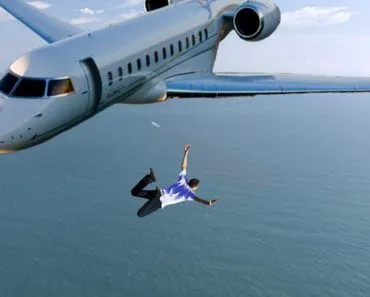
Not quite like Batman, but close. Wingsuit flying lets you glide through the air in a webbed suit that generates lift and cuts drag, steering by tilting your body like a bird’s wing. A modern suit reaches a glide ratio near 3:1. Landing is the catch: you normally deploy a parachute, because hitting the ground at gliding speed would be fatal.
“The Batman”… those two words are enough to send most guys into daydream mode. The emotion that this superhero invokes in a person is almost inexplicable, but his cultural significance is undeniable. The character’s complexity excites us, his darkness touches a darkness within us and inspires us to seek justice in our own world. There seems to be no other symbol that is more alluring than the Bat Signal. (Even while writing this article, I must have slipped into comic book daydreams a dozen times or so.)
Then, there is the other side to The Batman – the high-end tech addict and gadget-loving billionaire behind the mask. The grappling gun, his utility belt, the Batmobile, the Batwing… these are on every Batman fan’s wish list. Every Batman worshiper’s dream is to be able to spread their cape behind them and glide. If that’s one of your deepest desires, then perhaps wingsuit flying is the kind of adventure sport you’re looking for.
What Is Wingsuit Flying?
Wingsuit flying is a combination of two adventure sports: skydiving and hang gliding. A person jumps from an aircraft or from a very high altitude and glides through the air. The diver has to wear specially designed attire called a Wingsuit. The suit has webbed wing surfaces, which are present between the legs, the arms, and the body in order to increase the surface area. This fabric surface area generates enough upward force to prevent the diver from free falling.
With the help of the suit, a wingsuit diver can reduce the speed at which they fall, while increasing his or her horizontal speed. The suit is essentially inflated by the air through which it is moving with the help of small inlets. This helps the suit maintain a rigid structure. Therefore, the divers can rest their limbs and the suits will remain outstretched at all times during the dive. Current wingsuits have parachutes that are on the back: the regular chute and the reserve chute. This sport also requires a diver to deploy their parachute at the optimum altitude to land safely. A typical wingsuit flyer descends at around 65 to 100 km/h (40 to 60 mph), while moving forward through the air much faster, at roughly 160 to 200 km/h (100 to 125 mph). Modern suits achieve a glide ratio of about 2.5:1 to 3:1, meaning that for every meter dropped, the flyer travels two and a half to three meters forward.
They are also nicknamed ‘flying squirrel suits’, and the comparison is apt: certain squirrels really do glide between trees using a stretched flap of skin called a patagium.
How Do You Control Movement During Flight?
To understand how to maneuver a proximity flying suit, we have to understand the basics of Flight Physics.
-
Climb and Descent in Wingsuits
Consider any body that is moving through the air. There will be four major forces acting on a body during flight. The horizontal forces are called Thrust and Drag. Thrust is defined as the force resulting from the forward movement of a body. Its opposite component is called Drag, which is an opposing force generated by the medium through which the body is moving. To put in simpler words, the reason why your hand gets pushed back when you stick it outside of a moving car is due to the air resistance (Drag).
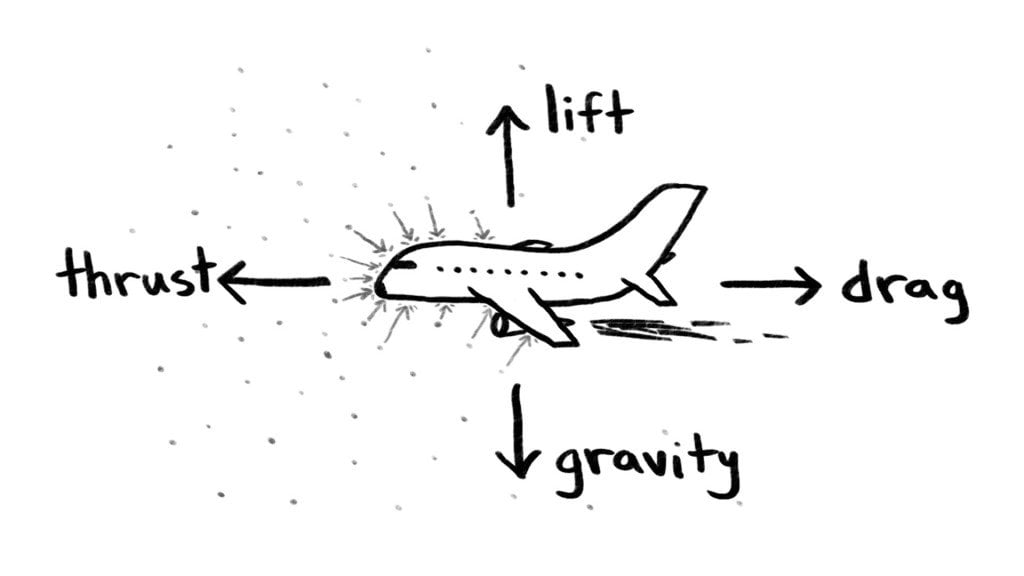
(source: viralportal.net)
The vertical forces that act on the body are Lift and Gravity. Lift is the force acting on a body that results in the body moving up, which is typically caused by wing-like components. Gravity is the force of attraction towards the earth. The total force is the weight of the body, which is the product of mass and gravity (W=mg). Consider an airplane taking off… the combination of forces, specifically Lift (generated by the wings) and Thrust (from the engines), helps move the aircraft along the runway and then ascend. A rocket lifting off vertically is a different case: there are no wings generating Lift, so it relies almost entirely on Thrust overcoming Gravity to climb in a straight line. Therefore, the balance of these four forces determines how a body moves through the air.

(source: natgeotv.com)
In the case of proximity flying, the suit’s aim is to generate a certain amount of Lift, thus reducing the rate at which the diver falls. The required path of flight for the diver is the blue arrow on the image. The shape of the suit, after inflating, helps to reduce the drag of the diver.
-
Turning in Wingsuits
Now, let’s look at how a body turns in midair. As kids, when we were running around the ground pretending to fly, every time we made a turn, we would show this by tilting our arms. Of course, we were trying to copy the movement of birds or planes, but why do we do that? To understand this, we’ll consider the example of a bird.

(source : leospek/ shutterstock.com)
When the bird banks (rolls) its wings into a turn, it tilts the lift force, which always acts roughly perpendicular to the wings, off the vertical. That tilt splits the lift into two components: a vertical part that still holds the bird up, and a horizontal part that points toward the inside of the turn. This sideways component is the centripetal force, the inward force that pushes a body along a circular path, and it is what swings the bird around.
A wingsuit flyer steers the same way, by tilting the body like a bird’s wing. Rolling to one side directs part of the lift sideways, and that sideways force pushes the flyer into a turn. The steeper the bank, the sharper the turn.
Can We Land Like The Batman?
One major flaw in the quest to glide like Batman appears during the landing phase. Researchers have discovered that even though we might be able to glide like Batman, landing will be a major problem. The force that would be exerted on a body while landing is fatal. In other words, if there was a real Batman, he wouldn’t be able to land as we see him do in movies or games. Robin’s got a point… However, that issue was not going to stop enthusiasts in the real world from coming up with a solution. The force at which the diver lands is a problem, so we have to provide enough cushion to absorb that force.
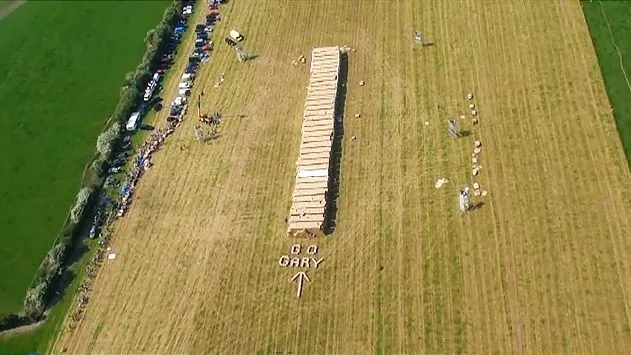
Despite the dangers, one man has actually pulled it off. In May 2012, British stuntman Gary Connery became the first person to land a wingsuit without deploying a parachute. He jumped from a helicopter at about 730 meters (2,400 feet) near Henley-on-Thames in England and glided down onto a 110-meter (350-foot) runway built from roughly 18,500 cardboard boxes, which crumpled and absorbed the impact. (A separate viral clip of a flyer named Rafael Dumont supposedly landing on Italy’s Lake Garda without a chute also made the rounds, but its authenticity has been widely questioned.) The trick to any such landing is to come in at a very shallow angle, much like an aircraft on approach, so that the impact is spread out rather than absorbed all at once.
Although we still can’t glide from building-to-building, burst through windows, or safely land on the tops of cars, we can definitely soar through the skies like “The Dark Knight”!