You feel lighter in water because buoyancy pushes up against gravity, cutting your apparent weight. Gravity still works underwater, and water can support over 90% of you.
Have you ever been completely submerged in a fluid? If you are someone who enjoys swimming, that answer should be obvious. Curiously, there are some who claim to have never had such experiences. They’re wrong… but we’ll get to that a bit later.
However, it is a common observation that objects feel lighter in water. If you’re unfamiliar with the feeling, immerse your hand in a pail of water and feel it for yourself.

What Do You Mean By Weight?
Weight is not just the number on a scale; it is a measure of how strongly gravity attracts mass. In physics, weight is written as W = mg, where m is the object's mass (in kilograms) and g is the acceleration due to gravity (about 9.8 m/s2 at Earth's surface). Mass stays the same wherever you go, but weight depends on g, so it changes when gravity changes.
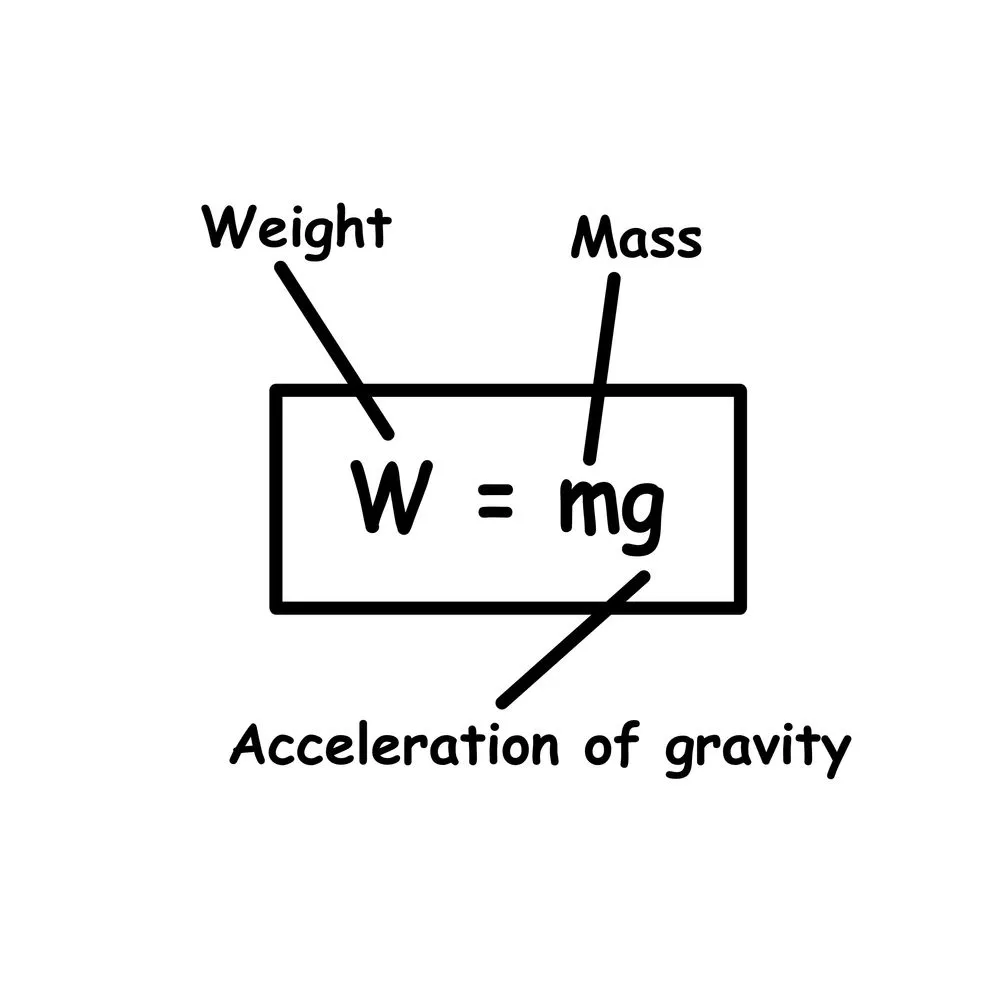
We’ve all seen films of people on the moon jumping high off the ground or effortlessly kicking large rocks. This clearly indicates that the value of weight can change, even when mass remains constant. Here, the value of the gravitational constant changes, so the body’s weight changes.
However, we’re not talking about swimming on the moon. We don’t feel lighter in water for the same reasons that we would feel lighter on the moon.
There is a force acting against gravity when a body is submerged in water, which is what makes us feel lighter. The buoyant force is this upward force that acts against gravity.
Regardless of how familiar you are with buoyant force, you may have heard the story of the scientist sprinting naked down the streets of Greece yelling, “Eureka!” At the center of the story is a scientific principle known as Archimedes’ principle.
Story Of Archimedes’ Principle
The origins of Archimedes’ principle lie in the story of an ancient ruler who commissioned a golden crown from his goldsmith. The goldsmith made the crown, as his king ordered, but the king was suspicious about the purity of the gold used in the crown. There were no methods to verify such purity at the time.
Thus, the king tasked local scientist Archimedes with solving the problem without damaging the crown.

Archimedes decided to deliberate on the issue, but later, when he went to take a bath, he noticed that when he entered the tub, water spilled out. The amount of this water seemed to be proportional to his submerged volume.
The scientist figured that he could use this knowledge to compare the crown to an amount of gold of the same weight. Hence, he could find out if the gold was truly pure.
As the story goes, he was so overwhelmed by his own revelation that he raced naked through the streets to the king, screaming “Eureka!” We don’t know how factual that story is, but the principle still stands.

Buoyancy And Apparent Weight
Archimedes’ principle states that the upward buoyant force exerted on a partially or fully submerged body is equal to the weight of the fluid displaced by the body. Mathematically, this is the product of density, the volume of the displaced fluid, and the value of the gravitational constant.
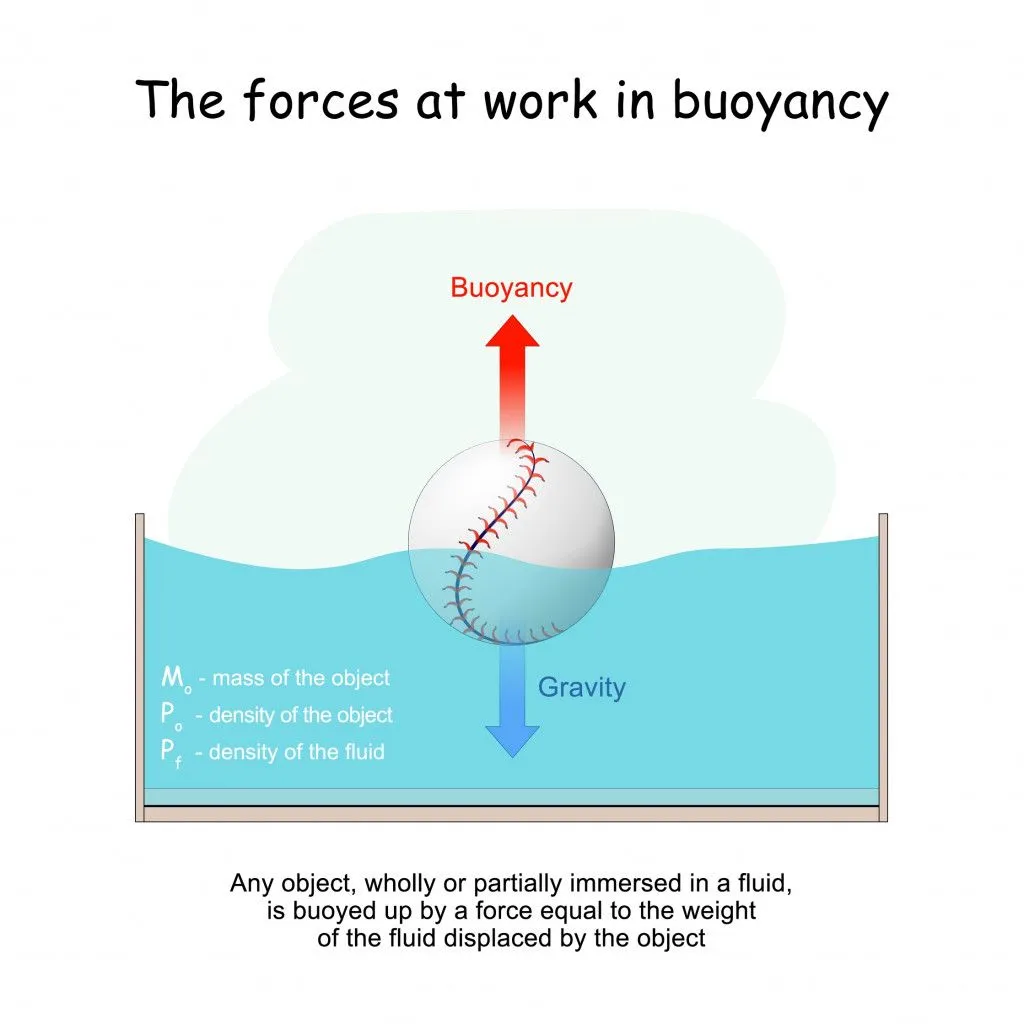
However, there is one more question remaining… why is there an upward force at all? What causes it?
To understand that, let’s delve into a bit of fluid statics. The pressure in a fluid varies linearly with depth. This means that the pressure force acting on top of a submerged body is actually less than the pressure force acting at bottom of the body. The forces are thus unbalanced, and we get a net force acting upward.
Apparent Weight
Now, we have presented sufficient theorems, equations, and even bawdy stories to comprehend our original dilemma. When a body is submerged in a fluid, the buoyant force acts in the direction opposite to the weight. What we feel is the resultant of these two forces, which is buoyant force subtracted from the actual weight, equaling the apparent weight.
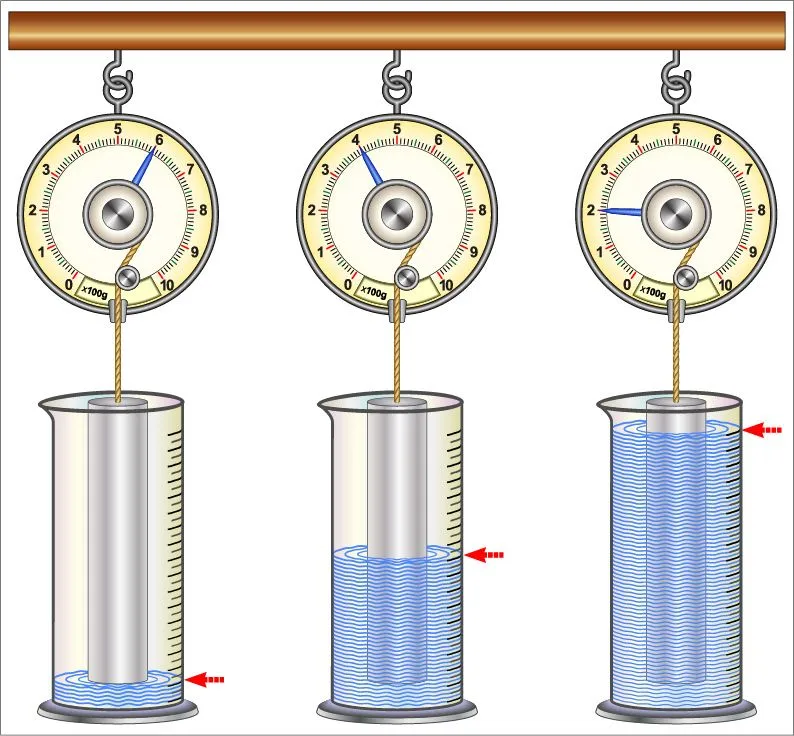
The concept of apparent weight gets even more interesting if you think of yourself as already drowned in an ocean of air (which is also a fluid). The weight you feel every minute is also apparent weight. Now you know the answer if anyone asks whether you’ve been completely submerged in a fluid.
Buoyancy is also the reason why things float on water. This is how we can get on boats and travel safely across the sea.
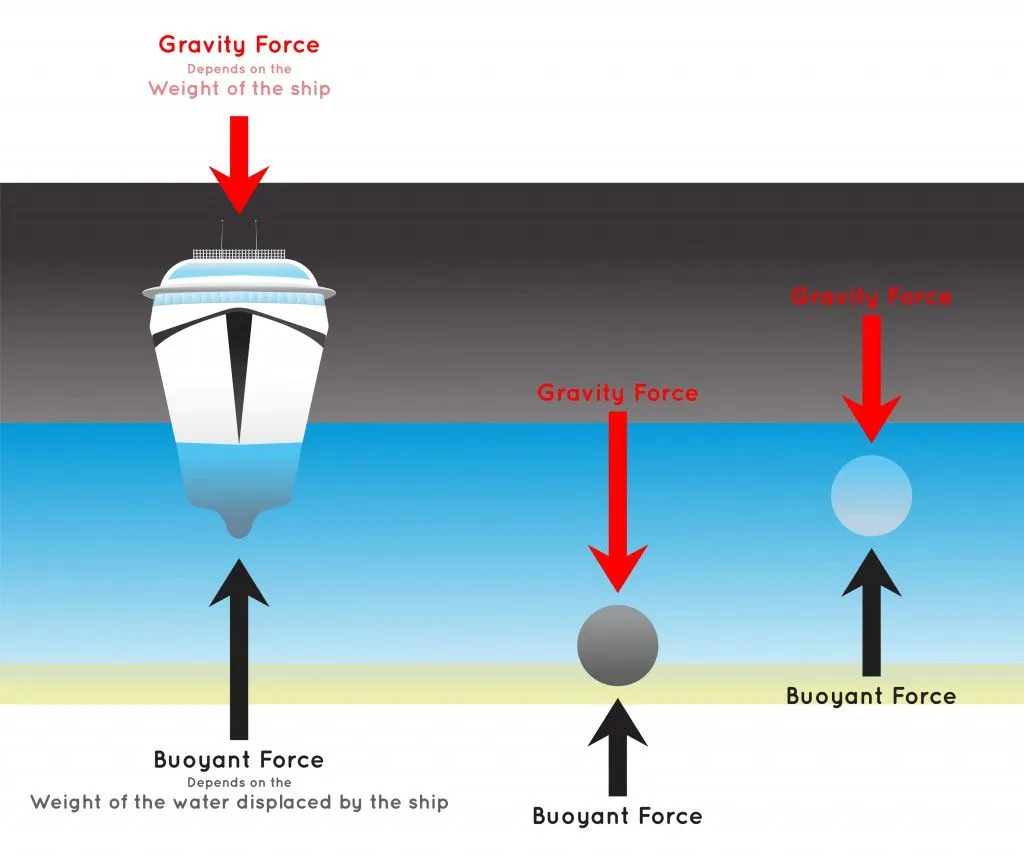
Another fascinating point to note is that buoyancy force varies with density. In fluids like mercury, things will behave even lighter than in water. You can also go for an eye-popping ride in a hot air balloon thanks to buoyant force.

Try playing around with this interesting simulation that displays how different factors affect the buoyancy and apparent weight of a submerged body.
Is There Still Gravity Underwater?
Here is a point that trips up a lot of people: gravity does not switch off when you dip below the surface. The water you wade into is still sitting on the same planet you are, so the same gravitational pull keeps acting on every part of your body. Your true weight (W = mg) is unchanged. What changes is the apparent weight you feel, because buoyancy now pushes upward and cancels part of that pull. Gravity is still doing all of its usual work; it simply has company.

NASA actually leans on this fact every day. Astronauts rehearse spacewalks in a giant pool called the Neutral Buoyancy Laboratory in Houston, where their gear is carefully weighted so the buoyant force almost exactly matches their weight. The result feels remarkably like the floating of orbit, yet gravity inside that pool is completely normal. The sensation of weightlessness comes from balancing forces, not from removing gravity. This is the same reason a brick sinks while a beach ball bobs to the top: gravity pulls both downward identically, but buoyancy depends on how much water each one shoves aside.
So if you have ever wondered whether things still fall underwater, they do. Drop a coin in a pool and it heads straight for the bottom, because for a dense object gravity wins the tug-of-war against buoyancy. Gravity behaves nothing like it does in the apparent weightlessness of orbit, where there genuinely is very little to push back against your body.
How Much Lighter Are You In Water?
By how much does the water actually lighten you? Archimedes' principle gives a clean answer: the apparent weight you lose equals the weight of the water your body pushes out of the way. Submerge a 5 kg object that displaces 2 kg of water and a scale will read just 3 kg, an apparent loss of exactly 2 kg. The math is simply true weight minus buoyant force.
For a human, the result is striking because our bodies are almost exactly as dense as water. The average human body has a density of roughly 985 kg/m3, barely below fresh water's 1,000 kg/m3. Take the example physicists often use of a 60 kg woman: floating in fresh water, about 97% of her volume sits below the surface, which works out to an average density near 970 kg/m3. Because she displaces a volume of water that weighs almost as much as she does, the water holds up nearly her entire weight. Only the last few percent of her body, the part poking above the surface, is left unsupported.
That near-perfect match is why floating feels almost effortless and why a deep breath matters so much. Your lungs add a large pocket of air without adding much mass, dropping your overall density below water and letting you bob at the top; breathe out and you sink lower as your density creeps up past the water's. Bone is denser than water and tends to sink, fat is less dense and floats, and muscle sits right around the same value, so body composition decides exactly how high you ride. In effect, water can support more than 90% of your weight, which is exactly the same density tug-of-war that decides why ice floats on water.
Conclusion
Even the tiniest observation, such as spilling water after dipping something into it, might lead to significant conclusions. You might have been taking a leisurely dip in the pool when a question occurred in your mind that brought you to this article. And here you discovered that you feel lighter in water because of buoyancy and your apparent weight.
You can also take another lesson away from this. If you discover something while bathing, try to remember to put on some clothes before running to tell your friends, lest your embarrassment be forever etched in history!
References (click to expand)
- Fluid Mechanics: Fundamentals and Applications | Request PDF. ResearchGate
- The Golden Crown - Physics. Weber State University
- Archimedes' Principle - College Physics. OpenStax
- Archimedes' Principle and Buoyancy - University Physics. Physics LibreTexts (OpenStax)
- Are Human Bodies Denser Than Water? Physics Van, University of Illinois
- Neutral Buoyancy Laboratory. NASA Johnson Space Center