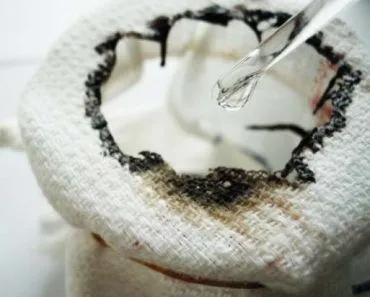
No. A strong acid dissolves a hot substance faster than a cold one. Acids dissolve things by donating protons, and that reaction speeds up with temperature. A hot substance already carries extra energy, while a cold one first draws heat from the acid, slowing the process down.
Whenever we talk about acids, we typically presume them to be hazardous or harmful. Yes, they are harmful if used in the wrong way, but acids are essential, just like any other chemical constituent on Earth.
Our stomach houses a strong acid, HCl (Hydrochloric acid), without which we could never digest food. Folic acid found in leafy vegetables and fruits is an essential supply of vitamin B. Vinegar (acetic acid) makes our food taste better. Given this dual nature of acids, it is interesting to study their properties.
What Are Strong Acids?
The strength of an acid is usually determined by its ability to donate protons (H+) when dissolved in water (Brønsted acid). Hence, there exists a scale called the ‘pH scale’ (the “p” is usually said to come from potenz, German for “power,” though its exact origin is still debated), which identifies the strength of an acid or a base.
It ranges from 0 (most acidic) to 14 (most basic/alkaline).
We determine pH using a simple formula pH = -log10[H+], where [H+] is the concentration of protons expressed in mol/L.
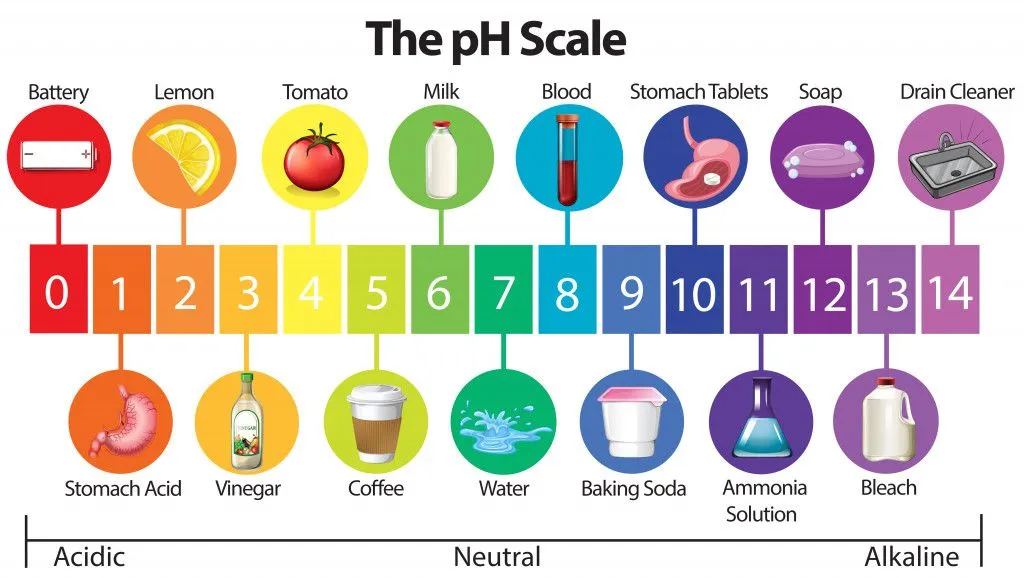
So, when we talk about strong acids, we are in the pH 0 to 2 range. Strong acids are identified based on their rapid donation of protons, and some of them are highly corrosive, such as HCl, H2SO4, HNO3, picric acid etc. Weak acids include acetic acid (vinegar), citric acid (lemons), benzoic acid etc.

Relative Permittivity(ε) Of Acids
Relative permittivity is also called the ‘Dielectric Constant’ of a liquid. It is the measure of force required to keep two charged particles separated. The higher the value of the dielectric constant, the less force will be required to keep the charged particles separated. The formula to calculate dielectric constant is:
εr = ε / ε0
Where,
ε = Permittivity – Depends upon the nature of the medium between the two charges
ε0 = Permittivity of Vacuum – A constant – 8.854 × 10⁻¹² J −1 C2 m−1 .
Dielectric constant is a dimensionless quantity. For example, we always take the dielectric constant of a vacuum as 1 and that of water at 250C as 78, i.e., almost two-fold greater than that of vacuum. This simply means that in a vacuum, the two charged particles cannot be separated, as a vacuum offers less resistance to the inter-ionic force, whereas in water, the two charged particles can remain as is and stay stable.
The dielectric constant of a substance is very large if its constituent molecules can be easily polarized. In water, there is high polarity due to a highly electronegative oxygen atom bonded to an electropositive hydrogen atom. This makes water an excellent polar solvent, which is why it is often called the ‘Universal Solvent’.
When talking about strong acids, we assume that they are highly ionizable, because only then can they donate protons. A high dielectric constant helps here, since it lets the acid pull its own ions apart and keep them separated. Concentrated sulfuric acid is a striking example, with a dielectric constant in the region of 84 to 100, comfortably above water. Most other strong acids, however, sit well below water once you set aside their watery solutions, as the table below shows.
| ACID | TEMPERATURE (0C) | DIELECTRIC CONSTANT (εr) |
| Sulphuric Acid (H2SO4) | 20 | 84 |
| Hydrochloric Acid (HCl) | -95 | 9.3 |
| Nitric Acid (HNO3) | 14 | 55 |
| Hydroiodic acid (HI) | -50 | 3.4 |
A high dielectric constant means an acid can dissolve ionic and polar substances readily, sometimes even better than water can. The corrosive bite of a strong acid, though, comes mainly from how freely it hands over protons, not from its dielectric constant alone. Those donated protons attack and break down materials very quickly, and the reaction is often highly exothermic, which raises the temperature.
Effect Of Temperature On Solubility
Water, being a universal solvent, has many applications in reactions and processes. Many substances dissolve readily in water, while some require heating to be dissolved. The idea here is ‘energy supply’; when we supply heat, we are basically increasing the kinetic energy of the solutes. When they gain energy, their motion speeds up and disintegrate, and are then squeezed between the solvent molecules.
Imagine that students are seated in an orderly fashion in a classroom while class is going on. Suddenly, someone shouts that there is a fire inside the school (heat source); the immediate reaction of students will be running to flee the school.
The scattering of the children from an orderly arrangement into a chaotic one is what happens when we heat a solute. Hence, it is a general trend that when we dissolve a solid in water, upon increasing the temperature, solubility increases (the reverse is true for gases).
The same goes with a strong acid. When we put in a hot substance, we are handing extra energy to the system, so the molecules collide and react faster and the acid gets to work sooner. Hence, the acid dissolves a hot substance more quickly than a cold one.
Which Food Gets Digested Quicker, Hot Or Cold?

In terms of applying this concept, we ought to ask ourselves: should we eat hot food or cold food, given that our stomach contains a very strong acid (HCl)? Studies of gastric emptying suggest that a hot meal tends to leave the stomach faster than a cold one, so eating warm food may ease digestion a little compared to eating it cold.
Warm food already carries extra heat into the stomach, so the acid and digestive enzymes can get to work on it a little sooner. Cold food, on the other hand, first has to be warmed up by the body before it is fully broken down, which takes a bit more time and energy.
Hence, there is a difference in the time required to digest hot vs. cold food.
Is Acid Hot Or Cold?
A bottle of acid sitting on a laboratory shelf is not hot. Left alone, a strong acid rests at whatever the room temperature happens to be, exactly like a glass of water standing beside it. So why do so many of us picture acid as something scalding? The answer is that acids do their damage through chemistry, not heat, and that chemistry can release heat very quickly.
When acid touches skin, the injury is a chemical burn rather than a thermal one. The acid donates protons that denature the proteins in your tissue, a process doctors call coagulation necrosis. Your nerves register that damage as burning, but no flame or hot surface was ever involved.
An acid can genuinely heat up, though, and the classic example is dilution. Mixing concentrated sulfuric acid with water is strongly exothermic, and the temperature right at the point of mixing can climb past the boiling point of water. That is exactly why chemists follow the old rule, add acid to water, never water to acid: trickling a thin stream of acid into a large volume of water lets the water soak up the heat, whereas doing it the other way round can make the mixture boil and spit acid back out. Reactions between strong acids and metals or carbonates are often exothermic as well, so a beaker that started at room temperature can warm up noticeably once the reaction gets going.
So, is acid hot or cold? On its own, neither. It is a chemical waiting to react, and it is that reaction, not any built-in warmth, that can make things heat up fast.
How Do Acids Dissolve And Break Down Materials?
We keep saying that acids dissolve things by handing over protons, but it is worth seeing what that actually looks like with real materials.
With metals, the acid stages a swap. The hydrogen ions from the acid pull electrons off the metal atoms, turning those atoms into dissolved metal ions while the freed hydrogen bubbles away as a gas. The general pattern is metal + acid → salt + hydrogen. Drop a piece of zinc into hydrochloric acid, for instance, and you get zinc chloride in solution plus a steady stream of hydrogen bubbles: Zn + 2HCl → ZnCl2 + H2. Reactive metals such as magnesium and zinc react readily, while a less reactive metal like copper barely reacts at all, which is why the choice of metal matters as much as the choice of acid.

With carbonates, the acid produces fizz. Limestone, marble, chalk and eggshell are all built on calcium carbonate, and a strong acid breaks them down into a salt, water and carbon dioxide: 2HCl + CaCO3 → CaCl2 + H2O + CO2. The bubbles you see are the escaping carbon dioxide, and this same reaction is why acid rain slowly eats away at marble statues and gravestones.
One quick note on wording: acids do not really melt things. Melting is a physical change driven by heat, whereas an acid is snapping chemical bonds and carrying the pieces off into solution. The result can look like melting, but it is a chemical reaction from start to finish.
Can Sulfuric Acid Dissolve More Than Water?
A popular claim floating around is that concentrated sulfuric acid can dissolve more than water can. It is a fun idea, but the honest answer depends on what you mean by ‘more’.
If you mean the widest variety of substances, water still wins. Water is called the universal solvent precisely because it dissolves more different substances than any other liquid, a talent that comes from its lopsided, polar shape. Sulfuric acid does not beat water at that broad job.
Where sulfuric acid pulls ahead is in its aggression toward specific materials that water simply ignores. It readily attacks many metals, and when concentrated it is a powerful dehydrating agent: it can strip the hydrogen and oxygen straight out of organic matter such as sugar, wood or paper and leave behind a black column of carbon. Tip concentrated sulfuric acid onto ordinary table sugar and, within seconds, the white crystals swell into a steaming pillar of black carbon. Water could sit on that same sugar all day and only dissolve it.

So water is the better all-round solvent, while sulfuric acid is the better destroyer of a shortlist of tough materials. They are simply winning at two different games.
Conclusion
Strong acids dissolve substances readily because they donate protons so freely, and a high dielectric constant can help by stabilizing the ions involved. Hot substances dissolve faster than cold ones, as they already carry plenty of thermal energy, which lets the acid do its work quickly. A cold substance, by contrast, first draws some heat out of the acid to warm itself up, which slows the dissolving process down.
References (click to expand)
- Shriver (2009). By Peter Atkins - Shriver & Atkins' Inorganic Chemistry (5th Edition) (11/18/09). W. H. Freeman, 2009
- Huheey J. E., Keiter E. A., Keiter R. L.,& Medhi O. K. (2006). Inorganic Chemistry: Principles of Structure and Reactivity. Pearson Education
- Atkins P., Paula J. D.,& Keeler J. (2019). Atkins' Physical Chemistry 11e: Volume 3: Molecular Thermodynamics and Kinetics. Oxford University Press
- Sun, W. M., Houghton, L. A., Read, N. W., Grundy, D. G., & Johnson, A. G. (1988, March 1). Effect of meal temperature on gastric emptying of liquids in man. Gut. BMJ.
- Acid–Base and Gas Evolution Reactions. Chemistry LibreTexts.
- Metals with Acid. Department of Chemistry, University of Washington.
- Water, the Universal Solvent. U.S. Geological Survey.
- Sulfuric acid as a dehydrating agent. Royal Society of Chemistry (RSC Education).
- Chemical Burns. StatPearls, NCBI Bookshelf.
- Add Acid to Water or Water to Acid? Safely Diluting Acids. Science Notes.