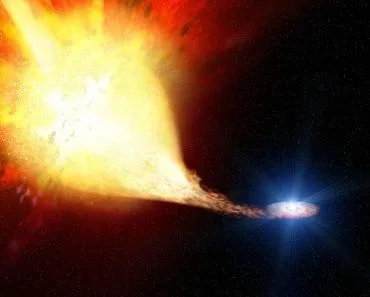
The magnetic field of a dead star does not vanish. As the stellar core collapses, magnetic flux is conserved (the product of field strength and surface area stays roughly constant), so the field is squeezed into a tiny volume and amplified enormously. This is why neutron stars and magnetars, the corpses of massive stars, carry the strongest magnetic fields known.
In the grandeur of the cosmos, stars’ lifecycles are incredibly fascinating. They are not just fiery balls of gas; they are celestial giants with magnetic fields that profoundly impact their journey from birth to death. This article explores what becomes of a dead star’s magnetic field, with insights from recent scientific breakthroughs.
The Birth Of A Magnetic Field In The Stellar Core
To understand the full story of a dead star’s magnetic field, we must also explore the origins of magnetic fields in the universe. As molecular clouds collapse under the influence of gravity, the magnetic fields within them help regulate the fragmentation and formation of stars. In essence, the magnetic field of dead stars continues to influence the creation of new celestial bodies, continuing the cycle of stellar birth and death.
The fate of a dead star’s magnetic field must be understood by appreciating its significance during the star’s lifetime. Stars, including our own Sun, generate their magnetic fields deep inside, not at the surface. A magnetic dynamo operates near the base of the convection zone, where the Sun’s churning, electrically charged gas (plasma) and its differential rotation work together to build and twist the field. The corona, the Sun’s wispy outer atmosphere, is shaped by this field but does not produce it.
These magnetic fields are responsible for a wide range of phenomena, from solar flares to the sunspots that periodically dot the Sun’s surface. The fields of dead stars impact surrounding star formation as well, but let’s take a deeper look at the processes involved during stellar evolution.
What Happens When A Star Dies?
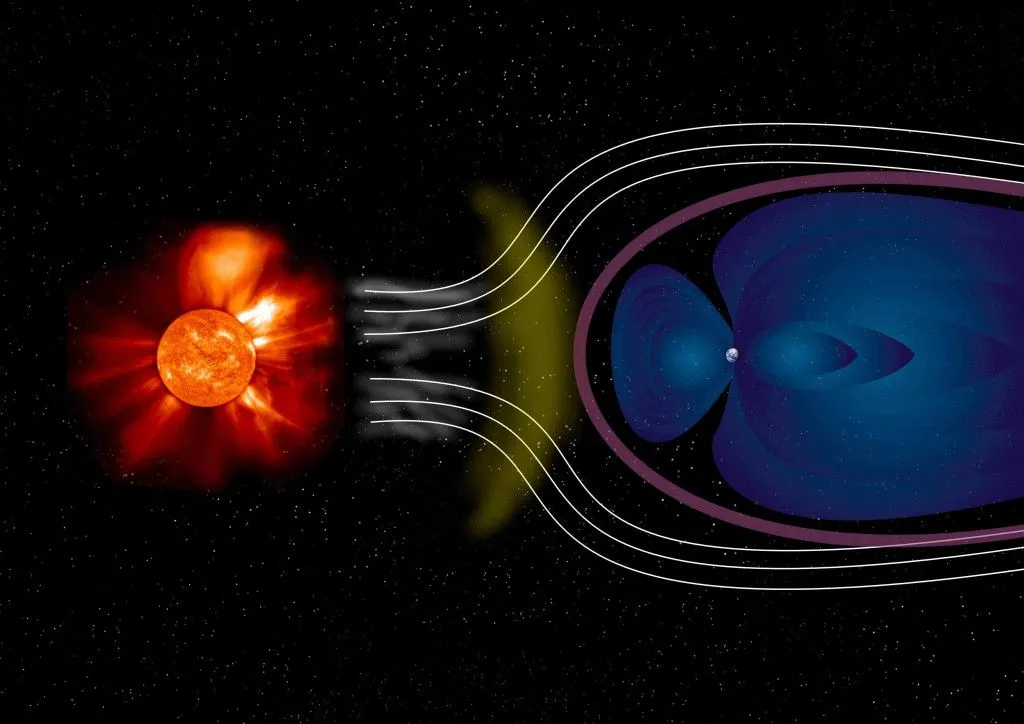
During a star’s active phase, its magnetic field has a profound impact on its behavior. It can influence the star’s rotation, mass loss, and the expulsion of material into space. Moreover, it plays a crucial role in the formation of planets and the overall structure of stellar systems. However, when a star reaches a point where it can no longer sustain fusion in its core, it embarks on a remarkable journey towards its ultimate fate.
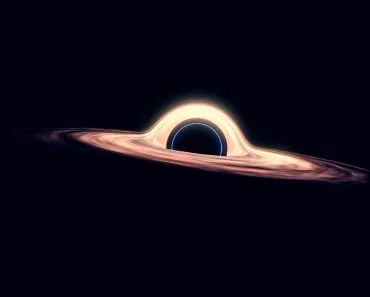
As stars run out of hydrogen fuel, they undergo a series of transformations, depending on their mass. Low-mass stars like the Sun, for instance, swell into red giants before shedding their outer layers and collapsing into white dwarfs. High-mass stars, on the other hand, meet more explosive ends, culminating in supernova explosions that can leave behind neutron stars or black holes. Throughout these transitions, the fate of a star’s magnetic field is equally intriguing.
So why does the field survive at all? The key idea is the conservation of magnetic flux, sometimes called flux freezing. In the hot, highly conducting plasma of a star, magnetic field lines are effectively locked into the gas, so the total flux threading the core (the product of field strength and surface area) stays roughly constant as the core shrinks. When the core of a massive star collapses, its radius plummets from something like 1 million kilometers (about 620,000 miles) down to roughly 10 kilometers (6 miles). Because flux is conserved, squeezing the same field lines into that far smaller surface amplifies the field by a factor of around 10 billion. The “fossil field” inherited from the parent star is not destroyed by death, but concentrated by it.
Recent observations and research have provided new insights into the enigmatic nature of magnetic fields linked to dead stars.
Magnetic Fields Of Incredibly Dense Stars
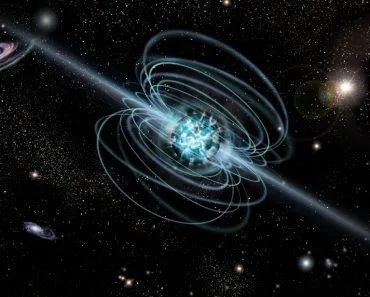
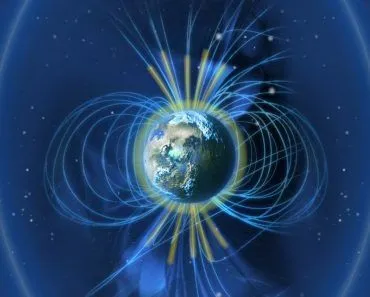
One remarkable discovery comes from the study of neutron stars, the remnants of massive stars after a supernova. Neutron stars are incredibly dense, containing roughly the mass of our Sun in a sphere just a few kilometers in diameter. These exotic celestial objects are also known for their incredibly strong magnetic fields. A typical neutron star carries a field of around 100 million tesla (1012 gauss), already trillions of times stronger than Earth’s. The most extreme members of the family, the magnetars, reach roughly 1 billion to 100 billion tesla (1013–1015 gauss), the strongest magnetic fields known anywhere in the cosmos. For comparison, the strongest magnets built on Earth top out near 45 tesla.
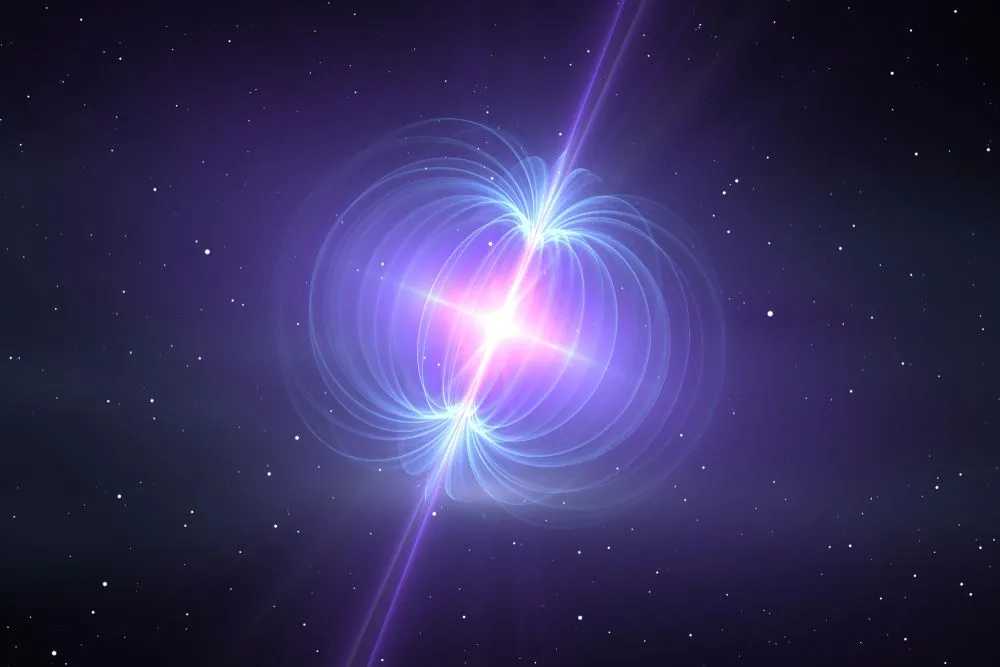
Recent observations have shown that the magnetic fields of neutron stars can persist long after the star has gone supernova. In some cases, these magnetic fields even shape the surrounding environment, channeling charged particles and powering beams of radiation. This persistence challenges any naive assumption that a star’s magnetic field would simply dissipate during the tumultuous processes leading to a supernova.
This is exactly why neutron stars are sometimes nicknamed “zombie stars”: they are technically dead, having shut down nuclear fusion, yet they still shine and broadcast across the cosmos, powered by leftover heat and those colossal magnetic fields rather than by any ongoing fuel burning. NASA’s NICER mission studies these objects, using the metronome-steady pulses of rapidly spinning neutron stars (pulsars) as natural “celestial clocks” precise enough to navigate a spacecraft.
Astronomers are even beginning to read the surfaces of these magnetic corpses. In 2022, a team using NASA’s Imaging X-ray Polarimetry Explorer (IXPE) studied the magnetar 4U 0142+61, about 13,000 light-years away in the constellation Cassiopeia. The polarized X-ray light it emitted suggested the star is so strongly magnetized that it likely has a bare, solid surface with no gaseous atmosphere, a state of matter that simply cannot exist anywhere on Earth. It is a vivid reminder of how exotic the magnetic legacy of a dead star can be.
The Origin Of Magnetic Fields In The Universe
Another big question that only makes one ponder without any relief is how did magnetic fields first come into existence in the Universe?
The honest answer is that astronomers are still not sure. One popular idea is that faint “seed” fields were sown in the very early universe, perhaps amplified out of quantum fluctuations during the inflationary era. Another, explored in recent work, is that no primordial seed is needed at all: turbulence in the hot plasma of the young cosmos could have generated and amplified magnetic fields from scratch. Whichever proves correct, these tiny seeds were then stretched and strengthened over billions of years into the vast cosmic magnetic fields we observe today. Understanding this cosmic-scale magnetism provides essential background for studying the smaller-scale fields within stars and their remnants.
Conclusion
The magnetic field of a dead star is an intriguing phenomenon that continues to startle astronomers and astrophysicists alike. Recent discoveries have revealed that these magnetic fields can persist long after a star’s demise, influencing the surrounding environment and even playing a role in the birth of new stars.
The complexity and persistence of these magnetic fields remind us that although we are still many decades away from discovering the physics behind every process in the Universe, our understanding of magnetic fields in dead stars has certainly evolved in recent years, along with our appreciation for the profound interplay between magnetism and the Universe.
References (click to expand)
- The Role of Magnetic Fields in Star Formation - Harvard CfA.
- The Solar Dynamo - NASA Marshall Space Flight Center.
- Neutron Stars in Different Light - NASA Imagine the Universe.
- Magnetars: Special Stars With That Attractive Charm - NASA Imagine the Universe.
- Magnetic Field Generation in Stars - Space Science Reviews.
- Magnetised dead star likely has solid surface - UCL News.
- How the universe got its magnetic field | MIT News.
- The Secret of Magnetic Cycles in Stars | Center for Astrophysics.