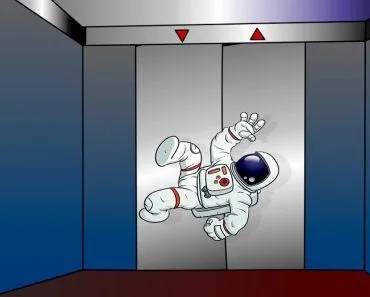
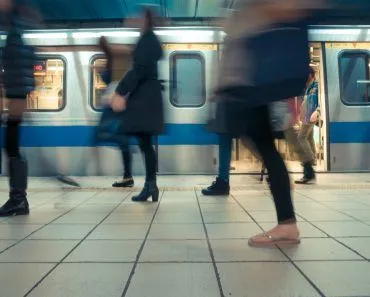
The force that makes one feel a particular set of sensations is the acceleration, and the section of a roller coaster that exploits this acceleration (more accurately known as centripetal acceleration) are the clothoid loops. A clothoid loop assumes the geometric shape of a teardrop. A clothoid is a section of a spiral that has a continually changing radius.
Amusement parks are a place where people of all ages go to enjoy themselves and relax, but if there’s one thing that captures the attention of both children and adults alike, it’s roller coasters! Personally, this makes me wonder what it is about roller coasters that provides such widespread excitement to so many of us, but such dreadful fear in others. The reason for these intense emotions is not due to the speed that one experiences, but rather the forces and the feeling of weightlessness that affect riders. Let’s now take a look at the physics of roller coaster loops to reach an understanding of how one experiences the powerful forces and the notion of weightlessness.
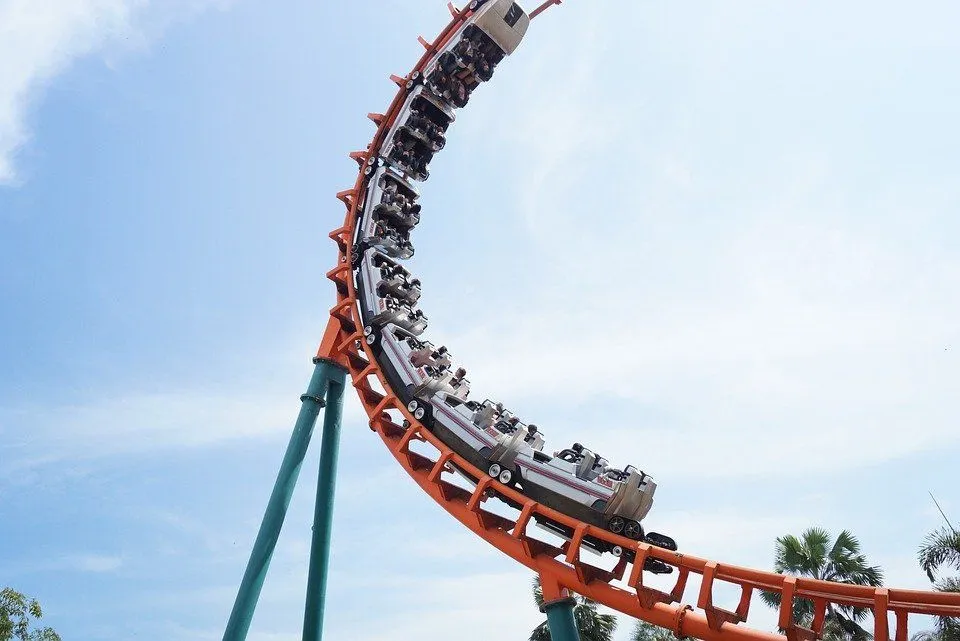
How Do Roller Coasters Actually Work?
Here is the first surprise: a roller coaster has no engine. Once the train rolls out of the station, nothing drives it forward except gravity. The only powered part of the entire ride is the very first climb, the lift hill, where a motor-driven chain (or, on newer rides, a cable or a magnetic launch) hauls the train up to the highest point of the track. From there the train is simply let go, and physics handles the rest of the journey.

What the lift hill is really doing is storing energy. At the top of that first hill the train is barely moving yet sits high above the ground, so it holds its maximum gravitational potential energy, given by PE = mgh (mass times the acceleration due to gravity, g = 9.8 m/s2, times height). As the train plunges down the far side, that height is traded for speed: potential energy converts into kinetic energy, KE = ½mv2. Climb the next rise and the swap runs in reverse, kinetic energy turning back into potential energy as the train slows. This constant back-and-forth is just the law of conservation of energy at work, with the total staying roughly the same while its form keeps changing.
This also answers a question riders often ask: why is the first hill almost always the tallest, and why must it stand higher than the top of any loop that comes later? Because friction and air resistance steadily bleed energy away as heat and sound, the train can never coast back up to a height greater than where it began, and in practice every subsequent hill has to be lower than the one before it. The lift hill therefore has to be built tall enough that, even after those losses, the train still carries enough speed to clear every dip, turn and loop further down the line.
Physics Of Loops
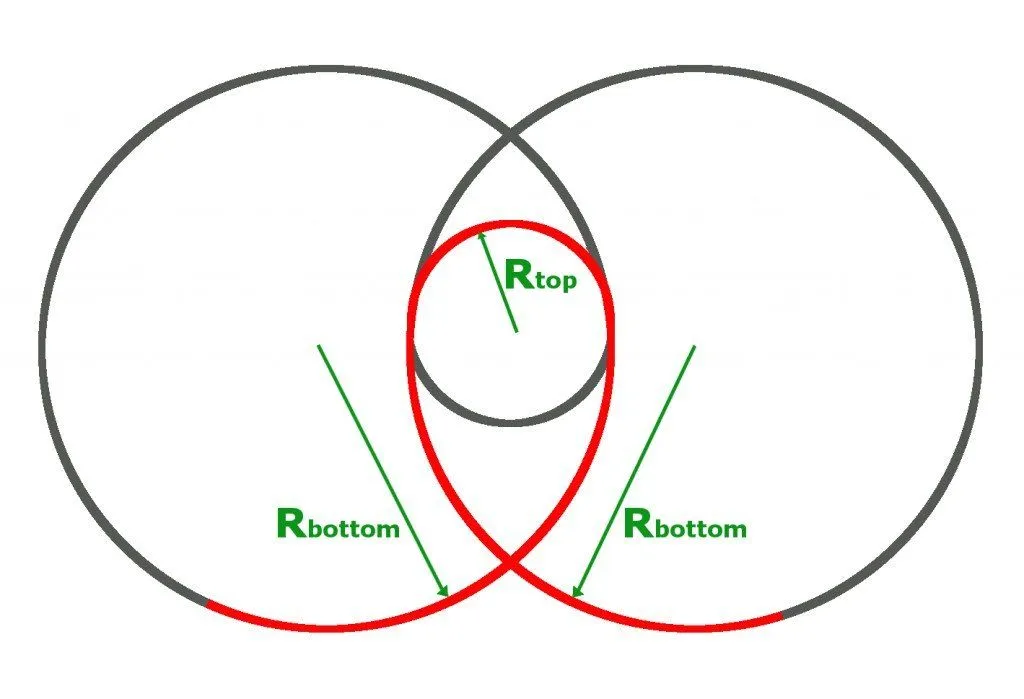
The primary force that makes one feel a particular set of sensations is the acceleration, and the section of a roller coaster that exploits this acceleration (more accurately known as centripetal acceleration) are the clothoid loops. A clothoid loop assumes the geometric shape of a teardrop. A clothoid is a section of a spiral that has a continually changing radius. Unlike a circular loop, which has a constant radius, a clothoid loop has a greater radius at the bottom of the loop than at the top. To make the envisioning of the clothoid loop easier, let’s imagine two circles of the same radius that overlap one another to form the base of the clothoid, while a smaller circle forms the radius at the top of the clothoid.
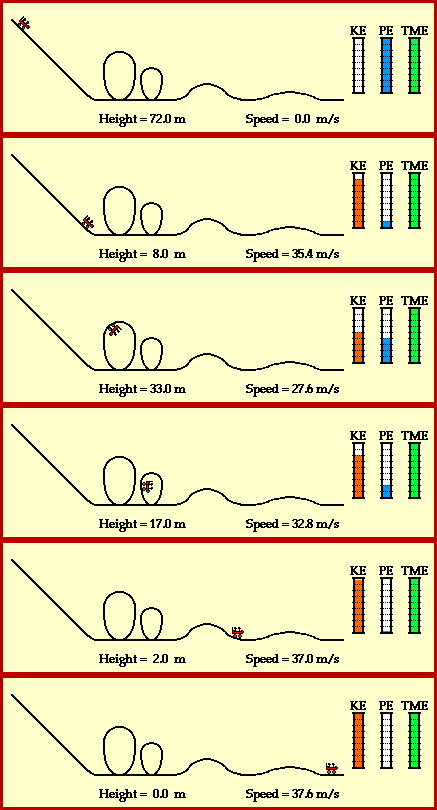
As the roller coaster cart passes through the clothoid loop, one experiences acceleration based on two main factors: the constant change in direction and the constant change in speed. A rightward moving roller coaster car gradually becomes an upward moving roller coaster car and a leftward moving roller coaster car, then a downward moving roller coaster car. In other words, there is a continuous change in the direction of the roller coaster car as it moves through the clothoid loop. As the roller coaster car begins to ascend the loop, it begins to slow down. An increase in height leads to an increase in potential energy, which results in a decrease in kinetic energy and speed. Conversely, a reduction in height increases kinetic energy and speed, so the roller coaster car experiences the highest speeds at the bottom of the loop (both upon entering and leaving the loop) and the lowest speeds at the top of the loop.
Force Analysis Of A Loop
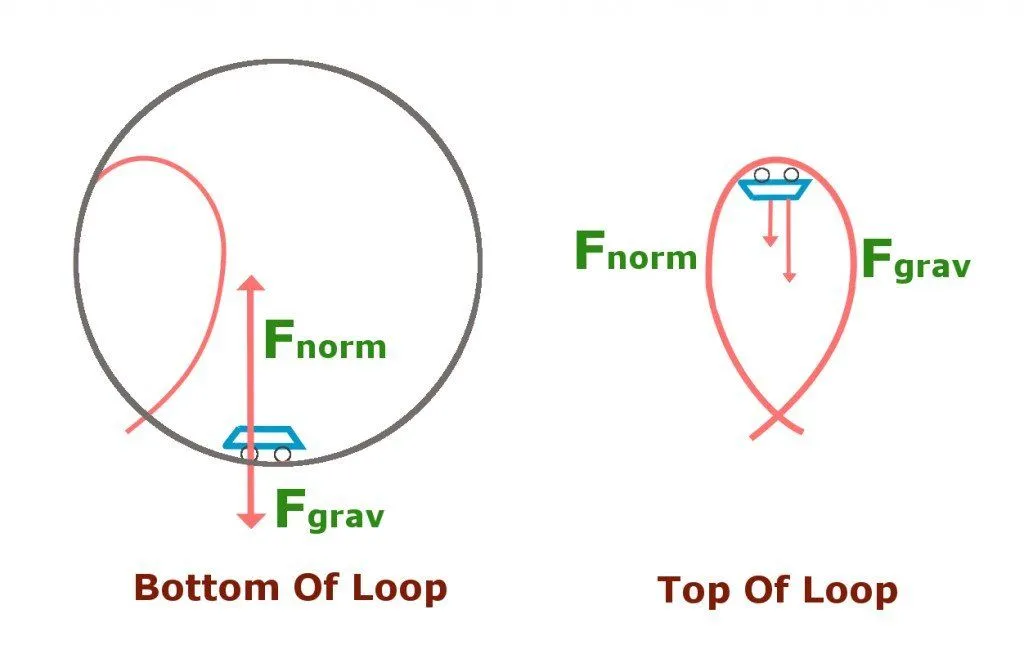
Whenever an object moves in a closed curved path, it experiences a net inward acceleration that results in the object experiencing a net inward force. Before we proceed any further with the analysis of what forces a person experiences on a roller coaster, we will assume that the roller coaster car does not experience any friction or air resistance. With that in mind, there will be two forces that act upon the roller coaster car: the FORCE OF GRAVITY (FGRAV) and the Normal Force (FNORMAL). The normal force is directed in the direction of the track, while the gravitational force is always directed downwards. At the bottom of the loop, the track pushes upwards on the car with a normal force. However, at the top of the loop, the normal force is directed downwards; since the track (the supplier of the normal force) is above the car, it pushes downwards on the car. The free-body diagrams for these two positions are shown in the diagrams at the right.
The magnitude of the force acting on the roller coaster car (or passenger) can be calculated using the formula FGRAV=m.g, where the acceleration due to gravity is represented by g (where g=9.8 m/s2). The magnitude of the normal force depends on three factors: the speed of the car, the radius of the loop, and the mass of the rider. As depicted in the free body diagram, the magnitude of FNORMAL is always greater at the bottom of the loop than it is at the top. The normal force must always be of the appropriate size to combine with the FGRAV in such a way to produce the required inward or centripetal net force. At the bottom of the loop, the Fgrav points outwards, away from the center of the loop. The normal force must be sufficiently large to overcome this FGRAV and supply some excess force to result in a net inward force. In a sense, FGRAV and FNORMAL are in a tug-of-war and FNORMAL must win by an amount that is equal to the net force. At the top of the loop, both FGRAV and FNORMAL are directed inwards. FGRAV is found in the usual way (using the equation FGRAV =m*g). Once more, the FNORMAL must provide sufficient force to produce the required inward or centripetal net force.
Where Is Centripetal Force At Work On A Roller Coaster?
Centripetal force is not some exotic extra force bolted onto the ride. It is simply the name we give to the net inward force that any object needs in order to follow a curved path. As physicists describe it, curved motion requires a force directed toward the center of curvature of the path, and its magnitude is F = mv2/r (mass times speed squared, divided by the radius of the curve). The useful takeaway is that this force always points toward the center of whatever curve the track is tracing, so to find it you simply look for wherever the rails bend.

And the rails bend in plenty of places. On a banked turn, the curve’s center is off to one side, so the centripetal force points horizontally toward the inside of the bend, supplied by the track pushing on the wheels. At the crest of a hill, the center of the curve sits below the track, so the force points downward; gravity supplies much of it, the track barely has to push, and that drop in support is exactly why your stomach lifts and you briefly feel weightless. At the bottom of a valley or dip, the center is now above you, so the force points upward, and the track has to shove hard against the train, pressing you into your seat and making you feel heavy. In a vertical loop, the center lies inside the loop, so the inward force points toward the middle the whole way around, holding the car (and you) against the track even when you are upside down.
So the honest answer to “where is centripetal force at work?” is: everywhere the path curves. Every turn, every hilltop, every valley and every loop has it. Along the straight, level stretches between elements, where the track is not curving at all, there is no centripetal force, just the train coasting in a line until the next bend arrives.
Sensations Of Weightlessness
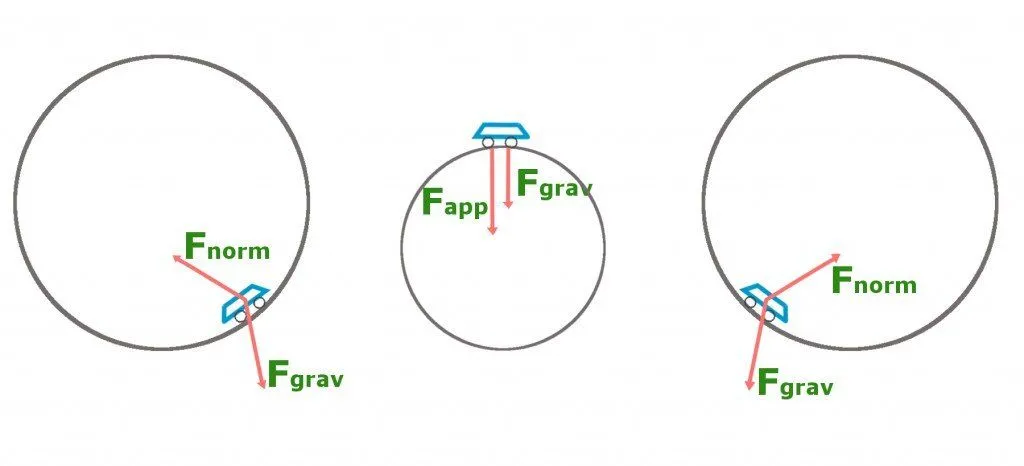
When you are on a roller coaster ride and travel through a loop, you will likely experience a small normal force at the top of the loop and a sizable normal force at the bottom of the loop. The normal force provides the feeling of a person’s weight. The more you weigh, the more normal force you will experience when at rest in your seat. However, when you board a roller coaster ride and accelerate through the clothoid loops, you will feel a normal force that is continually changing and one to which you are not accustomed.
This normal force provides a sensation of weightlessness or weightiness. At the top of the loop, a person will feel partially weightless if the normal forces become less than the person’s weight. At the bottom of the loop, a rider will instead feel very heavy due to the increased normal forces. It’s important to realize that the force of gravity and the weight of your body are not changing; only the magnitude of the normal supporting force is constantly changing.
With all of that information in mind, next time you go on a roller coaster, you’ll know why you feel a certain way, whether that is ecstatic, scared…. or just nauseous!
References (click to expand)
- Physics of roller coasters.
- Roller Coaster Physics.
- How rollercoasters work | Science of ....
- Physics of a roller coaster. The Chinese University of Hong Kong, Department of Physics.
- Physics of Roller Coasters. TeachEngineering (Duke University).
- Centripetal Force. HyperPhysics, Georgia State University.