Table of Contents (click to expand)
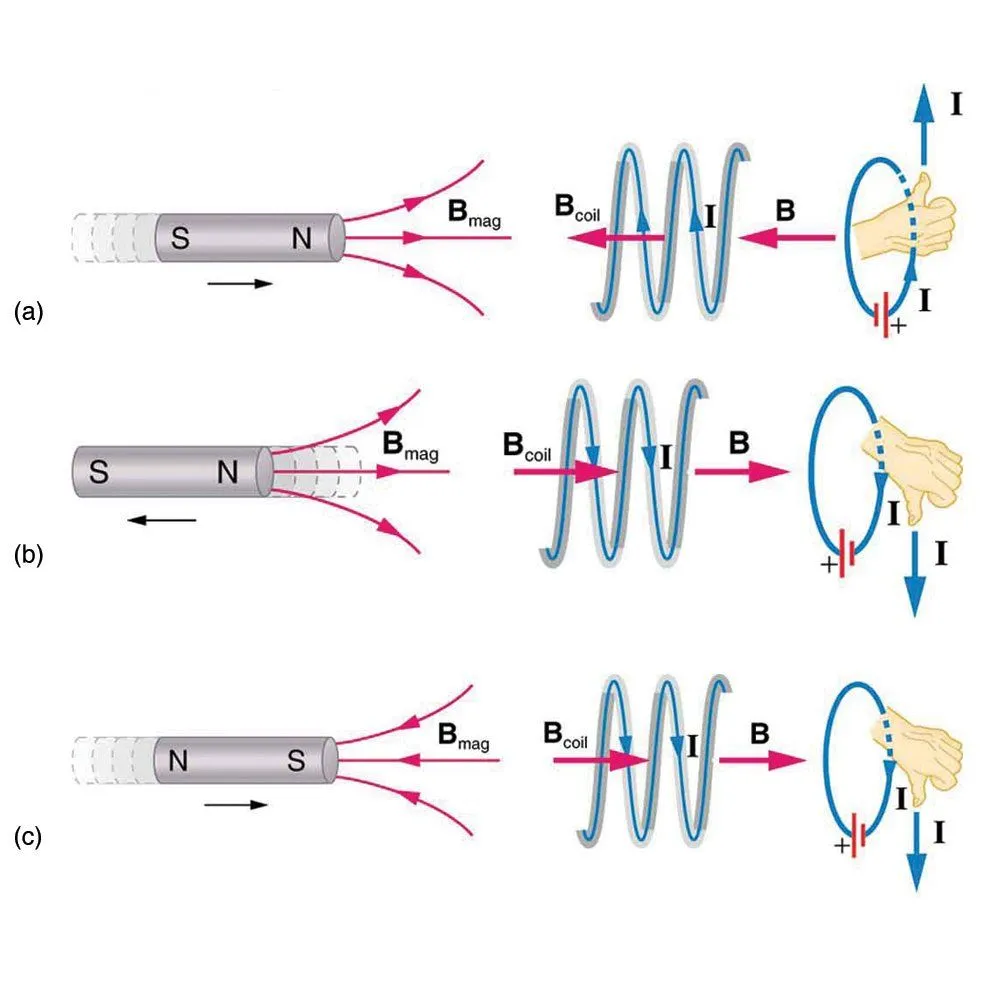
Lenz’s law states that an induced current always flows in the direction whose magnetic field opposes the change in magnetic flux that produced it. Named after Heinrich Lenz, a Russian physicist of Baltic German descent who stated it in 1834, the law is true because it is a direct consequence of the conservation of energy: if the induced current aided the change instead of opposing it, you would get energy for free.
In 1831, Michael Faraday demonstrated that a wire coiled on one side of an iron ring, when powered by a battery, induces a current in a wire coiled on the opposite side of the ring. This wireless (as if by magic) transfer of power was evident from the sudden spike in the reading of a galvanometer (a device used to measure current) that was connected to the second coil.
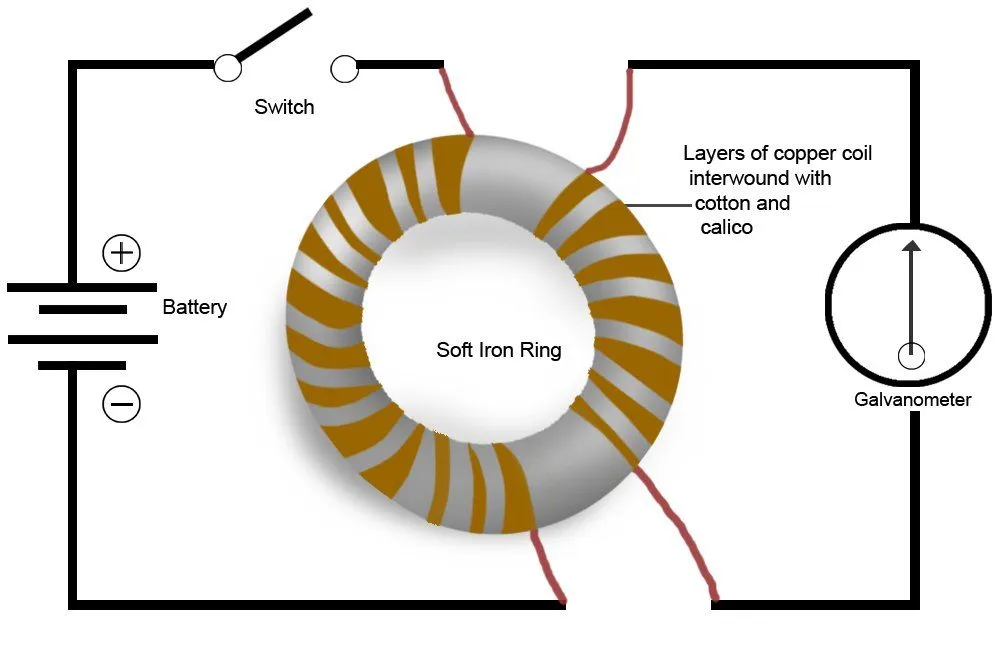
A decade earlier, in 1820, Hans Christian Oersted had demonstrated that an electric current generates a magnetic field; now Faraday had demonstrated that the converse was also true: a changing magnetic field generates an electric field. Change is the key word here: to induce a constant current in the second coil, Faraday had to perpetually connect and disconnect the battery to the first coil. If the magnetic field doesn’t change or waver around a wire, no electric field is created, and therefore no current is induced.
Faraday’s law of induction is mathematically described as:
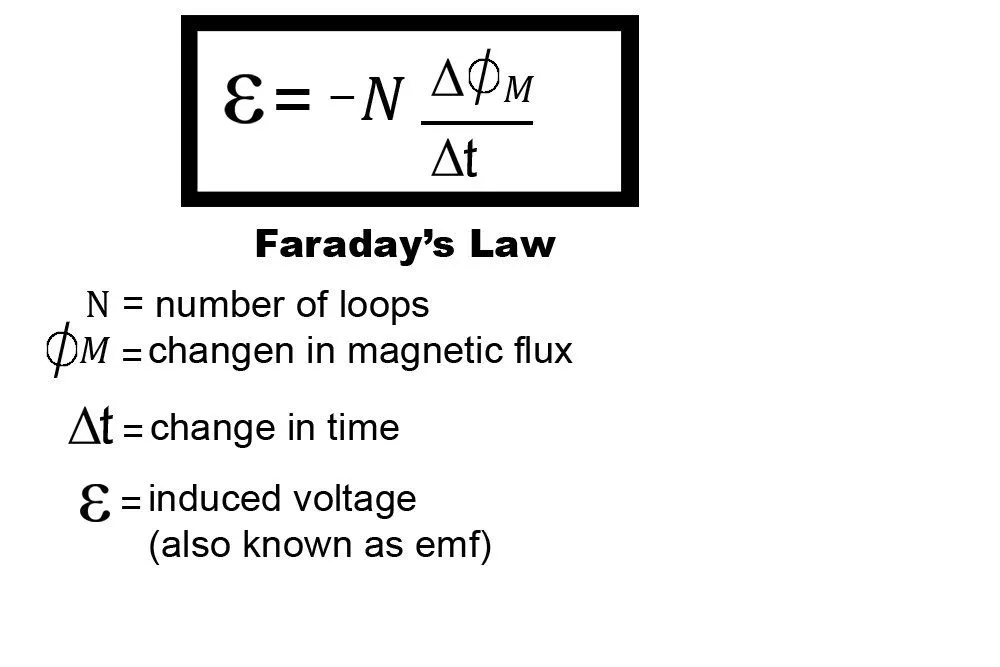
According to the formula, a voltage ‘ε’ is induced in a coil due to the rate of change of magnetic flux (Δφ/Δt) – the rate of change of magnetic field ‘B’ pervading an area ‘A’. The voltage is also a function of the turns or loops of coil ‘N’, for the simple reason that multiple turns cause the magnetic field to intersect the circuit multiple times. However, what does the negative sign signify?
The negative sign symbolizes Lenz’s Law, formulated by physicist Heinrich Lenz, according to which the direction of the induced current is such that the magnetic field this current generates opposes the change in the magnetic flux to which it owes its existence. Or, as D.J. Griffiths succinctly summarized it: Nature abhors a change in flux. However, why is this so?
What Is The Formula For Lenz’s Law?
Lenz’s law does not have a separate equation of its own. Instead, it lives inside Faraday’s law of induction as that single, crucial minus sign. Written out in full, the induced voltage in a coil is:
ε = −N (ΔΦ / Δt)
Here, each symbol carries a specific meaning, so let us unpack them one by one:
- ε is the induced electromotive force, or EMF, measured in volts (V). It is the voltage the changing magnetic field conjures in the coil.
- N is the number of turns (loops) in the coil. Double the turns and you double the induced voltage, because the flux now threads the circuit twice as many times.
- ΔΦ is the change in magnetic flux, measured in webers (Wb), where 1 Wb equals 1 volt-second (1 V·s) or 1 tesla-square-metre (1 T·m2).
- Δt is the time interval (in seconds) over which that flux changes, so ΔΦ/Δt is simply the rate at which the flux is changing.

The magnetic flux Φ itself is given by Φ = B·A·cos θ, where B is the magnetic field strength (in tesla), A is the area of the loop (in square metres), and θ is the angle between the field and the line perpendicular to the loop. Flux therefore changes whenever the field strength, the loop area, or that angle changes, which is why spinning a coil inside a magnet, or pushing a magnet toward it, generates a current. This is the same principle that lets an induction motor turn electrical energy into motion.
The negative sign is the whole point of Lenz’s law. It tells you the direction of the induced EMF: the current it drives always sets up a magnetic field that opposes the original change in flux. Strip the sign away and you are left with the magnitude alone, |ε| = N (ΔΦ / Δt), which tells you how big the voltage is but not which way it pushes.
A quick worked example makes it concrete. Suppose a coil of N = 200 turns sits in a field, and the flux through each turn drops from 6 × 10⁻⁵ Wb to 1 × 10⁻⁵ Wb in 0.1 seconds. The change in flux is ΔΦ = (1 × 10⁻⁵) − (6 × 10⁻⁵) = −5 × 10⁻⁵ Wb. Plugging in: ε = −200 × (−5 × 10⁻⁵ / 0.1) = +0.1 V. The positive result tells us the induced EMF acts to oppose the decrease in flux, exactly as Lenz’s law demands.
Why Lenz’s Law Is True
The implications of nature not abhorring or approving a change in flux are profound. If this were the case, we could have built perpetual motion machines, machines that can do work perpetually or indefinitely without a source of energy. In other words, infinite, unconditional energy… forever.
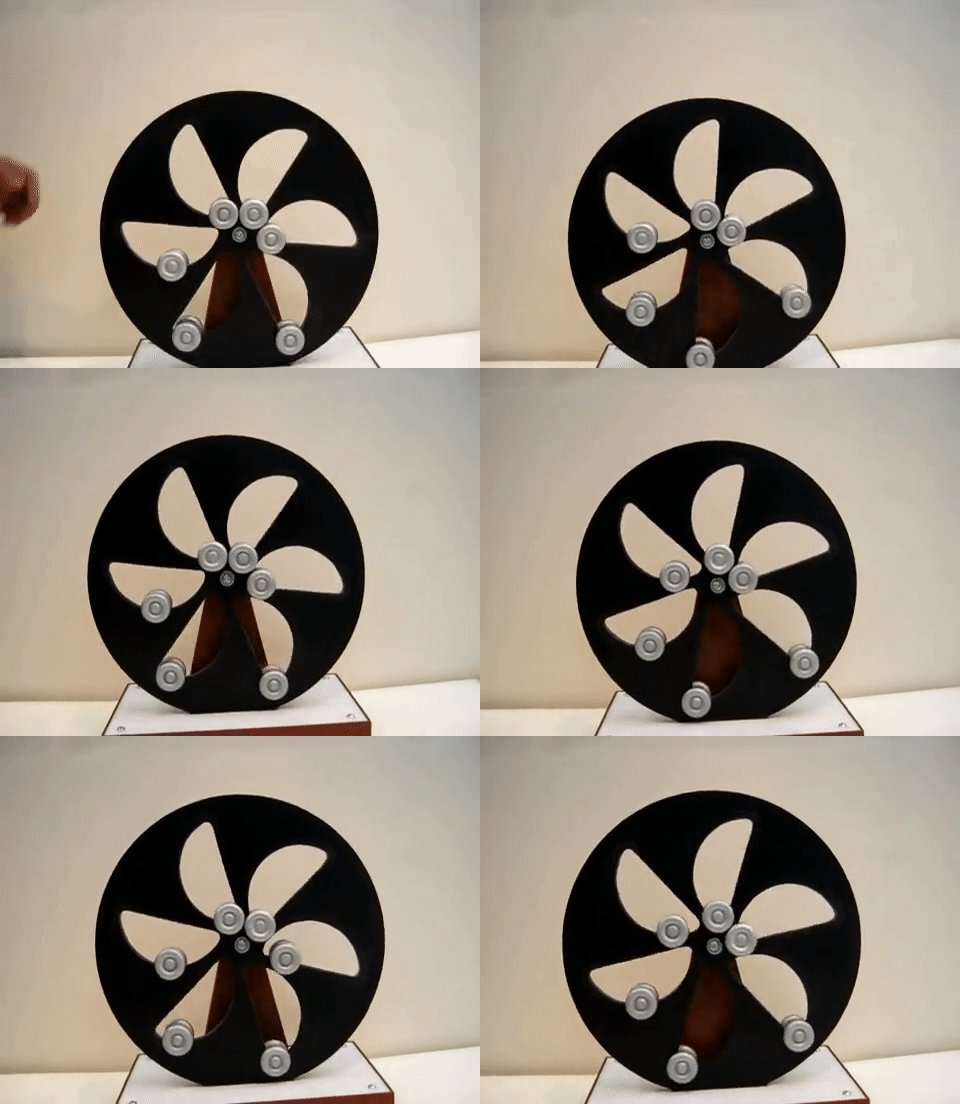
Of course, perpetual motion machines cannot be built because producing energy is a conditional affair. Their conduct contradicts a fundamental law of the universe, the law of conservation of energy. Energy, as physics textbooks have perennially stated, cannot be created nor destroyed. It can only transition from one form to another, which is to say, a system cannot create energy, but only extract some from a source, another system, which extracts its energy from another source and so on.
The source of electric energy induced in the coil is a changing magnetic field, which is generated by a moving magnet, which is being moved by you or a machine, which extracts the energy to move the magnet from food or fuel and so on. Once the source is exhausted, once no more varying magnetic field can be produced, generating energy in the system or inducing a current in the coil is a physical impossibility.
However, if the magnetic field generated by the induced current didn’t oppose the change in flux, but rather encouraged it to further change by contributing its magnetic energy, the current would further increase, without requiring the coil to extract more energy from an external source. A free lunch!
In fact, the current would compound: this incremented current generates its share of magnetic energy that also contributes to the varying magnetic field, thereby inducing an even greater current, which generates a greater magnetic field, and so on until an infinite current is generated. One could then power every device in the universe with a single generator by casually shaking the tiniest of magnets in its vicinity.
This is tantamount to saying that a ball merely nudged forward, rather than gradually coming to a halt, would increasingly accelerate and eventually achieve infinite velocity because the friction it experienced wouldn’t oppose its motion, but instead fuel it! The negative sign simply signals that the transfer of energy obeys the law of conservation of energy. If a system can produce more energy with the very energy it is producing, why shouldn’t this work:
References (click to expand)
- Faraday's Law. HyperPhysics, Georgia State University.
- Lenz's Law. Isaac Science (University of Cambridge).
- Lenz's law. Encyclopaedia Britannica.
- Faraday's Law of Induction: Lenz's Law. College Physics (OpenStax). Physics LibreTexts.
- Faraday's Law of Induction: Lenz's Law. Lumen Learning / SUNY College Physics.
- Heinrich Friedrich Emil Lenz. Encyclopaedia Britannica.