Murphy’s Law states that “anything that can go wrong, will go wrong”. It isn’t actually a law of nature but a quote-turned-maxim, originating in 1949 with USAF Captain Edward A. Murphy Jr. during a rocket-sled deceleration test in which all 16 of his G-force sensors had been wired backwards.
You have probably experienced moments of misery countless times. The day you leave your house without an umbrella, it starts to rain heavily. You buy a rising stock, but it rapidly starts to fall. You go to the bathroom, and your phone starts ringing from the other room. You try to get your favorite drink from a vending machine, and the can gets stuck.
When you drop a slice of buttered toast, it always seems to fall with the butter side down. You may think that the whole world in some eerie way is conspiring to make a mockery of you, demean you, and defeat you.
Guess what? One of the alleged laws of our world perfectly captures this travesty—Murphy’s Law. Although there are a few variations to it, the most famous phrasing is “What can go wrong will go wrong.”
Not Exactly A Law
The interesting part of Murphy’s Law is that it’s not a law in a true sense! Instead, it is a popular quote that has become a maxim. Murphy’s Law is often jokingly called the fourth law of thermodynamics. Some even call it the inverse of the Midas touch!
So how was this unusual law discovered, and why it is so popular?
Where Did Murphy’s Law Come From?
The aerospace industry is where work is done in a harsh, unforgiving environment. Though you might not believe it, that is where Murphy’s Law was born.
MX981 Project And The Testing Of G
In 1949, officers at Edwards Air Force Base in California performed experiments as a part of the MX981 project. The project was intended to assess the human response during a rapid deceleration. Experiments were conducted to simulate and understand the impact of an airplane crash on our physiology.

In the initial stages, officers tied dummies to the rocket sled. This rocket sled accelerated up to 1000 kilometers per hour and then abruptly halted. However, the officers weren’t convinced with results based on dummies. They felt that having an actual human as a test subject would give more reliable results.
Colonel Stapp, who was part of this project, took on the challenge. He agreed to get himself tied up in place of a dummy and endure rapid deceleration. The Air Force captain, Edward Murphy, was assigned the responsibility of designing the harness to strap around Colonel Stapp.
The final design submitted by Murphy’s harness had 16 sensors to measure G forces (gravitational forces) acting on the subject (Colonel Stapp). There were two ways in which each of these 16 sensors could be configured. One was right, and the other was wrong.
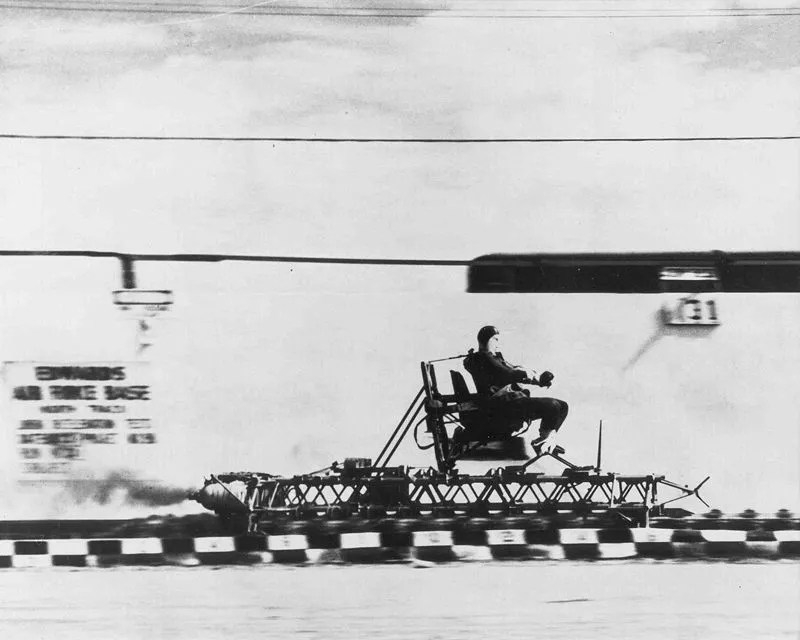
After tying Colonel Stapp to the rocket sled, the rocket sled took off. The team suddenly stopped the rocket sled once it reached 40 G. Under 1G, we would weigh around 70 kg on average, but under 40 Gs, we weigh 40 times more—about 2800 kg.
So, the 40G shift was an enormous amount of acceleration that the gutsy Colonel Stapp had to endure as part of the experiment. After the experiment, he survived with a concussion and bleeding from several bodily orifices.
As luck would have it, despite enduring this gruesome ride, the sensors didn’t register any readings! Colonel Stapp immediately called Edward Murphy to see what had gone wrong.
Murphy’s Law At Play: All 16 Sensors Were Configured Wrong!
After careful inspection, Edward Murphy realized that every single sensor of the total 16 sensors was configured incorrectly. Not even one was in the right configuration! Captain Murphy was dejected, and pointing towards the technician (who had configured the sensors), said in a derogatory tone, “If there are two ways to do something, and one of those ways will result in disaster, he’ll do it that way.” This was the original form of Murphy’s Law.
After this incident, Murphy went back to Wright Airfield, where he was stationed, but Colonel Stapp, the man known for his flamboyance, was impressed by Murphy’s proclamation. In a press conference soon after, Colonel Stapp gave encouraging remarks about the rocket sled experiments. He said they had taken into account ‘Murphy’s Law’ and were therefore able to ensure the highest safety standards. When asked what ‘Murphy’s Law’ was, Stapp condensed the original version as “Whatever can go wrong will go wrong.”
This condensed or misquoted version of Murphy’s proclamation was picked up as Murphy’s Law by the media and was soon being talked about and used beyond the aerospace circle.

Proliferation Of Murphy’s Law
Murphy’s Law and its variations have been collected in numerous books and websites. Several bands are named after Murphy’s Law, and it was even mentioned in Christopher Nolan’s movie, Interstellar. In the movie, while explaining Murphy’s Law to her daughter, the protagonist Cooper gives a more positive spin to Murphy’s law and says, “Whatever can happen will happen.”
Murphy wasn’t the first to realize this supposed perversity of fate. In the eighteenth century, famous Scottish poet, Robert Burns, wrote that the best laid schemes of mice and men oft go awry. In the nineteenth century, the English novelist James Payn famously rhymed about it in 1884: “I never had a slice of bread, particularly large and wide, that did not fall upon the floor, and always on the buttered side!” These are all subtle manifestations of Murphy’s Law.
What Are Some Everyday Examples Of Murphy’s Law?
Part of why Murphy’s Law feels so universal is that everyone can instantly rattle off their own examples. The supermarket queue you join always seems to crawl while the one you just left races ahead. Toast slides off the counter and lands butter-side down. The one morning you leave the umbrella at home, the sky opens up. Your printer jams only when you are already late, and the phone rings the very moment you step into the shower.

What makes this collection interesting is that the examples are not all the same kind of event. A few of them have a genuine physical or statistical explanation rather than being cosmic spite. As we will see in the next section, buttered toast really does tend to land butter-side down because of the height of an ordinary table, and the “slowest lane” feeling has a tidy mathematical reason. If traffic is split across several lanes that all move at roughly random speeds, the chance that yours happens to be the fastest is only one in however many lanes there are, so most of the time you will be watching someone else inch ahead.
The rest, though, are largely a trick of memory. Thanks to our negativity bias, the maddening misfires lodge in our heads while the countless times things went perfectly smoothly quietly slip away.
Is Murphy’s Law Real?
So, is Murphy’s Law actually true? Not really. In 1995, scientist Robert Matthews showed that a few commonly cited examples of Murphy’s Law, like the landing pattern of buttered bread, are not about bad luck but physics (the work earned him an Ig Nobel Prize the following year). In his paper, Tumbling toast, Murphy’s Law and the fundamental constants, he explained that toast sliding off a table at a typical dining-table height does not have time to complete a full half-rotation before hitting the floor — so it almost always lands butter-side down, regardless of which side started up.

Selective Memory And Negative Bias
Another reason why people acquiesce to Murphy’s Law is that it plugs into our inherent negativity bias and selective memory. We tend to remember unwanted things that happened to us and focus on them much more than on those things that went in our favor. Basically, anything that goes bad is likely to linger in our minds much longer than the things that went right.
Illusory Correlation
Matthews also talked about something called “illusory correlation”, which is why people believe in Murphy’s Law. Illusory correlation is when a person wrongly sees a relation between two variables, when in reality no such relation exists. These two variables can be a person, action, idea, or event. For example, when we are in a traffic jam, we always get the feeling that we’re in the slowest lane. This faulty presumption stems from our inherent behavior. We focus more on cars going past us than pay attention to ourselves going past other cars.
David Hand, statistician and professor of mathematics at Imperial College London, reckoned that the law of truly large numbers should make Murphy’s Law occasionally turn true. Additionally, selection bias would ensure that those occurrences would linger in our minds for longer, giving the sense that Murphy’s Law is universal, when that’s not really the case.
Sod’s Law, Finagle’s Law, And Yhprum’s Law: Murphy’s Famous Cousins
Murphy’s Law has a small family of close relatives that are easy to mix up. The best known is Sod’s Law, the British counterpart, usually phrased as “if something can go wrong, it will.” Its name comes from the sympathetic slang term “unlucky sod,” and across the United Kingdom it is invoked in almost exactly the situations where North Americans would blame Murphy. Many people treat the two as identical, although Sod’s Law is often described as the harsher version, insisting that things go wrong not just eventually but at the worst possible moment.
Finagle’s Law, sometimes called Finagle’s Law of Dynamic Negatives, makes that bad timing explicit: “anything that can go wrong, will, at the worst possible moment.” The phrase was popularized by science fiction author Larry Niven, whose asteroid-mining “Belter” characters half-jokingly worshipped Finagle alongside a mad prophet named Murphy. A programmer’s favorite spin-off, O’Toole’s corollary, gloomily adds that “the perversity of the Universe tends towards a maximum.”
Not every cousin is so gloomy. Yhprum’s Law (which is “Murphy” spelled almost backwards) is the cheerful inversion, stating that “anything that can go right, will go right.” It is the rare reminder that, every so often, the universe lets you keep your buttered toast butter-side up.
Offshoots Of Murphy’s Law
Although Murphy’s Law might not be 100% correct when scientifically tested, it occasionally turns out to be true. Murphy’s Law captures a jaded and pessimistic view of the world very well, which is why it’s so popular.
Since its popularization following the remark by Colonel Stapp, astute thinkers have provided some interesting spins to the original Murphy’s Law and have come up with their own versions. In fact, there have been hundreds of offshoots to Murphy’s Law that have found their way into books and websites. We’ll conclude this article by looking at some of those witty offshoots:
- Nothing is as easy as it looks.
- Left to themselves, things tend to go from bad to worse.
- You always find something in the last place you look.
- A good plan today is better than a perfect plan tomorrow.
- You never find a key until you replace the lock.
- Matter will be damaged in direct proportion to its value.
- Those who can, do. Those who cannot, teach.
References (click to expand)
- (2001) Project MX-981: John Paul Stapp and Deceleration Research. The United States National Library of Medicine
- Matthews, R. A. J. (1995, July 18). Tumbling toast, Murphy's Law and the fundamental constants. European Journal of Physics. IOP Publishing.
- Murphy's law | UCL Science blog. University College London
- Matthews, R. A. J. (1995, July 18). Tumbling toast, Murphy's Law and the fundamental constants. European Journal of Physics. IOP Publishing.
- Murphy's Laws - Cheap Thoughts. Angelo State University
- Sod's law. Wikipedia
- Finagle's law. Wikipedia
- Murphy's law. Wikipedia