Table of Contents (click to expand)
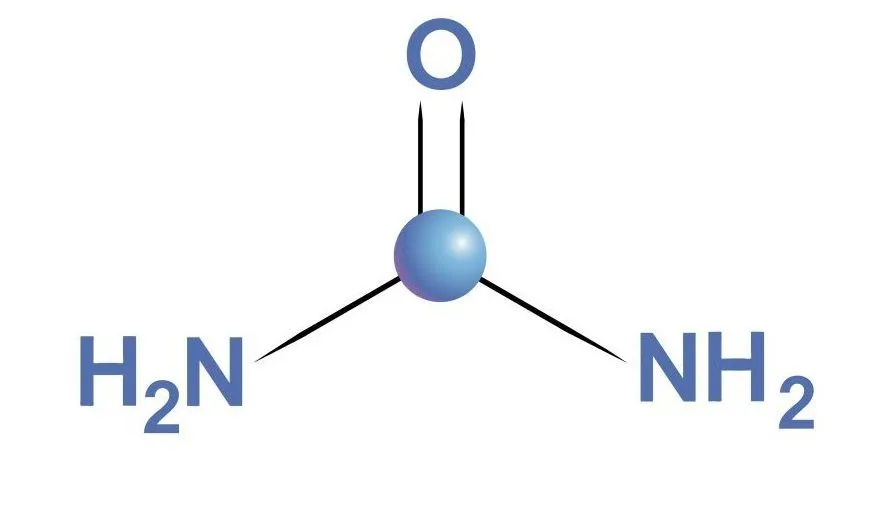
Urea (CO(NH2)2) is a non-toxic, water-soluble organic compound the body uses to safely eliminate excess nitrogen. It is produced in the liver through the Urea Cycle, a series of reactions in the mitochondria and cytoplasm of liver cells that converts toxic ammonia into urea, which then travels through the blood to the kidneys and is excreted in urine. Industrially, urea is also manufactured on a massive scale from ammonia and carbon dioxide for use as a fertilizer and in diesel exhaust fluid.
Our bodies are incredible machines, executing billions of different actions and commands simultaneously, with our trillions of cells operating in unison to keep us thriving and functioning. On a cellular level, however, these metabolic activities can be broken down into chemical reactions, some of which create byproducts that the body needs to eliminate. Urea is the final, non-toxic product of such a metabolic cycle, which can then be eliminated from the body. Before we go into the details of why urea is so important, let’s take a look at how and where it is produced.
The Urea Cycle
The majority of the food that we eat can be categorized as either fats, proteins or carbohydrates, all of which can produce energy for the body when it is metabolized or broken down. Carbohydrates are broken down into sugars through a number of enzymatic processes, which can then be metabolized for energy. Fats and oils are broken down into fatty acids and glycerol in the small intestines. Finally, proteins are broken down into amino acids by hydrochloric acid and specialized enzymes, at which point those amino acids move into the small intestine.
The Urea Cycle, also known as the Krebs-Henseleit Cycle, is how these small chains of amino acids, that are not reconstituted for new protein production, can ultimately be metabolized to generate energy for the body. When amino acids are metabolized in the liver, they produce free ammonia, as well as carbon dioxide. Unfortunately, ammonia is highly toxic to the body, and must be converted rapidly into something less dangerous, as the buildup of ammonia in the body could be fatal. Thus, ammonia enters the Urea Cycle and is converted into non-toxic urea, which the body can easily eliminate.
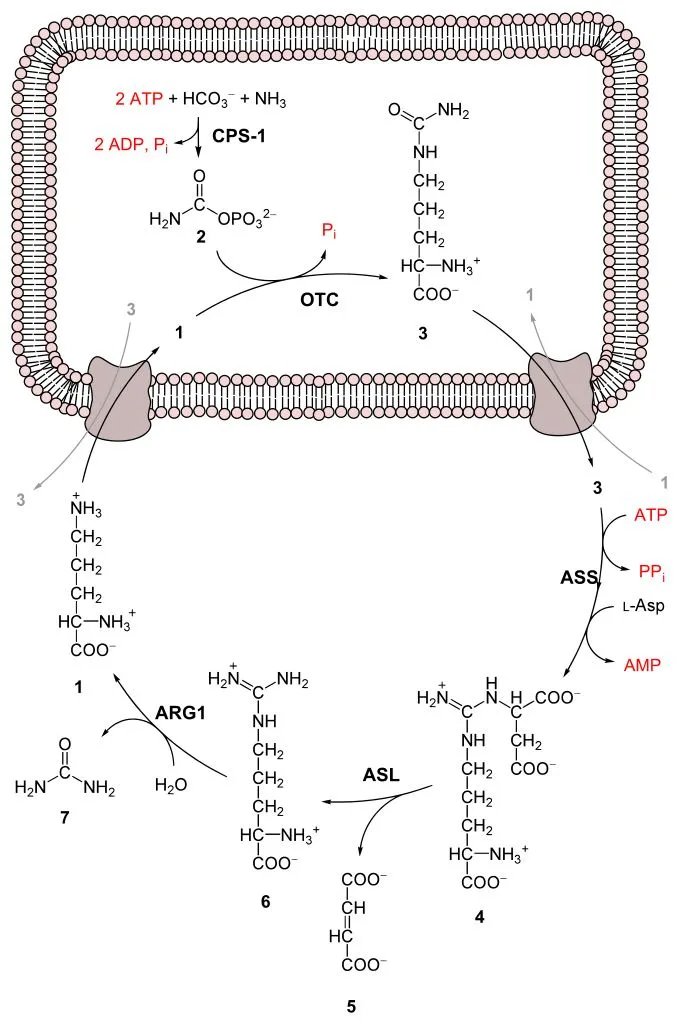
The cycle takes place in the mitochondria and cytoplasm of liver cells, beginning in the mitochondria. The ammonia and carbon dioxide combine, with the help of 2 ATP, to form carbamoyl phosphate. The amino acid ornithine, shuttled into the mitochondrion, then combines with carbamoyl phosphate (helped along by the enzyme ornithine transcarbamylase) to form citrulline. Citrulline is exported into the cytoplasm, where it reacts with the amino acid aspartate, with the help of another ATP, to form argininosuccinate. The enzyme argininosuccinate lyase then splits this molecule into fumarate and arginine. Finally, the enzyme arginase cleaves arginine to produce urea and ornithine, thus completing the cycle. Ornithine is transported back into the mitochondrion to rejoin the Urea Cycle, while urea, being a soluble compound, is absorbed by the blood and carried to the kidneys.
While that explanation may have been heavy with enzyme names, the short story is this: ammonia enters the Urea Cycle, goes through four transformative steps, and at the cost of four high-energy phosphate bonds (three ATP are hydrolyzed, but one of them is split all the way to AMP), liver cells produce non-toxic urea as a result. This can then be carried to the kidneys and excreted as a significant part of our urine every day.
Why Is Urea Important?
In our bodies, urea is a safe container for eliminating excess nitrogenous waste in the body, ensuring we don’t have a dangerous buildup of ammonia in the liver. Furthermore, urea plays a role in the reabsorption of water in the kidneys, and is important for maintaining a good water balance in the body. It functions as a signal to the body to produce hyper-concentrated urine, rather than further draining the body of water.
Proper maintenance of urea and ammonia levels in the body is critical to overall health, as an excess of either can cause acid-base imbalances, as well as serious illness. If a person or infant is suffering from enzymatic deficiency and the urea cycle cannot function normally, vomiting and coma may follow. Ammonia is an incredibly potent compound and must not be allowed to accumulate in the body. The Urea Cycle and the proper movement/elimination of urea through urine is a life-saving sequence that may process 10-20 grams of potentially deadly ammonia every single day!
How Is Urea Made Industrially?
So far we have looked at how your liver makes urea, but the urea in a bag of fertilizer or a jug of diesel exhaust fluid never went anywhere near a kidney. It is built from scratch in chemical plants, and it is one of the most-produced industrial chemicals on Earth, with global capacity sitting at roughly 180 million tonnes a year. The starting ingredients are the same two molecules your liver uses: ammonia and carbon dioxide.

First, the ammonia itself has to be made. That comes from the famous Haber-Bosch process, which forces nitrogen from the air to react with hydrogen under high pressure to form ammonia (NH3). That ammonia is then fed into a second step, the Bosch-Meiser process, patented by Carl Bosch and Wilhelm Meiser back in 1922. It happens in two stages. Ammonia and carbon dioxide combine in a fast, heat-releasing reaction to form ammonium carbamate (2 NH3 + CO2 ⇌ NH2COONH4). That carbamate then slowly dehydrates, splitting into urea and water (NH2COONH4 ⇌ CO(NH2)2 + H2O).
The reactors run hot and under enormous pressure, typically around 190 °C (374 °F) and 140 to 175 bar (roughly 2,000 to 2,500 psi), conditions that strike a balance between the two competing steps. Notice that the chemistry is essentially a shortcut version of what your body does: instead of the multi-enzyme Urea Cycle, industry slams ammonia and CO2 together directly. The molecule that comes out, CO(NH2)2, is chemically identical to the urea in your urine.
What Else Is Urea Used For?
If urea is just a waste product in our bodies, why make so much of it? Because that small molecule is an incredibly efficient way to carry nitrogen, and crops are hungry for nitrogen. More than 90% of all the urea manufactured worldwide ends up as fertilizer. By mass, solid urea is about 46% nitrogen, the highest of any common solid nitrogen fertilizer, which is why it is the world's most widely used one. Once spread on soil, it breaks down into ammonia and feeds plant growth, closing a loop with the natural nitrogen cycle.

The other use you may have run into is in modern diesel vehicles. Diesel exhaust fluid (DEF), sold under brand names such as AdBlue, is simply a solution of 32.5% urea in highly purified water. It is sprayed into the hot exhaust stream, where the heat breaks the urea down into ammonia. In a device called a selective catalytic reduction (SCR) catalyst, that ammonia reacts with harmful nitrogen oxides (NOx) and turns them into two harmless products: ordinary nitrogen gas and water (4 NO + 4 NH3 + O2 → 4 N2 + 6 H2O). That is why so many diesel cars and trucks now carry a separate DEF tank. Beyond fertilizer and DEF, urea also goes into urea-formaldehyde resins for plywood and particleboard, melamine production, and as a non-protein nitrogen source in cattle feed.
Who First Made Urea in a Lab?
Urea holds a special place in the history of chemistry. In 1828, the German chemist Friedrich Wöhler heated an inorganic salt, ammonium cyanate, and was startled to find that it rearranged into urea, the very same compound found in urine. It was the first generally accepted laboratory synthesis of a naturally occurring organic compound from purely inorganic starting materials. Wöhler was delighted, writing to his mentor Jöns Jacob Berzelius that he could "make urea without the use of kidneys, or indeed of any animal, be it man or dog."
You will often read that this single experiment "destroyed" the doctrine of vitalism, the old idea that the chemicals of living things carried a special "vital force" that no laboratory could reproduce. The real story is more measured. Historians point out that vitalism did not collapse overnight, and it took further syntheses over the following decades before the idea truly faded. Even so, Wöhler's accidental creation of urea is rightly remembered as a milestone that helped open the door to modern organic chemistry.
A Final Word
The metabolic pathways of the body are fascinating and foundational aspects of our survival. The Urea Cycle may not get as much attention as glycolysis or the Citric Acid Cycle, but its production of urea allows us to process excess nitrogenous waste in a fast and efficient way. It takes only a small expenditure of energy to create urea, but this cycle allows our bodies to utilize proteins as a major energy source, and the non-toxic byproduct aids in the regulation of urine concentration and helps maintain acid-base homeostasis! Outside the body, that same humble molecule, churned out by the hundreds of millions of tonnes in chemical plants, feeds the world's crops and helps scrub pollution from diesel exhaust, which is a remarkable second life for what began as a waste product.
References (click to expand)
- Weiner, I. D., Mitch, W. E., & Sands, J. M. (2015, August). Urea and Ammonia Metabolism and the Control of Renal Nitrogen Excretion. Clinical Journal of the American Society of Nephrology. Ovid Technologies (Wolters Kluwer Health).
- Walker, V. (2009, August 20). Ammonia toxicity and its prevention in inherited defects of the urea cycle. Diabetes, Obesity and Metabolism. Wiley.
- periments in the rat (2-4) and man (5) have twenty-sixth days ....
- Physiology, Urea Cycle. StatPearls. NCBI Bookshelf (National Library of Medicine).
- Bosch-Meiser process. Wikipedia.
- Green urea production for sustainable agriculture. Matt (Cell Press).
- NOx Selective Catalytic Reduction (NOx-SCR) by Urea. ACS Catalysis.
- Friedrich Wohler. Encyclopaedia Britannica.