Bubbles are round because the surface tension of the soap film pulls them into the shape of a sphere. This happens because the surface tension is the force that balances the inward force of the air molecules on the bubble and the outward force of the air molecules on the bubble.
In the case of bubbles, the air molecules trapped inside experience a force from the air molecules outside the bubble. They, in turn, also exert an equal and opposite force. Due to this, the air bubbles inside try to cluster together into a shape that minimizes their contact with the outside air. The resultant shape is spherical.
I remember that whenever I used to go to any fair, I always looked for one of those little things that you can make bubbles with. You know, the little bottle of soap solution and a ‘wand’ that you can dip into the former and then blow through to make round, beautiful bubbles.
Well, if my description isn’t helping much, the following picture should tell you what I’m talking about:
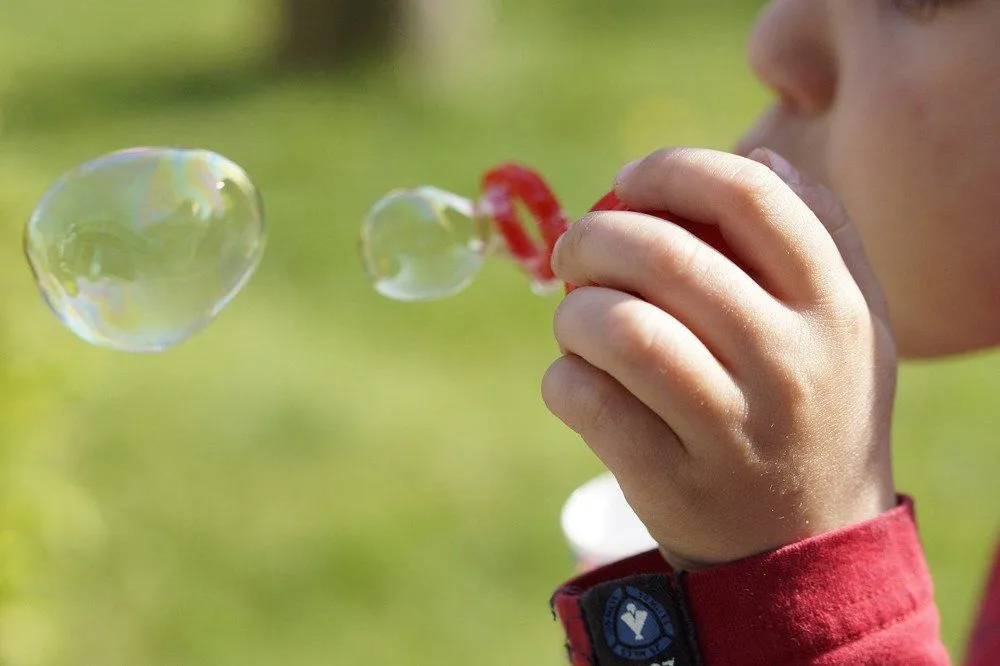
I’m sure that you’ve made bubbles using this ‘device’ at some point; if not, you may be dead inside. Or from another planet.
Anyway, the thing about the bubbles that’s really cool is that a) they are so colorful, and b) they usually are absolutely spherical. No matter what the size, bubbles that form with this toy are always round!
Come to think of it, it’s not just the bubbles made by this toy that are spherical, but practically all bubbles, right? Have you ever thought about why?
Note: Not all bubbles are necessarily spherical; they can come in different shapes other than a sphere, but for the scope of this article, we shall only consider the most generic shapes, i.e. spherical ones.
So, let’s get started.
What Are Bubbles?
A soap bubble is an extremely thin layer of soapy water that encloses a given volume of air. As such, the bubble forms a hollow sphere and possesses an iridescent surface (i.e., a surface that appears to gradually change color when viewed from different angles).
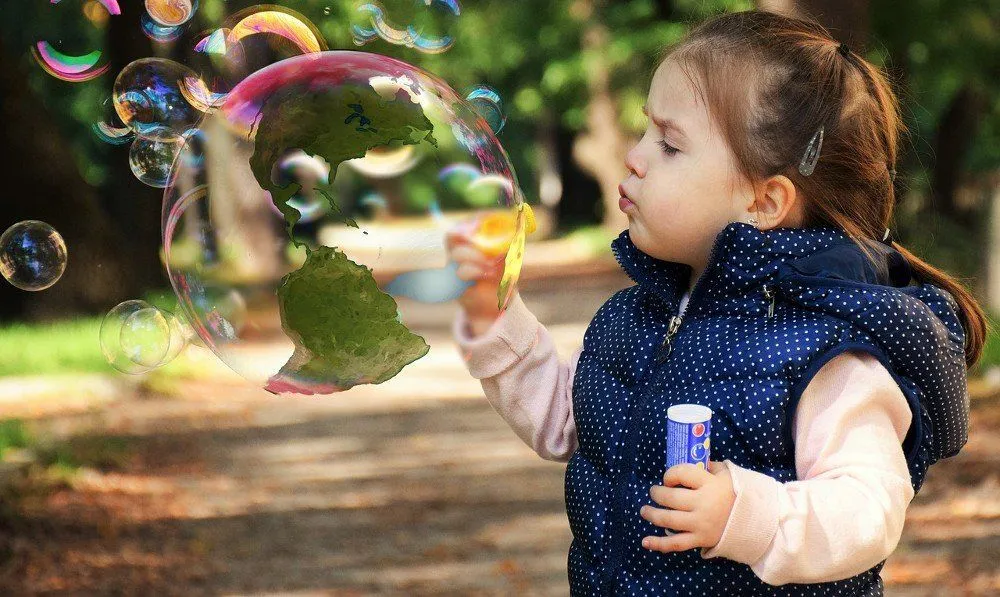
Simply put, you could say that a bubble is just air wrapped in soap film. The soap film is made of water (or some other liquid) and soap.
Soap bubbles don’t last more than a few seconds, and often burst on their own or after coming in contact with something else. Bubbles can pop when they’re poked with something, or even burst all by themselves. The latter happens when the water between the soap film surface evaporates.
Those are some basic things to know about bubbles in general. Now, let’s address the question we posed in the title:
Why Are Bubbles Round?
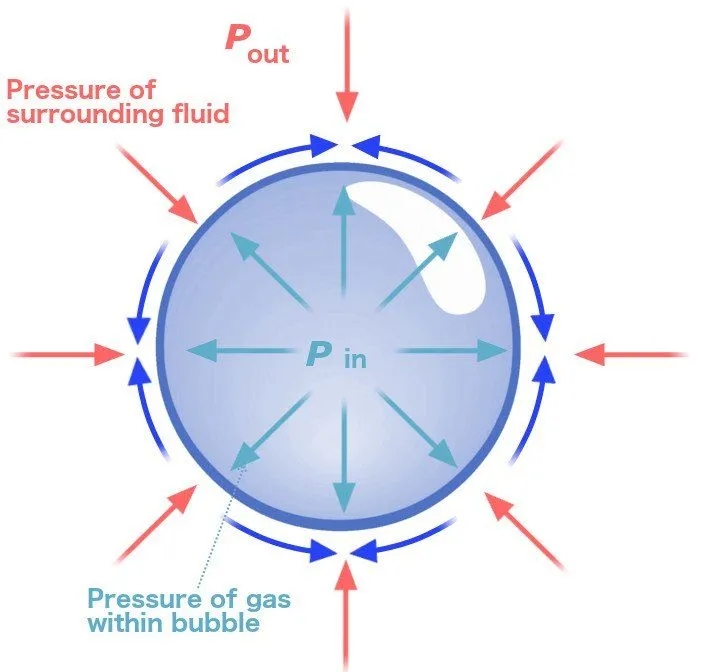
As mentioned earlier, a bubble is essentially a film of soapy water that surrounds a given volume of air. Now, this thin soapy film is made of molecules that have a tendency to pull each other together. The air surrounded by this film is contracted by the film, and since it’s a gas, it exerts an equal force on every surface point that comes in contact with it.
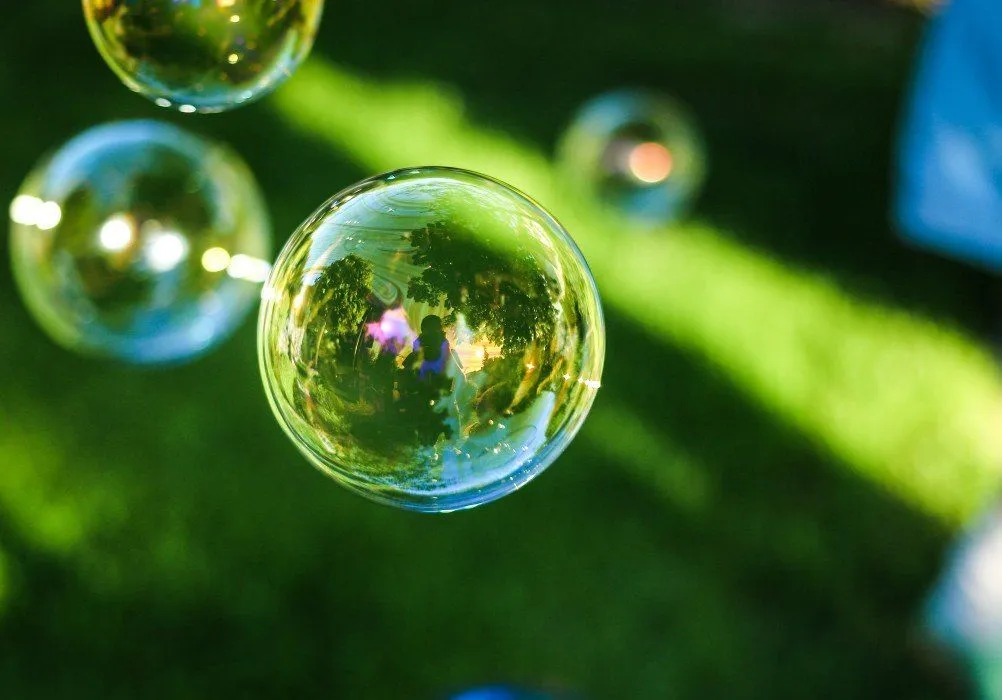
The film goes on contracting until a point is reached when the forces causing the contraction of the film are balanced by the pressure (which causes the air molecules to exert a force on the film) that the trapped air exerts back on the film. At this juncture,the forces exerted and experienced by both parties are in equilibrium.
The resulting shape of such an equilibrium of forces is a sphere, because, mathematically, a sphere is the only shape in which every single point is exactly the same as every other point in the shape. Thus, in a spherical bubble, every soap molecule is pulling on an equal number of surrounding soap molecules.
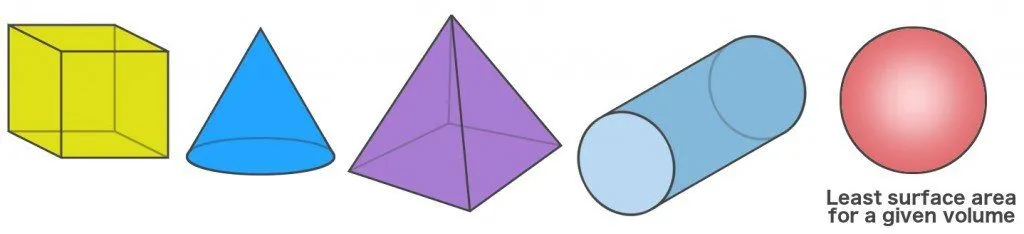
Another way to look at the spherical shape of bubbles is that a sphere is the only shape that can store a given volume (of anything) and retain the smallest surface area. For instance, let’s assume that you have two containers, one of which is spherical and other cubic. Both of these containers can store the same amount of material in it.
If you measure their dimensions, however, you’d notice that the surface area of the spherical container would be less than the cubic one. This applies for every other shape when compared with a sphere; the latter always has the least surface area for a given volume.
In the case of bubbles, the air molecules trapped inside experience a force from the air molecules outside the bubble. They, in turn, also exert an equal and opposite force. Due to this, the air bubbles inside try to cluster together into a shape that minimizes their contact with the outside air. The resultant shape is always spherical and the force that pulls the air bubbles together and keeps them in a spherical shape is referred to as surface tension.
In other words, you could say it’s the surface tension that is responsible for the spherical shape of bubbles.
Why Are Liquid Drops Spherical Too, Not Just Bubbles?
Here’s the thing that surprises a lot of people: a soap bubble isn’t doing anything special. A free droplet of water does exactly the same trick. If you’ve ever watched a dewdrop sitting on a leaf, or the little beads of water that hop around on a freshly waxed car, you’ve seen tiny liquid spheres. The reason is identical to the bubble story above. The molecules at a liquid’s surface are pulled inward by their neighbors, and that pull, surface tension, shrinks the surface until it is as small as it can be for the volume of liquid it holds. The shape with the smallest surface area for a given volume is, once again, the sphere.

The one difference worth noting is what is on the inside. A bubble is a thin film of soapy water wrapped around air, so it has two surfaces, an inner one and an outer one. A liquid drop is solid liquid all the way through, with just a single surface. But the rule that governs the shape is the same in both cases: a surface trying to get as small as possible. That is why textbooks so often lump drops and bubbles together. They are two faces of one piece of physics.
It is also why a raindrop is rounder than the cartoon teardrop we like to draw. A small falling drop is held into a near-spherical ball by surface tension, and only gets squashed when it grows large and air resistance starts to flatten it. We unpack that in detail in our piece on the real shape of a falling raindrop.
Are Bubbles Perfect Spheres?
Almost, but not quite. A small, freely floating soap bubble is an extremely good sphere, because at that size surface tension overwhelms every other force acting on it. But perfect is a strong word, and there are a few situations where a bubble visibly gives up its roundness.
The first is sheer size. As a soap bubble gets bigger, its own weight starts to matter. Researchers who studied giant soap bubbles found that the shape stays close to spherical only up to a certain scale, and beyond that the bubble sags and flattens under gravity, much like a water balloon resting on a table. For a typical soap mixture that flattening only becomes obvious when bubbles approach a few meters across, which is why the everyday bubbles from a wand still look round, while record-breaking giant bubbles droop noticeably at the top.

The second is company. The moment a bubble touches another bubble, the two share a common wall, and that wall is flat (or gently curved) rather than round. Push a crowd of bubbles together into a foam and the round shapes vanish almost entirely, replaced by many-sided cells. There is a tidy rule here: where soap films meet, they always join three at a time, at angles of exactly 120°. Mathematicians proved a related result, the double bubble theorem, showing that two merged bubbles take the least-area shape, three spherical caps meeting along a circle at 120°. Surface tension is still minimizing area; it is just doing it for the whole cluster at once instead of one lonely sphere.
And of course, a bubble clinging to a wand, a straw, or a tabletop is only part of a sphere, because the solid surface anchors one side of it. So the honest answer is that a single, small, free-floating bubble is a near-perfect sphere, and everything else is a tidy compromise.
Do Soap Bubbles Float or Sink?
Watch a bubble drift across a sunny garden and it can look weightless, but most ordinary bubbles are actually very slowly sinking. A bubble is mostly air, yet it also carries that thin shell of soapy water, and the shell adds a little weight. That makes the whole bubble a touch denser than the surrounding air, so gravity gradually wins and it settles downward before it pops.

Whether a bubble rises or sinks comes down to one comparison: is the bubble, shell and all, lighter or heavier than the air it pushes aside? Change the gas and you change the answer. Fill a bubble with a light gas such as helium and it climbs like a tiny balloon. The reverse trick is a classic demonstration: pour a layer of carbon dioxide into a tank and bubbles will hover on top of it without falling in. Carbon dioxide is denser than ordinary air, roughly 1.8 grams per liter versus about 1.2 grams per liter, so an air-filled bubble is too buoyant to sink through it and floats on the invisible CO2 layer instead.
This is the same buoyancy that floats a boat or lifts a hot-air balloon, scaled down to something you can blow with a plastic wand. The bubble does not need to be magical to float; it just needs to weigh less than the air it is sitting in. (And if you have ever wondered why that thin shell eventually gives out, we cover it in why bubbles pop.)
References (click to expand)
- SURFACE TENSION. The Santa Cruz Institute for Particle Physics
- Why are bubbles round? - UCSB Science Line. The University of California, Santa Barbara
- Surface Tension and Bubbles - Hyperphysics. Georgia State University
- The Shape of Bubbles - Exploratorium. The Exploratorium
- (2005) Bursting Bubbles - Stanford University. Stanford University
- On the shape of giant soap bubbles. Proceedings of the National Academy of Sciences (PNAS), 2017. NCBI/PMC
- Double bubble is no trouble - Plus Magazine. University of Cambridge
- Surface tension - Wikipedia
- The Floating Soap Bubble - Chemical Education Xchange (ChemEdX)