Toasting bread is a chemical change, not just a physical one. Once the surface temperature climbs past about 140 °C (285 °F), the Maillard reaction kicks in: reducing sugars (mostly glucose and fructose released from the bread's starch) react with amino acids in its proteins, producing the golden-brown colour and hundreds of new flavour and aroma molecules. At the same time, dry radiant heat drives off the bread's water, leaving a crisp, hardened crust.
Bread, to be sure, is loved by nearly everyone. There are many reasons for its popularity, but for me, it’s indispensable because you can make so many delicious dishes with bread as a key ingredient; its culinary applications are too numerous to list. However, let’s talk about one of the most popular options that bread offers to humanity – toast!
Why does it appear and taste the way it does?
Before you put a slice of bread in a toaster, it has its usual color, i.e., white or brown, but when it pops out of the toaster, it assumes a brownish hue. Not only that, it becomes much more delicious than its basic state. Why does that happen?
Why Does Bread Turn Hard When Toasted?
Bread attains a hardened texture after being put in a toaster, because, well… it ‘gets toasted’. In technical terms, ‘getting toasted’ means that it’s exposed to a considerable amount of concentrated heat inside the toaster. The resultant brown color is the consequence of the Maillard reaction (more details here) that occurs when bread is radiated with heat.
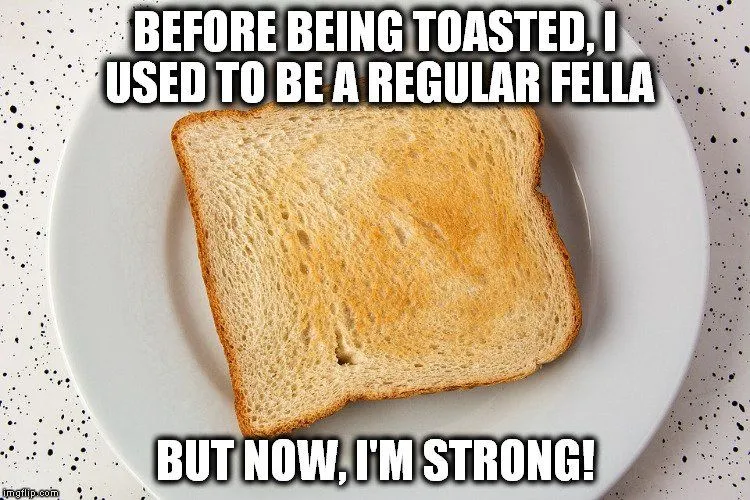
When you put bread in the toaster, the dry heat from the toaster eliminates every trace of moisture from within the slice. As a result, its elasticity disappears. Poof!
This simple physical phenomenon is why toasted bread is harder than regular, plain bread.
Why Does Bread’s Taste Change Upon Toasting?
Now you know why bread gets hard when toasted, but why does it change color and flavor?
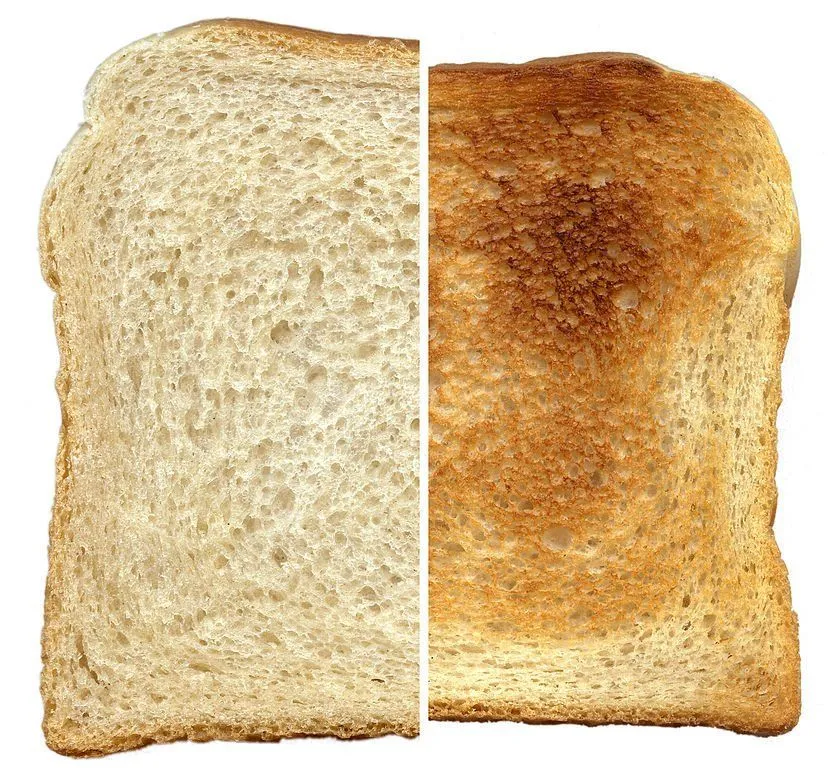
These changes are due to the Maillard reaction mentioned above. In basic terms, it’s a chemical reaction that consists of reducing sugars and amino acids that gives bread its characteristic flavor. You can find applications of this reaction in many day-to-day food items, including condensed milk, roasted coffee, black garlic, french fries and so on.
Bread contains proteins and carbohydrates. Due to the Maillard reaction, the outer layer of carbohydrates and amino acids combine, resulting in a caramelized brown color and that signature flavor of toasted bread. For all of this to happen, you need to heat the bread to temperatures in the range of 120 to 160 degrees Celsius (250-350 Fahrenheit), which is provided by the toaster. You insert a regular, relatively bland slice of bread into the toaster, and out comes a crispy, crunchy and tasty alternative!
Humans have known for centuries that foods take on new aromas and tastes when they turn brown, but it was only in 1912 that French chemist Louis-Camille Maillard figured out the chemistry. He showed that under high heat, the carbonyl group of a reducing sugar (such as glucose, fructose, or lactose) reacts with the amino group of a nearby amino acid to form new compounds that then cascade into hundreds of brown-coloured, intensely aromatic molecules called melanoidins.
It’s interesting to note that while the Maillard reaction occurs fairly quickly when you cook, it can also occur over longer periods of time in foods stored at lower temperatures. For instance, the flavors that ripening cheese develops, are, in part, due to the Maillard reaction. Another example of the Maillard reaction taking a long time is Serrano ham, a raw meat that is dry-cured for a few months to bring out amazing flavors!
Dry Heat Is The Key!
For the Maillard reaction to occur properly, it’s important that the applied heat is ‘dry’ in nature. In other words, no water!
If you want to master the Maillard reaction and use it to your advantage when cooking, you need to create the right ‘environment’ around your food to let chemistry do its thing and bring out the best flavors. You see, the Maillard reaction moves fastest at high temperatures with little moisture, plus neutral to slightly alkaline conditions.
If you use excess water, it either slows or completely halts the Maillard reaction, which is the main reason why boiling doesn’t cause browning in foods, but grilling does.
Therefore, it’s important to get the right conditions in place for the Maillard reaction to work wonders on your recipes.
Next time you crunch into a delicious slice of toast, remember that such a pleasant taste is actually the result of chemical reactions occurring at a microscopic level within the individual particles of bread!
Is Toasting Bread A Chemical Or Physical Change?
This is the question most people actually arrive with, and the short answer is: toasting bread is mainly a chemical change. To see why, it helps to remember the difference. In a physical change, you only rearrange the same molecules. Slicing bread, freezing it, or letting it go stale all leave the same substances behind, just moved around or dried out. In a chemical change, bonds actually break and re-form, and you end up with brand-new substances that weren’t there before.

Chemists list a few classic signs that a chemical change has happened: a new colour appears, a new smell or taste shows up, and the change can’t simply be undone. Toasting ticks every box. The pale slice turns golden-brown, the kitchen fills with that roasted aroma, the flavour deepens, and crucially, you can never turn toast back into plain white bread. Those signs point straight to the Maillard reaction we covered above, in which reducing sugars react with amino acids to build hundreds of new molecules, including the brown pigments called melanoidins. Those molecules are genuinely new chemicals, which is the textbook definition of a chemical change.
So what about the “evidence” teachers ask for? Point to the irreversible colour change, the new aroma compounds, and the formation of melanoidins, none of which existed in the original slice. There is a small physical side too: the dry heat boils off water and stiffens the crust, and that part (losing moisture) is a physical change. But the browning and the new flavour, the things that make toast toast, are chemistry. If you’ve ever burned a slice to a blackened crisp, that’s the same chemical story pushed to its extreme, with the sugars and starches breaking down (charring) rather than simply browning.
Is Burnt Toast Bad For You? The Acrylamide Question
Once you accept that toasting is chemistry, a fair follow-up is whether that chemistry produces anything you should worry about. The compound people ask about is acrylamide. It forms in starchy foods such as bread, potatoes and coffee beans when they’re cooked at high, dry temperatures, roughly above 120 °C (248 °F), which is exactly the territory where toasting happens. Acrylamide is born from the same Maillard chemistry that browns your toast: the amino acid asparagine reacts with reducing sugars, so the deeper the browning, the more acrylamide tends to form.

Is that dangerous? It’s worth keeping a sense of proportion. The International Agency for Research on Cancer classifies acrylamide as “probably carcinogenic to humans” (Group 2A), a label based on strong evidence in lab animals but only inadequate evidence in people. In practice, the food-safety advice is simple and low-stress: aim for a light golden colour rather than a dark, scorched brown. The UK’s Food Standards Agency puts it as cooking starchy foods “to a golden yellow colour, rather than brown.” So you don’t need to give up toast. Just go for golden over charcoal, scrape off any badly burnt edges, and enjoy your breakfast knowing the same reaction that makes toast delicious is one worth keeping on the lighter side.
References (click to expand)
- (2001) A review of Maillard reaction in food and implications to kinetic .... ucanr.edu
- Five things everyone should know about…The Maillard ... - Grow. The University of Wisconsin–Madison
- Changes in Matter: Physical and Chemical Changes. Chemistry LibreTexts
- Burnt food (acrylamide) and cancer. World Cancer Research Fund
- Acrylamide (IARC Summary & Evaluation, Volume 60). International Agency for Research on Cancer