“The two most common elements in the universe are hydrogen and stupidity.” ~ Harlan Ellison
What is the most common thing between fans of Lionel Messi and Cristiano Ronaldo?
It’s not their love and crazed affection for their icons, but rather HYDROGEN.
Hydrogen makes up around 10% of the human body by mass. It is present in the form of water and other organic molecules throughout the body.
So, what we all have in common is hydrogen.
The first element of the periodic table and the most abundant chemical substance in the universe, Hydrogen derives its name from Greek (“hydro” meaning “water” and “genes” meaning “former”), a name given by the French chemist Antoine Lavoisier. Hydrogen constitutes roughly 75% of all normal (baryonic) matter in the universe by mass. Its atomic number (the number of protons present in the nucleus) is 1. It normally exists in its gaseous state under standard conditions. It is a colorless, odorless, and highly combustible element.
The pure form of hydrogen is scarcely present in the Earth’s atmosphere because it escapes the Earth’s gravity quickly, as suggested by some studies. It is mainly found combined with oxygen and water, as well as in organic matter.
There are three naturally occurring isotopes (atoms of the same element having the same atomic number, but different mass numbers) namely Protium (¹H), Deuterium (²H), and Tritium (³H). A fun fact is that hydrogen is the only element whose isotopes have different names that are commonly used. Surely, this element holds a special status in the field of Science!
How Was Hydrogen Discovered?
In 1671, Robert Boyle produced hydrogen gas while studying the reaction of iron with acids, but he didn’t initially recognize it.
Later, in 1766, Henry Cavendish recognized hydrogen as a distinct element when he conducted experiments dissolving metals like zinc, iron, and tin in acids such as hydrochloric acid and sulfuric acid. He collected the resulting gas and showed that it was a distinct substance, a highly inflammable air that he referred to as "inflammable air," which later came to be known as hydrogen. Later, he also showed that hydrogen burns in air to form water. This led to the end of the belief that water was an element. Hence, Henry Cavendish is credited with the discovery of hydrogen.
Why Does Hydrogen Burn With A Popping Sound?
Hydrogen is a highly reactive element. This non-toxic gas is highly combustible as well.
When hydrogen undergoes a chemical reaction with oxygen, that is, when it burns in air, it produces a characteristic popping sound.
Let’s explore the reason behind this unusual sound.
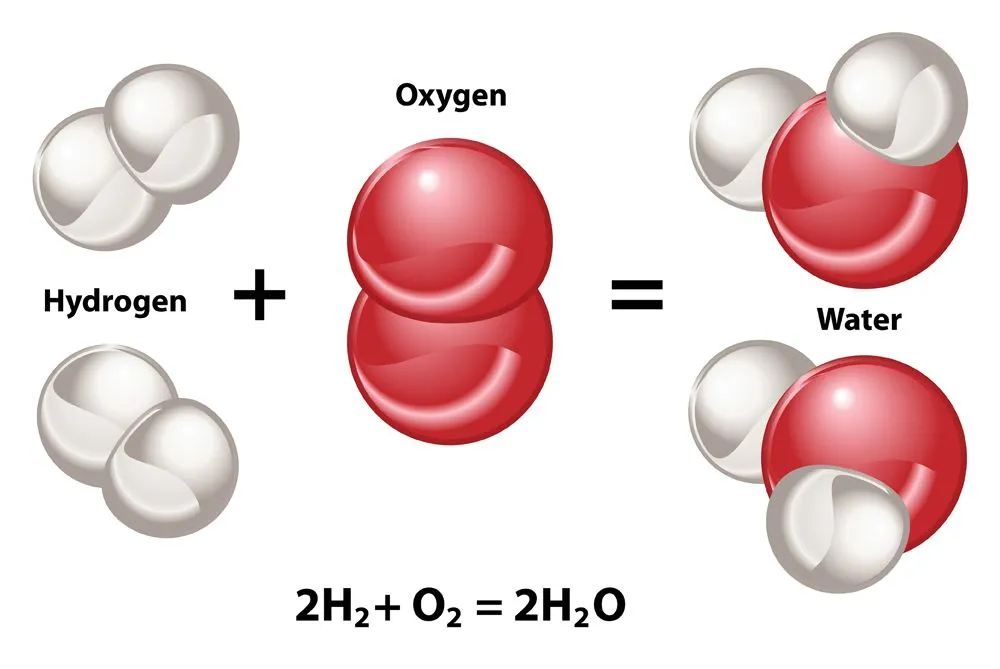
When two molecules of hydrogen combine with one molecule of oxygen, they undergo a chemical reaction to produce two molecules of water, and also release a lot of energy. This reaction is therefore exothermic in nature. Hydrogen is also called “water-former” because of this reaction.
The energy released in this reaction is mostly in the form of heat. This heat imparts kinetic energy to molecules of the gaseous mixture and causes them to expand. The air surrounding the gases also starts expanding very rapidly. This sudden and quick expansion of gas molecules creates a localized pressure wave (a mini shockwave) that travels through the air. When this pressure wave reaches our ears, we perceive it as the characteristic 'pop' or 'squeaky pop' sound. In chemistry, this is the basis of the well-known "squeaky pop test" used to confirm the presence of hydrogen gas: a lit splint placed near a sample of hydrogen will produce a distinctive popping sound.
The loudness of the pop depends on how the hydrogen is mixed with air. A tube of nearly pure hydrogen burns with only a soft, dull pop, because the flame can only consume the gas as fast as oxygen reaches it from outside. A roughly 2:1 mixture of hydrogen and oxygen, on the other hand, has both reactants already side by side, so it burns almost instantly and gives a much louder, sharper report.
What Happens To The Atoms When Hydrogen Burns?
So far we have talked about molecules, but what is actually happening at the level of individual atoms? It turns out the pop is the sound of chemical bonds being rearranged.
Hydrogen gas does not float around as lone atoms. Two hydrogen atoms are joined together into a molecule, written as H2, and oxygen in the air travels as O2. When you bring a flame near the mixture, the heat supplies just enough energy to start snapping these bonds apart. The bond holding each pair of hydrogen atoms breaks, and the bond holding the two oxygen atoms together breaks as well. The freed atoms immediately reshuffle into a new, more stable arrangement: each oxygen atom grabs two hydrogen atoms to form water, H2O. The whole event is summed up by one balanced equation:
2H2 + O2 → 2H2O
Reading it out, two molecules of hydrogen react with one molecule of oxygen to give two molecules of water. No atoms are created or destroyed; the same hydrogen and oxygen atoms simply end up in different molecules. The reason energy pours out is that the new oxygen-hydrogen bonds in water are stronger (lower in energy) than the bonds that were broken, and the difference is released as heat and light. According to the US National Institute of Standards and Technology, forming one mole of liquid water this way releases about 286 kilojoules. That surplus heat is what drives the rapid expansion of gas described above, and therefore the pop.
The Squeaky Pop Test: Step By Step
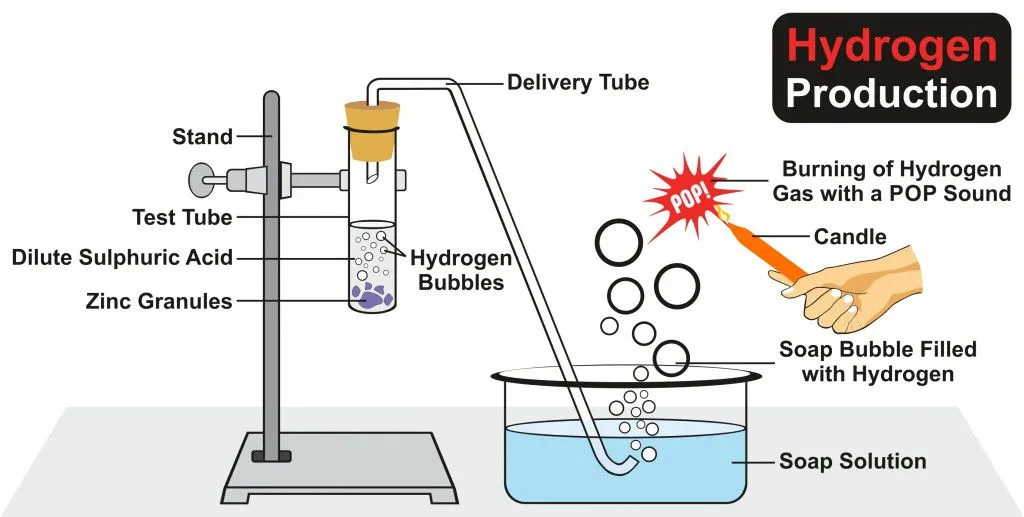
The popping sound is not just a curiosity. It is the standard laboratory test, often called the squeaky pop test, used to confirm that a gas is hydrogen. If you have ever collected gas by reacting a metal such as zinc with an acid, this is how you check what you made.

The procedure is simple:
- Collect the gas in a test tube, holding it upside down since hydrogen is lighter than air.
- Light a wooden splint and let it burn with a small flame.
- Hold the burning splint at the open mouth of the test tube.
- Listen. If the gas is hydrogen, it ignites at once and burns with a sharp, high-pitched "squeaky pop".
The note you hear is the rapid combustion of the trapped hydrogen as it meets the air, producing the same kind of pressure wave described earlier. Hydrogen is flammable across a wide span of mixtures with air, roughly 4 to 75 percent by volume, so the test works reliably even when the tube is not full. Importantly, the test uses a burning splint, not a glowing one. Hydrogen does not relight a glowing splint the way oxygen does; it needs an actual flame to set it off. Because a pure hydrogen flame is almost invisible in daylight (a real hazard NASA engineers once tracked by sweeping a straw broom through the air to find where it caught fire), the sound, rather than the sight, is what tells you the test has worked.

Which Gas Burns With A Pop Sound?
If a question ever asks you which gas burns with a pop sound, the answer is hydrogen. No other common gas behaves quite the same way under a lit splint, which is exactly why the pop is such a handy fingerprint. It helps to line the squeaky pop test up against the two other splint tests you will meet in the same chemistry lesson, because each gas gives a different signal:
- Hydrogen (H2): a lit splint produces a squeaky pop as the gas burns to form water.
- Oxygen (O2): a glowing splint, blown out so only embers remain, bursts back into flame (relights) because oxygen feeds combustion.
- Carbon dioxide (CO2): a lit splint is put out, and bubbling the gas through limewater turns it milky white.
This contrast is the heart of a classic electrolysis demonstration, where water is split into its elements. The tube that collects gas at the negative electrode (the cathode) fills with hydrogen and pops; the tube at the positive electrode (the anode) collects oxygen and relights a glowing splint. The pop, then, is not only an answer to a trivia question. It is one of the simplest and oldest ways chemists have to identify an invisible gas using nothing more than a splint and a good pair of ears.
Some Other Reactions Involving The Emission Of Sound
1) The burning of firecrackers emits sound energy due to the explosive chemical reactions of potassium nitrate, sulphur, and carbon into potassium carbonate, nitrogen, potassium sulphate, and carbon dioxide.
2) Usually, a popping sound is heard while lighting an oxy-acetylene torch because of a blockage or leakage of gas flow in the torch.
The Future Of Hydrogen
Recent studies suggest that hydrogen is a promising source of “clean” fuel for the Earth. Its great abundance in the universe is an added advantage for us. It is already powering the universe through stellar hydrogen fusion processes and proton-proton reactions, just to name a few.
Hydrogen can very effectively serve as a pollution-free fuel, as it has no molecules of carbon in it. It produces water when burned. A tremendous amount of energy can be harnessed from chemical reactions involving hydrogen that could solve the problems of energy deficiency.
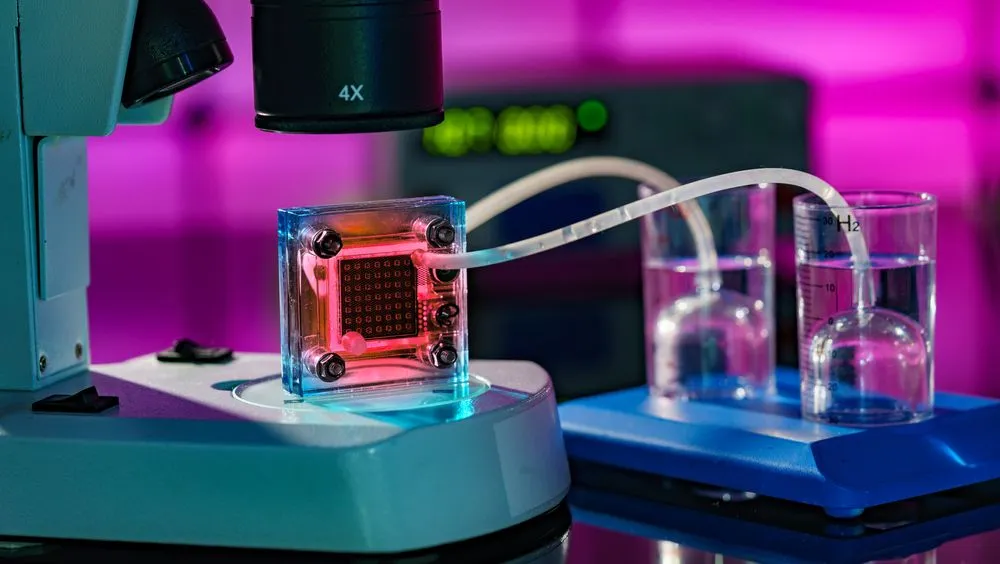
However, it’s not always easy to achieve a great feat. The same is the case with harnessing hydrogen for our benefit. Hydrogen fuel is expensive, which is a major drawback, since industries prefer cheaper fuels. Also, the current process to produce hydrogen itself is not so “clean” or “pollution-free”. Hydrogen for industrial use is mostly produced from natural gas, which generates carbon dioxide (CO2).
Researchers have been working towards finding alternative and more environmentally friendly ways for the mass production of hydrogen. If humankind is successful in discovering and inventing better methods of hydrogen production that would be cost-effective, as well as cleaner and greener, then hydrogen could quench our thirst for unlimited energy for generations and generations. Hopefully, this day isn’t too far away!
References (click to expand)
- Facts About Hydrogen | Live Science. Live Science
- Isotopes of hydrogen | Britannica. britannica.com
- Hydrogen - Element information, properties and uses. rsc.org
- Why does combining hydrogen and oxygen typically produce .... Scientific American
- Combustion of hydrogen in air | Demonstration. Royal Society of Chemistry (RSC Education)
- Water, Condensed phase thermochemistry data. NIST Chemistry WebBook
- Testing for CO2, O2, and H2. Carolina Knowledge Center