Yes, decibels can be negative. The decibel (dB) is a logarithmic ratio relative to a reference value. For sound, the standard reference is 20 micropascals (the threshold of human hearing). Any sound quieter than that reference produces a negative dB reading. The world's quietest rooms, like Microsoft's anechoic chamber, reach roughly −20 dB.
The decibel is a unit of measurement used globally to gauge sound levels in a given environment. It is a logarithmic scale that expresses the ratio of one value of a physical property to another, making it an exponential unit. In the medical field, decibels are associated with normal hearing.
In most urban areas, music cannot be played louder than a certain decibel level after a specific time at night. Certain areas like hospitals or schools are designated as “silent zones,” where noise levels inside and outside the area must not exceed a specific decibel limit. Decibels are primarily used to measure volume in many other places.
However, it varies from standard units such as meters, kilograms, and hertz because the decibel is a ratio between two values.
Decibel Definition
The decibel (dB) is a unit of measurement used to quantify sound levels, signals, communication, and electronics. It can express an absolute value or a change in value (+1 dB or -1 dB). In the former case, it represents the ratio of a value to a reference value.
Despite its widespread use, the decibel is often misunderstood. Unlike kilograms or meters, which are defined quantities of mass and distance, respectively, decibels measure the relationship between two power values. They allow us to comfortably talk about numbers of different magnitudes without dealing with large numbers or scientific notation.
To use decibels, we determine the ratio between the two quantities and convert it into a logarithm. When dealing with power quantities, the number of decibels is ten times the logarithm to base 10 of the ratio of two power quantities.
In simple words, decibels tell you that “10 to the power of this number gives you the ratio of these two quantities.”
For instance, a sound that is ten times more powerful than a reference is +10 dB; one that is one hundred (10²) times more powerful is +20 dB; one thousand (10³) times more powerful is +30 dB.

Why Do Decibels Follow A Logarithmic Scale?
Logarithms are incredibly convenient when dealing with numbers that have large differences, which is why decibels are logarithmic. The human ear can hear a wide range of sounds, and the ratio of the sound pressure that causes permanent damage to the ear to the limit that undamaged ears can hear is over a million.
Due to the vastness of this range, logarithmic units are very useful in certain situations.
How Can The Decibel Value Be Negative?
Decibels are not an absolute measure of sound energy but a comparison with a reference value.
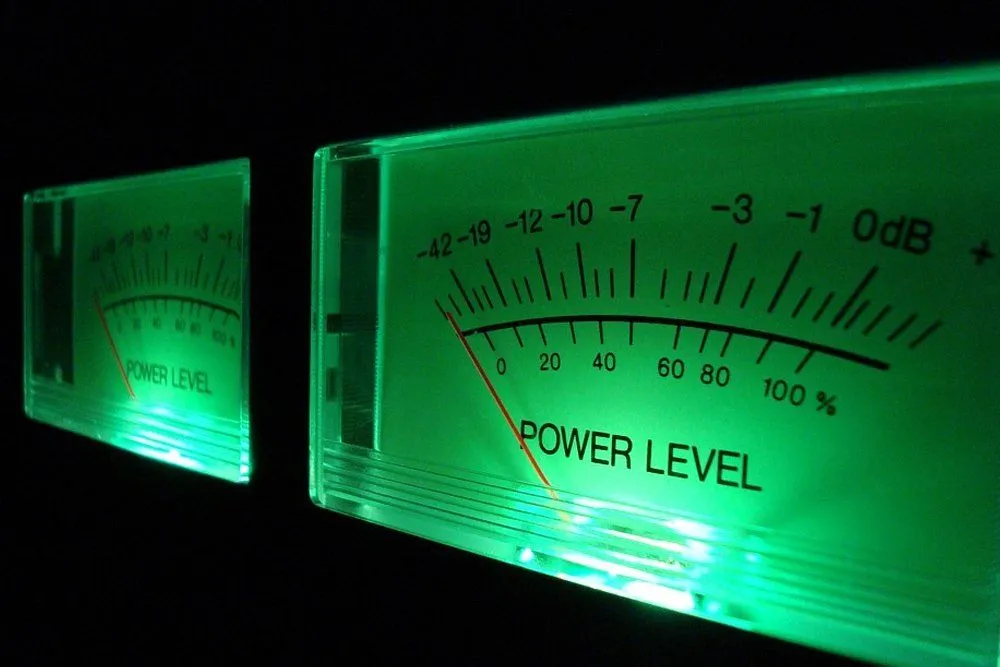
Decibels and the Celsius scale share a common concept. Both scales use 0 as a reference point. In the Celsius scale, 0 represents the freezing point of water. Similarly, in the decibel scale, 0 dB is the minimum sound level that a human ear can perceive without any external assistance.
Specifically, the acoustic 0 dB SPL is anchored to a sound pressure of 20 micropascals (the quietest tone an average healthy young human ear can detect at 1 kHz). If the sound level is positive, the sound is louder than this minimum threshold; a negative dB simply means the sound is softer than that reference. The world's quietest rooms sit well below it: Microsoft's anechoic chamber in Building 87 holds the Guinness World Record at −20.35 dBA (A-weighted), having taken the title in 2015 from Orfield Laboratories in Minneapolis, which had measured −9.4 dBA. Both are far below the threshold of human hearing. The meaning of 0 dB also varies by context: in professional sound equipment (dBFS in digital audio), 0 dB is the maximum level before distortion occurs, so all useful signals are negative.
Because the decibel is a ratio rather than an absolute physical unit, it always implicitly references a baseline; for sound it is 20 µPa, for digital audio it is full-scale, and for radio it might be a milliwatt (dBm). The flexibility is exactly why dB is used everywhere from acoustics and audiology to telecommunications and astronomy.
Are Negative Decibels Louder Or Quieter?
Quieter. A minus sign in front of a decibel reading does not mean "negative sound" or some kind of anti-noise that cancels what you hear. It simply means the sound sits below the 0 dB reference you are measuring against, and the more negative the number, the fainter the sound.
On the sound pressure scale, where 0 dB SPL marks the threshold of human hearing, a reading of −20 dB works out to one-tenth of the reference sound pressure (and one-hundredth of the reference intensity), because every 20 dB step represents a tenfold change in pressure. So a −20 dB room is not silent in any absolute sense. It is simply far quieter than the faintest tone a healthy young ear can normally detect.
Common Decibel Levels (And What Negative Decibels Sound Like)
It helps to see where negative decibels sit on the everyday scale. The threshold of human hearing is pegged at 0 dB, a whisper is around 25 dB, normal conversation lands near 60 dB, and a chain saw screams at about 110 dB. Negative values live right at the bottom, in rare engineered rooms built to strip out almost all sound.
| Sound | Level (dBA) |
|---|---|
| Microsoft anechoic chamber (quietest place on Earth) | −20 |
| Threshold of human hearing | 0 |
| Quiet natural area, no wind | 20 |
| Whisper | 25 |
| Suburban street at night | 40 |
| Household refrigerator | 55 |
| Normal conversation | 60–70 |
| City traffic | 85 |
| Power mower | 107 |
| Chain saw (about 1 m away) | 110 |
| Threshold of pain | 125 |
| Jet engine (about 30 m away) | 140 |

The quietest place ever measured is Microsoft's anechoic chamber in Building 87, which recorded a background level of −20.35 dBA. People who sit inside it describe an unsettling experience: with nothing external to hear, the body's own sounds take over, and you become aware of your heartbeat, your breathing, and even the faint rush of blood in your ears. Some visitors find the absence of any ambient sound so disorienting that they have to sit down, because the brain leans on faint background echoes to help keep its bearings. That is what the far bottom of the decibel scale actually feels like.
Last Updated By: Ashish Tiwari
References (click to expand)
- HEARING LOSS.
- Decibels.
- Decibel Scales: Sound Pressure Level and Sound Intensity ....
- Kumar, S., Bhushan, P., Prakash, O., & Bhattacharya, S. (2018, March 5). Double negative acoustic metastructure for attenuation of acoustic emissions. Applied Physics Letters. AIP Publishing.
- How to Read an Audiogram | Iowa Head and Neck Protocols.
- Acoustics: Introduction to MIDI and Computer Music.
- Decibel Level Comparison Chart. Yale Environmental Health & Safety.
- World's quietest room: 'Anechoic chamber' at Microsoft's headquarters. CNN.