The law of reflection is the principle that when a ray of light hits a surface, the ray of light will reflect off the surface at the same angle as it hit the surface. The angle of incidence is the angle at which the ray of light hits the surface, and the angle of reflection is the angle at which the ray of light reflects off the surface.
The law of reflection (in physics) states that when a light ray is incident on a plane surface, the incident ray, the reflected ray and the “normal” to the surface of the mirror all lie in the same plane. It also states that the angle the incident ray makes with the normal is equal to the angle that the reflected ray makes with the normal.
If you are a tennis player, particularly a good one, you must be quite good at estimating the path that the ball will follow just by looking at the way it was hit by your opponent. If you’re not good at tennis, then you might not be very good in this particular department.
However, we’re not here to talk about tennis. The reason the tennis example was appropriate is that it shows how important it is, in a game like tennis, to be able to predict how a projectile (i.e., the tennis ball) is going to behave. The life and success of a tennis player becomes much easier if they are skilled in those particular predictions.

Law Of Reflection Definition
The law of reflection states that when a light ray is incident on a plane surface, then the incident ray, the reflected ray and the normal to the surface of the mirror all lie in the same plane. Additionally, the angle that the incident ray makes with the normal is equal to the angle that the reflected ray makes with the normal.
Light is known for ‘behaving’ in a very predictable manner, which is actually a very good thing for us. Due to this predictability, we’re able to determine what path it will follow once it strikes a flat surface.
If you observe a single ray of light approaching and bouncing off a flat mirror, you can always tell how the reflected light ray will behave, i.e., what direction would it go and at what angle. This is basically what the law of reflection is all about.
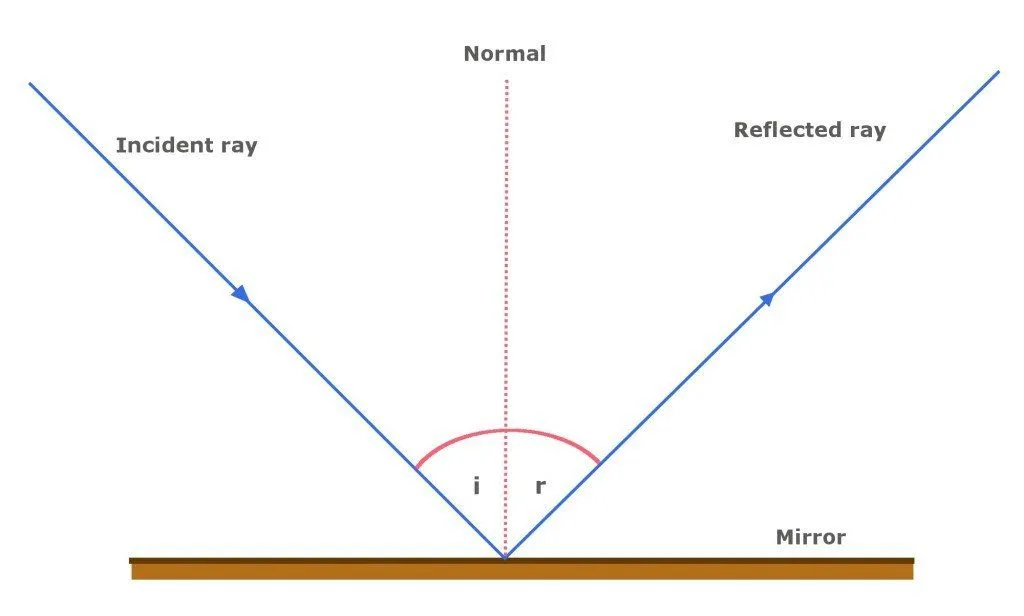
Here’s a diagram to help you visualize the law of reflection a bit better:
Angle Of Incidence And Angle Of Reflection
In the diagram above, the light ray approaching the mirror is known as the incident ray, while the one that bounces off the mirror is called the reflected ray. Note that at the point where the incident ray meets the mirror, a straight line can be drawn perpendicular to the surface of the mirror. This line is called the ‘normal’.
Now, the angle that the incident ray makes with the normal is called the angle of incidence, while the angle that the reflected ray makes with the normal is known as the angle of reflection. The law of reflection simply states that both of these angles have the same value. For instance, if the angle of incidence is 45 degrees, the angle of reflection will also be 45 degrees.
Law Of Reflection Example
There are countless examples where the law of reflection comes into play, primarily because the law of reflection works not only for visible light, but other electromagnetic radiation as well. However, the one example (related to visible light) that we come across almost every day is related to the mirrors we have in our homes.
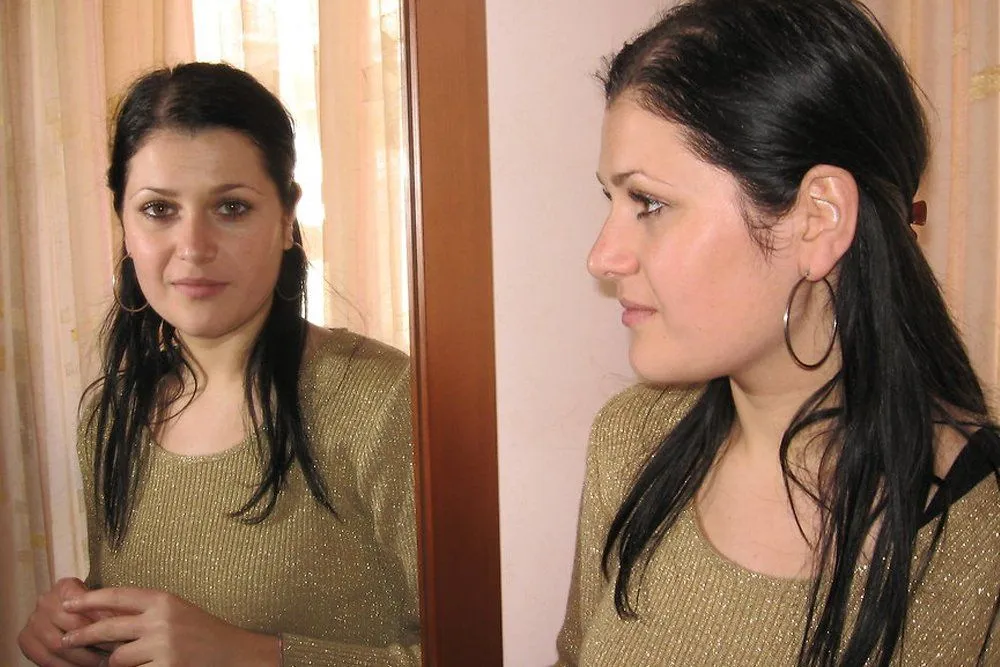
You have probably been in the situation countless times when you’re looking at the mirror, but also talking to someone at the same time… while maintaining eye contact! How does that happen?
Since your eyes are pointed towards the mirror, how can you make eye contact with someone else? Well, quite simply, because it’s not you, but your mirror reflection that makes eye contact with the person to whom you are talking. It’s very similar to the woman’s image pictured above, and is a very good example of the law of reflection at work in real life.
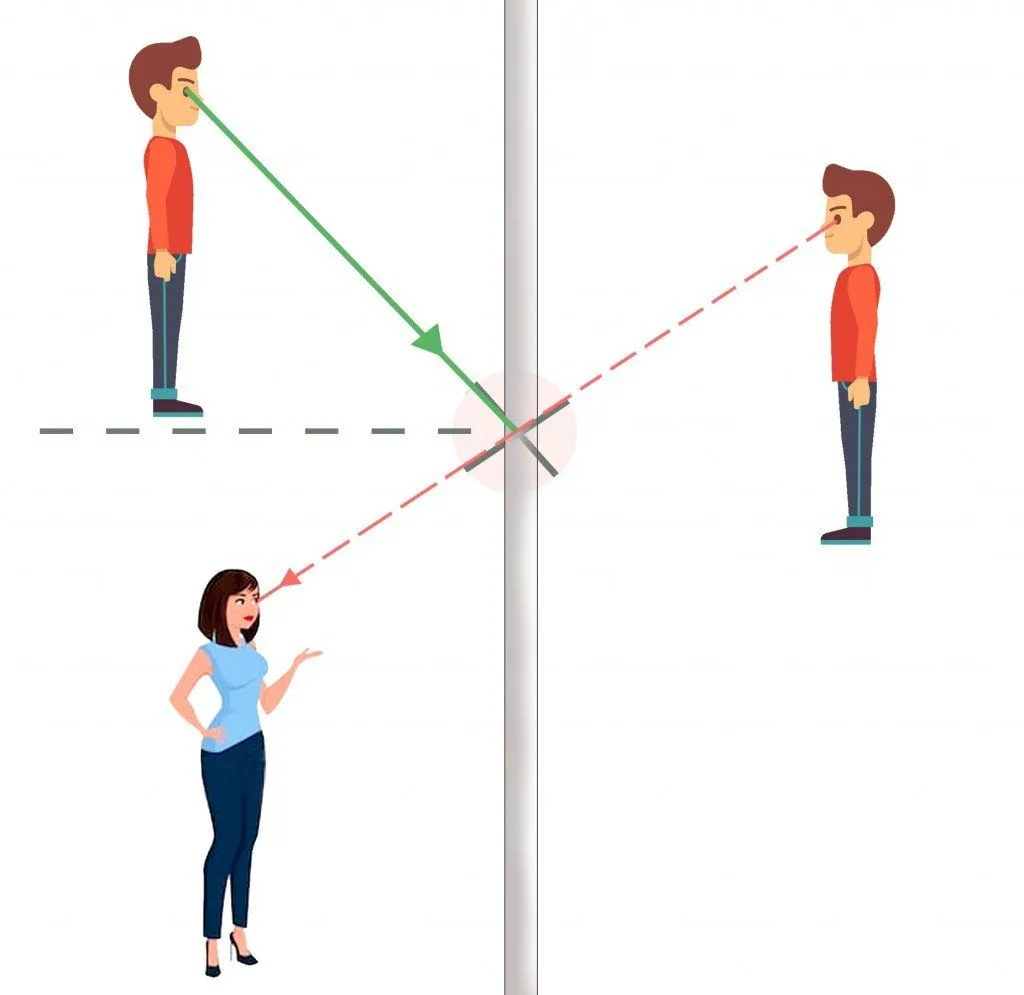
You can make eye contact with someone else through your mirror reflection because you know, subconsciously, that the law of reflection comes into play whenever you look at a mirror. So, when you look into the mirror at a certain angle, your mirror reflection will be able to make eye contact with the other person in the room!
What Are Some Real-Life Examples Of Reflection?
The mirror on your wall is the obvious one, but once you start looking, the law of reflection is at work almost everywhere you turn. Here are a few everyday examples worth knowing:
- The bathroom mirror. When you brush your teeth or fix your hair, you’re looking at a virtual image, the reflection that appears to sit behind the glass. It lies the same distance behind the mirror as you stand in front of it, and directly across from you. The rays bouncing off the smooth surface never actually meet behind the mirror; they only appear to come from there, which is exactly why the image is called ‘virtual’.
- A periscope. The instrument that lets a submarine crew see the surface from below uses two mirrors set parallel to each other, each tilted at 45° to the tube. The top mirror catches light from the scene and turns it through a right angle down the tube; the second mirror turns it through another right angle into the viewer’s eye. Two clean applications of the law of reflection let you see over a wall, or out of the water, while staying hidden.
- A kaleidoscope. Invented by the Scottish physicist Sir David Brewster around 1816, a kaleidoscope is really just two mirror strips touching along one edge. With the mirrors set at 60°, a single object produces six symmetrically placed images; set them at 90° and you get four. Every repeating, symmetrical pattern you see through the eyehole is built entirely from reflections.
- Still water. A calm lake reflects the sky and the shoreline almost like a mirror, because the flat water surface sends rays back in an orderly way. Ruffle that surface with a breeze and the crisp image breaks up, which is a neat preview of the next section.
In every one of these cases the rule is the same: the angle of incidence equals the angle of reflection, both measured from the normal. The clever bit is simply arranging the surfaces to send light exactly where you want it to go.
Specular vs. Diffuse Reflection: Why A Mirror Shows Your Face But Paper Doesn’t
Here’s a puzzle worth chewing on. A mirror and a sheet of white paper both reflect light, yet you see a sharp image of yourself in one and nothing of the sort in the other. If the law of reflection always holds, why the difference?

The answer comes down to the surface, not the law. When a beam of parallel rays strikes a smooth surface like a mirror, every ray meets a surface facing the same way, so they all reflect in the same direction and stay parallel. This is called specular reflection (from speculum, the Latin word for mirror), and it’s what preserves a clear image. ‘Smooth’ here means smooth compared with the wavelength of light, which is why a polished mirror qualifies but a sheet of paper does not.
A sheet of paper, a strip of cloth or a painted wall is microscopically rough. The crucial point that trips up a lot of students is this: each individual ray still obeys the law of reflection perfectly. But because neighboring patches of the surface tilt in slightly different directions, the reflected rays head off at many different angles and scatter. This is diffuse reflection. No single, orderly image survives, so you end up seeing the object itself rather than a reflection of your face.
Diffuse reflection isn’t a flaw; it’s the reason you can read this page from almost any angle and see people, leaves and walls from every side. Most of what your eyes take in all day is diffusely reflected light. Specular reflection is actually the special case, reserved for the handful of genuinely smooth surfaces around you.
References (click to expand)
- Chapter 30 The Law of Reflection - www.farmingdale.edu
- The Law of Reflection - Rensselaer Polytechnic Institute (RPI). Rensselaer Polytechnic Institute
- The reflection and refraction of light - Physics. Boston University
- Reflection and Fermat's Principle - Hyperphysics. Georgia State University
- 16.1 Reflection - Physics. OpenStax (Rice University)
- The Law of Reflection - Physics II. Lumen Learning / Austin Community College
- Periscope - Encyclopaedia Britannica
- Kaleidoscope - Encyclopaedia Britannica
- 3.1: Mirrors (Specular and Diffuse Reflection) - Physics LibreTexts