Table of Contents (click to expand)
- Defining Black Cat
- When Cats Were Revered And Killing Them Was A Serious Crime
- Black Cat Anathema In The Middle Ages
- Cultures With Contrarian Views – Black Cat Is Good!
- What Is The Spiritual Meaning Of A Black Cat Crossing Your Path?
- What About The Direction The Cat Walks?
- What Should You Do If A Black Cat Crosses Your Path?
- Why The Superstition Still Matters (And Costs Cats)
Bad omen surrounding black cat crossing the road or treating bad cat as inauspicious is nothing but superstition.
Even in today’s technological era, in certain parts of the world, thousands of people regard seeing a black cat as inauspicious. If a cat crosses their path, they take it as a decidedly bad omen. Many even cancel their schedules and appointments at the very sight of seeing a black cat crossing their path, for they assume that it will bring unfavorable results to their scheduled events.
Do you know why an apparently innocuous and cute creature like a cat (particularly a black one) is considered so inauspicious in certain cultures and communities? Let’s find out!
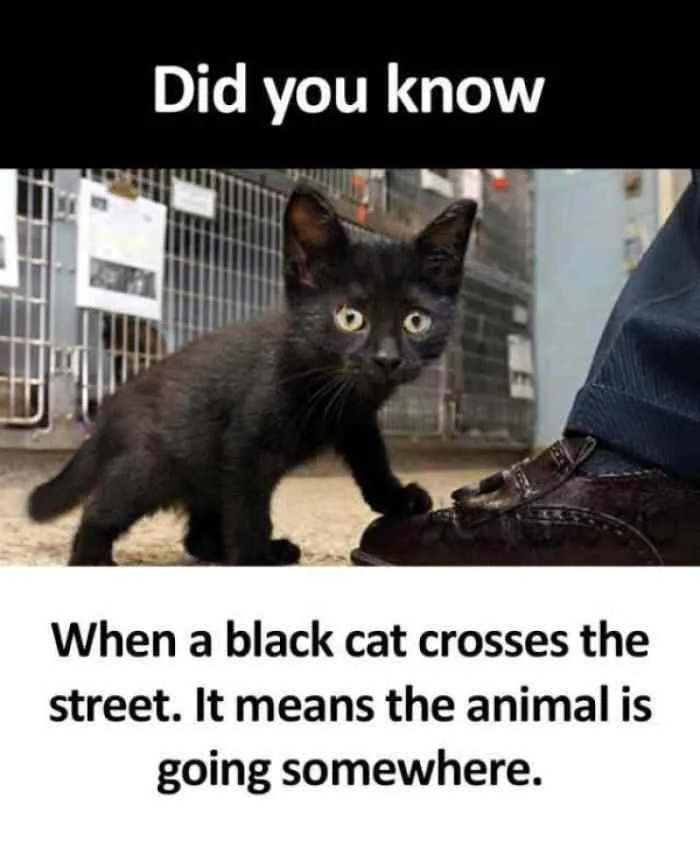
Defining Black Cat
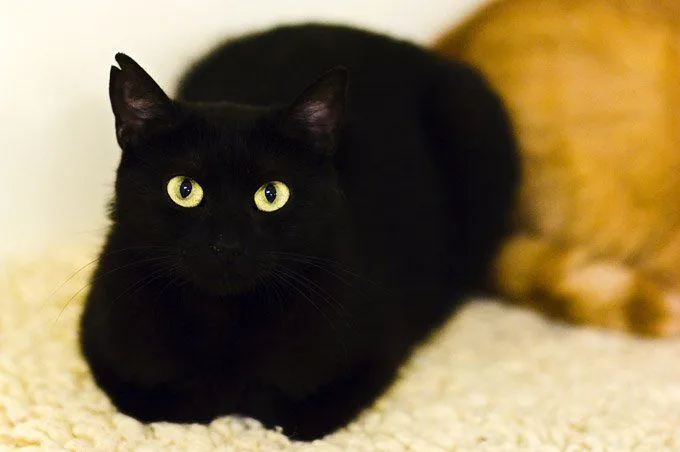
Before I debunk the myths surrounding black cats, let us take an initial biological view of black cats. According to scientific animal classification, a black cat is a cat (often domestic) with black fur, which is an indicator of a mixed or specific breed. Now, according to records from the US Cat Fanciers’ Association (CFA), there are 22 cat breeds that can be associated with black cats.
Bombay Cat
The most striking pure-black breed is the Bombay, developed in Louisville, Kentucky in 1958 by breeder Nikki Horner. She set out to create a domestic cat that looked like a miniature black panther, by crossing sable Burmese with black American Shorthairs. Horner called the result a “patent leather kid with the new penny eyes.” The Cat Fanciers’ Association officially recognized the Bombay in 1970.
What catches our ‘eyes’ when looking at a Bombay is, of course, the eyes. Their copper-gold color is one of the breed’s signature traits. A common myth is that the cat’s deep black fur is what “spills over” into the eyes, but fur color and eye color are actually governed by separate genes. The black fur is produced by the dominant B allele combined with a non-agouti gene that fills the coat with eumelanin; the gold eye color comes from a separate accumulation of melanin in the front layer of the iris. Bombay breeders simply selected for both traits together.
One thing the old folklore got right by accident: in random-bred cat populations, solid-black males are slightly more common than solid-black females, because the orange (ginger) gene sits on the X chromosome. A male needs only one non-orange X to be solid black, while a female needs two.
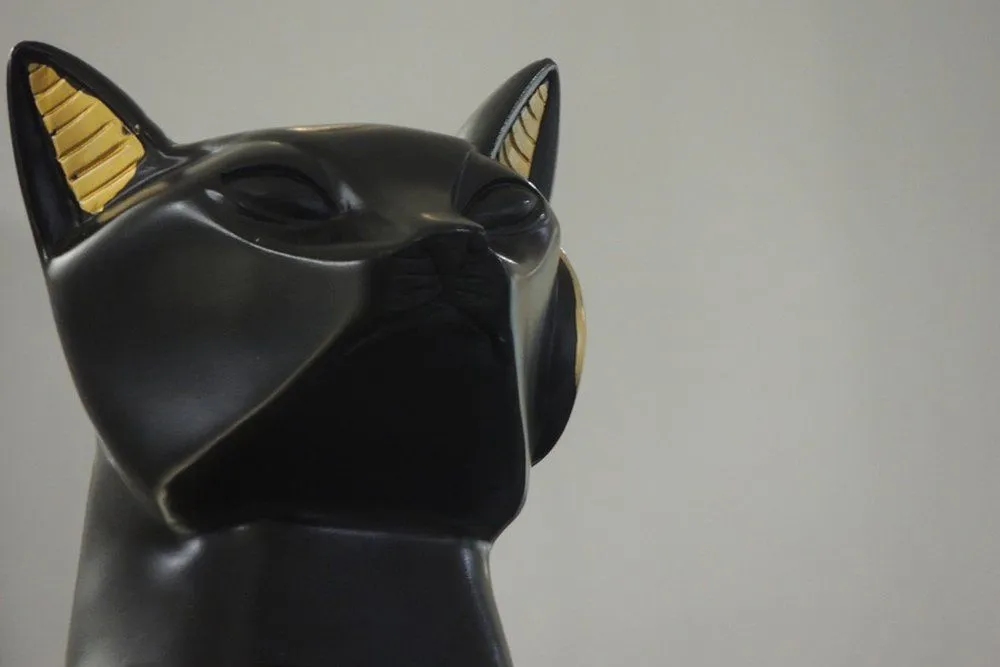
Bastet – Goddess With A Cat’s Head
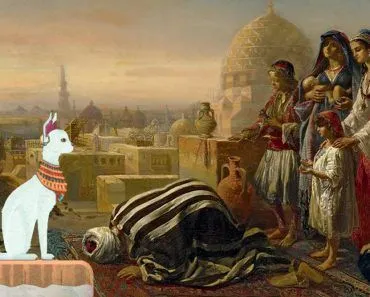
The belief that a black cat brings bad luck is nothing but superstition, but it has very old roots. The ancient Egyptians worshipped a feline goddess called Bastet (also rendered Bast, B’sst, Baast, Pasht, Ubaste, and Baset; the Greeks who later wrote about her simply borrowed their own word for cat, ailouros). Interestingly, Bastet started out as a lion-headed warrior goddess and only gradually “domesticated” into the cat-headed figure most of us picture today, as cats themselves became more domesticated in Egyptian households.
When Cats Were Revered And Killing Them Was A Serious Crime
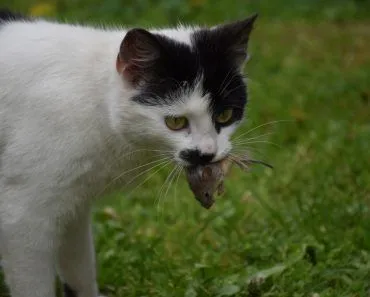
Cats were highly revered in ancient Egypt, partly due to their ability to combat rodents, such as mice, rats and even snakes. Rodents or vermin that make up this delicious diet of cats were abhorred by farmers, as they used to eat crops and other food stock. Cats domesticated in royal family homes in some instances were dressed in gold. They were even allowed to eat from their owners’ plates!
Killing a cat was considered a serious felony. Punishment when found guilty of killing a cat was death. Such was the legacy of Bastet that whenever a black cat died in ancient Egypt, its dead body was preserved like a royal family member as a mummy. Recently, archaeologists have recovered remnants of thousands of black cats from a cemetery in Egypt.
Black Cat Anathema In The Middle Ages
Black cats in western history have often been looked upon as a symbol of evil omens. Most of Europe considers the black cat a symbol of bad luck, particularly if a black cat walks across a person’s path, which is believed to be an omen of misfortune, misery and death.
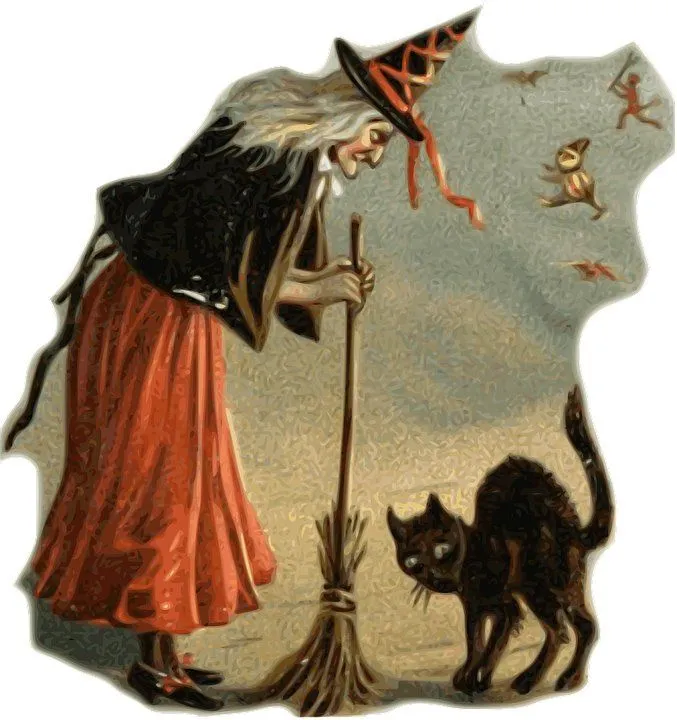
According to European folklore of the Middle Ages, black cats were able to change into human shapes to act as spies or couriers for witches or demons. Witches and mystics used the skulls of black cats to prepare mysterious medicines. As a result, people began thinking of black cats as a sign of Satan. The religiously devout Europeans in the Middle Ages were suspicious of black cats as companions, and thought of them as a part of demon sorcery. Black cats were completely abandoned, and anyone caught playing with a black cat was severely punished or even lynched!
Much of this anti-cat hysteria can be traced to a single document. In 1233, Pope Gregory IX issued a papal bull called Vox in Rama, which described an alleged Luciferian sect in Germany whose initiation rite supposedly involved a giant black cat that came to life from a statue, and whose followers kissed its back. The bull never actually ordered cats to be killed, but it gave the black cat its official place in the medieval imagination as the witch’s and the devil’s companion. Once the association stuck, it carried straight through to the witch trials of the 16th and 17th centuries, including those in Salem, where keeping a black cat could literally be used as evidence against a suspected witch.
Cultures With Contrarian Views – Black Cat Is Good!
That being said, not all the cultures regard black cats with such a miserable view. The Scots have believed for ages that a sudden black cat’s arrival to a room brings prosperity. The Japanese believe that a black cat crossing your path actually brings a good luck. Some people in Germany believe that a cat crossing left to right in the path of a human can bring good fortune.
Many sailors used to carry black cats, as they believed the animals would bring them good luck and ensure their safety during their voyage. In fact, many times, even a fishermen’s spouse would keep black cats with them at home, in the hopes that black cats would protect their husbands at sea!
Hopefully, this article has made you more aware of the myths and superstitions surrounding black cats. Remember that these dark felines are just like any other cats: lovable and playful creatures, and when cared for, can provide years of loving companionship.
What Is The Spiritual Meaning Of A Black Cat Crossing Your Path?
This is one of the most common things people type into a search bar once the moment has passed, and the honest answer is a little unsatisfying: there is no single spiritual meaning, because different cultures have read completely opposite messages into the very same animal. The meaning isn’t carried by the cat; it is supplied by whichever tradition you happened to grow up in.

In Japan, for example, the black cat reads as protective rather than sinister. The country’s famous beckoning-cat charm, the maneki-neko, grew out of an Edo-period legend attached to Gotokuji temple in present-day Tokyo. As the story goes, a cat at the temple gate beckoned the feudal lord Ii Naotaka inside moments before a violent thunderstorm broke, and a grateful Naotaka turned the temple into his family’s patron shrine. The lucky-cat figurine you now see by shop doorways descends from that tale, and you can still buy black ones sold as good-luck charms in their own right.
Celtic tradition went somewhere stranger. Highland folklore tells of the Cat Sìth (or Cait Sidhe), a fairy cat, traditionally described as black, that was widely believed to be a witch in disguise and was linked to the souls of the dead. Older still is the Egyptian goddess Bastet we met earlier, whose cats stood for protection and the home. Set these traditions side by side and the pattern is hard to miss: where one culture saw a demon, another saw a guardian.
So if you are hunting for the true spiritual meaning, the science-minded version is this: the significance you feel is something your own mind assigns after the fact, not a signal the cat is sending. That is precisely why the readings contradict one another from one country to the next, and it is the same reason we cling to superstitions even when we know they are irrational.
What About The Direction The Cat Walks?
A lot of the modern lore tries to refine the basic superstition by adding a direction rule. The version you’ll most often hear in the United States and the United Kingdom is that a black cat crossing from your right to your left brings misfortune, while one crossing from left to right is harmless or even lucky. In parts of Germany, the directions are sometimes reversed: left to right is bad, right to left is good.
The simple answer to all of this: the direction doesn’t mean anything. There is no controlled study, no statistical pattern, and no biological or astronomical mechanism that would let the path of a small mammal across a road change your day. The directional rules are after-the-fact attempts to make a vague superstition feel more specific, and they vary too much from country to country and decade to decade to mean anything coherent.
What can influence your day, of course, is what psychologists call confirmation bias: if you’re primed to remember bad luck after seeing a black cat, you’ll notice your bad luck more, and forget all the times you saw a black cat and nothing happened. Multiple studies on superstition (including work by University of Hertfordshire psychologist Richard Wiseman) suggest that people who consider themselves “lucky” or “unlucky” are mostly responding to their own attention patterns, not to any external signal.
What Should You Do If A Black Cat Crosses Your Path?
Practically speaking, nothing. Keep walking. There is no effect to undo, because the crossing never set anything in motion in the first place. In fact, depending on where you live, you might be expected to do the exact opposite of worry. In both the United Kingdom and Japan a black cat crossing your path is widely taken as good luck, and it is mainly in the United States and parts of continental Europe that the same event gets read as the unlucky version. The folklore can even split inside a single country: Cats Protection, the UK’s largest cat charity, notes the old Yorkshire saying that it is lucky to own a black cat but unlucky to meet one. When a belief reverses itself from one region to the next, that is a strong hint it is tracking local custom rather than cause and effect.

Historically, of course, people who feared the omen did not simply shrug it off. Folklore collections record an assortment of small “cancelling” rituals meant to neutralize the bad luck. One frequently recorded version is to turn over your left shoulder three times and spit over your left shoulder three times; another is to turn around and take a different route so the cat never technically finishes crossing your path. These are best understood as comfort behaviors. They ease the uneasy feeling, which is the only thing the superstition ever really produced in the first place, the same ritual reassurance that keeps some people wary of Friday the 13th. If you want the genuinely useful response, it is the unglamorous one: pet the cat if it is friendly, and get on with your day.
Why The Superstition Still Matters (And Costs Cats)
It would be tempting to dismiss the whole topic as harmless folklore, except for one stubborn fact: black cats sit in U.S. animal shelters longer than cats of any other color. The ASPCA and several university studies have found that black cats are adopted more slowly and euthanized at higher rates than the typical shelter cat. Some of this is photographic (black fur is harder to capture on adoption-listing photos), but some is the long shadow of the medieval superstitions described above.
The same superstition spikes around Halloween each year, leading many U.S. shelters to either restrict black-cat adoptions in October or, more recently, to run dedicated “Black Cat Appreciation Day” events (August 17) to push back against the stigma. So while a black cat crossing your path can’t change your luck, the belief that it can has been changing theirs for centuries.
References (click to expand)
- The Four Faces of Luck. David Aldous, University of California, Berkeley.
- Vox in Rama (1233 papal bull of Pope Gregory IX). Overview and primary-source excerpts.
- Bastet. Encyclopaedia Britannica.
- Bombay. The Cat Fanciers’ Association breed profile (Nikki Horner / Louisville, 1958).
- ASPCA / Petfinder campaign on adoption rates for black cats and dogs.
- What is the story of maneki-neko, the Japanese beckoning cat? Tets Kimura, Flinders University. The Conversation.
- Scottish wildcat mythology and folklore (Cat Sidhe / fairy cat). Trees for Life.
- Cat-sìth (Highland fairy cat folklore). Supplementary overview.
- If a black cat crosses your path. Cats Protection (UK).
- Black cat crossing superstition (turn and spit ritual). USC Digital Folklore Archives.