Table of Contents (click to expand)
A warranty is a written, time-limited promise from the manufacturer to repair or replace a faulty product, like a 2-year warranty on a hard drive. A guarantee is a broader, usually free pledge that the product will work as advertised, and is often tied to a refund (think ‘30-day money-back guarantee’). Both can be legally enforced.
‘A guarantee is better than a warranty. Isn’t it obvious?’
That’s what most people would say if you asked which one was better. These are two most commonly used words in the commercial world; no matter where/what/why you buy, you will be bombarded with these two terms more than you might expect. And yet, a lot of people still don’t understand the differences between the two.
So, let’s deconstruct these terms and look for differences between them.
What Is A ‘Warranty’?
The dictionary definition of the word ‘warranty’ is ‘a written guarantee, issued to the purchaser of an article by its manufacturer, promising to repair or replace it if necessary within a specified period of time’. In other words, it’s a formal promise of the manufacturer to the consumer (of their product) assuring them that, for a given period of time, the quality and performance of the product shall be on par with the expectations of the consumer.
Suppose that while shopping in an electronics store, the salesman informs you that you will receive a warranty of 3 years if you buy the hard drive of a particular brand. This means that the manufacturing company of that hard drive would repair, replace or refund you should the hard drive become dysfunctional within the time span of three years.
What Is A ‘Guarantee’?
A ‘guarantee’ is also a promise of the maker regarding the quality of a certain product to its consumer, only it’s a more comprehensive term and carries more value in customers’ eyes. Although a guarantee may be written into a warranty contract, it’s typically not as well-defined as a warranty.
Imagine if I sold you a product that I made and told you that it had a guarantee of five years. This would mean that I’d be answerable to you in case the product did not perform as expected or if something went wrong with it internally (companies don’t generally guarantee external damages).
The difference between the two can be summarized as:
| Warranty | Guarantee |
| Assurance | Promise |
| Repair | Replacement/Refund/Repair |
Difference Between Warranty And Guarantee
From a purely legal standpoint, there isn’t a significant distinction between a warranty and a guarantee, but there are still a few differences that you should be aware of:
General Perception
Although not technical at all, this is the most important point of distinction between the two. People associate the term ‘guarantee’ with a full refund or replacement of the product itself, whereas a warranty often points in the direction of repairs and maintenance to the same product. Quite predictably, therefore, a guarantee is generally considered better than a warranty in public opinion.
So, if you get a guarantee of a specific time period on a television, you would expect a replacement or a full refund of the TV should it go out of order within a year, regardless of whether you get a written guarantee letter or not. A warranty, on the other hand, is usually associated with the repair/mending of the product within a stipulated time span.
Time Span
A warranty letter clearly states the time period for which the warranty is valid for a given product. That window can run anywhere from 90 days on a budget gadget to a full ten years on a major appliance, with most consumer electronics landing at one or two years. A guarantee, on the other hand, isn’t always so cleanly bounded, with the obvious exception of phrases like a ’30-day money-back guarantee’. It’s more of a generic term that makers lean on to boost credibility (and, by extension, sales). That’s why companies love splashing ‘lifetime guarantee’ across their marketing, even when the small print actually points to, say, a 10-year warranty topped off with the inevitable ‘terms and conditions may apply’.
For instance, consider this:
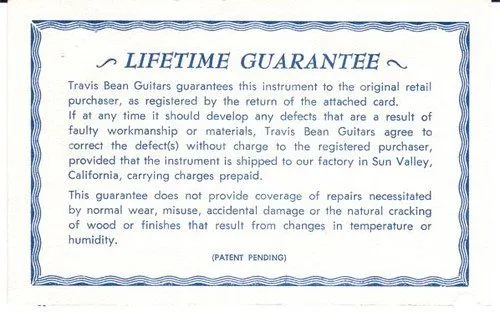
If you read through the terms carefully, you’d realize that this is basically a warranty being called a ‘lifetime guarantee’.
Monetary Perspective
The manufacturer’s warranty that ships with a product is free; in the United States, federal law (the Magnuson-Moss Warranty Act) actually requires a written warranty to be included at no extra charge. What you’re paying for at checkout when the salesperson offers an ‘extended warranty’ on the TV or laptop is, strictly speaking, a service contract, sold separately by the retailer or a third party. A guarantee, on the other hand, is essentially always free.
As A Legal Contract
Both are legally enforceable. A written warranty is the more formal instrument, and in the US the Magnuson-Moss Act lets a consumer sue in court (and recover attorney’s fees) if the manufacturer doesn’t honor it. A guarantee is also a contract: a ‘money-back guarantee’ commits the seller to a refund on request, and advertising regulators (the FTC in the US, the Consumer Rights Act 2015 in the UK) treat those promises as binding too. Skipping either one in court is rarely a good look for a seller.
Although there are definitely plenty of technical ramifications involved in terms of giving assurances on a commercial scale, this brief summary gives you a basic idea about the distinctions and similarities between a guarantee and a warranty. It’s clear that there is no obvious winner here; all you have to do is make sure not to forget to read the ‘terms and conditions’ when buying a product.
References (click to expand)
- Service contracts versus warranties: What's the difference? Michigan State University Extension
- Warranties in the Sale of Goods. Judicial Education Center, University of New Mexico
- Businessperson's Guide to Federal Warranty Law. U.S. Federal Trade Commission
- 16 CFR Part 239: Guides for the Advertising of Warranties and Guarantees. Electronic Code of Federal Regulations