Table of Contents (click to expand)
Golf balls have dimples to reduce aerodynamic drag. As the ball flies, the dimples trip the airflow into a thin turbulent boundary layer that clings to the surface longer and delays separation. This shrinks the low-pressure wake behind the ball, roughly halving its drag, so a dimpled ball travels nearly twice as far as a smooth one.
Here’s a fun fact: back in the early 17th century, people actually played with golf balls made of wood. The wooden design gave way to the “featherie,” a leather pouch stuffed tight with boiled feathers, which remained the standard for more than two centuries. In 1848 it was replaced by the smooth “gutty,” a ball molded from gutta-percha (the dried sap of a Malaysian tree). And here’s where it gets interesting: golfers noticed that an old gutty, once it was nicked and scuffed up from play, actually traveled much farther than a brand-new smooth one. Ball makers took the hint and began hammering deliberate marks into the surface, and in 1905 the Englishman William Taylor patented the now-familiar dimple pattern.
Thus, the era of dimpled golf balls dawned.
The Golf Ball

In order to be used in official matches and tournaments, a golf ball must meet certain criteria: its diameter must be at least 42.67 millimeters (1.68 inches) and its weight must not exceed 45.93 grams (1.62 ounces), as set by the USGA and R&A. It should also have a pattern of depressions or ‘dimples’ on its surface, usually somewhere between 300 and 500 of them (there are a few other requirements as well). While the former two requirements seem perfectly logical, it’s the last one that strikes most people as a bit odd.
Why Do They Need To Put Dimples On Golf Balls?
Well, we answered this already – when it was first observed that scuffed-up balls or those with irregularities on their surface traveled farther than new, smooth ones, golf balls underwent a structural change and dimpled golf balls came onto the scene. However, why do dimpled balls travel faster than smooth ones? Let’s find out.

Anything that moves through air faces a number of forces; the flight of a golf ball involves two principal forces – lift and drag. While drag is a resistive force that slows the ball down as it moves, lift provides an upward force on the ball, making it go higher. To ensure that your golf ball goes farther and higher, you want to reduce drag while increasing lift.
As soon as the ball is hit, it goes airborne and air starts flowing over its contours of the front side, and eventually separates from the ball at its back side. Since the ball is moving at such a high speed, it creates a region of turbulence in its wake where the air pressure is low, due to the fluctuation in air flow. It’s this region of turbulence that makes all the difference in the way the ball moves.
Now, let’s look at the nature of airflow in a smooth and a dimpled ball, respectively.
Smooth Golf Ball
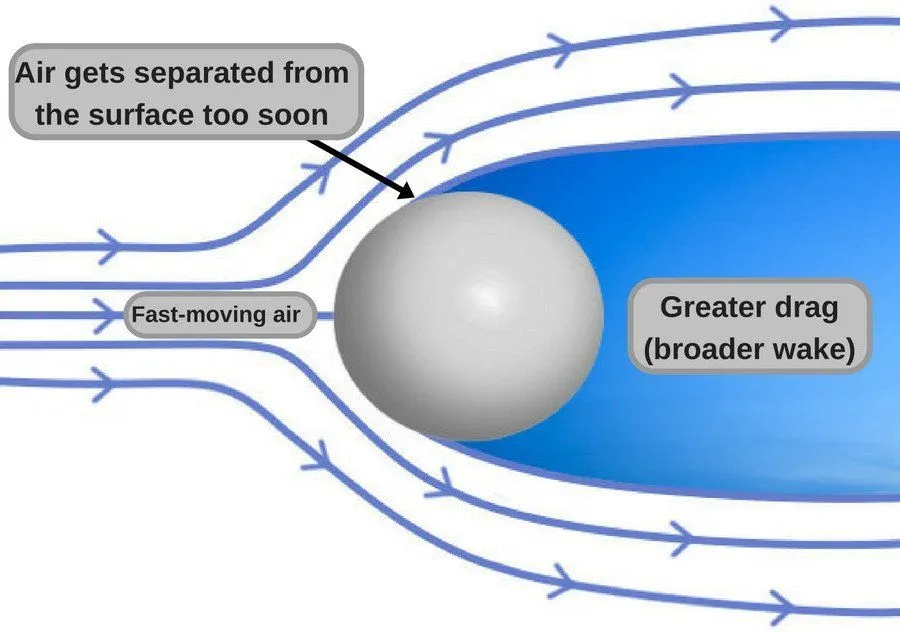
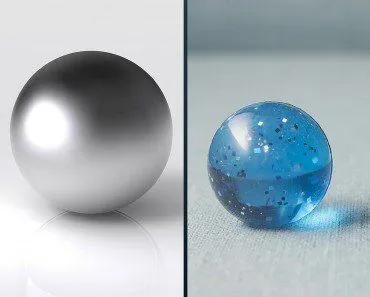
As you can see in the image above, the air that comes in contact with the front part of the ball separates quickly on the back side, resulting in a much wider wake behind the ball. A bigger wake means a larger area of low air pressure, which means higher drag. A sort of suction is created in that region, which pulls on the ball and greatly resists its forward motion, hence reducing the ball’s speed.
Dimpled Golf Ball
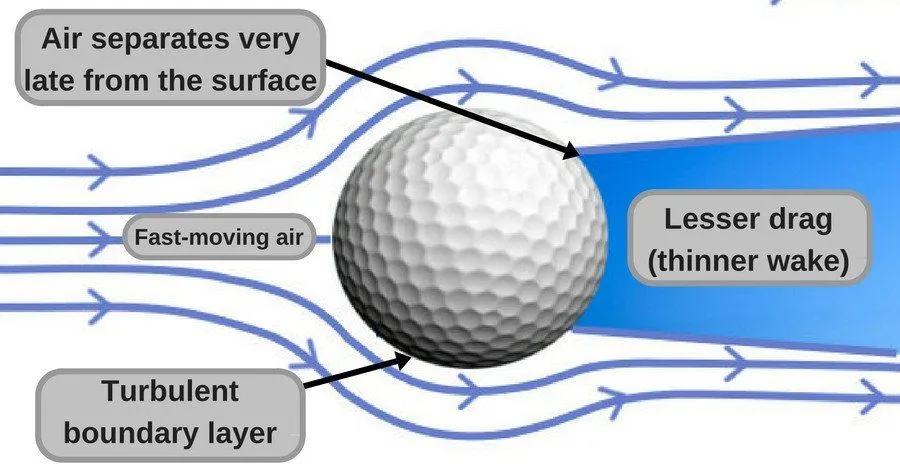
In a dimpled ball, however, the airflow changes drastically. The dimples trip the thin layer of air hugging the surface (the ‘boundary layer’) into turbulence. That might sound like a bad thing, but a turbulent boundary layer actually carries more energy, so it clings to the curved surface for longer and separates much later, near the back of the ball rather than near its middle. Therefore, a much smaller wake is created behind the ball, which reduces drag, i.e. the backward pull on the ball. The turbulence adds a touch of friction drag, but the drop in pressure drag is far larger, so the ball comes out well ahead. In fact, a dimpled ball has roughly half the drag of a smooth one, which is why it can travel nearly twice as far.
Lift Generated By A Dimpled Ball
A dimpled golf ball not only holds its speed better than a smooth one, but it can also attain more lift, provided there is significant backspin on the ball. Backspin makes the air move backwards faster on the top of the ball than at the bottom, thanks to the dimples. Again, this dimple design creates a region of low pressure above the ball and one of high pressure below the ball, which provides more lift to keep the dimpled ball airborne a little longer. Roughly half of that lift comes from the backspin itself, and the other half from the dimples sharpening the pressure difference.
Here’s an interesting video of the United States Golf Association (USGA) explaining the role of dimples on golf balls:
Before we finish, here’s a quick question: if dimples help reduce drag and provide a bit of lift, then why don’t airplanes, choppers and automobiles also have dimples on their exteriors?
Well, there’s a reason behind that too, but that’s a topic for another day.