Table of Contents (click to expand)
No language is objectively easy or hard. The difficulty depends on how closely it resembles your native tongue. For English speakers, the US Foreign Service Institute rates Spanish, French and other related languages as easiest (roughly 600 to 750 hours of study), while Arabic, Mandarin, Cantonese, Japanese and Korean are the hardest (around 2,200 hours).
If you have ever traveled abroad to a country where a different language is spoken, you know how difficult it can be to navigate the world without the power of words. Obviously, in our globalized world where international travel is common, learning more than one language is a major advantage. While you may have studied another language during high school or college, your options for which language to choose from were probably quite limited.
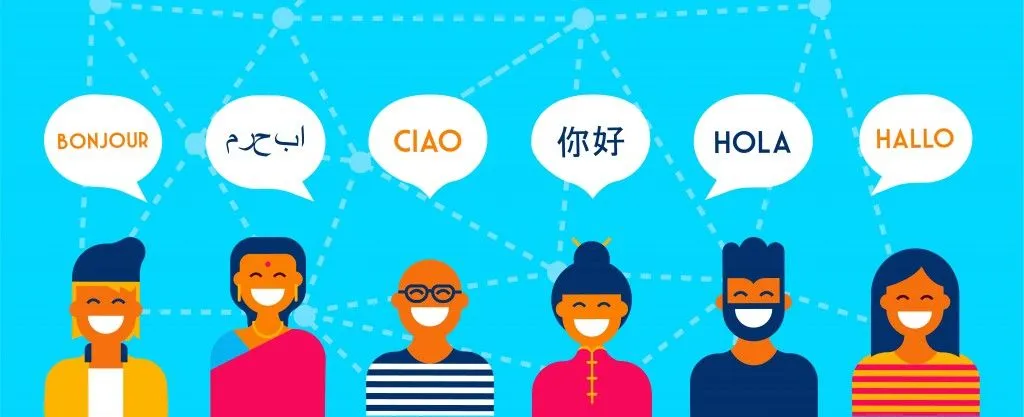
However, there are more than 7,000 languages spoken in the world, ranging from languages spoken by more than a billion people (Mandarin Chinese) to languages spoken by fewer than 1,000 people in remote areas of our planet. People who are eager to expand their language skills often wonder what the “easiest” language is to learn, but that answer (as usual) is not as simple as you might expect!
How Do We Learn Language?
As you are likely aware, researchers have found that it is easier to acquire language skills as a child than it is as an adult. Additionally, it is much easier for a child to learn a second language, particularly before the age of 7 or 8, than it would be to learn that same secondary language later in life. The reason for this childhood advantage is the plasticity of the brain, meaning its flexibility and adaptability. Basically, during the first few years of life, our brains are processing an incredible amount of inputs and stimuli as we “learn” about the world. The brain is like a sponge, and can create and strengthen neuronal pathways quite easily. This makes the code of language somewhat easier to crack when we’re young.

Through observation, listening, mimicking and repetition, children are able to start speaking in their native language (the language spoken in the home and to them) often within the first 12-18 months of life. While every child develops at a slightly different speed, there is no denying that language is acquired quite rapidly in those youngest years. The zones of our brain that are engaged in this process include the Broca and Wernicke areas, including parts of the temporal and parietal lobes. When you observe brain scan activity during language analysis or learning, you can see the complex network of neural connections needed to listen, process and understand language, both written and spoken. This requires both the right and left hemispheres to decipher the syntactic, semantic, and sentence-level meaning of what is said.
Over time, our ability to understand and produce our first language becomes like second nature, because those pathways were created and solidified based on that particular conception of language. Similarly, if you learn a second language during those early years, your brain will have the flexibility to absorb and imprint that additional linguistic knowledge. Note: to retain those secondary language skills, they must be practiced or refreshed as you grow up.
Once we grow past childhood, however, myelination of the brain increases, solidifying our neuronal pathways in place, making it more difficult to acquire language.
What Makes A Language Difficult?
Aside from our physical and cognitive limitations in acquiring language once we’re older, many people assume that some languages are inherently harder to learn than others, but in truth, it’s all relative! More specifically, the difficulty of learning a language is directly correlated to its similarity to your first language, and the logical, semantic, and syntactic pathways you have already established.
For example, if you are a native English speaker, the idea of learning Mandarin Chinese or Russian may seem like an incredible challenge, but if you are a native Vietnamese speaker, then learning Chinese would be more intuitive (as they are both analytic languages). Similarly, a Russian speaker might struggle to learn French or German, but picking up Ukrainian as a second language would be quite simple (as Ukrainian and Russian both belong to the East Slavic branch of the Indo-European language family).
The six largest language families in the world are Niger-Congo, Austronesian, Trans-New Guinea, Sino-Tibetan, Indo-European, and Afro-Asiatic. Learning languages from within the same language family is often considered easier, because they will likely share some fundamentals, i.e., cognates (words with a shared origin that often sound or look the same), grammar and conjugation rules, tonality vs non-tonality, gendering, formality levels etc.
If you are trying to learn a new language that varies widely from your native language in relation to these basic linguistic elements, you’re going to struggle! Tonality in language is often considered the hardest obstacle to overcome. In languages such as Vietnamese, Thai, Mandarin or Zulu, the meaning or use of words may differ based on their tone (pitch) and movement on each syllable. In other languages, the accent/stress placement within a word can change its meaning. These nuances can be difficult to master for people whose first language is non-tonal (i.e., English, French). In non-tonal languages, changes in tone suggest something about the emotional state of the speaker, but do not change the meaning of the word being spoken.

Moreover, languages that are “smaller”, meaning that they have less complexity of vocabulary, tend to rely more on tonality and inflection, whereas “larger” languages are often easier to piece together in a strict template based on word placement and vocabulary, like a puzzle. For example, in Mandarin (which has four tones, plus a neutral one), the single syllable “ma” can mean “mother”, “hemp”, “horse” or “scold” depending on the pitch you give it. In English, those would simply be four different words. In answer to the original question of the article, the easiest languages to learn will be those that are fundamentally similar to your own, in terms of grammar, vocabulary, mouth shape, tonality, gendering of nouns, formality distinctions, and syntax.
A Final Word
If you are hungry to stretch your brain and widen your language skills, regardless of age, it is possible to master a new language. The US Foreign Service Institute, which trains American diplomats, puts a rough number on this for English speakers. Closely related languages such as Spanish, French, Italian and Dutch take about 600 to 750 hours of study to reach professional working proficiency, while the “super-hard” languages (Arabic, Mandarin, Cantonese, Japanese and Korean) take around 2,200 hours. Notably, those hardest languages do not all come from one family. Mandarin and Cantonese are Sino-Tibetan, Arabic is Afro-Asiatic, and Japanese and Korean sit largely on their own, so the difficulty comes from how far each one is from English rather than from any single trait like tone. While those numbers seem daunting, language learning can be a lifelong hobby. To understand which languages will be the most accessible to you, as a learner, look into the major language families. Read about the unique fundamentals of a language and determine whether your brain is ready to forge some new pathways!
References (click to expand)
- Foreign Language Training. Foreign Service Institute. US Department of State. state.gov
- Isolating language. Encyclopaedia Britannica. britannica.com
- De Houwer, A. (2019, January 24). Bilingual Language Acquisition. The Handbook of Child Language. Blackwell Publishing Ltd.
- Bowerman, M.,& Levinson, S. (2001). Language Acquisition and Conceptual Development (Language Culture and Cognition Book 3). Cambridge University Press
- Janson, T. (2002). Speak: A Short History of Languages. OUP Oxford
- Hao, Y.-C. (2012, March). Second language acquisition of Mandarin Chinese tones by tonal and non-tonal language speakers. Journal of Phonetics. Elsevier BV.