Table of Contents (click to expand)
To break the sound barrier, an object must fly faster than the speed of sound, about 1,235 km/h (767 mph) at sea level and a bit slower at altitude. It takes a powerful engine and sturdy materials to push past the drag that spikes near that speed, but with both, breaking the barrier is routine. Humans have been doing it in aircraft since 1947.
When you are told that there is a barrier blocking your path, one naturally assumes that there is some sort of physical obstruction making it impossible or more difficult to pass. If you’re a fan of aeronautics or have the need for speed, then you’ve likely come across the phrase “sound barrier”. Basically, the sound barrier is the speed of sound, so any object or person going faster than the speed of sound has effectively “crossed” the sonic barrier.
 These seem like rather abstract distinctions, so let’s get down to concrete details. What is the sound barrier and how does one break it? More specifically, does it require any additional force or effort to cross?
What Is The Sound Barrier?
The sound barrier is the common name for the increasing amount of drag that any object or aircraft experiences as it approaches the speed of sound. The speed of sound, more specifically, is the maximum rate at which vibrations can move through the air as sound. As an object moves through the air, it generates sound waves, which will propagate in every direction, including in front of the plane. The faster an object is moving, the closer it is to the speed of sound, so it is essentially “catching up” to the noise that it is generating! The “barrier” of sound refers to the higher level of drag and friction present at such great speeds, which can be exceeded, but it takes a great deal of effort!
It is easier to imagine this phenomenon in the sense of something more tangible, such as the waves that form in a lake when an object moves through it. If you drop a rock, it will create waves moving outward in concentric circles. However, if you are sailing a boat, you will notice that the boat will create waves that propagate in front of its direction of movement, i.e., in front of the boat. Similarly, when an aircraft or any other object flies through the air, the sound waves in front of the plane move out of the way, forming tight “waves” in front of the object.

Now, when the speed is increased in these situations, something very different happens. When a speedboat races across a placid lake, the water in front of the boat cannot get out of the way in time, so the waves are unable to propagate; instead, they combine and the energy manifests as a large wake left behind the boat after it passes by. Translate this situation into the air; when an airplane exceeds the speed of sound (about 1,235 km/h or 767 mph at sea level, though it drops to roughly 1,060 km/h or 660 mph up at cruising altitude, where the air is colder), that tightening wall of sound waves is left behind the moving object, like a wake. Just as the wake behind a boat is often more powerful than the small individual waves that compose it, the wake of sound waves left behind a plane comes in the form of a “sonic boom”.
Is It Hard To Cross The Sound Barrier?
As mentioned above, the term “barrier” is a bit of a misnomer when discussing the speed of sound, but crossing that barrier can be quite difficult. In the past, in fact, it was believed that the speed of sound was the ultimate endpoint of human flight. In earlier models of airplanes, the extreme pressure changes at high speeds, and the remarkable force of moving air, would result in accidents, loss of flight control, or even physical destruction of the aircraft. Basically, if you flew fast enough, your plane would begin to tear apart.
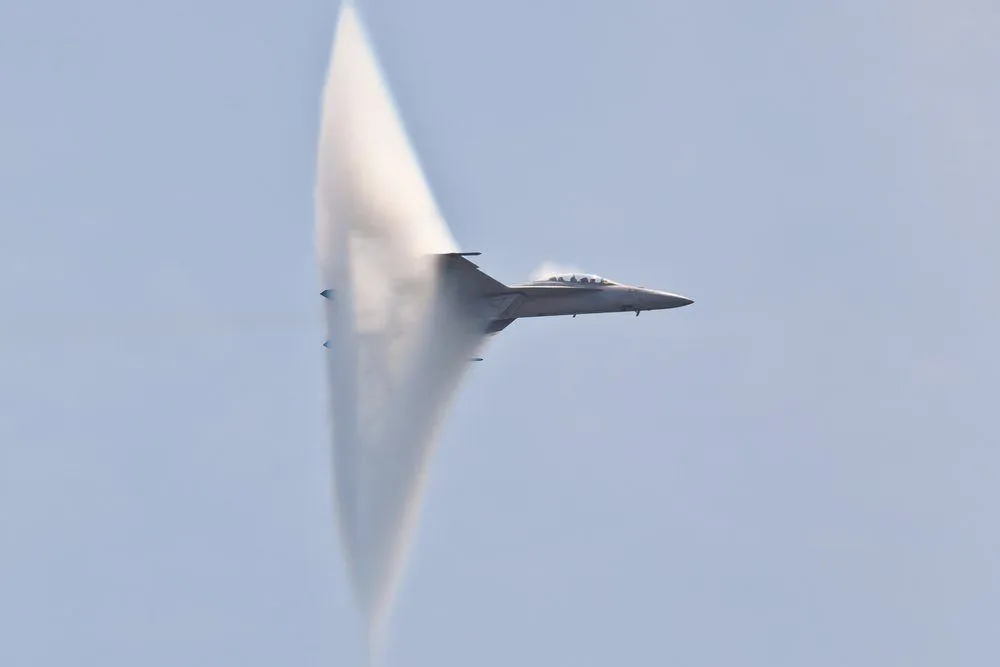
However, with the advent of sturdier building materials and a more precise knowledge of aeronautical engineering and fluid dynamics, it became possible to create a more durable aircraft that could exceed the speed of sound, and thus, humanity’s fascination with sonic booms was born. Interestingly enough, humans had been hearing tiny sonic booms for centuries; the crack of a whip comes from the tip actually moving faster than the speed of sound, resulting in a small sonic “burst” that we hear as a terrifying “crack!”
 In specific answer to the question, yes, it is hard to cross the sound barrier, but with a strong enough engine powering the flight, and sturdy enough materials, it is quite normal to break the sound barrier. The first person to do it in level flight was US Air Force test pilot Chuck Yeager, who pushed the rocket-powered Bell X-1 past Mach 1 on October 14, 1947. Humans have regularly been breaking the sound barrier in various aircraft ever since. Even so, hearing a sonic boom echo through your city when an Air Force jet blows past can still be a shock!
What Happens When You Exceed The Speed Of Sound?
When a pilot blows past the speed of sound, it literally means that the plane is moving too fast to hear the noise that it’s making! Despite the sonic boom generated by the plane (which can sound like a tragic explosion!) the transition from subsonic to supersonic speed can actually be quite smooth for an aircraft.
However, when you cross this barrier, air pressure and fluid dynamics work slightly differently; the center of pressure will shift backwards, which could result in a loss of control if it doesn’t remain in balance with the center of mass. Pilots who fly at supersonic speeds understand that even the smallest errors can result in disaster. Fortunately, given the multimillion dollar aircraft criss-crossing the skies these days, the potential for human error has been removed as much as possible. The cost and complexity of supersonic travel have long limited its appeal for the mass market. The most famous attempt to sell commercial flights at that speed was the Concorde, which cruised at about Mach 2 from 1976 until it was retired in 2003, grounded by high running costs, dwindling passenger numbers, and the aftermath of its only fatal crash. No supersonic airliner has carried paying passengers since, though several companies are now racing to bring one back.

In terms of the risk of supersonic travel on the human body; it can handle any constant speed, but it cannot handle heavy acceleration. Inside an aircraft, the effects of different acceleration will be experienced, but most humans can withstand/survive sustained force anywhere from 4-6G. Without the protection of an aircraft, such as the case of someone like Felix Baumgartner, who in 2012 jumped from a record-breaking 38,969 meters (127,852 feet) above the Earth, the dangers are more real. If the body fails to fall steadily, and instead begins to rotate around a central axis at that speed, it could cause the blood to pool in the head and feet, resulting in a loss of consciousness. If the pressure of the blood in those two extremities is not remedied, the intense pressure could actually crush the brain. Fortunately, there aren’t many opportunities for a human to break the sound barrier without an aircraft; in fact, Baumgartner was the first in history to do it, reaching about 1,358 km/h (844 mph) in freefall before his parachute opened.
A Final Word
Breaking the sound barrier may sound like a huge and daunting challenge, but it is a rather commonplace boundary in aerodynamic circles and the military/aviation industries. The science behind achieving such a speed, and the subsequent sonic boom, is quite interesting, and continues to drive us towards faster and faster forms of flight. The next great discovery when it comes to speed, however, is reaching the speed of light! Sure, it would require the complete breakdown of the known physical laws of the universe, but it sure would make for a great story!
References (click to expand)
- Sound barrier - Wikipedia. Wikipedia
- Chuck Yeager Broke the Sound Barrier in the Bell X-1. Smithsonian National Air and Space Museum
- What's the fastest speed a human has ever experienced? BBC Science Focus
- SEEBASS, R. (1969, May). Sonic boom theory. Journal of Aircraft. American Institute of Aeronautics and Astronautics (AIAA).
- SPEARMAN, M. (1979, August 17). Historical development of worldwide supersonic aircraft. Aircraft Systems and Technology Meeting. American Institute of Aeronautics and Astronautics.
- Role of the Mach Number. NASA Glenn Research Center
- Felix Baumgartner: First person to break sound barrier in freefall. Guinness World Records