Submarines get oxygen mainly from onboard generators that split fresh water into hydrogen and oxygen by electrolysis, with compressed oxygen tanks and chemical oxygen candles as backups. Drinking water is produced by desalinating seawater, either by distillation using reactor heat or by reverse osmosis.
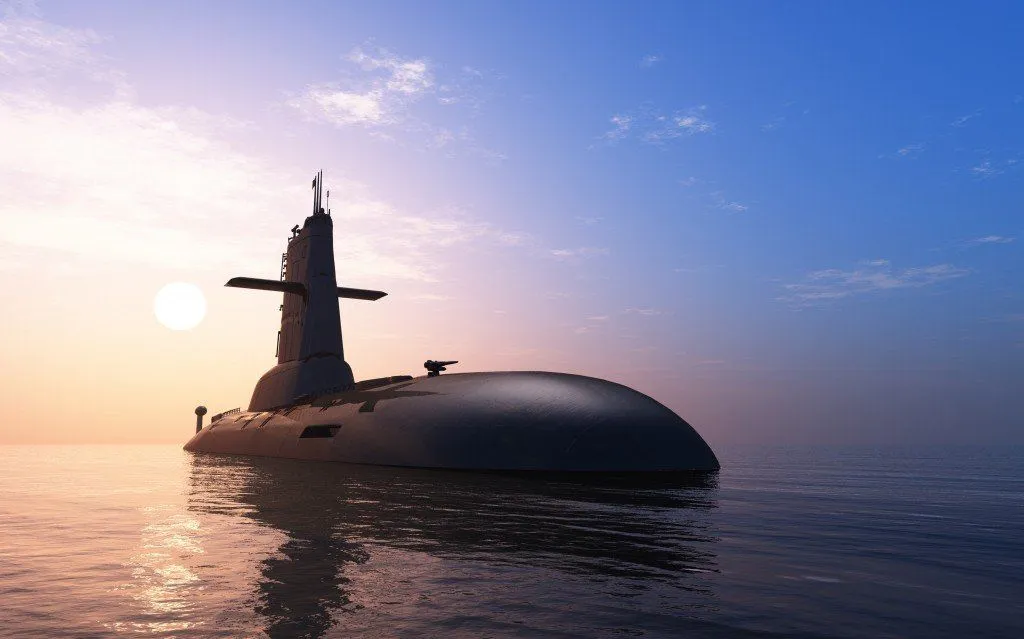
A submarine is a special ship designed to operate independently underwater for days. The most notable thing about a submarine is that it stays underwater for days. This leads to a natural question – if a submarine is constantly surrounded by water, how does it have enough drinking water for its crew members?
Even more importantly, how do the crew members get breathable oxygen, the most crucial requirement for human life?
Life Support Systems In Submarines
Due to their multifaceted usefulness, submarines have become essential to naval armies from various countries worldwide. One of the most common applications of submarines is to surveil and defend a country’s maritime borders. Human-crewed submarines are deployed underwater along a nation’s coastal borders to look for suspicious activities in the waters.
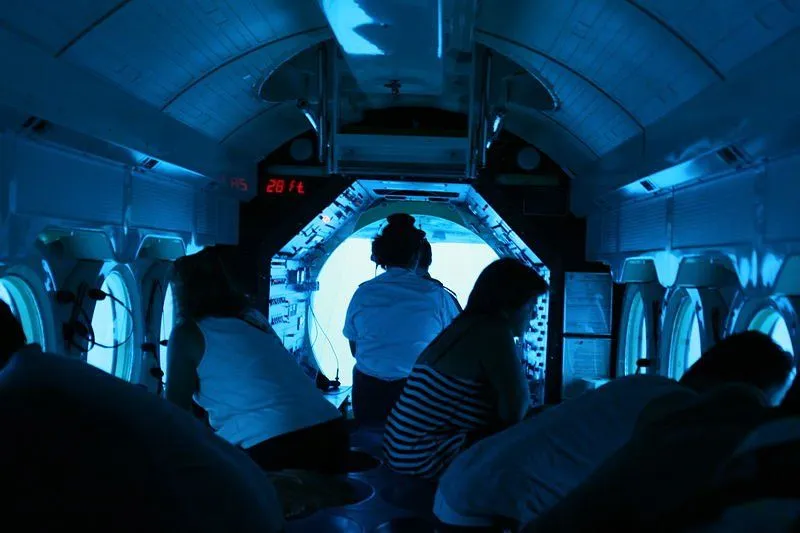
This necessitates deploying a considerable number of “manned” submarines underwater. A modern nuclear submarine typically carries a crew of around 130 to 160 sailors. U.S. Virginia-class attack submarines run with about 135 crew members, while Ohio-class ballistic missile submarines carry roughly 155. Smaller diesel-electric boats may have crews of 30 to 60. Therefore, you need a system in your submarine that can take care of the water needs of the entire crew, maintain comfortable temperatures onboard, and, most importantly, provide fresh, breathable air without interruption.
How Does A Submarine Crew Get Drinkable Water Onboard?
Submarines are surrounded by water almost always, but that’s seawater, which is salty. As such, it cannot be directly used by the crew or even to maintain the engines and batteries of the submarines, which consume around 4000 gallons of water per week. (Source)
To get freshwater, submarines have a distillation apparatus (called an “evaporator”) that heats seawater into vapor (leaving the salt behind) and then condenses the vapor back into pure water for drinking, personal hygiene, and cooking. On nuclear submarines, the heat for this process comes straight from the reactor, which lets a single boat churn out tens of thousands of gallons of fresh water a day. Some modern boats also use reverse-osmosis units that push seawater through a fine semi-permeable membrane to filter the salt out, either alongside or as a backup to the evaporator.
How Does The Crew Get Breathable Air Inside A Submarine?
There are three main ways to put oxygen into a submarine’s air. The first is the oxygen generator (the workhorse on nuclear submarines), which uses electrolysis to split fresh water into hydrogen and oxygen by passing an electric current through it. The hydrogen is vented overboard, and the oxygen is fed into the cabin. The second is high-pressure oxygen storage tanks, used to top up levels quickly. The third is the chemical oxygen candle (or chlorate candle), a solid block of sodium chlorate that, when ignited, decomposes at around 600°C and releases pure oxygen. Candles are used as a backup or in emergencies. Oxygen is either released periodically throughout the day at specific intervals or whenever the automated system detects a drop in oxygen levels.
What About Non-Nuclear (Diesel-Electric) Submarines?
The electrolysis story above applies mainly to nuclear submarines, which have an almost limitless supply of electricity from their reactor to split water all day long. Most of the world's navies, however, still run diesel-electric boats, and they face a tougher problem. A diesel engine, like the one in a car or truck, needs air to burn its fuel, and there is no air to breathe hundreds of metres down. So how do these submarines manage?

A conventional submarine carries two power sources. On or near the surface, it runs its air-breathing diesel engines, which both drive the boat and recharge a large bank of batteries. Once submerged, the diesels shut off and the boat runs silently on those batteries through an electric motor. The catch is that the batteries eventually run flat, so the submarine has to come back up to run its diesels again. Early submarines, including most of those in World War II, were really submersibles: they spent most of their time on the surface and dived only to attack or hide.
The first big improvement was the snorkel, a retractable air tube developed by Dutch engineer Jan Jacob Wichers, which the Royal Netherlands Navy fitted to the submarines O-19 and O-20 in the late 1930s. Raised just above the waterline, it lets a submerged boat draw in fresh air and run its diesels at periscope depth, recharging the batteries and refreshing the cabin air without fully surfacing. Germany adopted the idea during the war as the schnorchel, fitting it to U-boats from 1943 onwards to dodge Allied radar. Modern conventional boats still use snorkels, but a far cleverer answer arrived later: air-independent propulsion (AIP), which lets a non-nuclear submarine generate power underwater without surfacing at all. Sweden's Gotland-class boats, for example, use a Stirling engine that burns diesel fuel with liquid oxygen carried onboard instead of air from the surface, running almost silently and extending submerged endurance from roughly a day to several weeks. German Type 212 boats achieve the same with hydrogen fuel cells, which combine stored hydrogen and oxygen to produce electricity (and water) with no combustion at all. AIP is one reason a modern diesel submarine can stay hidden underwater for weeks rather than days.
Removal Of Carbon Dioxide
Breathing is a two-way process – we inhale oxygen and exhale carbon dioxide. We don’t need to worry about the carbon dioxide we exhale in open spaces. Still, in a closed metal tube hundreds of feet beneath the water’s surface, it can become a serious threat to survival if not removed periodically. As a result, it’s just as important to eliminate the carbon dioxide that the crew members constantly release as it is to provide oxygen.
This is where scrubbers come in.
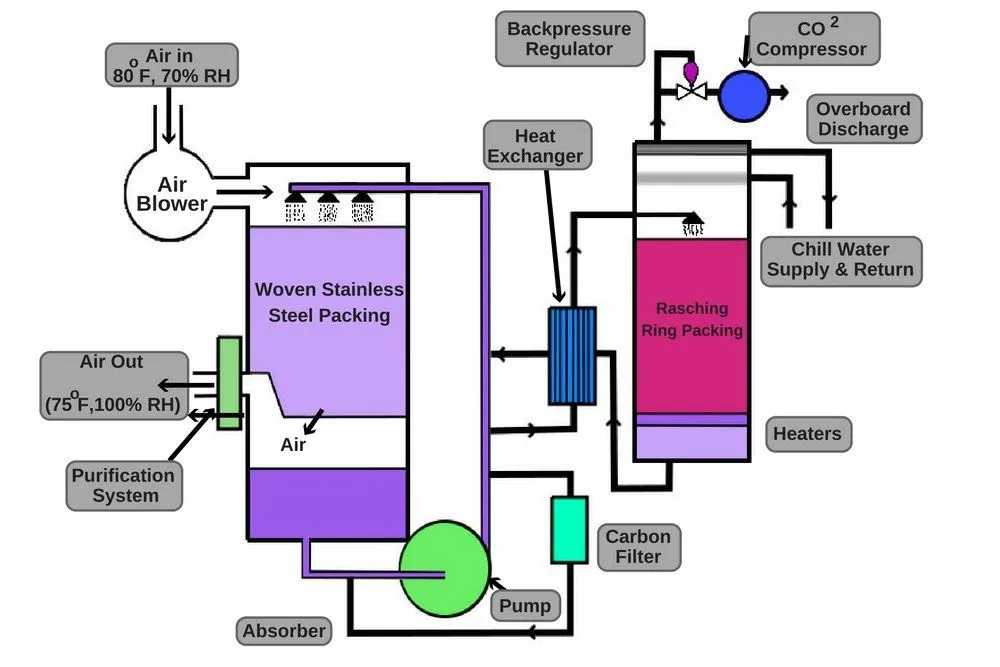
Modern nuclear submarines run on regenerative amine scrubbers (typically using a monoethanolamine, or MEA, solution) which absorb carbon dioxide from the cabin air when cool and release it again when heated, so the CO₂ can be pumped overboard and the same chemical reused over and over. Smaller boats, rebreathers and recompression chambers tend to use soda lime instead, a non-regenerative mix of sodium hydroxide and calcium hydroxide that traps CO₂ through a one-way chemical reaction. Either way, the goal is the same: pull the CO₂ out of the air before it builds up to dangerous levels.
Removal Of Excess Humidity
Excess humidity can harm the inside of a submarine, as it can condense on the walls and equipment. To address this issue, submarines are equipped with ‘dehumidifiers’ that prevent moisture accumulation within the chamber due to breathing and perspiration.
Overall, the safety and comfort of the passengers aboard a submarine are ensured through sophisticated machinery onboard. However, being confined to a metal tube hundreds of feet underwater without sunshine and suffering from homesickness can be a lot less thrilling than it may seem.
Last Updated By: Ashish Tiwari
References (click to expand)
- GELLER, R. E. (1968, November). Oxygen safety - Submarine to aircraft. Journal of Aircraft. American Institute of Aeronautics and Astronautics (AIAA).
- The Machinery of Modern Submarines.
- Lee, D., Lee, J., & Lee, K. H. (2002). A Decision-Support System to Improve Damage Survivability of Submarine. Developments in Applied Artificial Intelligence. Springer Berlin Heidelberg.
- Loveman, G. A. M., & Edney, J. J. E. (2021, February 3). Predicting the effect of decompression sickness on survival following submarine tower escape. Journal of Defense Analytics and Logistics. Emerald.
- Shadle, T., & Daley, T. (1991, July 1). U.S. Navy Submarine Life Support Systems. SAE Technical Paper Series. SAE International.
- Submarine - Toward Diesel-Electric Power. Encyclopaedia Britannica.
- AIP - The Swedish Way. The Submarine Review. Naval Submarine League.