The oxygen that people breathe in airplanes comes from the air outside. The air is supplied from the compressor stage of turbine engines and is passed through a bunch of machinery to ultimately be piped into the cabin for passengers. There is also an outflow valve, usually at the rear of the airplane, which collects and discharges the air inside the cabin. This way, a constant supply of fresh air is maintained.
If you’ve ever travelled in a commercial jet, you would have noticed that, aside from the bland food and the obligation of being in the same place for hours on end, life at 35,000 feet is reasonably comfortable, at least if you’re not traveling every day. However, comfort is an incredibly subjective term, I know, so let’s just talk about a much more basic human need – survival.
The primary requirement for human survival is oxygen. Given that fact, traveling in a commercial airplane isn’t much different from being on land, an abundance of oxygen onboard the plane makes sure that we survive! We have discussed the emergency oxygen masks that drop out automatically in the event of cabin depressurization in this article, but how do we breathe so comfortably in a plane under normal conditions?
Natural Availability Of Oxygen At 35,000 Feet
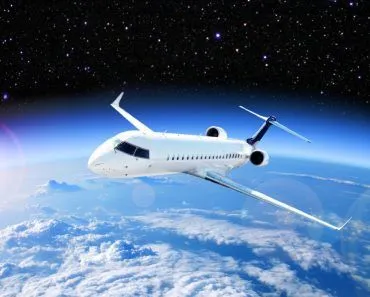
You might already know that ‘breathable’ air is in short supply at the altitude where most commercial planes operate. However, the word ‘breathable’ has a lot of significance in this context, because the availability of air itself at that altitude is not actually a problem. In other words, there’s ample air at 35,000 feet, and there is sufficient oxygen in it. In fact, there are even trace gas molecules up at the altitude where the International Space Station orbits, enough that the ISS still has to be reboosted every few weeks to make up for atmospheric drag.
So, there’s plenty of air at the height where airplanes fly; it’s just that the pressure of the oxygen in that air is too low to be inhaled directly by humans.
How Fresh Air Is Provided To Passengers During Flights?
Most commercial jets use the same idea of ‘bleeding’ hot compressed air from inside the jet engines and then passing it through a set of machines to be processed and finally piped into the passenger cabin. (The Boeing 787 Dreamliner is the notable exception: it skips engine bleed air entirely and uses dedicated electric compressors fed by intakes ahead of the wings, which is part of why its cabin can hold a more comfortable 6,000-foot equivalent altitude instead of the usual 8,000 feet.)
As a plane flies, fast-moving air enters both the jet turbine engines. This fast-moving air is compressed as it passes through layers of fan blades inside the turbine. It’s at the compressor stage that a portion of the hot air is ‘bled off’ from within the turbine. The air generated at this point is therefore known as bleed air.
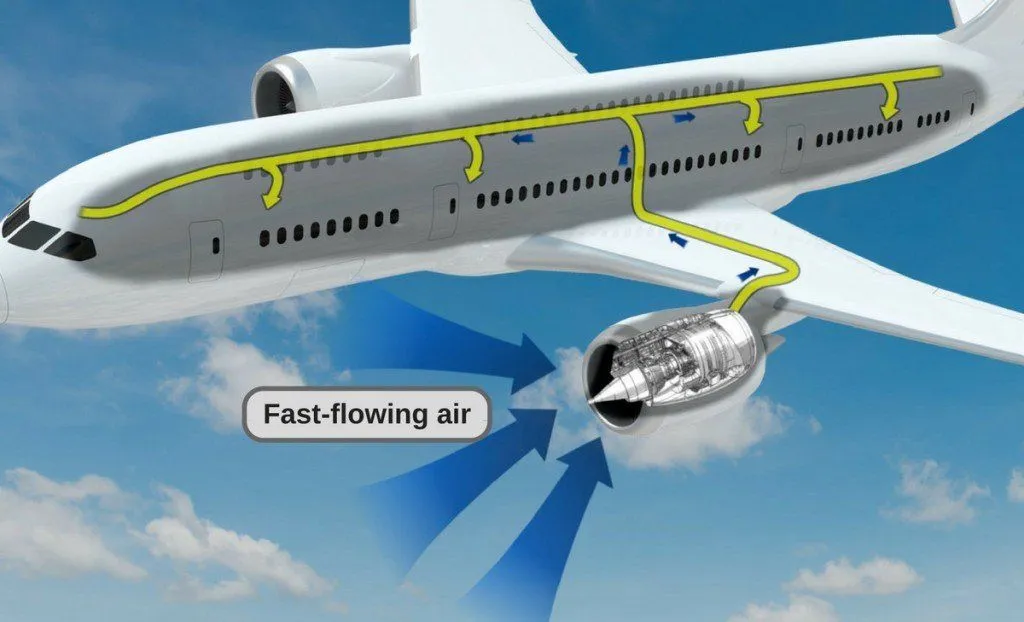
Now, this bleed air is very hot, with a temperature in the range of a couple hundred degrees Fahrenheit, so it obviously must be cooled first. That’s why this hot bleed air is allowed to expand and passed through a heat exchanger so that it cools to a comfortable temperature. This cool, filtered air is then dispersed in the passenger cabin at a pressure that humans can comfortably breathe.
There’s also an outflow valve, usually located in the rear of the cabin, which ensures that the ‘used’ air is vented out of the airplane, thereby regulating air quality inside the cabin.
So, the two jet turbine engines you see on either side of a plane not only keep the plane airborne by providing forward thrust, but also help maintain cabin air pressure so that we remain comfortable and conscious throughout the duration of our flight.
So, Can You Actually Breathe At 35,000 Feet?
Not for long, and the reason comes down to pressure rather than the percentage of oxygen. Air is still roughly 21% oxygen at cruising altitude, just as it is on the ground, but the air itself is far thinner up there. At sea level the atmosphere pushes down at about 760 mmHg (101 kPa), so the oxygen on its own contributes a partial pressure of roughly 159 mmHg (760 × 0.21). At 35,000 feet, the U.S. Standard Atmosphere puts the total pressure at only about 238 hPa, or 179 mmHg, which means oxygen’s share falls to around 38 mmHg.
That partial pressure is what drives oxygen across the thin walls of your lungs and into your blood, and at 38 mmHg there simply isn’t enough push to keep your brain supplied. This is why a sudden loss of cabin pressure at 35,000 feet leaves a person with only a brief window before they black out: the ‘time of useful consciousness’ at that altitude is roughly 30 to 60 seconds. Pressurizing the cabin to the equivalent of about 8,000 feet (where the pressure is near 565 mmHg) restores enough partial pressure for the oxygen to reach your bloodstream comfortably. So the cabin isn’t pumped full of extra oxygen; it’s simply squeezed back up to a pressure your lungs can work with.
Why Do Planes Have Drop-Down Oxygen Masks (And Do They Get You High)?
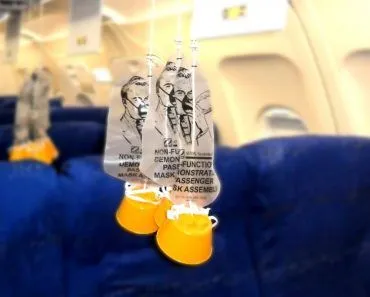
The masks tucked above your seat are a backup for one specific emergency: a sudden loss of cabin pressure. If the pressurization system fails and the cabin climbs above roughly 14,000 feet, the overhead panels open and the yellow masks drop. We cover the hardware in depth in our companion piece on whether airplanes really carry oxygen for the oxygen masks, but the short version surprises most people: on the majority of airliners, the oxygen does not come from a tank at all.

Instead, most passenger masks are fed by a chemical oxygen generator. Tugging the mask toward you pulls a firing pin that sets off a tiny charge, which kicks off a reaction in a small canister of sodium chlorate (NaClO3). As it decomposes, the sodium chlorate releases breathable oxygen and leaves behind ordinary table salt. The reaction is hot (the canister can climb past 250 °C, or about 480 °F), so a faint burning smell in the cabin during a real depressurization is normal and not a sign of fire. Each generator runs for roughly 12 to 20 minutes, which is plenty of time for the pilots to descend to 10,000 feet or lower, where the outside air is breathable again.
And no, the oxygen will not get you high. This is a common piece of internet folklore, but the gas coming out of the mask is just pure oxygen, the same thing you breathe all day. There is no nitrous oxide and no intoxicant of any kind. If a few passengers in old emergency footage look oddly calm, that is the relief of being able to breathe again, not a chemical buzz.
Can You Bring Your Own Oxygen On A Plane?
If you need supplemental oxygen for a medical reason, the answer is a qualified yes, but not in the form most people imagine. In the United States, the FAA prohibits passengers from carrying their own compressed or liquid oxygen cylinders aboard a commercial flight. A pressurized tank of oxygen is treated as hazardous cargo, so any in-flight medical oxygen supplied as gas has to be arranged through the airline itself, and not every carrier offers it.
What you can bring is a portable oxygen concentrator (POC). Rather than storing oxygen, a POC pulls in ordinary cabin air and filters out most of the nitrogen, delivering a concentrated stream of oxygen on demand, which is why it isn’t classed as a compressed-gas hazard. The FAA accepts any POC that is legally marketed in the US, carries the required conformance label, and does not interfere with aircraft systems. In practice, airlines also ask travelers to give about 48 hours’ notice, carry a physician’s statement, and bring enough charged batteries to cover at least 150% of the total trip time, including layovers and possible delays.
References (click to expand)
- Bleed air - Wikipedia. Wikipedia
- Cabin Environmental Control Systems - CiteSeerX
- Altitude and Oxygen Physiology - ATSC 113. University of British Columbia.
- Partial Pressure of Oxygen. StatPearls. NCBI Bookshelf.
- The Science Behind Emergency Oxygen. RSC Education, Royal Society of Chemistry.
- Chemical Oxygen Generators. SKYbrary Aviation Safety.
- 14 CFR 25.1447 - Equipment Standards for Oxygen Dispensing Units. Legal Information Institute, Cornell Law School.
- PackSafe - Portable Oxygen Concentrators (POCs). Federal Aviation Administration.