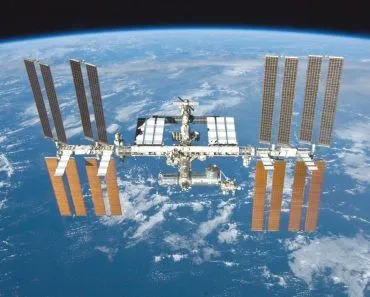
Astronauts on the International Space Station get drinking water primarily by recycling it. The ISS’s Water Recovery System captures every drop it can — sweat, breath condensate, shower runoff, hand-washing water, even urine — and filters it back into drinkable water that NASA says is purer than most municipal tap water. As of 2023, that system reaches roughly 98% recovery efficiency, supplementing initial supplies and resupply missions.
When it comes to taking stuff into space, astronauts and their mission control teams are some of the world’s most incredibly efficient packers. In fact, they have to be, because carrying stuff into space is extremely expensive. Even the tiniest things have to be logged, documented and accounted for before taking it on the voyage to space.
Can you guess what is perhaps the most important carry-on, and also outstandingly heavy?

So, do astronauts tote all the water they need to last for a few months in space? If not, how do astronauts get their hands on drinking water in space?
Why Don’t They Send Water Tanks Into Space?
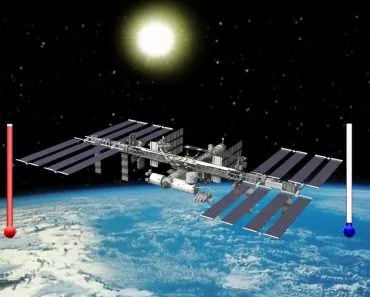
The farthest humans have ever lived, and continue to live, from Earth is a spaceship called the ‘International Space Station’ or simply the ‘ISS’. It is basically a laboratory that orbits our planet and perpetually plays host to a few astronauts who spend time there for research or other operational purposes.
As mentioned earlier, sending things into space is very expensive. Consider this, launching a SpaceX rocket still costs on the order of $1,200 per pound (Falcon 9), and even the cheapest Falcon Heavy ride sits around $640 per pound — with Starship promising to bring that figure down further when it enters routine service.

Therefore, ferrying water to and from Earth is financially impractical, so in order to deal with the ‘water woes’ onboard a spaceship (in this case, the ISS), there are some innovative techniques and methods already in place. However, if you get squeamish easily, then my advice would be to tread carefully through the next paragraph.
The Way They ‘Make’ Drinkable Water On The ISS
What does one do when there is a fixed amount of water available onboard and practically no means to replenish its supply?

Yes! That’s exactly what astronauts do. If you’re living on the ISS, you’re going to lose a certain amount of water every time you exhale or sweat. A single breath or a drop of sweat may not be much in terms of replenishing the water supply, but the ISS routinely hosts seven crew members (plus visitors), and everyone sweats and exhales. The vapors created by these acts of exhalation and sweating help to maintain the ambient cabin humidity, and are eventually condensed and used to replenish the general water supply of the ISS.
The ISS has a complex water management system that extracts every last drop of water it can access, whether it comes from people’s breath, recycled shower water, residue from hand-washing and oral hygiene, astronauts’ sweat and even urine! “It tastes like bottled water, as long as you can psychologically get past the point that it’s recycled urine and condensate that comes out of the air,” says Layne Carter, who manages the ISS water system from the Marshall Flight Center in Alabama.
Even the lab mice and other research animals occasionally onboard the ISS contribute their share too — they also exhale and urinate, and the recovery system doesn’t discriminate.
Such rigorous water conservation is crucial onboard the ISS, because without it, it would take 40,000 pounds of ferried water from Earth to support just four crew members for one year onboard the ISS.
In June 2023, NASA announced that its Environmental Control and Life Support System (ECLSS) had hit a long-standing milestone: 98% water recovery on the ISS, up from the previous ~93%. The remaining 2% is essentially unavoidable losses to airlock cycling and small leaks. That improvement is critical for future deep-space missions, where Earth-resupply isn’t an option.
It goes without saying that water obtained after such extensive treatment is absolutely pure; in fact, it’s purer than the tap water we drink back here on Earth! “We certainly do a much more aggressive treatment process (than municipal waste water treatment plants). We have practically ultra-pure water by the time our water’s finished,” says Carter.
So ‘Recycled Water’ Is All The Water They Have Onboard The ISS?
No. That wouldn’t make sense, because even to recycle water, there has to be a certain amount of water to start with.
The Russian module Zarya on the ISS contains some contingency water containers (known as ‘CWCs’ in astronaut lingo) that were brought to the shuttle during assembly missions. Each CWC holds about 90 pounds of water and looks like a duffle bag.

Also, not all astronauts aboard the ISS drink recycled water that contains recycled urine. The section of ISS that’s run by Russia uses a different water filtration system that only uses water from shower runoff and condensate. By avoiding recycled water from urine, the Russians make a little less than what their American counterparts make (3.6 gallons) on the ISS.
All the current systems of reuse and recycling are undoubtedly effective, but not absolutely efficient. Researchers are continuously trying to build better and more efficient machines and support systems to reduce water loss and figure out other ways to harness water from waste products.
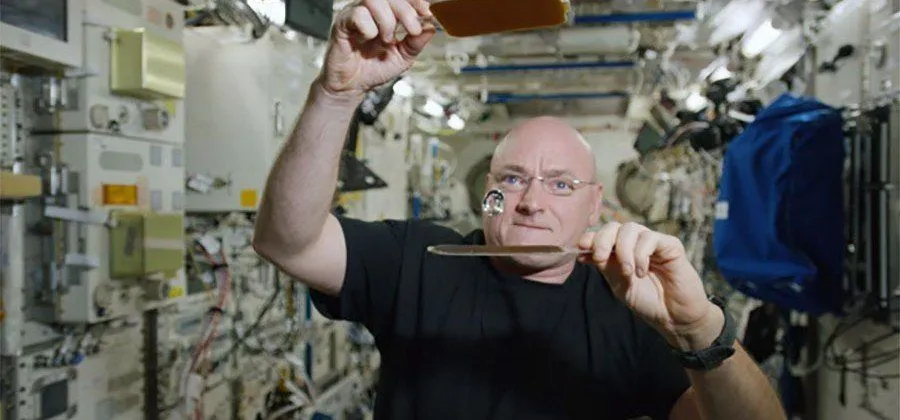
There’s no denying that if you’re one of the people aboard the ISS, there wouldn’t be many people who are more enthusiastic about water conservation than you!