Table of Contents (click to expand)
The ISS makes most of its breathable oxygen on board by electrolyzing water — splitting H₂O into hydrogen and oxygen with an electric current — in a unit called the Oxygen Generation System (OGS). The water itself is heavily recycled from crew urine, sweat, and cabin condensate, so the station does not need a constant supply from Earth. Pressurized oxygen tanks delivered by cargo ships and solid-fuel oxygen candles serve as backups.
The International Space Station (commonly called the ISS) is a manned satellite that orbits our planet at an altitude of roughly 250 miles (about 400 km). At any given time, it hosts about 7 astronauts performing a number of experiments, conducting studies and research, and doing a bunch of other stuff to enhance our knowledge of how things work in space.
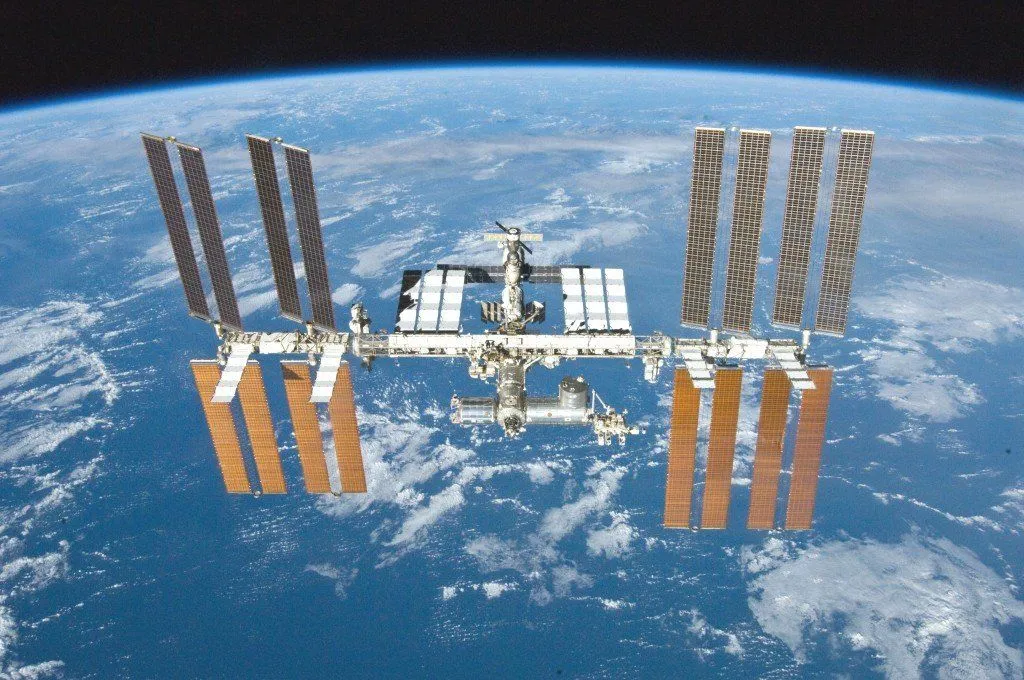
Needless to say, there are a number of life support systems aboard the ISS to ensure that the crew’s stay there is as comfortable as possible in space.
The three most important things that humans need to survive are water, food and oxygen. We have already discussed how astronauts get drinking water aboard the ISS in this article, so now it’s time to talk about how astronauts get breathable air so far above Earth’s surface.
Is There Any Oxygen In Space?
Before we get into how the ISS makes oxygen, it’s worth answering the question that sits underneath all of this: is there any breathable oxygen out there in the first place? The short answer is no. Space is very nearly a perfect vacuum. There is no air to breathe, which is precisely why the station has to manufacture its own.

Down here at sea level, the air you’re breathing is roughly 78% nitrogen and 21% oxygen, at a pressure of about 101 kilopascals (14.7 psi). Climb higher and that blanket of gas thins out fast. By the time you reach the Kármán line at 100 km (62 miles), the conventional boundary of space, the pressure has dropped to a tiny fraction of what it is at sea level, on the order of a single pascal. For all practical purposes, there is no atmosphere left to inhale.
The ISS orbits far higher still, at roughly 400 km (250 miles). At that altitude the surrounding environment is an extreme near-vacuum. So the oxygen molecules drifting around in space are far too sparse to keep anyone alive. Every breath an astronaut takes has to be generated, stored, or recycled inside the station itself. That is the whole job of the life support hardware we’re about to look at.
Electrolysis Of Water
Electrolysis is the primary method by which oxygen is ‘made’ on the International Space Station. However, what is the meaning of electrolysis?
‘Electrolysis’ refers to the chemical decomposition of a liquid or solution containing ions by passing an electric current through it. The electrolysis of water, therefore, is the name of the process through which water is broken down into its constituents—hydrogen and oxygen.
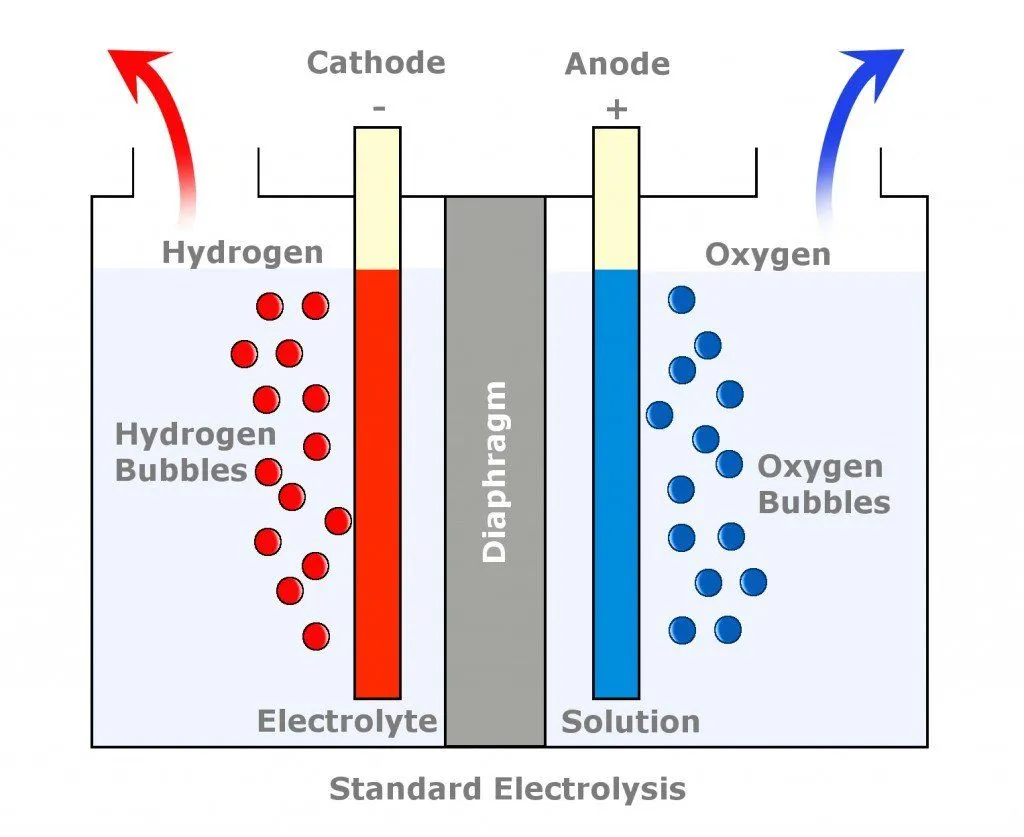
If you think about it, the oxygen that we breathe here on Earth also comes from the splitting of water, only it’s not a mechanical process, unlike the electrolysis of water on the ISS. Plants, trees, algae, cyanobacteria and phytoplankton… all of these organisms decompose water molecules as one of the steps in photosynthesis (the process that converts sunlight and water into food).
You see, a water molecule is composed of two atoms of hydrogen bonded to one atom of oxygen. When you run a current through water, those atoms are separated and released as gaseous hydrogen and oxygen (Source).
The Oxygen Generation System or OGS is a rack designed by NASA to electrolyse water to produce gaseous oxygen. The oxygen produced in this way is then vented to the cabin atmosphere of the ISS. Note that the OGS is a part of the ECLSS (Environmental Control and Life Support System) aboard the ISS.
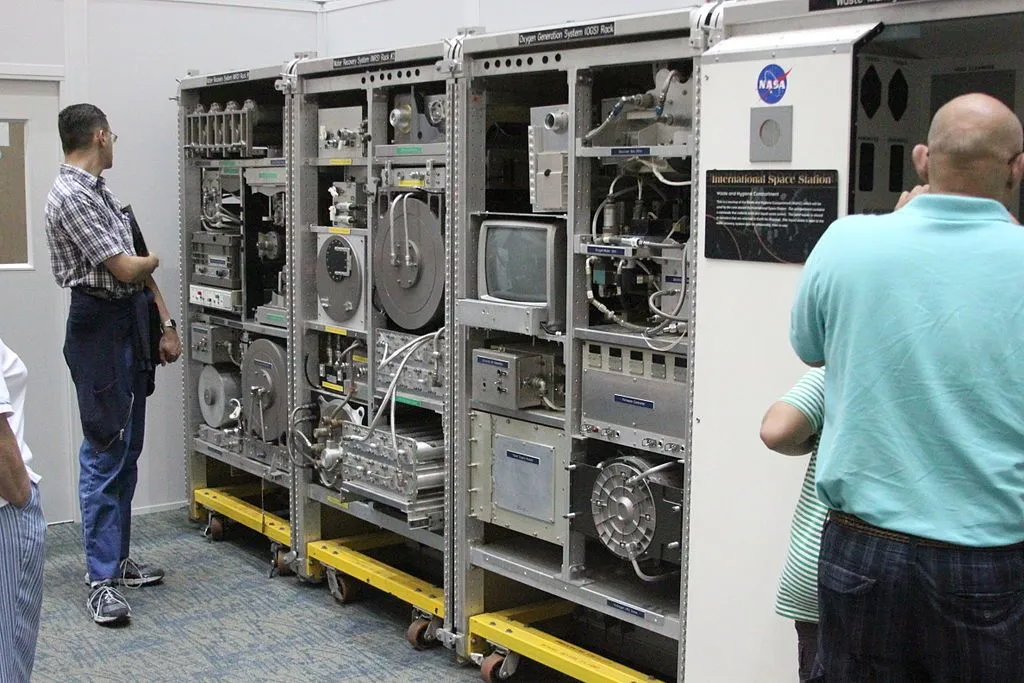
The other vital component of the ECLSS is the Water Recovery System (WRS), which works in tandem with the Oxygen Generation System.
So, astronauts aboard the ISS get their oxygen from the electrolysis of water, but where does all that water come from?
Enter the WRS!
Collecting Water From Within The ISS
The Water Recovery System or the WRS is a component of the ECLSS that provides clean water by recycling the crew’s urine, sweat, other condensate in the cabin and wastes produced due to Extra Vehicular Activity.
The water that is collected is obviously put through stringent tests so that it’s absolutely pure and ready to be reused to support the daily requirements of the crew, lab animals, EVA and payload activities.
This water is then used to conduct electrolysis and create breathable air to sustain life on board.
Pressurized Oxygen Tanks
Pressurized oxygen tanks provide a backup to the main method of synthesizing breathable oxygen (i.e., electrolysis). Unmanned cargo ships carry these oxygen tanks and deliver them to the space station. These tanks are stored in the space station and used whenever necessary.
The crew can also produce oxygen chemically by igniting SFOG (Solid Fuel Oxygen Generation) canisters, which are comprised of lithium perchlorate. Each canister can provide a limited supply of oxygen for a crew member.
What About The Carbon Dioxide Astronauts Breathe Out?
Breathing is only half a loop. Making oxygen keeps the crew supplied, but every astronaut also exhales carbon dioxide, and in a sealed metal can the size of the ISS, that CO2 would build up to dangerous levels within hours if nothing removed it. So the station doesn’t just add oxygen, it actively scrubs the air clean.

The workhorse here is the Carbon Dioxide Removal Assembly (CDRA), part of the same ECLSS family as the oxygen generator. The CDRA pulls cabin air through a four-bed molecular sieve packed with zeolite, a porous crystalline material made of silicon, aluminum and oxygen that traps CO2 molecules. While one bed soaks up carbon dioxide, a saturated bed is heated and vented to space to regenerate, then the beds swap roles. NASA’s standard keeps the average carbon dioxide partial pressure below 3 mmHg, far lower than it would be if the gas were left to accumulate. If the CDRA goes offline, the crew falls back on disposable lithium hydroxide (LiOH) canisters, which chemically lock CO2 into solid lithium carbonate.
Here’s the clever part. Remember that electrolysis splits water into oxygen and hydrogen. Rather than just dumping that hydrogen overboard, the station can feed it into a Sabatier reactor, where it reacts with the captured carbon dioxide to produce methane and, crucially, water. That recovered water goes right back into the Water Recovery System to be electrolyzed into yet more oxygen. In other words, the crew’s exhaled CO2 becomes part of the raw material for their next breath, which is a big part of why the ISS doesn’t simply run out of oxygen. Each crew member uses only about 0.9 kg (roughly 2 lb) of oxygen per day, and recycling like this lets a relatively modest water supply stretch a very long way.
References (click to expand)
- Water on the Space Station - NASA Science. The National Aeronautics and Space Administration
- International Space Station — NASA
- ISS ECLSS — Environmental Control and Life Support System (Wikipedia)
- Environmental Control and Life Support Systems (ECLSS) — NASA
- OCHMO Technical Brief 004: Carbon Dioxide — NASA
- Advanced Oxygen Generation — Houston We Have a Podcast, NASA
- Where is space? — NOAA NESDIS