No, salt water taffy is not made of ocean salt water. The legend traces the name to an 1883 flood at an Atlantic City candy shop, where soaked taffy was jokingly sold as “salt water taffy” and the name stuck as a marketing winner. The actual recipe uses a small amount of regular salt plus plain water.
If you’ve ever strolled along the boardwalk in Atlantic City, or basically any other coastal town in the world, you’ve probably given in to your sweet tooth and bought a few delicious pieces of salt water taffy for your walk. They come in countless flavors and – while they may be hard to get out of your teeth – this tasty treat is beloved from sea to shining sea.
However, what puzzles almost everyone is the name of this peculiar candy, specifically the “salt water” part. When you pop one of these taffies into your mouth, they don’t taste particularly salty, nor are they watery. So where does the name come from? And is there really salt water in the production process?
What Is Salt Water Taffy?
Salt water taffy is a type of soft candy that has been popular for more than a century around the world. The process of making salt water taffy is quite interesting, actually, and is often a production process that is visible to customers in stores where salt water taffy is made. For those who don’t know, taffy is made by combining sugar, cornstarch, corn syrup, salt, butter, water, food coloring and various flavoring elements. The consistency of this candy is quite soft, yet when most people think of taffy, it is a hard candy.
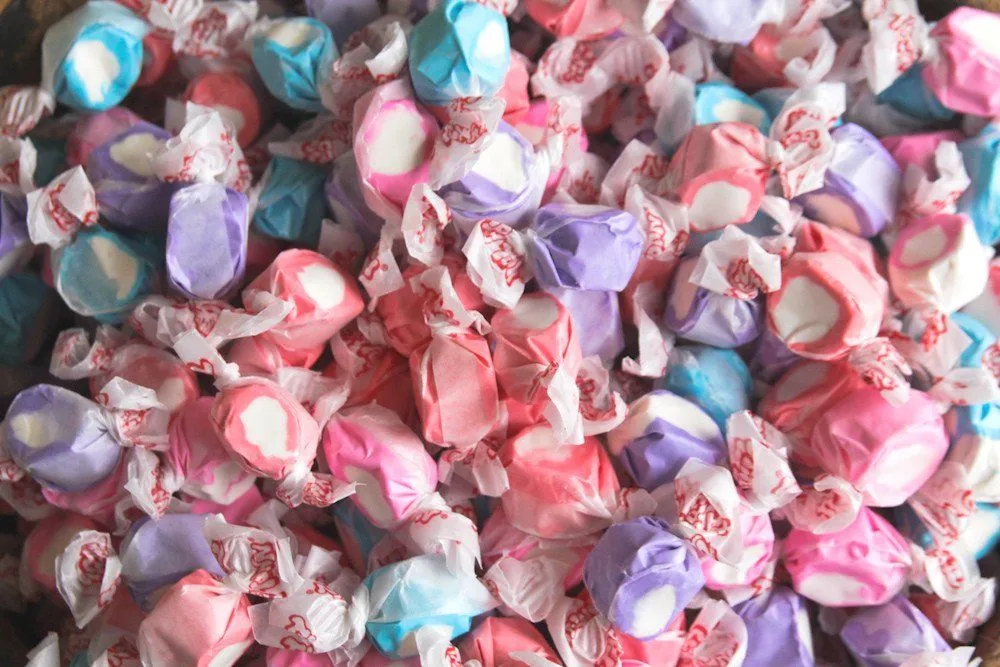
Salt water taffy is unique because of how it is made. Originally blended in copper kettles over the fire, the taffy would then be laid out on marble slabs to cool. To prevent the taffy from getting too hard, however, the taffy pull was invented, a machine that would help to stretch and fold the soft taffy in large bands, trapping air between the layers, which would help the candy retain its consistency. Once it was sufficiently aerated, it would be laid back on the slab and cut into small sections, wrapped in wax paper, and voila! A delicious piece of salt water taffy for passers-by on the boardwalk.

While some people are quick to point out that the recipe of salt water taffy does indeed include both salt and water, that doesn’t refer to salt water that you could get from the ocean. No, the name salt water taffy has a far more interesting origin story.
The Story Of Salt Water Taffy
By the late 1800s, taffy was already being created in various forms, but it wasn’t catching on as a major product in coastal towns. As the story goes, however, David Bradley was a candy store owner in Atlantic City in the 1880s, which meant that his little boardwalk store was at risk of flooding by the nearby ocean. On one such occasion, in 1883, Bradley’s shop did flood, ruining much of his merchandise.
According to the story, a young girl came into the shop while Bradley was perusing the damage and figuring out what to do next. She asked for a piece of candy, and since most of his products had been waterlogged by water from the ocean, he jokingly told her that all he had to sell was salt water taffy. Perhaps not getting the joke, the girl tried a piece and then bought some. Bradley’s mother was also present in the store and heard the exchange, and then praised her son for the clever and catchy name.
He began marketing the taffy as salt water taffy, despite not using salt water as a primary ingredient, and the candy became a huge hit. Within the next few decades, salt water taffy became a mainstay in more than 400 coastal towns in the United States and abroad, and is now a cherished part of Americana.
There are other accounts of how the name originated, including the fact that the use of salt water actually made the taffy better, which was discovered after a similar flood to the one in Bradley’s story.
Whether Bradley’s story is true or not, salt water taffy’s other two kingpins were Joseph Fralinger and Enoch James, two innovators in the industry who began to box and sell the taffy as a souvenir in Atlantic City, and also developed the automated taffy pulling machine, many of which you can still see in small towns and candy stores.
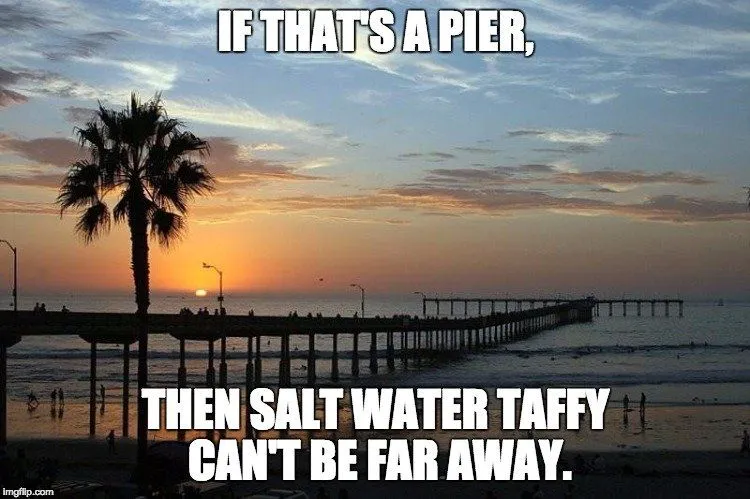
Many origin stories make it difficult to separate fact from fiction, but we do know that a few things are true…. salt water taffy is an excellent name, and those candies are downright addicting!
Why Is It Called Salt Water Taffy?
Here is the honest answer: nobody can prove exactly why. Historians who have dug into it generally agree that the half-dozen origin tales floating around are likely all apocryphal, which is a polite way of saying they are good stories that may never have happened. The famous flooded-shop version is the one everyone repeats, but a second tale claims a storm simply washed seawater over a batch of taffy, after which a sharp confectioner realized the accidental name sold beautifully. What every version agrees on is the punchline you already know: there is no ocean water in the recipe. The candy contains a pinch of ordinary table salt and plain tap water, nothing more exotic than that.
If you want a documented twist instead of folklore, look to 1923. That year a man named John Edmiston managed to register a trademark on the very phrase "salt water taffy" (U.S. trademark number 172,016) and promptly started demanding royalties from every shop that used it. Other candy makers were not amused, sued, and in 1925 the trademark was struck down on the grounds that the term was already in common use. So the name had been bouncing around the boardwalk for roughly four decades before anyone even tried to own it. Like a lot of candy lore, the legend is far more memorable than the paperwork, which is probably exactly why it stuck.
Who Invented Salt Water Taffy, And When?
If "who invented it" means "who first joked about salt water taffy," the answer is lost to legend. But if it means "who turned it into the souvenir empire of Atlantic City," history names two men, and they are very real.

The first is Joseph Fralinger, a former glassblower and fish dealer who took over a boardwalk taffy stand and, over the winter of 1885, taught himself confectionery from books. The following spring he sold his first batch of salt water taffy. His real stroke of genius was not the recipe but the packaging: he boxed the taffy so vacationers could carry a one-pound souvenir of the shore back home. The boxes flew off the shelves, and Fralinger earned the nickname "the King of Salt Water Taffy."
His chief rival was Enoch James, a confectioner who arrived from the Midwest and is credited with the improvements that made the candy genuinely pleasant to eat. James refined the recipe so it was less sticky and far easier to unwrap, cut it into bite-sized pieces instead of long ropes, and is credited with mechanizing the labor-intensive "pulling" process. Between Fralinger's marketing and James's engineering, the treat exploded in popularity, and by the 1920s an estimated 450-plus businesses were churning out salt water taffy. It has been a fixture of Americana ever since.
How Is Salt Water Taffy Made?
The recipe sounds almost too simple: sugar, corn syrup, water, butter or oil, a little cornstarch, salt, flavoring and food coloring are boiled together into a hot, dense syrup. The magic is not in the ingredients but in what happens next, and there is real physics behind it.

Once the syrup cools enough to handle, it gets pulled, stretched out, folded back on itself, and stretched again, thousands of times, by hand or on a hooked machine. A 2023 study in the journal Physics of Fluids by researchers at the Okinawa Institute of Science and Technology and MIT looked at exactly what this does to the candy. Under the microscope, taffy turns out to be a mass of tiny air bubbles and oil droplets suspended in a thick, syrupy matrix. The relentless pulling whips in those air bubbles and breaks the oil into ever-smaller droplets, and because both the bubbles and droplets behave like little elastic balls that spring back toward a round shape thanks to surface tension, they give the finished candy its signature springy, chewy bounce.
That is also why a freshly pulled batch turns pale and glossy and grows lighter as it works: you are literally watching air being folded in. The same trapped air is what keeps the taffy soft for weeks instead of setting into a tooth-cracking brick, and why a sugary mixture that started out dense and dark ends up fluffy and pastel. Skip the pull, and you would just have a slab of hard candy.