Table of Contents (click to expand)
Facial muscles don't bulk up like biceps because we never apply progressive resistance to them. Smiling, chewing, and blinking happen all day, but at near-zero load, not enough mechanical stress to cause the micro-tears in muscle fibres that trigger hypertrophy. Without added weight, there is nothing to repair and rebuild larger.
When you go to the gym, it can often feel like you’re putting in a whole lot of effort without seeing any results. However, after a few months, or a few years, it is undeniable that you have seen some gains. Your muscles have grown, you’re filling out your shirts well, and you’ve put on some healthy pounds. Going to the gym might occupy 4-5 hours of your week, so you’re using those particular muscles from your workouts for a pretty small amount of your time. Even so, you can see significant increases in just a few months.
 When we talk about muscles, people immediately think of biceps, quads, pectorals and other common targets at the gym. However, our face is also covered in muscles, which are responsible for everything from blinking our eyes and changing our expression to chewing our food and whistling. Considering that we use our facial muscles throughout the day, every single day, why don’t those muscles bulk up in the same way? Shouldn’t we all be walking around with “cut” faces after a lifetime of chewing up three meals a day?
Before we dig into that specific answer, however, we should take a quick review of the fundamentals of muscle growth.
Muscle Growth
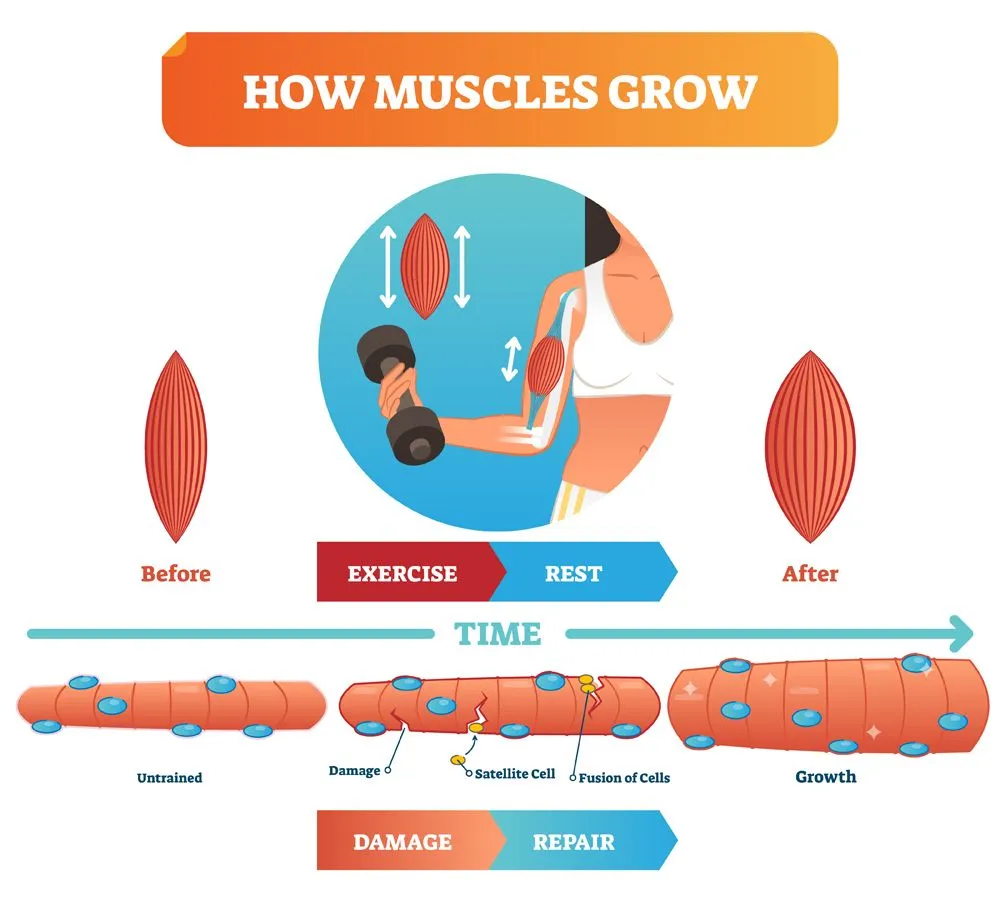
When you go to the gym and begin working out, you are essentially putting stress on your muscles in order to increase their size and strength. When you put stress on one of your more than 600 skeletal muscles (built from bundles of fibres, each fibre packed with myofibrils, and each myofibril made of repeating contractile units called sarcomeres), some of those muscle fibres get microscopically damaged and must be repaired. When those muscle fibers are bound back together, they increase in size, a process called hypertrophy, commonly known as muscle growth. An important factor to consider, however, is that additional muscle mass comes from more muscle proteins being synthesized than those being broken down. If your body is better able to activate the satellite cells (i.e., stem cells for muscles) and encourage new myofibrils of muscle protein to form, then your muscles will grow following exposure to stress (typically in the form of increasing amounts of weight).
That being said, even if your body is highly receptive to exercise and you can easily put on muscle mass after only a few weeks of devoted gym time, everyone has a limit. There is no muscle in the human body that could grow indefinitely. The main reason for this is myostatin, an inhibitory compound that works as a control gauge for muscle growth in the body. It negatively regulates skeletal and cardiac muscle based on our muscle mass. In certain bodybuilding and physical fitness circles, it is believed that increasing your amino acid intake can somewhat mitigate the effects of myostatin, allowing for bigger gains, but the results of this approach have yet to be definitively proven.
In short, our physical activity and exercise regimen determine our muscle growth, along with the influence of hormones, such as testosterone and IGF-1 (Insulin Growth factor), and certain genetic factors, such as the body’s activation levels of satellite cells.
Bulking Up The Facial Muscles
Given what we now understand about facial muscles, one thing becomes immediately clear… we might use our facial muscles all the time, but we aren’t necessarily putting stress on them. When you go and pump iron in the gym to boost your biceps, the stress is caused by the added weight. There are very few practical ways to increase the “weight” being moved around by your facial muscles as you smile, chew, blink and frown. Without that added weight, there is no damage to the muscles, and therefore no muscle regrowth or release of satellite cells to the site of the muscles. Additionally, even if there were some contraption that could add weight to the normal functions of our facial muscles, the development of new muscle is a gradual process dependent on regularity and repetition. It is not only impractical, but also a bit ridiculous, to imagine consistently exercising your face in that way over any length of time.
 There are some notable cases in which facial muscles can grow, resulting in a fuller or “larger” appearance of the face. You will often see this in competitive eaters, who use their jaws far more than the average individual. As a result, the muscles surrounding their jaws are larger and more bulked up, but these people represent a very small portion of the population. On the whole, our facial muscles can be toned or look more chiseled, but this is due to the lack of fat, not the presence of toned muscle. When we gain weight, our faces will also increase in size or roundness; thus, when we lose weight, some of that excess fat will leave our faces, revealing more of our bone structure and facial muscles.
While there is little evidence to suggest that you can bulk up your facial muscles, those muscles do have other similarities to larger body muscles. In recent years, facial massage and “facial gyms” have popped up in certain health circles around the world. Through manipulation of the facial muscles, it is possible to deliver a healthy glow and a relaxed feeling to the overworked muscles of our face. While going through the natural movements of our day, we may not notice areas of tension in our eyebrows, cheeks, neck or jaw. While the therapeutic value of these treatments is still debated amongst medical professionals, regular practitioners do claim that their muscles feel more relaxed and they are happier with their appearance!

Does Gaining Muscle Change Your Face?
One of the most common questions people ask after a few months of serious training is whether all that effort in the gym will actually reshape their face. The honest answer is yes, it can, but usually not in the way people expect. The biggest driver of change is body fat, not the muscles of your face. Your cheeks, jowls and the area under your chin carry a layer of subcutaneous fat, and when your overall body fat drops, that padding thins out and reveals more of the bone structure and jawline underneath. That is why a lean physique so often comes with a sharper, more angular face, even though you never trained a single facial muscle.
Muscle mass plays its own, more subtle role. A 2019 study in Frontiers in Psychology that digitally modelled how body composition maps onto the face found that the facial correlate of muscle mass strongly enhanced perceived masculinity, and did so more reliably than fat did. In other words, the frame you build in the gym leaves a faint signature in the face that people read as more masculine, separate from any fat loss. The two effects are distinct, which is why the researchers argue that fat and muscle should be judged separately rather than lumped together under a single body mass index number.
There is also a genuine muscular contribution around the jaw, but it comes from the chewing muscles rather than the delicate muscles of expression, which we will get to next. So if your face looks different after a year of training, most of the credit goes to a leaner body composition, with a smaller assist from added muscle and, in some people, a slightly stronger jaw.
Can You Actually Hypertrophy Your Facial Muscles?
To answer this properly, you have to split the face into two very different sets of muscles. The muscles of facial expression, the ones that let you smile, frown, blink and raise an eyebrow, originate on the bones of the skull but insert directly into the dermis of your skin. That is why they tug on your skin rather than move a joint, and it is also why they never bulk up. They are thin, they are wired for speed rather than force (the orbicularis oculi around the eye is one of the fastest muscles in the body), and you cannot load them with meaningful resistance. No amount of "facial gym" work will turn them into visible slabs of muscle.

The muscles of mastication are a completely different story. This group, led by the masseter along your jaw and the temporalis above it, runs from the skull down to the lower jawbone and drives the powerful bite you use to chew. Because they attach bone to bone and work against real resistance every time you clamp down on tough food, they behave much more like the skeletal muscles in your arms and legs, and they genuinely can hypertrophy. That is exactly why the answer to "can face muscles grow?" is a qualified yes: the chewing muscles can, while the expression muscles essentially cannot.
Doctors even have a name for it. Benign masseter hypertrophy is a well-documented condition in which the masseter enlarges through sustained overuse, often linked to habitual clenching, teeth grinding (bruxism) or heavy gum chewing. The result is a wider, more square-angled lower face, produced entirely by muscle rather than fat or bone. It is harmless, and when someone dislikes the look, it can be treated. So the competitive eaters mentioned earlier are not a fluke; they are simply the clearest example of the one facial region where ordinary use can, over years, build a visibly bigger muscle.
References (click to expand)
- Lui, J. C., & Baron, J. (2011, March 25). Mechanisms Limiting Body Growth in Mammals. Endocrine Reviews. The Endocrine Society.
- Muscle Hypertrophy: What Limits the Ability of Your Muscles to .... cathe.com
- What Happened When I Started Exercising My Face - Health. Health
- (1989) Smiling and facial exercise. - Abstract - Europe PMC. Europe PubMed Central
- Counihan C.,& Williams-Forson P. A. (2011). Taking Food Public: Redefining Foodways in a Changing World. Routledge
- Muscle hypertrophy - Wikipedia. Wikipedia
- Lei, X., Holzleitner, I. J., & Perrett, D. I. (2019). The Influence of Body Composition Effects on Male Facial Masculinity and Attractiveness. Frontiers in Psychology.
- Anatomy, Head and Neck: Facial Muscles. StatPearls. NCBI Bookshelf.
- Benign masseter muscle hypertrophy. National Center for Biotechnology Information.