Table of Contents (click to expand)
Those colorful balls strung along power lines are called aerial marker balls (or visibility/visibility-marker spheres). They’re installed to warn pilots of low-flying aircraft (helicopters, crop dusters, small planes) about wires that are otherwise nearly invisible from the air. In the U.S., the FAA’s Advisory Circular 70/7460-1 specifies their use, color (typically aviation orange, white, or yellow), and spacing, with each ball usually about 20–36 inches (50–90 cm) in diameter.
If you are someone who pays attention to the wires hanging above your head (in other words, you’re a nerd), then you have likely observed those big, basketball-sized colored balls hang along the length of power lines. However, those balls are not just limited to power lines; you might find such colored balls hanging on communication lines and guy wires as well.
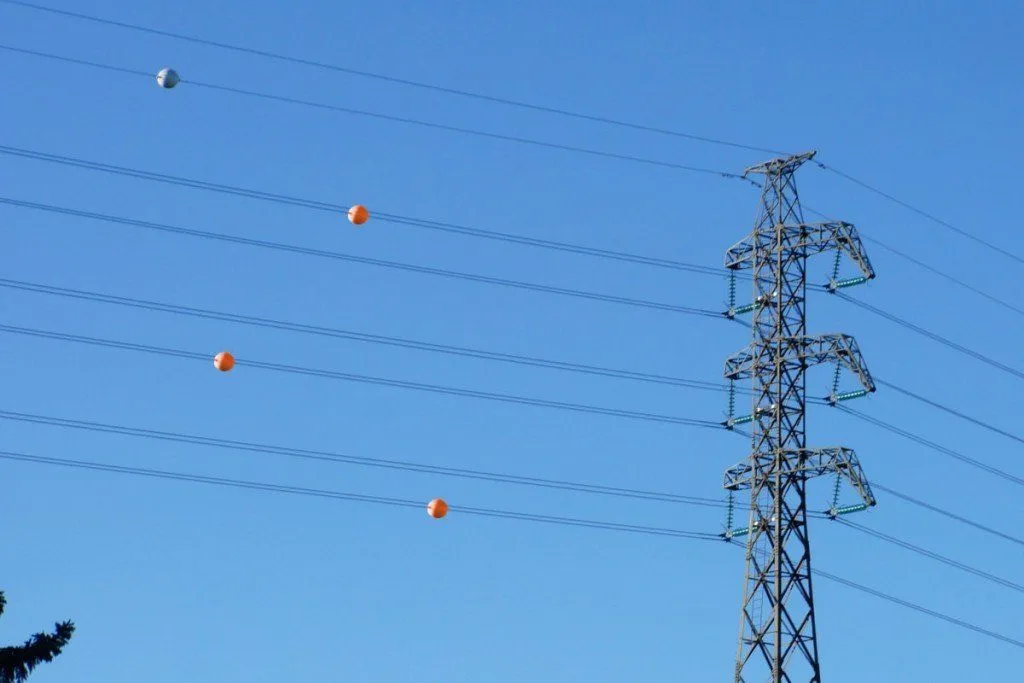
Surely those plastic balls fulfill some functional purpose, or are they just there to adorn the otherwise boring wires?
Challenges Of An Aircraft Flying Too Close To The Ground
As you already know, aircraft fly very high in the sky. Commercial jets, for instance, fly in the range of 35,000-40,000 feet above the ground. Military aircraft fly at different altitudes, depending on their operational requirements. This is to say that most aircraft fly at quite a high altitude, and there are a few reasons behind that.
First, flying too close to the ground poses the obvious danger of ramming into or striking objects on the ground, such as tall buildings, towers or even trees. You also can’t look very far ahead, since your field of vision would be blocked by stuff on the ground.

Too much hindrance in front of the airplane
There are countless technical reasons as well, such as high air density, poor radio reception, chances of engine inefficiency and so on.
However, there are moments in every flight that occurs anywhere in the world, when you have to fly too close to the ground – the crucial minutes of takeoff and landing.
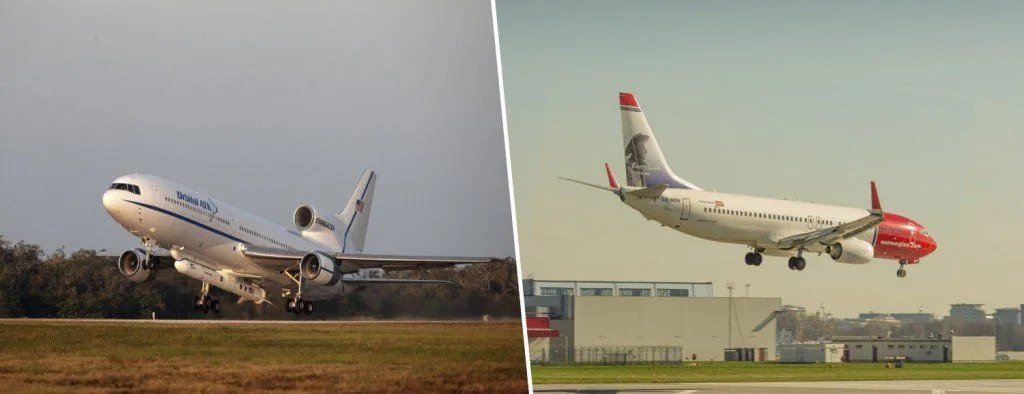
As one can imagine, these are the two most critical parts of any flight. Studies show that most plane crashes and accidents occur during either of these two stages. Since aircraft fly very close to the ground during takeoff and landing, aviation professionals have to make sure that the chances of any untoward incident are minimized.
Overhead Wires Pose A Danger To Low-flying Aircraft
Power transmission lines, communication wires and guy wires all pose a significant threat to aircraft, especially during takeoff and landing, as they’re too thin to be noticed from inside the cockpit. Additionally, their color is such that they tend to blend into the background, making it even more difficult for pilots to spot them, particularly in low-light conditions. Dirty windscreens don’t help either!
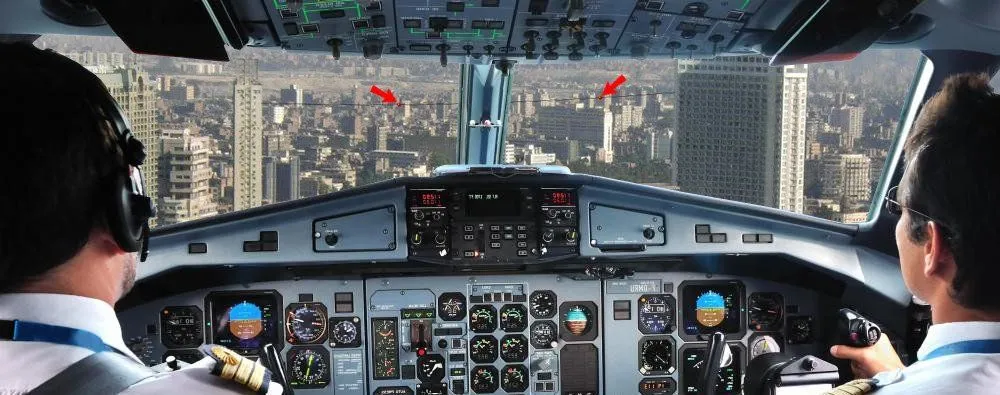
Therefore, unless the wire in question falls dead center in the vision of the pilot, it’s highly likely that the aircraft would fly straight through it, and in some cases, that would result in a catastrophe.
Aerial Marker Balls
The plastic balls that are commonly seen hanging from overhead power lines are called aerial marker balls, or simply marker balls. These are used to highlight structures (in this case, wires) when it’s impractical to make them visually recognizable (usually from a distance) by painting them.
In simple words, you could say that those colored balls are installed along the length of overhead wires so that the wires can be seen by pilots of low-flying aircraft. You will see such markers on extensive catenary wires that run across canyons, rivers, lakes and valleys.
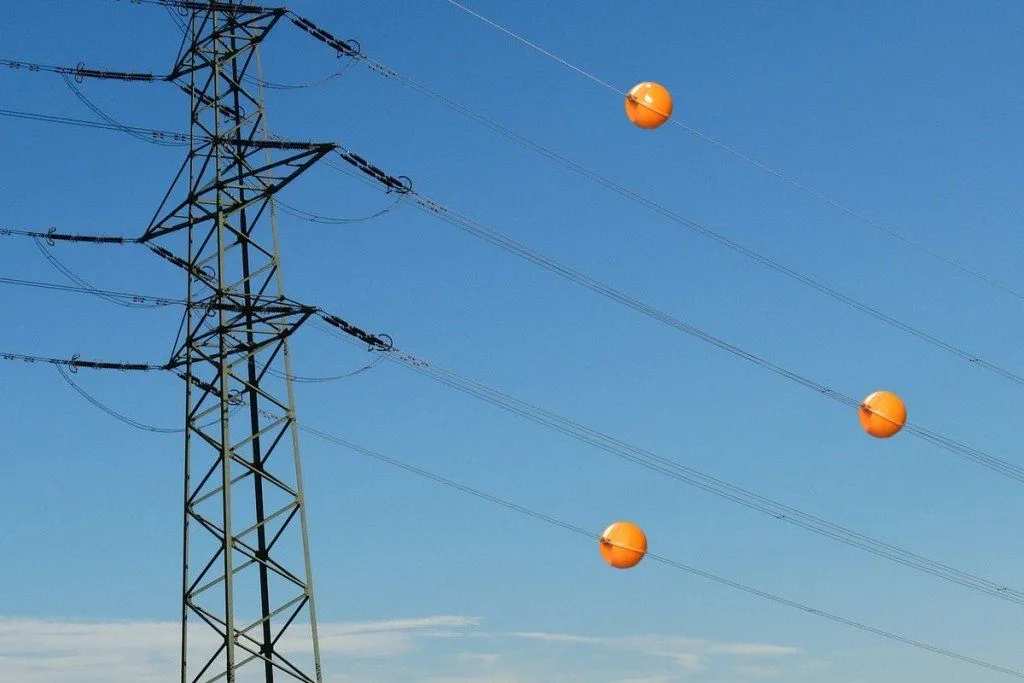
These markers are supposed to be easily spotted from a few thousand meters away. That’s why these markers are are big enough (not less than 91 centimeters (36 inches)) to be observed from a distance and distinctively shaped (such as, spherical or cylindrical). Also, they are usually painted in colors that offer the maximum contrast with the background terrain. Orange, red and white are some of the most commonly used colors in such aerial markers.
What Is A Balisor?
There’s also something called a balisor, which is actually a system of glowing beacons that use low-pressure neon lamps positioned along the length of high-voltage power lines.
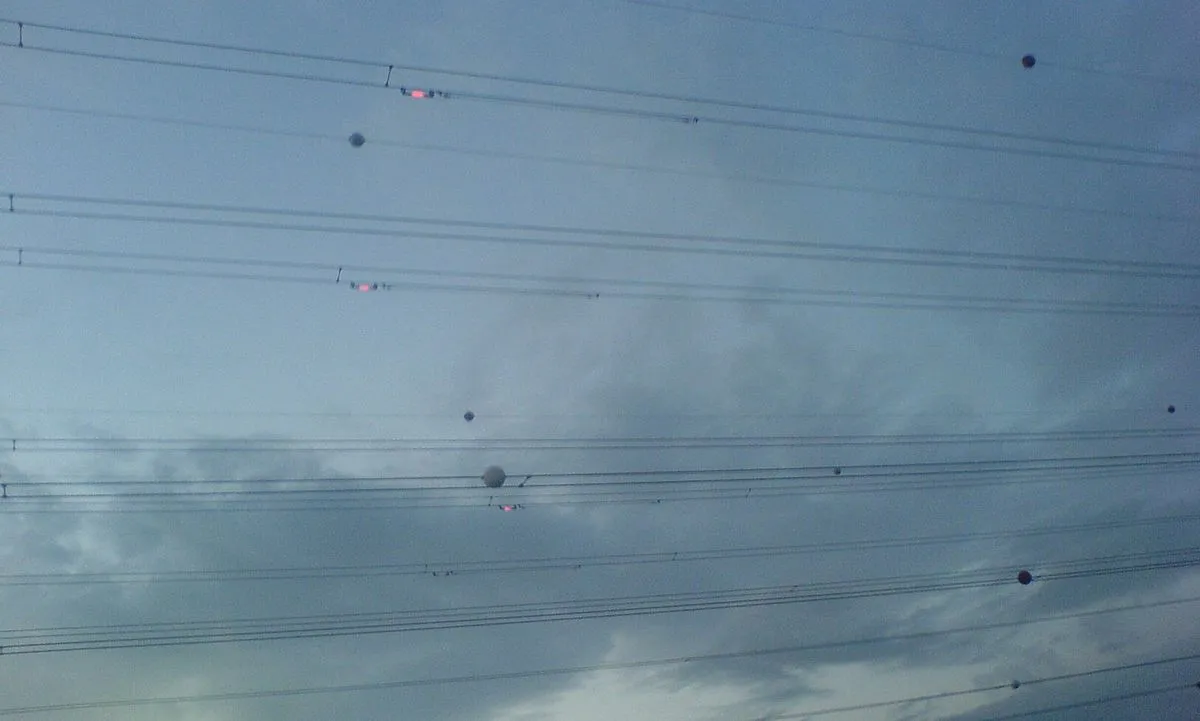
The thing about a balisor is that it consists of brightly-colored spheres (usually red) that glow at night using the power of the line on which they’re installed.
Do The Different Colors Mean Different Things?
This is the question most people ask once they notice that the balls aren’t all the same shade. The honest answer is a little anticlimactic: the colors are about visibility, not a hidden code. A red ball doesn’t flag a more dangerous wire than an orange one, and a white one isn’t carrying a different voltage. Every color on the line is doing the same job, which is making the wire impossible for a pilot to miss.

In the United States, the FAA’s Advisory Circular 70/7460-1 spells out exactly which colors are allowed: each marker must be a single solid color, either aviation orange, white, or yellow. The reason you see more than one color on a single span is that an alternating scheme stands out against the widest range of backgrounds. Orange reads clearly against snow, pale sky and water; white reads clearly against dark forest, rock and farmland. By switching between them along the wire, the line stays conspicuous whether the pilot is looking at it against bright cloud or a shadowed hillside.
There are two small rules worth knowing. The agency recommends putting an orange marker at each end of a marked span, then spacing the rest in between. And when a span carries fewer than four markers in total, they should all be aviation orange, the high-contrast fluorescent hue, since there aren’t enough balls to make alternating worthwhile. So the next time you spot a run of orange, white and yellow spheres, you’re not looking at a color code, but at a deliberately mixed palette engineered for maximum contrast.
How Big Are The Balls, And How Far Apart?
From the ground they look basketball-sized, and that’s roughly right, though the real specification is larger than most people guess. Under the FAA’s rules, the markers on extensive catenary wires (the long spans that cross canyons, rivers and lakes) should be at least 36 inches (91.4 cm) in diameter. Smaller 20-inch (50.8 cm) spheres are allowed on shorter spans, or on lower power lines below 50 feet (15.2 m) above ground that sit within 1,500 feet (457 m) of an airport runway end. So the typical ball is somewhere between 50 and 91 cm (20 to 36 inches) across, which is why a single marker can be the size of a beach ball or larger.

They have to be that big for a simple reason: a pilot needs to register the wire from far enough away to react. The markers are designed to be recognizable in clear daytime conditions from a distance of at least 4,000 feet (1,219 m). Spacing follows the same logic. Unlighted markers are spaced roughly every 200 feet (61 m) along the wire, with the balls packed closer together (about 30 to 50 feet, or 9 to 15 m, apart) in critical zones near runway ends where a low-flying aircraft is most exposed.
Modern markers are typically molded from tough, UV-stabilized plastic rather than the wood or metal of early designs, so they shrug off years of sun and weather without losing their color. When more than one wire shares the highest point of a crossing, installers often alternate the balls from wire to wire. That isn’t just tidy, but it spreads the added weight and wind load so no single conductor has to carry all of it, an issue that matters once you realize the markers ride on the same wires that already sag and sway in the wind, much as a helicopter pilot threading a valley has to account for every cable in the way.
Do Marker Balls Also Protect Birds?
Marker balls were invented for pilots, but birds turn out to be the other big winner. Overhead wires are nearly as hard for a flying bird to see as they are for a pilot, and collisions with power lines kill a large number of birds worldwide every year, with swans, cranes, bustards and other heavy, fast-flying species especially at risk. Making the wire visible helps them, too.

The evidence is fairly strong. A 2011 meta-analysis published in Conservation Biology pooled multiple field studies and found that marking the wires (with balls, swinging diverters or similar devices) cut bird collision mortality by about 78% compared with unmarked lines. The effect varied between studies and species, and markers help most in daylight, since an unlit ball is hard to see after dark. Even so, a roughly two-thirds-to-three-quarters reduction is a remarkable payoff for hanging a few plastic spheres on a cable.
This is why utilities now deploy a whole family of related devices, from the classic spheres to spiral coils and flapping flight diverters, specifically to reduce bird strikes alongside the aviation markers. It’s a neat example of one simple fix solving two problems at once: the same high-contrast ball that keeps a crop-duster from clipping a wire also gives a migrating crane the split second it needs to climb. For more on how birds manage the energy demands of long-distance flight, see our piece on how birds conserve energy during flight.
All things considered, I think it would be fair to say that aerial markers are incredibly simple, yet remarkably effective, devices that subtly safeguard the lives of people, and birds, sharing the skies.
References (click to expand)
- Balisor - Wikipedia. Wikipedia
- Q & A: Aerial markers on power lines | Department of Physics | University of Illinois at Urbana-Champaign - van.physics.illinois.edu
- Advisory Circular 70/7460-1, Obstruction Marking and Lighting. Federal Aviation Administration (FAA)
- Meta-analysis of the effectiveness of marked wire in reducing avian collisions with power lines. Conservation Biology (2011). PubMed / NCBI