Table of Contents (click to expand)
Guns are loud because firing a cartridge releases combustion gases at roughly 50,000 psi behind the bullet. When the bullet exits the barrel, that gas suddenly bursts into the open air faster than the speed of sound, producing a spherical shock wave called the muzzle blast. Most centerfire rifles peak at 159 to 174 dB, well above the 140 dB threshold at which a single shot can cause permanent hearing damage.
If you’re into action movies, then you’ve almost certainly lost count of how many times you’ve seen raging firefights between the “good guys” and “bad guys”. These fights may be based in different context, characters, and realities, but there’s one thing that is common to each and every firefight that you’ve ever seen in movies and televisions: the sounds of those guns firing.
We’ve gotten so used to it that we barely realize it’s there, but outside the fictional context of movies, have you ever wondered what actually causes the loud bang of a gunshot?
Gunshot Science
Who doesn’t know what a gunshot is? Loosely defined, a gunshot is basically a discharge of any firearm, such as a revolver, pistol, rifle or other such weapons. The gunshot is accompanied by a mechanical sound and leaves a chemical residue in its wake.
The process goes something like this: you pull the trigger, the bullet leaves the muzzle, there is a loud noise and you experience a forceful jerk in the ‘firing’ hand (recoil). Also, you can add a spinning cartridge flying out of the gun for dramatic effect.
Now, where does the loud bang come from in all of this?
The Physics Of A Gunshot
A typical bullet consists of three main parts: the primer (launches the bullet), propellant (accelerates the bullet through the barrel) and ‘bullet’ (the part that hits the target).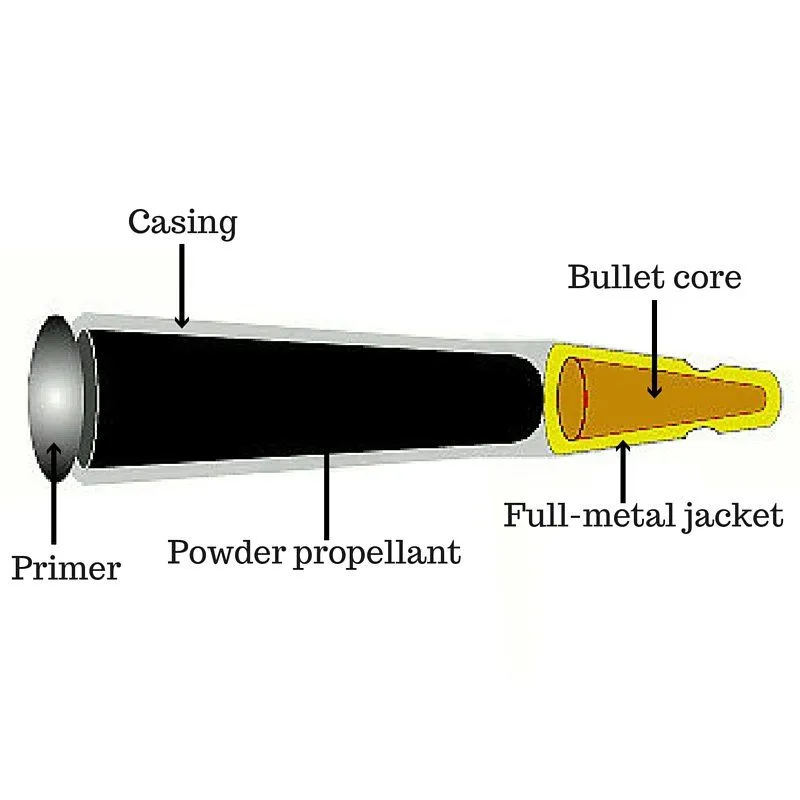
The moment you pull the trigger, a spring mechanism causes a metal firing pin to hit the back end of the bullet, which in turn ignites the small explosive charge in the primer. This ignites the propellant (this is the part that gives such high velocities to the bullet) and the chemicals in the propellant burn, rapidly producing a lot of gas. This gas drastically increases the pressure behind the bullet, causing the bullet to leave the barrel at an incredibly high speed to hit the target.
So, where does the ‘noise part’ occur? While the bullet travels down the barrel, it acts like a seal, trapping the high-pressure combustion gas behind it. The moment the bullet exits the muzzle, that seal breaks and the trapped gas suddenly bursts into the open air, expanding faster than the speed of sound. That creates a spherical shock wave called the muzzle blast, and that is the loudest part of the BANG you hear. A gunshot is actually a composite of three sounds: the muzzle blast (dominant), a separate sonic "crack" if the bullet is supersonic (more on that below), and minor mechanical noise from moving parts in the action. Centerfire rifles routinely peak at 159 to 174 dB at the shooter’s ear, and even a 9mm pistol hits 148 to 171 dB. OSHA flags 140 dB peak as the threshold beyond which a single unprotected shot can cause permanent hearing loss.
A champagne bottle also produces a popping sound when it’s uncorked. The principle of uncorking a champagne bottle is actually quite similar to firing a bullet, although we’re talking about a lot less pressure and speed in the case of a bottle of bubbly.
The ‘Crack’ Of A Bullet
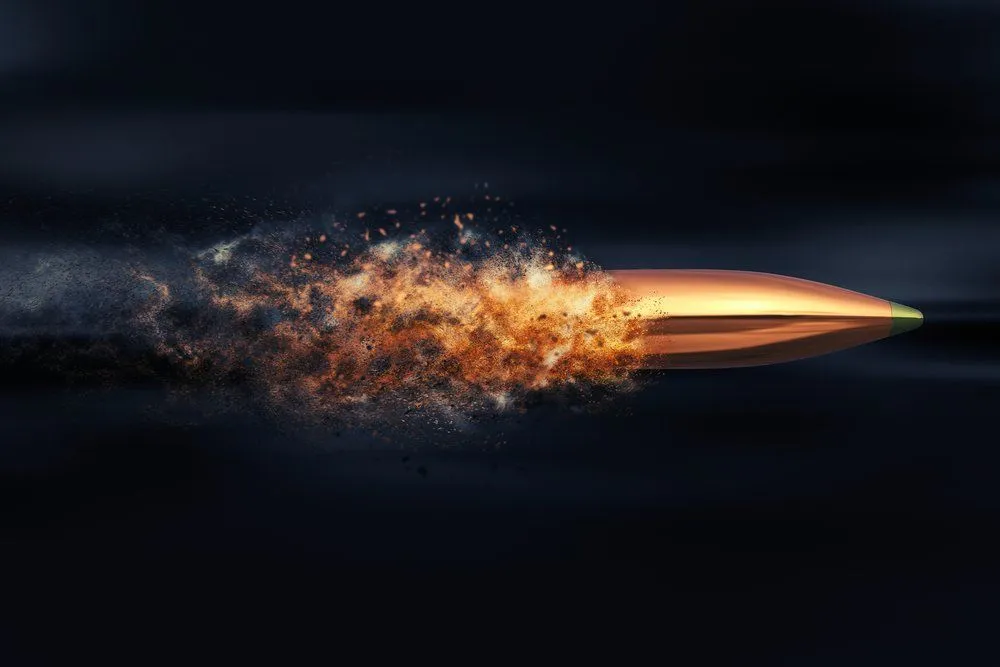
The BANG of gunfire is not the only sound associated with firing a bullet; there’s also an audible crack when the bullet passes by someone. This ‘crack’ is heard because most bullets travel faster than the speed of sound itself (about 343 m/s, or 1,125 ft/s, at sea level). A standard 5.56mm NATO rifle round leaves the muzzle at roughly 940 m/s, nearly Mach 2.7, so the bullet shoulders the air aside faster than the air can move out of the way. The result is a conical shock wave trailing the bullet, exactly like a supersonic jet’s sonic boom, just smaller. Many handgun rounds straddle the sound barrier (9mm Luger at ~370 m/s is just supersonic; .45 ACP at ~260 m/s is subsonic), and "subsonic" ammunition is deliberately loaded below the speed of sound so it produces no crack at all. For more on sonic booms, check out Why Do You Hear a ‘Boom’ When an Aircraft Speeds by Overhead?
This is also why Hollywood-style "silent" pistols are a myth. A suppressor only attenuates the muzzle blast (typically by 25 to 35 dB); it cannot do anything about the sonic crack created by the bullet itself downrange. Truly quiet shooting requires both a suppressor and subsonic ammunition, and even then it is still louder than a chainsaw.
How Loud Is A Gunshot, Really?
Numbers like “160 decibels” are hard to feel until you line them up against sounds you already know. The decibel scale is logarithmic, so every 10 dB is roughly a tenfold jump in sound intensity, which is why the gap between a gunshot and a noisy room is far bigger than the figures make it look. According to the National Institute on Deafness and Other Communication Disorders, normal conversation sits at about 60 to 70 dBA, a motorcycle at 80 to 110 dBA, a rock concert or maxed-out earbuds at 94 to 110 dBA, and a siren at 110 to 129 dBA. A fireworks show reaches 140 to 160 dBA, and an unsuppressed gunshot lands right alongside it, typically 140 to 175 dB peak depending on the firearm.
What makes a gunshot uniquely dangerous is not just how loud it is but how quickly it arrives. The NIDCD notes that long or repeated exposure to anything at or above 85 dBA can gradually damage hearing, but a single intense burst, such as a gunshot or explosion, can rupture the eardrum or harm the tiny bones of the middle ear instantly, causing hearing loss that is immediate and permanent. That is why occupational guidelines treat a peak of 140 dB as a hard ceiling: one unprotected shot already meets a person’s entire allowable daily noise dose. So the honest answer to “how loud is a gunshot?” is: loud enough that the very first round, with no ear protection, can leave a permanent mark. If you want to understand why the scale behaves the way it does, see our explainer on what a decibel actually measures.
Can A Gun Make A Loud Noise Without A Bullet?
Here is the part that surprises people: the bang you hear is the gas, not the bullet. The projectile is just along for the ride. That is exactly why blank cartridges exist. A blank holds a primer and a powder charge sealed by a crimped case or a thin wad, but no bullet at all. When the firing pin strikes it, the powder still burns and still floods the barrel with high-pressure gas, so the muzzle blast happens just the same. The result is a near-identical report with nothing fired downrange, which is why blanks are used in films, military training, funeral honors, and starter pistols at track meets.
Do not mistake “no bullet” for “harmless,” though. A study of starter pistols published in the International Journal of Audiology found that these blank-firing guns produce peak sound levels above 140 dB, high enough that just a handful of shots can exhaust a bystander’s safe daily noise exposure. The escaping gas, or muzzle blast, can also injure skin, eyes, or ears at close range. The takeaway reinforces the whole point of the article: a firearm is loud because of the sudden release of combustion gas, so a gun can absolutely make a deafening noise with no bullet in sight.
So, there you have it! The bang of a revolver is not some fantastical thing that popular culture has ingrained in our minds to make movies seem more exciting; instead, it is a very real thing with a clear scientific basis… who knew?
References (click to expand)
- Murphy WJ, Tubbs RL. Prevention of Noise-Induced Hearing Loss from Recreational Firearms. NIOSH (PMC).
- 29 CFR 1910.95 Occupational noise exposure. US OSHA.
- A Shot in the Dark: The Acoustics of Gunfire. Scientific American.
- The Physics of Guns. University of Alaska Fairbanks.
- How do bullets work? Explain That Stuff.
- Noise-Induced Hearing Loss. National Institute on Deafness and Other Communication Disorders (NIDCD), NIH.
- Meinke DK, et al. Impulse noise generated by starter pistols. International Journal of Audiology, 2013. PubMed.