The main reason power lines aren’t buried underground is cost. Recent US utility estimates put undergrounding at roughly $1-5 million per mile, compared with $100,000-$300,000 per mile for overhead lines. Population density and geology can move the number even higher. On top of that, buried cables are slower and costlier to repair, and they can carry less current per conductor because they can’t shed heat the way overhead wires can.
You’ve surely seen hosts of power lines criss-crossing each other, connecting buildings and other structures with main power lines. In particularly populated areas in some parts of the world, it’s not uncommon to see dozens of overhead power lines draped across poles and buildings.
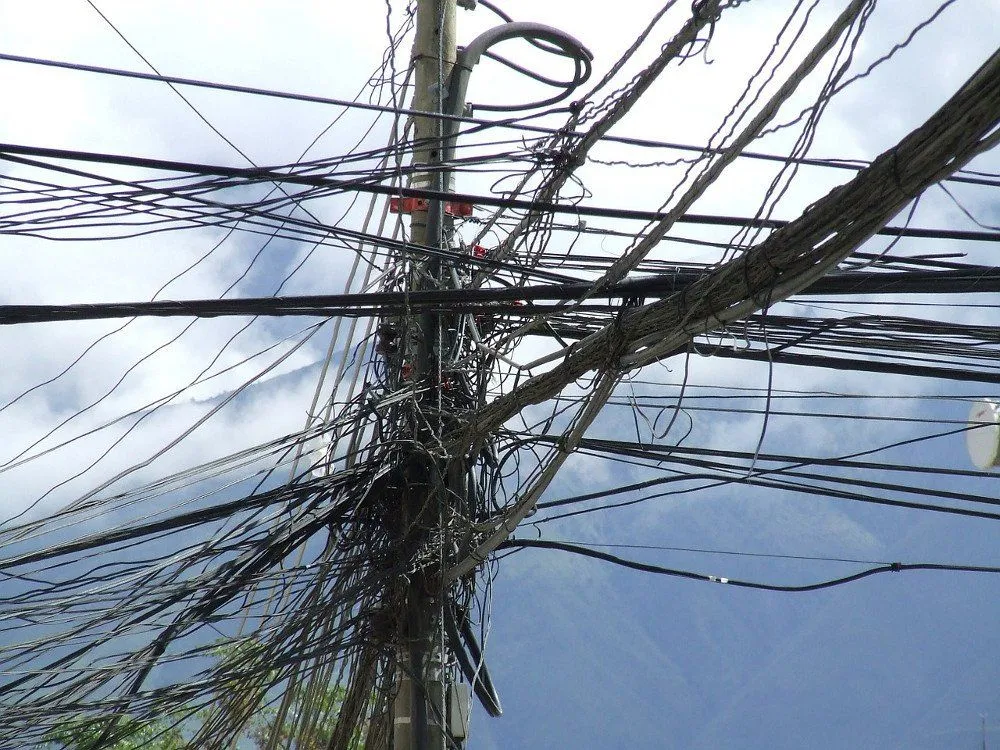
Not only does this look messy, but the overhead installation of such power lines has a few real drawbacks as well. For instance, overhead power lines are one of the first things that are affected when a natural calamity (e.g., hurricane, tornado) strikes. In some cases, even strong winds and falling trees can cause power outages.
With all that in mind, wouldn’t it make more sense to have an underground power system, i.e., one where all those power lines and wires are laid underground?
Well, I’ll let you in on a little secret…
Cities With Underground Power Lines
That’s correct. Large metropolitan areas and particularly ‘affluent’ neighborhoods (especially in developed countries) typically have underground power lines. In fact, in most European countries (e.g., Italy, Germany etc.), electricity distribution is usually buried (except for those near massive power plants and isolated homes in far-off places).
Even in the US, you’ll hardly ever find overhead power lines in affluent neighborhoods and major cities, such as Manhattan (New York) or Washington DC, among many others.

So, now that it’s been established that underground power distribution systems do exist, let’s move on to the main question of this article.
Reasons Behind The Rarity Of Underground Power Lines
There are a few reasons why the ‘overhead arrangement’ is so common in most parts of the world, but all of those reasons essentially boil down to one factor: cost.
First off, as you can imagine, it’s one heck of a challenge to install an underground power system. The ground can be too soft (so the trench/hole wouldn’t hold up) or too hard (meaning that it would take forever to dig). Either way, it means that you have to shell out more money.
Then comes the digging part. In developed countries like the US, you cannot just take some shovels and start digging a site. Most areas have strict rules as to where you can dig, how you dig, when you dig and even what you’re supposed to do with the stuff that you find while digging.

Furthermore, you might have to dig up existing roads and streets (thus blocking traffic for days) and ask for permission from everyone whose land you’re crossing while installing your power infrastructure.
This isn’t so bad if your installation site is located in a hinterland or if you are building new cities from scratch, but it becomes too much of a financial burden if you’re digging in the middle of a densely-populated city. Recent US utility estimates put burying power lines at roughly $1 million to $5 million per mile, compared with about $100,000-$300,000 per mile for new overhead lines. Population density and geology can push the number even higher.
Furthermore, the underground power infrastructure is more expensive, as is the maintenance and repair it would require.
Technical Disadvantages
The same number of underground power lines cannot carry an equivalent amount of current as their overhead counterparts, due to their inability to shed heat like the uninsulated overhead lines.
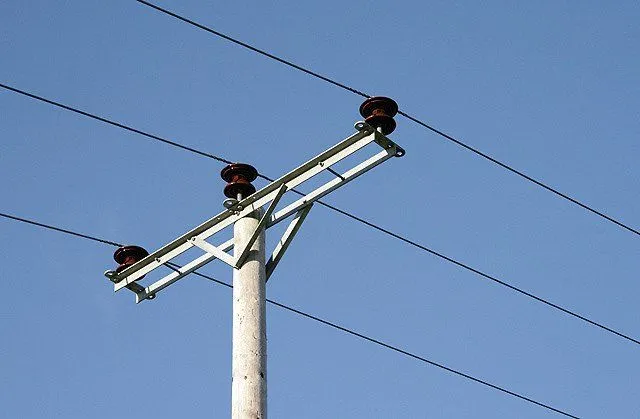
Adding more capacity to overhead wires is usually easier in most cases, which is an added benefit.
All in all, an underground power system is perfectly safe and plausible; that’s why it’s actually preferred in some parts of the world. However, for most countries and power companies, burying power lines underground simply doesn’t turn out to be as cost-effective as they’d want it to be. Hence, overhead power lines are here to stay, at least for a while.
Why Are Power Lines Left Sagging Instead Of Pulled Tight?
Look closely at any overhead line and you’ll notice the wires never run perfectly straight between poles. They always droop a little, forming a gentle curve called a catenary. It looks sloppy, but that slack is deliberate, and stringing a line drum-tight would actually be a serious engineering mistake.

The culprit is thermal expansion. Metals lengthen when they get hot and shrink when they cool, and a power line lives through a huge temperature range, baking in summer sun (and warming further from the current it carries) and freezing on a winter night. Take a 300-meter (about 980-foot) aluminum span and warm the conductor by 40 °C (72 °F). Using aluminum’s coefficient of linear expansion of roughly 23 × 10-6 per °C, the wire grows by about 0.28 meters (around 11 inches): ΔL = (23 × 10-6) × 300 m × 40 °C ≈ 0.28 m. That extra length has to go somewhere, and it shows up as deeper sag.
Now picture the reverse on a frigid night. The metal contracts and tries to pull itself shorter. If engineers had hung the wire bow-string tight, there would be no slack left to give up, so the only way to satisfy that shrinkage is for the tension to spike. Pile on a coating of ice and a gusting wind, and that tension can climb toward the conductor’s breaking strength, snapping the wire or yanking the crossarms and poles down with it. The built-in sag is the safety margin that lets the line breathe.
So utilities don’t just eyeball the droop. They run sag-tension calculations that balance two competing limits: enough sag that cold-weather tension stays safely below the breaking point, but not so much that a hot, heavily loaded wire dips low enough to threaten its clearance above the ground. The amount of sag you see hanging overhead is the carefully chosen sweet spot between those two failure modes.
References (click to expand)
- U.S. Energy Information Administration - EIA - EIA. The U.S. Energy Information Administration
- Should power lines go underground? - UF News. The University of Florida
- We Need to Put All Coastal Electricity Underground -- NOW. Columbia University
- Goldstein, Noam, "Consulting with Public About Undergrounding Power Lines for Downtown Revitalization: The Case of Hockanum Road and Manhan Rail Trail at Pleasant Street in Northampton, MA" (2015). School of Public Policy Capstones. 41. - University of Massachusetts Amherst
- Hassan Al-Khalidi - Technical Consideration And Impact Of Converting Overhead Power Lines To Underground Power Cables - CiteSeerX
- How Power Grids Work. Smith College
- Sag and Tension Calculations for High-Voltage Overhead Line Conductors. Energies (2024), MDPI
- Uncertainties in the Testing of the Coefficient of Thermal Expansion of Overhead Conductors. Energies (2020), MDPI