Bus seats are upholstered in a hard-wearing pile fabric called moquette (typically 85% wool and 15% nylon), and their busy, brightly coloured patterns are not just for decoration - they're engineered to camouflage stains, dust, scuffs and wear so the seats keep looking fresh without daily cleaning.
The spectrum of adjectives used for bus seats is broad. To begin with, most of us hardly take notice of the design of bus seats. Yet when we do, pleasing is not the first word that comes to mind. Mind bending, often hideous patterns are, however, characteristic to all forms of public transportation. Do bus companies cause visual anxiety for their passengers on purpose? Or do they really not have another alternative?
The Reason For Weird Patterns On Bus Seats
Before we get into this, here’s a little something for you to try. If you have fabric upholstery in your house, such as a sofa seat or a dining chair, try hitting it with a stick. What begins as a curious experiment will quickly turn into a cleaning chore, owing to the seemingly endless cloud of dust that will emanate from it. All of that is from just a few people using the furniture every day!
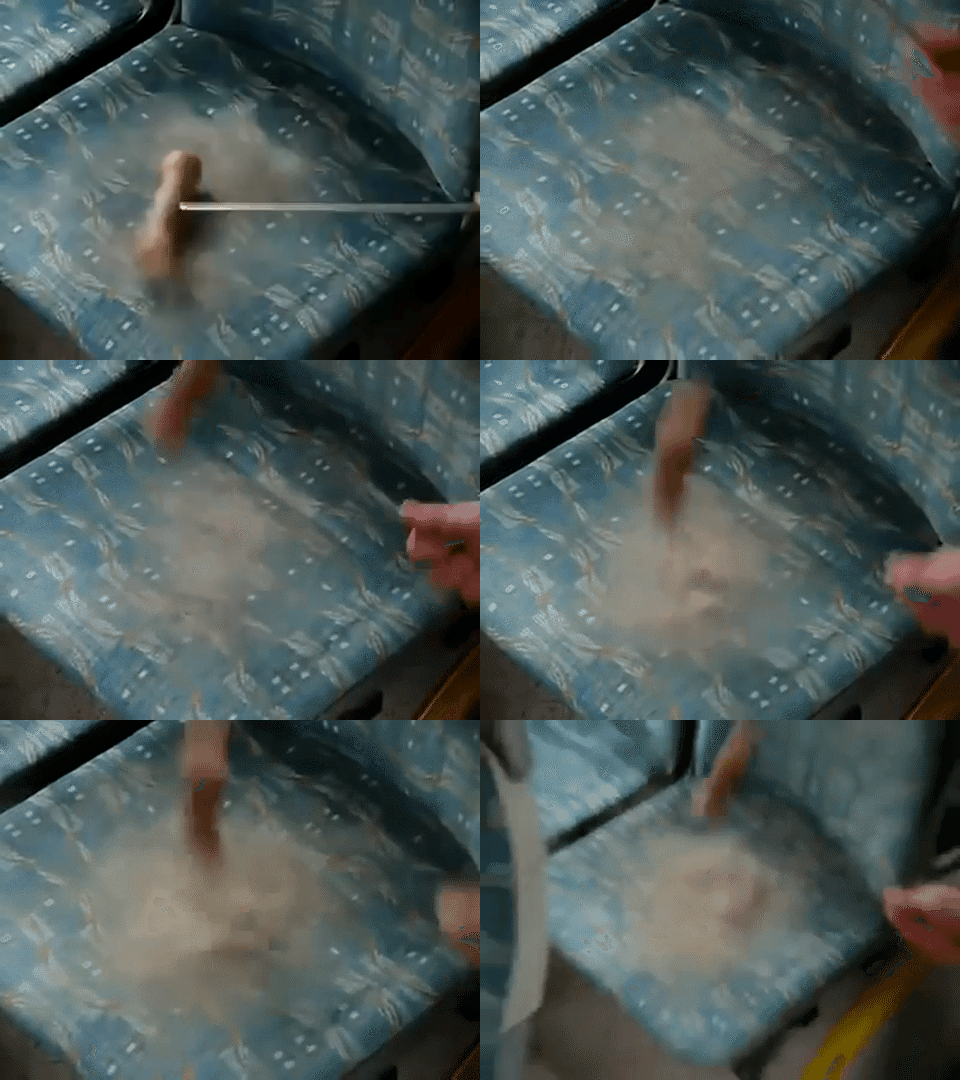
Now, let’s extend this example to the bus seat. A bus seat may see dozens or even hundreds of passengers every week, all year round. And if the public transport committee were to appoint someone to beat the seats with a stick, imagine the utter chaos that would ensue! To do away with the hassle of having to maintain public transport seats, an intelligent solution was adopted.
The weird, mind-bending patterns are designed to make the seats appear clean and unworn, even though they conceal a lot of dirt within those wild patterns. The secret lies in the type of material used to cover these seats.
Why Is The Seat Fabric So Special?
At first glance, it doesn’t seem like much thought goes into choosing textiles for upholstery in public transport. After all, how could something so mundane and unnoticeable warrant so much attention? As it turns out, this isn’t the case.
Public transport upholstery must serve a variety of functions. With the aesthetic side of things already spoken of, there are a few technical attributes it must also possess. The fabric should prevent propagation, or the spreading of flames in the event of fire.
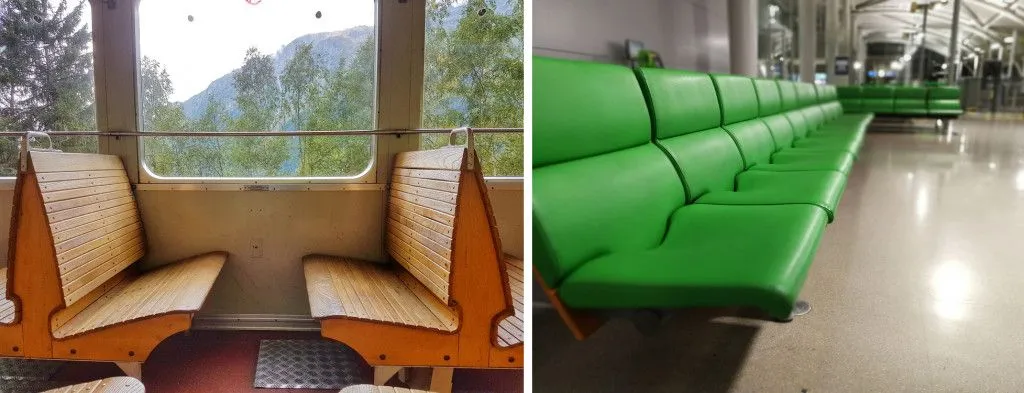
It should be a breathable fabric that allows the passenger to commute in relative ease with respect to the prevailing climate. At the same time, it should be durable enough to not show signs of wear and tear if subjected to mishandling or vandalism.
The quest for finding the most commuter-friendly fabric led transport companies through many materials. While materials such as wood and artificial leather have been used in the past, they did not offer much comfort to passengers. Short-haul trains, such as metros and tubes, still use hard polycarbonate and even stainless steel to make bench-type seats.
Moquette – The Magic Trick
French for carpet, moquette was first used by the London transport system. Traditional moquette is a blend of wool (85%) and nylon (15%), woven over a cotton backing; modern variants sometimes substitute recycled polyester for the wool. The way a cloth feels when touched is generally due to the way the threads are woven. Moquettes generally have standing fibers, known as pile, that lend them their plush, velvety texture. These standing fibers can either be looped (loop pile) or open-ended (cut pile). When compared to traditional fabrics, moquette offers many advantages.
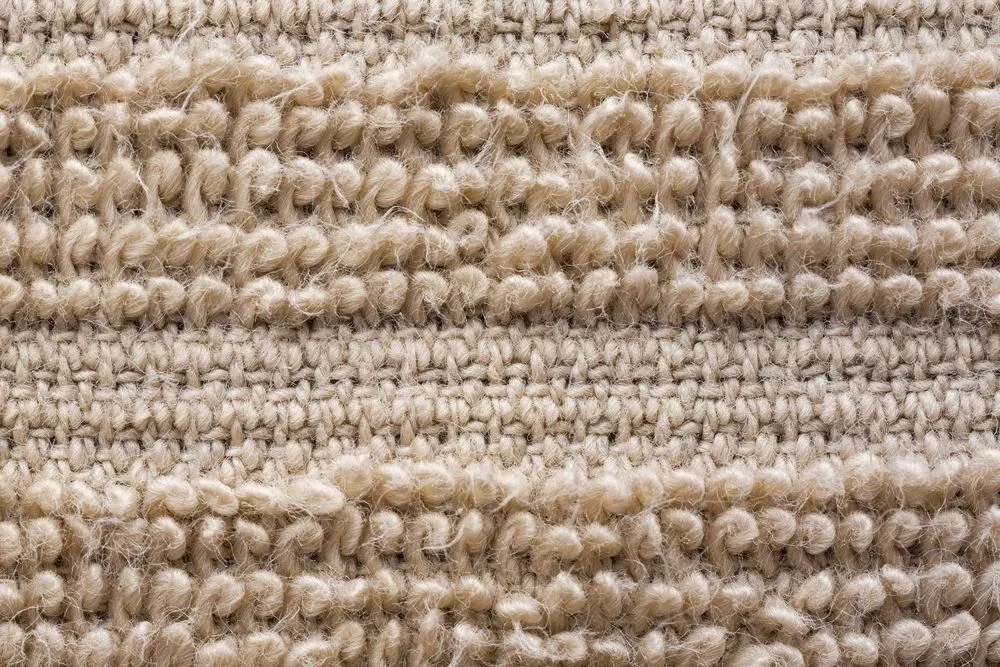
- They are inexpensive to produce and extremely durable, making them the most economical choice for use in public transport.
- The velvety weave of the fabric ensures any dirt or dust gets accumulated deep within the pile, without showing outward staining.
- Compared to leather and vinyl, moquettes are generally breathable. This greatly reduces discomfort in places where skin comes in direct contact with the fabric.
- The nature of the fabric greatly changes the way it interacts with fire and water. It is flame-retardant, which helps in fire safety. At the same time, it does not remain soaked for long in the case of spillage. Water remains on the outermost surface of the fibers and dissipates over a larger surface area, thereby drying out faster.
- Moquette offers a high level of customizability in terms of color matching and patterns. This enables big corporations to have their legacy symbols, logos etc. printed on their choice of upholstery, while staying true to their digital versions.
How Are The Weird Patterns Generated?
Is it hard to design something so gaudy and replicate it on such a huge scale? In fact, it is! Most moquette patterns today are generated by computer algorithms. Some transport companies will use their brand colors to make the design more utilitarian, as familiar colors improve brand recall. Since the primary role is to hide dirt and material wear, design principles remain roughly similar, whether you choose a specialized color scheme or not.
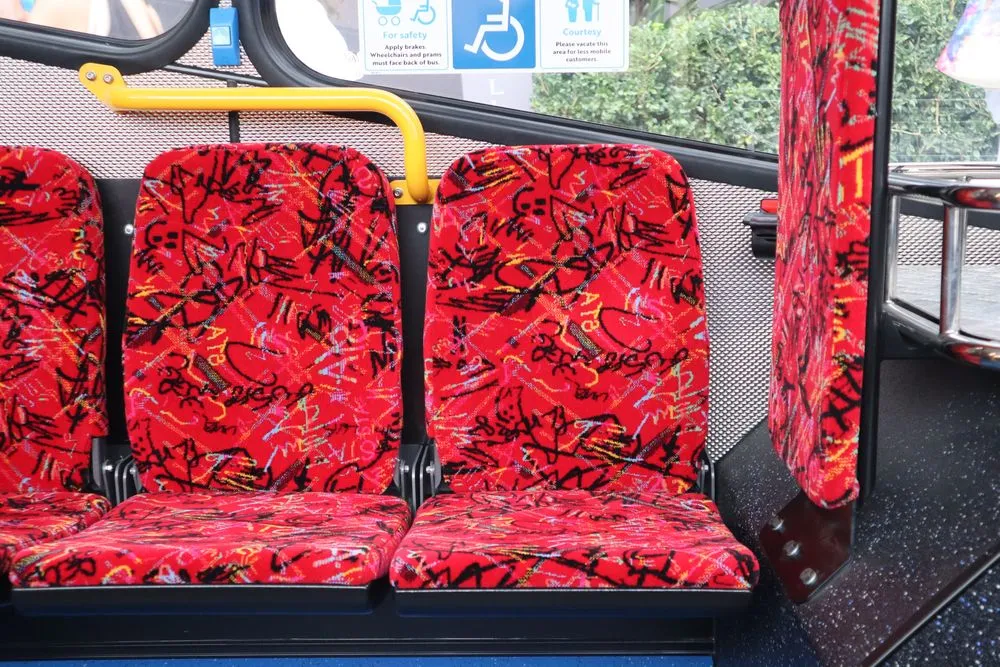
- The designs should not contain large patches of a single color.
- They should use deeper shades, such as blue, tan and maroon, over lighter shades such as white and cream.
- The monotony should be broken by the use of various shapes, patterns and gradients. Visual clutter should be induced by means of colors, contrasts and brightness of the fabric.
- The pattern selected for one square unit should be repeated over the entire lot of that fabric.
What Are Bus Seats Actually Made Of?
The moquette we have been admiring is only the outermost layer of the seat. A bus seat is really a sandwich of three parts working together. At its core is a rigid frame, usually made of tubular steel or moulded plastic, that bolts to the floor and carries the weight of every passenger. Wrapped around that frame is a block of foam padding, typically a polyurethane cushion a few centimetres thick, which does the actual job of making the ride bearable. Only then comes the fabric cover, stretched taut over the foam and clipped or stapled to the frame.

The cover is where transport operators have the most choice. Specialist mills such as Camira weave the wool moquette we have discussed, but they also supply hard-wearing polyester velours, wipe-clean vinyl and even leather for premium coaches. Each one strikes a different balance of comfort, cost and cleaning. Whatever the top layer, it must pass strict flammability tests, which is why you will rarely find an ordinary household upholstery fabric on public transport.
So when you ask what a bus seat is really made of, the honest answer is layered: a metal or plastic skeleton, a foam muscle and a woven skin. The busy pattern you notice is only the skin, but the engineering underneath is what lets the seat stand up to years of hard use.
How Are School Bus Seats Different?
If you grew up riding a yellow school bus, you may have noticed that its seats look nothing like the busy moquette benches on a city bus. That is deliberate. School bus seats in the United States are built around a safety idea called compartmentalization, laid out in Federal Motor Vehicle Safety Standard (FMVSS) No. 222.

Rather than relying on seat belts, the standard surrounds each child with a protective envelope of strong, closely spaced seats. The seat backs are tall and heavily padded, at least 610 mm (24 inches) high on modern buses, and are designed to flex forward in a crash so they soak up energy instead of passing it on. The cushions are thick blocks of foam, roughly 10 cm (4 inches) deep, that behave like a built-in buffer for the child sitting behind.
Because those seats have to be wiped down daily and survive decades of hard service, they are almost always covered in tough, wipe-clean vinyl rather than woven moquette. The trade-off is comfort for hygiene and durability, which is the exact opposite of the plush patterned fabric you find on a long-distance coach.
Are Bus Seats Actually Dirty?
Given that the whole point of the pattern is to hide dirt, it is fair to ask how much grime is actually lurking down in the pile. The uncomfortable answer is: quite a lot. Because moquette is porous and woven, it traps not only dust but skin cells, food crumbs and moisture, all of which feed bacteria.
Researchers who swabbed seats on the Portland, Oregon transit network found the gap between fabric and hard seating to be stark. Cloth-padded seats carried an average of about 80 bacterial colonies per 8 cm² patch, while vinyl seats averaged fewer than two. The scientists put the roughly 40-fold difference down to the fact that non-porous vinyl holds far fewer microbes and is easy to wipe clean, whereas cloth hides them below the surface where a rag can never reach.
That finding is one reason transit agencies like Portland's TriMet have switched some of their fleet from cloth seating to vinyl. The clever camouflage that keeps a fabric seat looking presentable is the very same property that lets it stay quietly filthy. So the patterns really are doing their job, perhaps just a little too well.
A Final Word
It is important to note that the longevity of service and decreased maintenance take priority over aesthetic appeal where public transport is concerned. Like public transport textiles, camouflage prints for military applications are also generated by means of complex algorithms that help them blend in with their surroundings.
References (click to expand)
- A history of moquette | London Transport Museum. The London Transport Museum
- L Zhang. Digital Camouflage Design Algorithm Based on Template .... Semantic Scholar
- Transport Upholstery Fabrics for Bus, Coach and Rail. Camira Fabrics
- 49 CFR 571.222 - Standard No. 222; School bus passenger seating and crash protection. Legal Information Institute, Cornell Law School
- School Bus Safety FAQs. School Transportation News
- A diversity of Antibiotic-resistant Staphylococcus spp. in a Public Transportation System. Osong Public Health and Research Perspectives