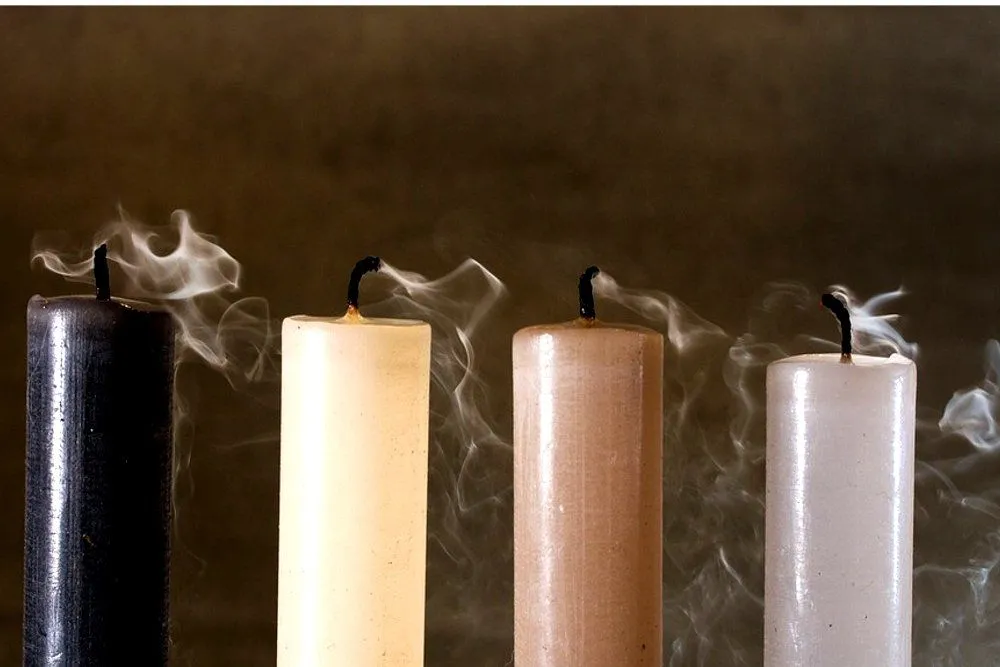
A candle doesn’t make smoke while it’s burning because the wax vapor coming off the wick is being completely combusted in the flame. The moment you blow it out, the wick is still hot enough to keep boiling wax for a few seconds, but there is no longer a flame to burn it — so the wax vapor cools, condenses into a mist of tiny unburned wax droplets and drifts upward as the wispy white “smoke” you see. (It’s really an aerosol of wax, not soot.) Because that smoke is essentially fuel, you can relight the candle by holding a match in the trail of smoke a centimetre or two above the wick — the flame will travel back down through the wax vapor and reignite the wick.
This is quite an intriguing aspect of candles… while they’re still lit, they don’t produce any smoke, but the moment they are blown out, they produce billowing streams of smoke for a short time.
What’s the reason behind this strange sorcery?
In order to understand that, it helps if we first take a look at how candles work.
How Does A Candle Work?
A candle works as a result of combustion (of fuel) – a process that generates heat, which consequently produces light.
A candle consists of two parts: a wick and a wax body.
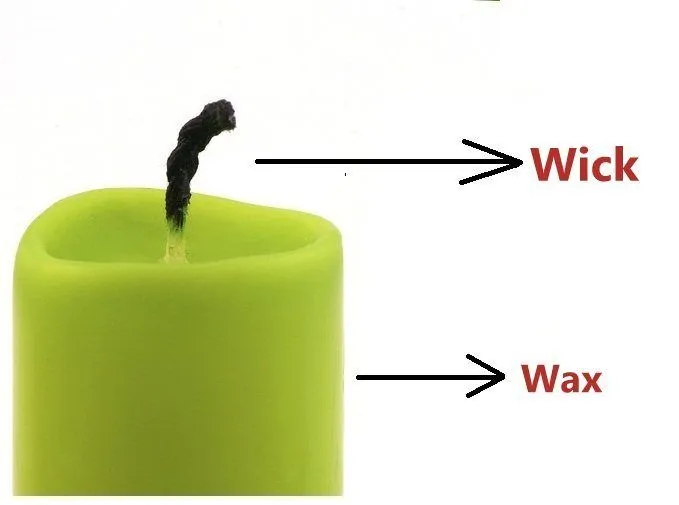
The wick is the small part that sticks out from the top of the wax body. This is the part that actually burns and produces a flame. A wick is usually a string of braided cotton that holds the flame of a candle for a set period of time, depending on the amount of wick that is used in the candle.
Capillary Action
The wick burns due to a phenomenon called ‘capillary action’ as the fuel (i.e., the wax) is supplied to the wick, which keeps the flame burning.
When a candle is lit by a match, the small amount of wax present on and near the wick begins to melt. The wick then absorbs the melted wax, and pulls it upwards (through capillary action). The flame’s heat evaporates the molten wax (the ‘fuel’, in this case), which in turn combines with oxygen in the air (combustion) to produce a constant flame.
This is how a candle keeps burning until it runs out of fuel. When that happens, we say that the candle has ‘burnt out’.
What Are The Parts Of A Candle?
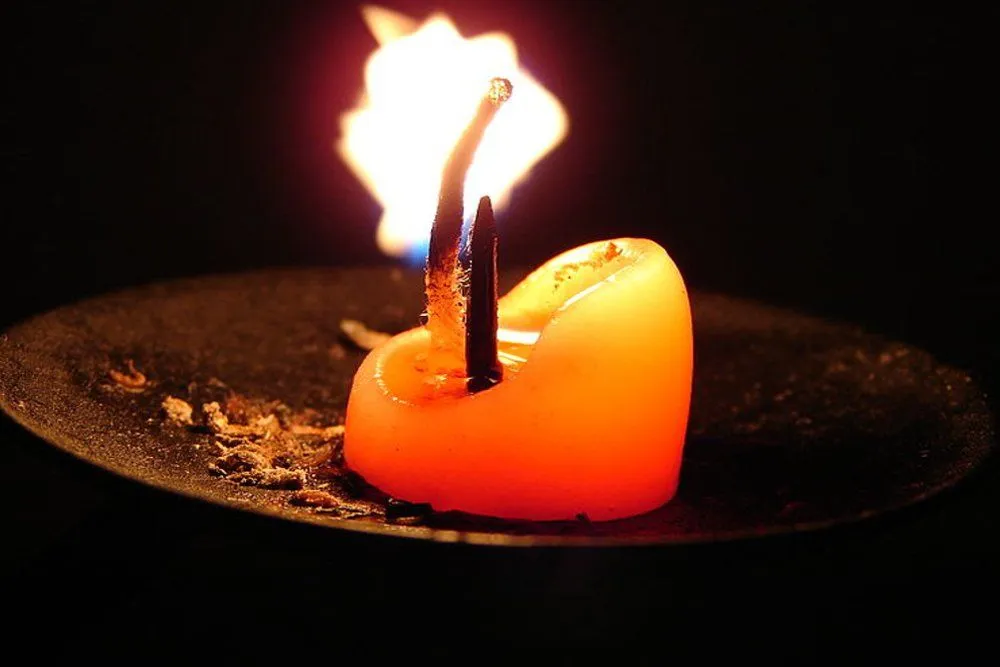
We have been throwing around the words “wick” and “wax,” so let’s slow down and name the actual parts of a candle, because there are really only three of them, plus the flame they create.

First, there is the wax body, which is really the candle’s fuel tank. Despite looking solid and ordinary, candle wax is a hydrocarbon, a chain of hydrogen and carbon atoms, and that is exactly what makes it burnable. Second, there is the wick, usually a braid of cotton, which behaves less like the thing that burns and more like a fuel pump. Third, once the candle is lit, a small pool of melted wax (the melt pool) gathers in the cup at the top of the candle and feeds the wick by capillary action.
The fourth “part” is the one everyone actually watches: the flame. Look closely and it is not a single block of color. According to the National Candle Association, the flame is layered. Near the base sits a faint blue zone, where oxygen is plentiful and the hydrocarbon molecules first vaporize and begin to break apart. Just inside and above it is a darker, oxygen-starved region of unburned wax vapor. Wrapped around that is the bright yellow (luminous) zone, where tiny carbon particles glow at roughly 1,000 to 1,200 °C (1,830 to 2,190 °F), giving the candle its warm light. The thin, almost invisible outer veil is hotter still, reaching about 1,400 °C (2,552 °F), where combustion is most complete.
So when people ask “what part of a candle produces the flame?”, the honest answer is that no single part does it alone. The wax supplies the fuel, the wick delivers it, and the flame does the burning a millimetre or two above the wick, in that rising vapor.
Why Does A Candle Produce Smoke When It’s Blown Out/extinguished?
The moment you blow out a burning candle, you have surely noticed that it produces smoke for a few seconds before becoming absolutely ‘inactive’. The smoke was nowhere to be seen when the candle was actually burning, so where does this smoke suddenly come from?
Interestingly, the smoke you see when you blow out a candle is not really “smoke” in the soot-and-ash sense at all — it is condensed wax vapor: a fine aerosol of tiny unburned wax droplets, suspended in the rising column of warm air. To put this in perspective, what steam (or rather, the white mist you see when steam meets cool air) is to water, this aerosol of wax is to candle wax.
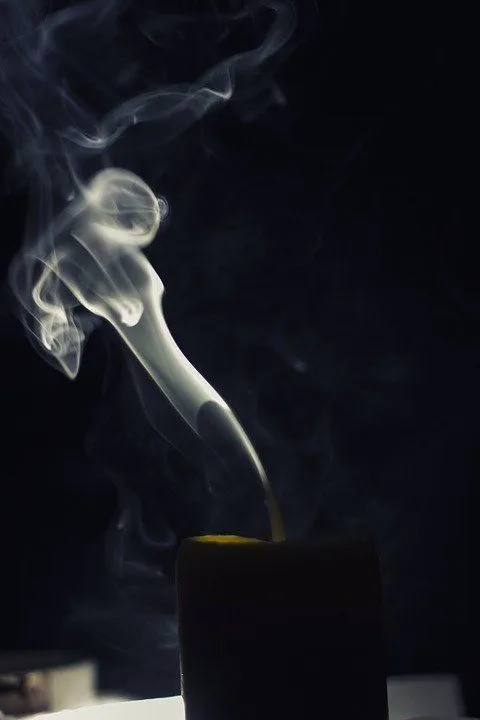
As mentioned earlier, when a candle burns, it’s not the wick that burns, but rather the wax of the candle. Candle wax is quite flammable, but only when vaporized. When you blow out the candle, the heat remains and continues to vaporize the candle wax (only for a few seconds though). This produces a trail of what appears to be candle smoke.
A very interesting thing to note is that since the smoke is vaporized wax, you could actually relight the candle by lightning the smoke (and not the wick itself)!
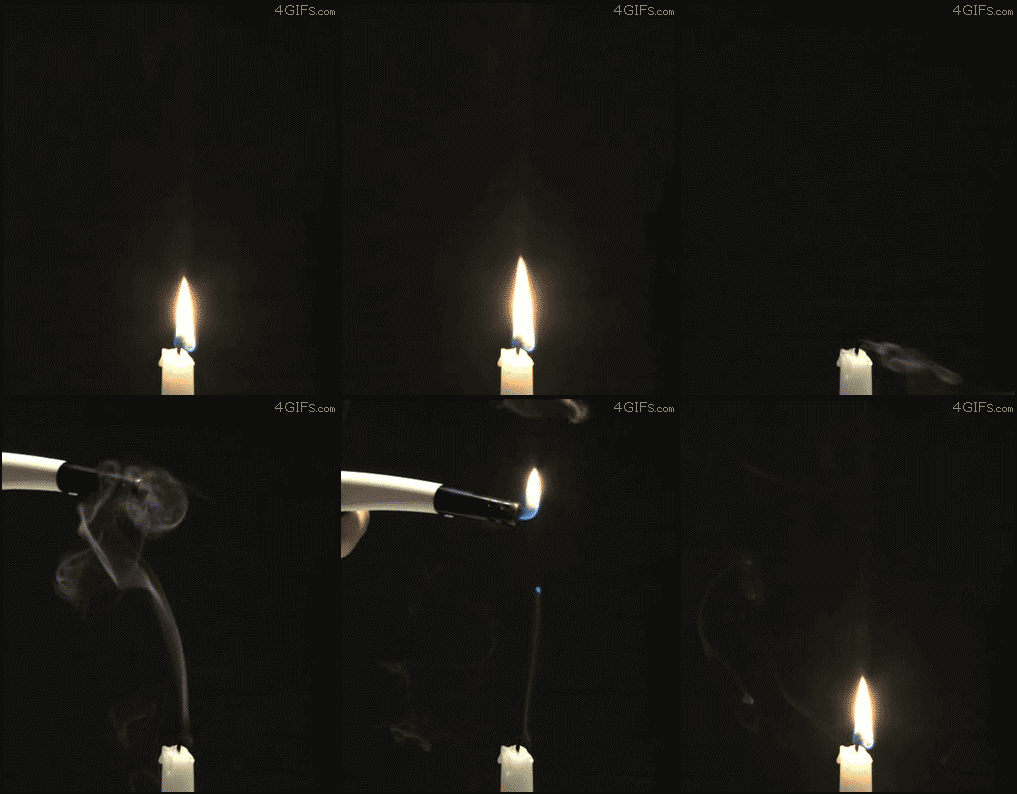
I’d say that that’s quite a cool experiment to try at home, don’t you think?
Why Does Blowing On A Candle Put It Out?
Here is a puzzle that trips a lot of people up: blowing on a campfire makes it roar, yet blowing on a candle snuffs it out. Why does the same puff of air do opposite things?
A candle flame is not short of oxygen, so adding more air does not help it. The flame survives on a delicate balance instead: it needs wax vapor that is both dense enough and hot enough to keep reacting with oxygen. As the physicists at the University of Illinois Urbana-Champaign explain, when you blow, you cool down the gases and the wick surface and spread the wax vapor out, so there is no longer a pocket of gas that has enough wax molecules in it and is hot enough for the reaction to keep going. Knock out either condition and the chain reaction of combustion stalls.
That is the difference from a campfire. A big fire holds a huge reservoir of glowing, red-hot fuel, and your breath mostly just feeds it extra oxygen while barely denting its temperature. A candle flame is tiny and lightweight, so a single breath carries away enough heat (and disperses enough fuel vapor) to drop it below its ignition point in an instant. The wick stays hot for a few more seconds, which is exactly why it keeps boiling off that telltale ribbon of wax-vapor smoke after the flame is gone.
References (click to expand)
- Do candles burn longer when they are in hot or cold air? - UCSB Science Line. The University of California, Santa Barbara
- Candle Flames - teacherlink.ed.usu.edu
- Why Does Blowing put out a Flame? | Physics Van | UIUC. The University of Illinois Urbana-Champaign
- Candle Science - National Candle Association