Life evolved to breathe oxygen rather than the more abundant nitrogen because O2 is chemically reactive while N2 is nearly inert. The N≡N triple bond takes about 945 kJ/mol to break, so cells can't tap nitrogen for energy. Oxygen, by contrast, readily grabs electrons at the end of cellular respiration, releasing the energy that powers nearly every complex organism on Earth.
If you paid attention in your science classes back in high school, you know that our atmosphere is made up of many gases, including nitrogen, oxygen, argon, carbon dioxide and trace amounts of several others, such as xenon, methane, krypton, hydrogen and water vapor.
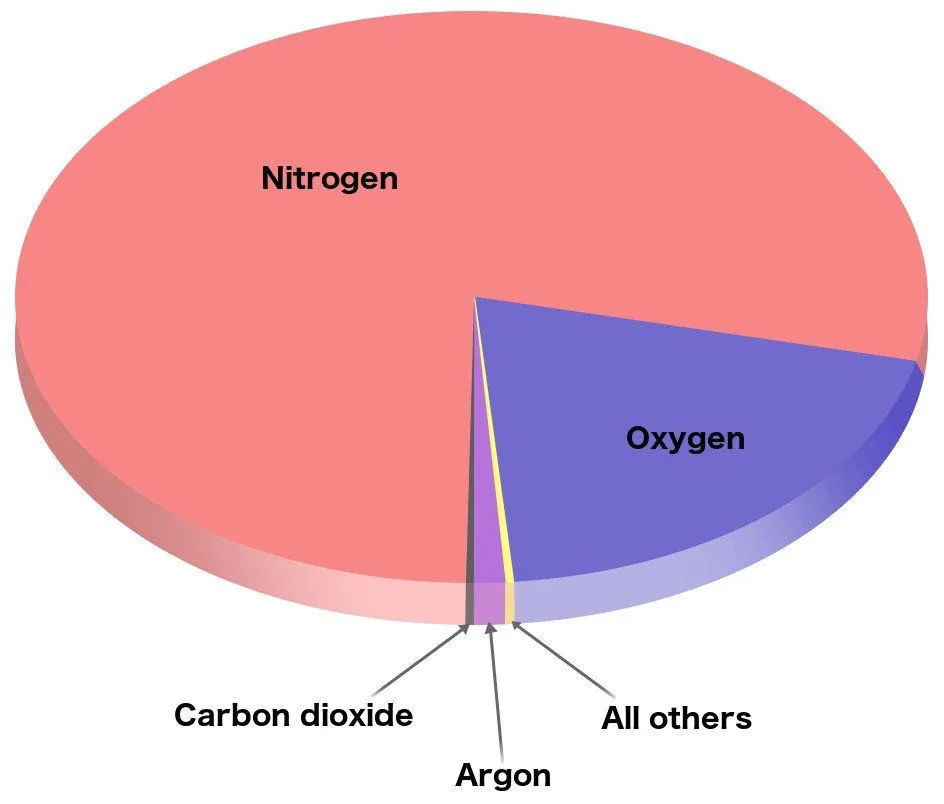
As you can see in the image above, the gas that accounts for the biggest chunk of the atmosphere is nitrogen. If we talk numbers, then 78.08% of the atmosphere is made of nitrogen. Clearly, it’s the most abundant gas in Earth’s atmosphere. The composition of atmospheres on other planets of the solar system is different from ours.
On the other hand, oxygen, the gas that nearly every complex organism relies on, comes in second place, accounting for about 20.95% of the atmosphere by volume. Argon fills most of what's left (around 0.93%), and carbon dioxide and other trace gases make up the rest.
If you think about it, that’s a little odd, isn’t it? Life has evolved to adapt to the second most abundant gas in the environment, but not the gas that is the most abundant. What could be the reason behind that?
Before answering this question, you need to understand a thing or two about the nitrogen molecule.
Nitrogen Gas Is Quite Inert
What this means is that nitrogen doesn’t react with things very easily. More specifically, nitrogen gas exists as N2, with a covalent triple bond holding the two atoms together. That triple bond is one of the strongest bonds in chemistry, taking roughly 945 kJ/mol (about 226 kcal/mol) to break, which is why N2 just sits in our lungs without doing much.
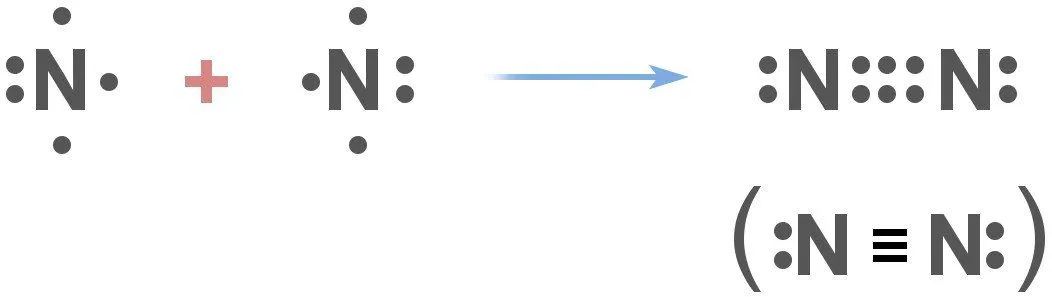
The thing about this sort of bond between two nitrogen atoms is that it’s extremely difficult to break. The bond is so strong that when chemists need to establish a ‘non-reactive atmosphere’ for their experiments, they often use nitrogen in one way or the other. The two nitrogen atoms are so closely bound to each other that it takes either a lightning bolt or certain ‘nitrogen-fixing’ bacteria in the environment that are capable of splitting them.
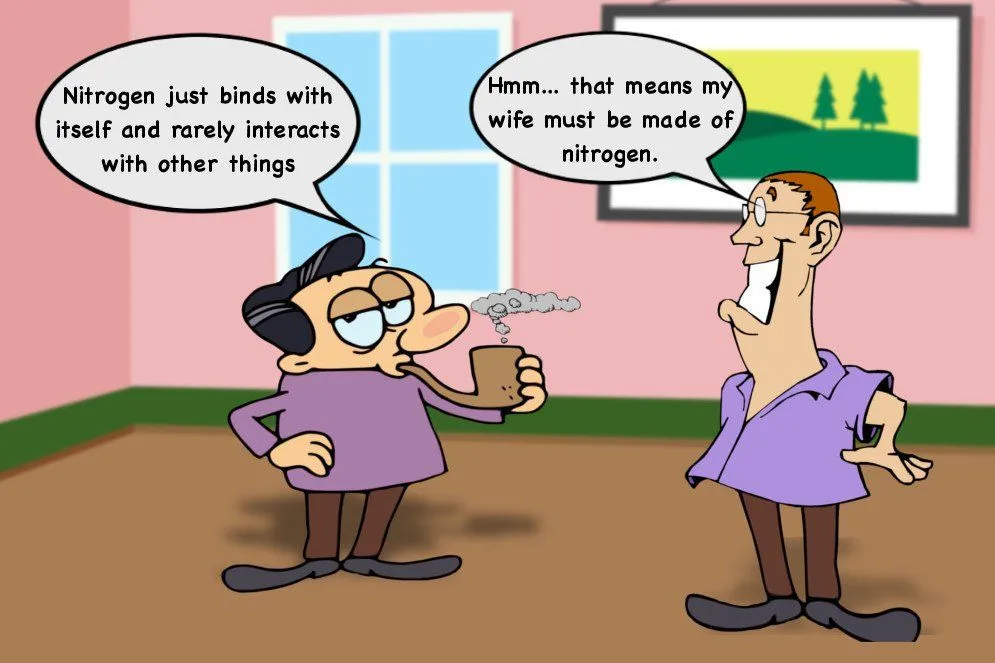
Oxygen, on the other hand, is much more reactive. In our cells, it sits at the very end of the electron transport chain and grabs electrons that were pulled off the food we ate. That single step releases the energy that drives ATP production, which keeps just about every animal, plant and fungus running. Nitrogen simply can’t do that job (it’s too unreactive to accept those electrons), so oxygen ended up as the “supporter of life” even though it isn’t the most abundant gas around.
Anyways, it’s not like life on Earth always depended on oxygen.
The Great Oxygenation Event
Roughly 2.4 billion years ago, Earth looked nothing like the place we know today, at least in terms of the gases in its atmosphere. There were no insects, no animals, and not even leafy plants. Most of the life (primarily microorganisms like bacteria and archaea) was limited to the oceans. The organisms that thrived back then were anaerobic, meaning they metabolized their food without using oxygen.
But then an upstart appeared, and everything changed for life on Earth. This upstart came in the form of cyanobacteria. Also known as blue-green algae, these cyanobacteria convert sunlight into energy and release oxygen as a byproduct. In more specific words, they are photosynthetic.
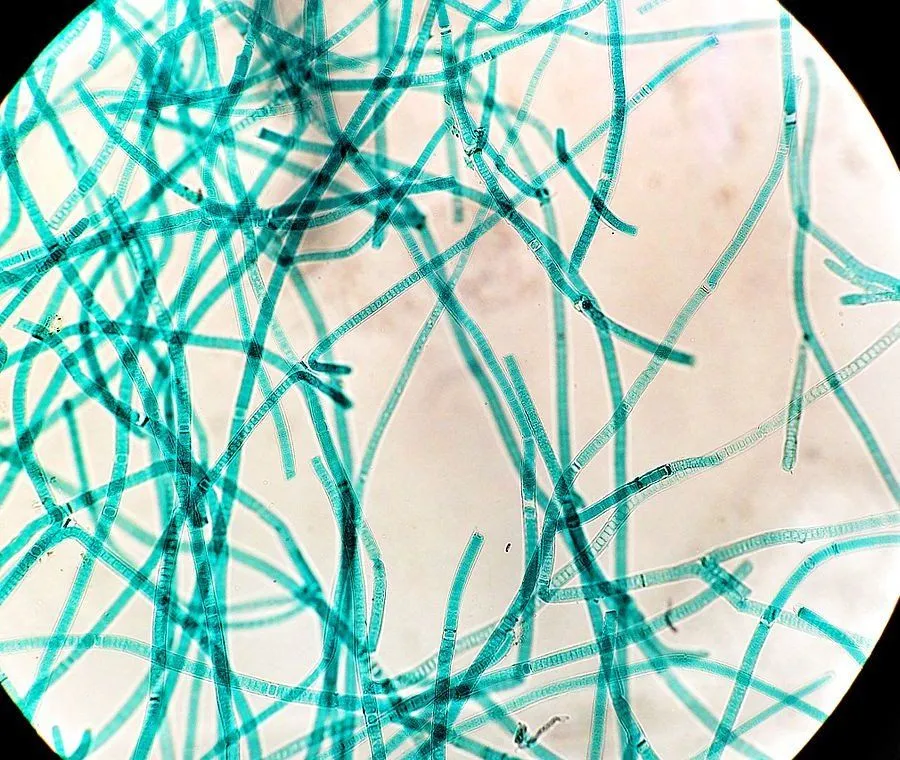
Back then, our atmosphere didn’t have as much oxygen as it does today. The little oxygen that our planet did have was either bonded with minerals or locked up within water molecules.
As cyanobacteria flourished, the supply of oxygen on the planet increased exponentially. The vast majority of anaerobic bacteria, for whom oxygen was toxic, began dying off due to this brutal onslaught of oxygen in the atmosphere. This event is what we call the Great Oxygenation Event.
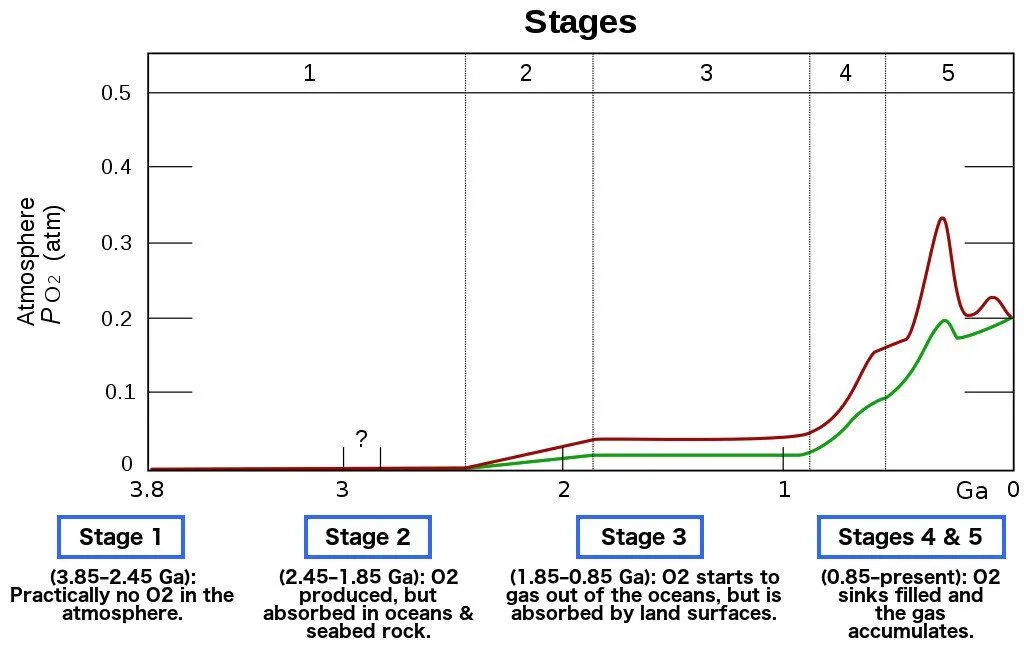
The Great Oxygenation Event is sometimes called the planet’s first mass extinction: a huge chunk of the existing anaerobic microbes was wiped out, and free oxygen finally began to build up in the air.
It was only after that buildup that more complex forms of life (including animals and, eventually, humans) could evolve, with oxygen as the ‘fuel of life’ driving their cellular machinery.
What's The Difference Between Nitrogen And Oxygen?
They sit side by side on the periodic table (nitrogen is element 7, oxygen is element 8), and in air they both float around as two-atom gases, N2 and O2. From there, though, the two could hardly behave more differently, and that difference is the whole reason this article exists.
The first big contrast is reactivity. As we just saw, the two nitrogen atoms in N2 are welded together by a triple bond that costs about 945 kJ/mol to break, so the molecule mostly refuses to take part in chemistry at body temperature. Oxygen's O2 is held by a weaker double bond and is one of the most eager electron-grabbers around, which is exactly why it can power cellular respiration and also why it rusts iron and feeds fires.
The second contrast is abundance versus usefulness. Nitrogen wins on quantity (78.08% of dry air versus oxygen's 20.95%), but oxygen wins on what biology can actually do with it. A quick side-by-side:
- Atmospheric share: nitrogen 78.08%, oxygen 20.95% (by volume).
- Molecular form: N2, triple bond (~945 kJ/mol); O2, double bond (~498 kJ/mol).
- Chemical personality: nitrogen nearly inert; oxygen highly reactive.
- Role in your body: nitrogen builds proteins and DNA (sourced from food, not air); oxygen releases energy in respiration (straight from the air you breathe).
What Do Nitrogen And Oxygen Make Together?
Here's a fun wrinkle: nitrogen and oxygen are swirling around each other in every breath of air, yet at the temperatures we live at, they simply ignore one another and barely react at all. Force enough energy into them, however, and they will combine to form a family of compounds called nitrogen oxides (collectively written as NOx).

The trigger is heat, and a lot of it. The reaction N2 + O2 → 2NO only gets going at very high temperatures (roughly 2,000 °C / 3,632 °F and above), which is why it doesn't happen in a calm room but does happen inside a car engine, inside power-plant boilers, and in the searing channel of a lightning bolt, where the air can briefly hit tens of thousands of degrees. The nitric oxide (NO) that forms then grabs more oxygen, NO + O2 → NO2, giving the reddish-brown nitrogen dioxide you may know as a component of smog. Lightning's version of this reaction is actually useful: the nitrogen oxides it makes wash down in rain as a natural fertilizer, one of the few ways inert atmospheric nitrogen gets turned into something living things can use.
Why Can't We Just Breathe Nitrogen?
If nitrogen makes up nearly four-fifths of every breath, it's reasonable to ask why we can't live on it. The honest answer is that we can't get anything out of it. Your lungs pull in plenty of N2 with each breath, but because it's so inert, it goes in and comes straight back out, carrying nothing useful to your cells. Nitrogen isn't poisonous; it's just a passenger.
The danger appears only when nitrogen crowds oxygen out entirely. Air normally holds about 20.9% oxygen, and the U.S. Occupational Safety and Health Administration (OSHA) classes anything below 19.5% as an oxygen-deficient atmosphere. Pump a space full of pure nitrogen and the oxygen share drops toward zero. What makes this so hazardous is that nitrogen is colorless, odorless and tasteless, so there is no choking sensation and no warning. A person can lose consciousness within a breath or two and never realize anything is wrong, which is why nitrogen is treated as a serious asphyxiation hazard in industrial-safety guidance. So we don't breathe nitrogen for fuel; we just tolerate it as the harmless bulk of the air surrounding the oxygen we actually need.
If Nitrogen Is So Useless, Why Do Our Bodies Still Need It?
Here's the twist that surprises a lot of people: even though you can't run on nitrogen the way you run on oxygen, you absolutely cannot live without it. Nitrogen is a core ingredient of every amino acid, and amino acids are the building blocks of proteins. It is also baked into the nitrogenous bases of your DNA and RNA. Pound for pound, nitrogen makes up roughly 3% of your body's mass, putting it among the four most abundant elements in living tissue.

So if we need it, and we're swimming in it, why can't we just grab it from the air? Because of that same stubborn triple bond. Neither plants nor animals can pry N2 apart on their own. That job falls to specialized 'nitrogen-fixing' bacteria (the rhizobia living in the root nodules of legumes like peas, beans and clover), which use an enzyme called nitrogenase to convert N2 into ammonia that plants can take up. Plants build that nitrogen into proteins, animals eat the plants, and we eat both. In short, the nitrogen in your muscles and DNA reached you through your dinner, not your lungs. (Humans also crack the triple bond industrially in the Haber-Bosch process to make fertilizer, which is what keeps modern crop yields high enough to feed eight billion people.) If you want to follow the full loop, we cover it in our explainer on the nitrogen cycle.
At any rate, asking “why didn’t we evolve to use nitrogen instead of oxygen (since the former is vastly available)?” is akin to asking “why didn’t we develop cars that ran on seawater rather than gasoline, since the former is much more readily available?”
Just as seawater cannot run a car, we can’t run on nitrogen because our bodies are not ‘designed’ to do that!
References (click to expand)
- Atmospheric Composition - tornado.sfsu.edu
- What is the Atmosphere? - UCAR Center for Science Education. The University Corporation for Atmospheric Research
- The Compositon of the Atmosphere - teachertech.rice.edu
- The Atmosphere: Getting a Handle on Carbon Dioxide - NASA Science
- The Oxygenation Catastrophe - The Origins Project, Arizona State University
- The Great Oxidation Event: How Cyanobacteria Changed Life - American Society for Microbiology
- GeoMan's Banded Iron Page - University of Oregon
- Sources of Nitrogen Oxides - Chemistry LibreTexts
- Oxygen-Deficient or Oxygen-Enriched Atmospheres - Occupational Safety and Health Administration (OSHA)
- Nitrogen Fixation by Legumes - New Mexico State University
- Nitrogen fixation - Wikipedia