Yes, a contingent of marching soldiers can collapse a bridge. This is because when soldiers march in unison, the otherwise scattered frequencies of people walking is transformed into a more unified frequency. If this frequency closely matches the bridge’s natural frequency, it could cause the bridge to resonate with amplified vibrations. The stronger the mechanical resonance that is produced, the better the chances are of the bridge collapsing.
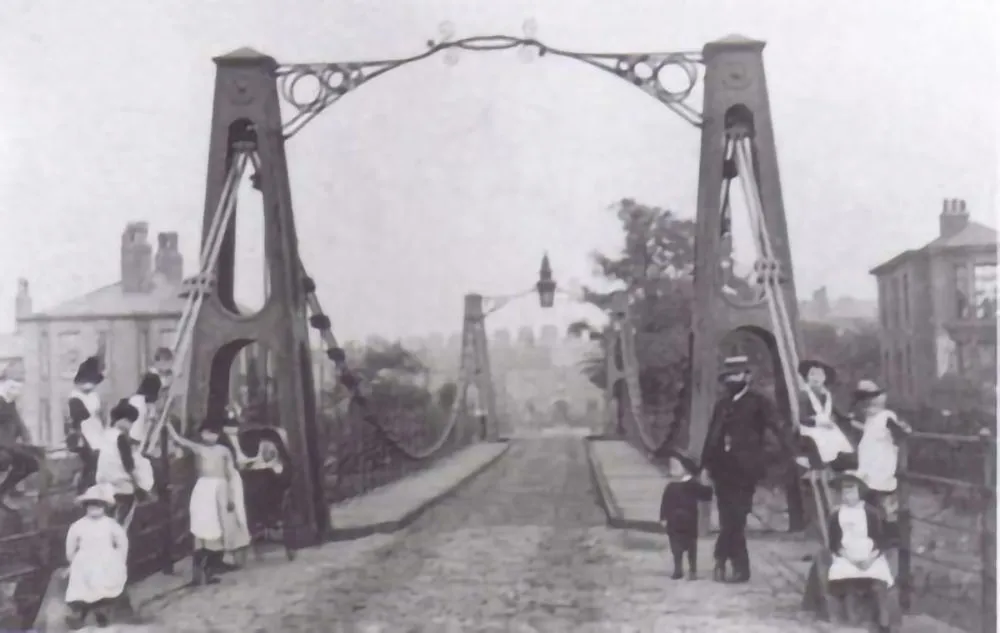
Well, the answer to this question is definitely YES! In fact, this has even happened before. On 12 April 1831, a detachment of 74 men from the 60th Rifle Corps marched across the Broughton Suspension Bridge near Manchester, England, and felt it start bouncing in time with their steps. Finding it funny, some of them whistled and stamped along to the rhythm, and moments later the bridge gave way and dumped them into the shallow River Irwell below. Luckily, the water was only a couple of feet deep, so although about 20 soldiers were hurt and a few bones were broken, nobody died. Too bad the brigade didn’t have a physicist on payroll to tell them better before they took that fateful stroll!
In fairness, marching alone didn’t doom the Broughton bridge. The official inquiry found that a badly forged bolt holding one of the anchoring stay-chains had snapped, and the structure was already weaker than it should have been. The soldiers’ rhythmic stamping simply supplied the final shove. Even so, the lesson stuck, and the British Army soon ordered troops to break step on every bridge they crossed.
Principle Of Frequency
This phenomenon is based on the simple principle of frequency, which aids and abets these destructive consequences. Frequency is the number of oscillations or vibrations that occur in a unit of time. To understand this better, imagine a pendulum swinging. The faster the pendulum swings, the greater its frequency.
Now, you must have noticed that pendulums with the same mass swing at different speeds when they are suspended on different lengths of cord or string. A shorter pendulum would swing more quickly than a pendulum held at a longer distance. This is due to the different natural frequencies of the pendulums caused by their different lengths.
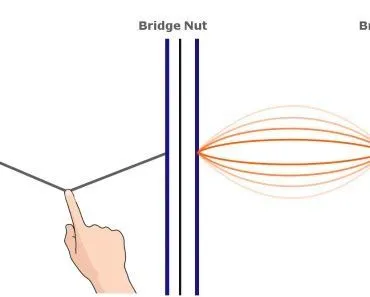
Natural frequency is the frequency at which a system tends to vibrate or oscillate on its own once it has been disturbed and then left to move freely. This is applicable to all things that are not absolutely inelastic (like warm clay), such as pencils, glass, trees, and yes, even bridges. Haven’t you ever wondered why different guitar strings produce different sounds? Quite simply, this is because they have different natural frequencies. Why do some swings go higher than others? Because they possess different natural frequencies. Why do some balls bounce and others don’t? The answer remains the same – different natural frequencies.
Have you ever felt the windows of your room rattling when a heavy truck lumbers along outside? This happens when the rumble of the truck’s engine drives the windows at a frequency close to their own natural frequency, so the panes start vibrating in sympathy. This effect is called resonance, but for something really dramatic to take place, a fairly rigid system has to be driven by an outside force whose frequency closely matches its own natural frequency. If that engine rumble lined up perfectly with the windows’ natural frequency, the resonance thus created could build up vibrations strong enough to shatter the glass. Similarly, when a singer sings at a frequency high enough to match the natural frequency of a wine glass, she effectively breaks the glass with the power of her voice alone!

Back To Bridges And Soldiers
When people walk on a bridge, they collectively create complex and scattered frequencies, the combination of which is nowhere near that of the natural frequency of the bridge. However, when soldiers march in unison, the otherwise scattered frequencies of people walking is transformed into a more unified frequency. If this frequency closely matches the bridge’s natural frequency, it could cause the bridge to resonate with amplified vibrations. The stronger the mechanical resonance that is produced, the better the chances are of the bridge collapsing.
Broughton wasn’t a one-off, either. On 16 April 1850, the Angers Bridge (the Basse-Chaîne) in France collapsed as a battalion of about 480 soldiers crossed it during a violent storm. The combination of wind rocking the deck, the troops unintentionally falling into step as they tried to keep their balance, and badly corroded anchor cables snapped the bridge in two and killed more than 220 people. It remains one of the deadliest reminders of how dangerous matched footsteps can be.
To combat this situation, engineers must make sure that they construct structures whose natural frequencies don’t line up with the steady rhythms that everyday traffic, wind, or marching feet can easily supply. Nonetheless, soldiers are now taught to break their stride when they pass over bridges. No matter what the engineers say, soldiers now know better than to trust them!
The Millennium Bridge: When A Crowd Did What Soldiers Couldn’t
Here is the twist: you don’t actually need an army to set a modern bridge swaying. On 10 June 2000, London opened the sleek new Millennium Footbridge across the River Thames, and roughly 90,000 people streamed across it on that first day, with up to 2,000 on the deck at once. Within minutes the bridge began to sway noticeably from side to side, and the wobble grew so alarming that engineers closed it just two days later, on 12 June. It would not reopen for nearly two years.

What is fascinating is that nobody was marching. The crowd was a perfectly ordinary mix of tourists and Londoners, walking out of step. The culprit was a subtler cousin of our marching problem that engineers named synchronous lateral excitation. Unlike the up-and-down resonance of stamping soldiers, this is a sideways effect. As people instinctively widen their stance to steady themselves on a slightly swaying deck, their little balancing pushes happen to nudge the bridge in time with its sway. The bridge sways a bit more, which makes more people unconsciously fall into step with it, which feeds the sway further. That runaway loop pushed the central span to about 70 mm (2.8 in) of side-to-side movement. So in a sense the bridge itself organized the crowd into a synchronized rhythm, doing the very thing armies are forbidden from doing on purpose. Engineers later argued that this self-balancing reflex, rather than people deliberately matching their steps, is the real trigger. The cure was to retrofit dozens of dampers (the project added 37 viscous dampers and 52 tuned mass dampers) to soak up the energy at a cost of around £5 million, and the “wobbly bridge” has stood steady ever since.
Why Do Soldiers Break Step, And Could It Really Topple A Bridge?
So what does it actually mean to “break step”? When a column is marching in step, every boot lands at the same instant, delivering one big, rhythmic thump after another. Breaking step simply means the order to stop marching in unison and walk normally instead, so the footfalls scatter back into the messy, out-of-phase pattern of an ordinary crowd. Those random footsteps still add weight to the bridge, but they no longer arrive as a single clean beat, so they can’t pump energy into the structure’s natural frequency the way a synchronized march can. It is the marching rhythm, not the weight of the soldiers, that does the damage.

The Broughton collapse of 1831 is exactly why the British Army adopted its standing order to break step on bridges, and breaking step on bridges remains standard military practice to this day. But just how easy is it to bring a bridge down this way? When the television show MythBusters tackled the myth, they found it surprisingly hard to pull off. Their first verdict was that marching alone “busted” the idea, because hitting and holding a structure’s exact natural frequency turned out to be far more delicate than the legend suggests. On a later revisit the team softened the call to “plausible”, agreeing that resonance from marching can in principle weaken a bridge, but only when several conditions line up at once. That fits the historical record perfectly: at both Broughton and Angers, the marching rhythm was the final shove on a structure that was already compromised by a faulty bolt or corroded cables. Breaking step costs a soldier nothing, and it removes that final shove entirely, so the order has stuck around for nearly two centuries.
References (click to expand)
- Why Do Soldiers Break Stride On A Bridge? - Live Science
- Broughton Suspension Bridge - Wikipedia
- Angers Bridge - Wikipedia
- 8 of the Most Devastating Bridge Collapses - HISTORY
- Forced Oscillations and Resonance - College Physics 2e - OpenStax
- Emergence of the London Millennium Bridge instability without synchronisation - Nature Communications (NCBI PMC)
- Millennium Bridge, London - Wikipedia
- Synchronous lateral excitation - Wikipedia