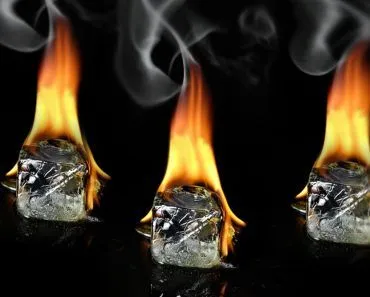
Walking barefoot across a bed of hot coals (often 500–700 °C / 930–1290 °F) is possible because wood charcoal and the ash that coats it have very low thermal conductivity, so heat transfers into the skin slowly. Each foot is in contact for less than half a second per step, which is too brief (and too little total energy) to burn the skin. It is physics, not religious mysticism.
Studies have shown that on the really hot days of a scorching summer, when the air temperature exceeds 40°C, the sun-soaked asphalt of the average two-lane blacktop road soars above 60°C. It turns out that even temperatures slightly lower than 60°C can easily put you in hospital. Burn-injury studies show that prolonged contact with surfaces hotter than about 50°C (122°F) starts to cause first-degree burns within roughly a minute, and at 60°C (140°F) a second-degree burn can develop in only a few seconds!
So how can firewalkers possibly walk on hot embers with temperatures in excess of 60°C without any ill effects? The answer is not magic and mysticism, but rather physics and physiology.
History Of Firewalking
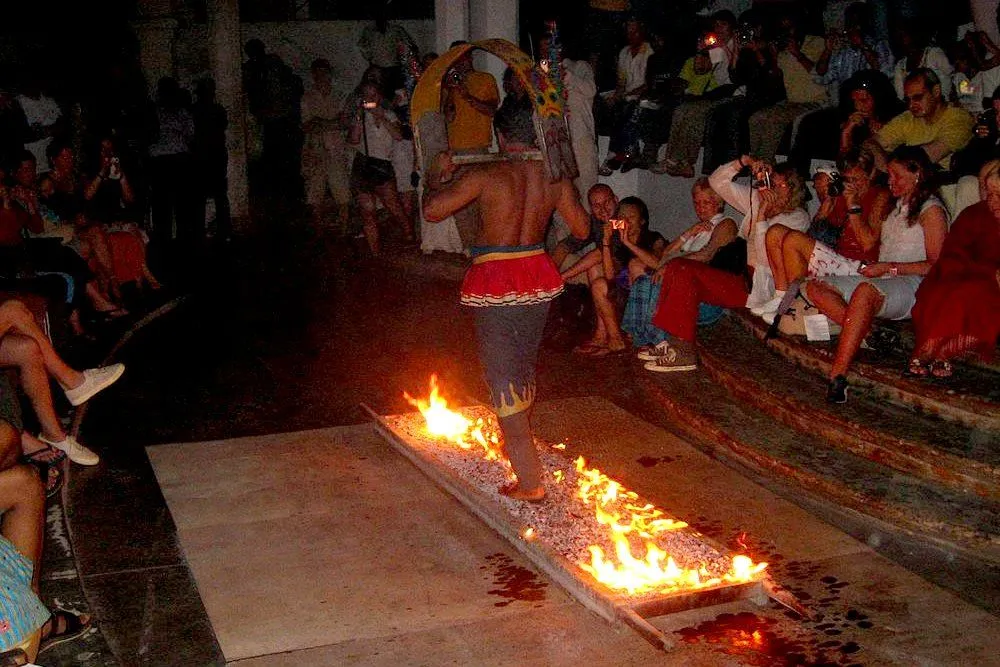
Firewalking is the act of walking barefoot on a floor consisting of hot embers or charcoal. Although firewalking has been practiced across many cultures and communities in different parts of the world, the earliest known reference dates to India (around 1200 BC).
In the past, firewalking had a strong religious or spiritual component. More specifically, firewalking was used as a rite of passage to test an individual’s strength or religious faith. It was often part of purification and spiritual healing.
More recently, many charlatans have used firewalking to exploit our personal insecurities and make money out of it. They claim to test your connection with a supreme power using firewalking. If you succeed in crossing the hot coals without getting burnt, they will take credit for establishing the connection to such a mystical power to protect you. However, if you fail or get burnt, they will glibly pass on the blame to you, claiming that you haven’t achieved a “high enough plane of consciousness”!

The Science Of Fire Walking
Short Contact Time And Low Thermal Conductivity Of Ember
The University of London Council for Psychical Research carried out one of the earliest recorded formal studies on the science of firewalking. Researchers from this council studied two firewalks to understand the scientific phenomenon behind firewalking. In 1935, one Indian and two British scientists walked across oak embers in a 12-foot fire pit. Two years later, in 1937, another firewalk was studied by the team of researchers, wherein once again one Indian man and a few Englishman walked over the bed of oak embers. None of the performers of the firewalk were reported to have been burnt (although one of them received a minor blister). After rigorous post-event analyses and studies, the council issued a report stating that neither religious faith nor spiritual powers had anything to do with the achievement of the impressive feat. The report concluded that the secret of the firewalk lies in the low thermal conductivity of the embers and the short contact time between the person’s feet and the hot embers.
A Closer Look Into The Science Of Firewalking
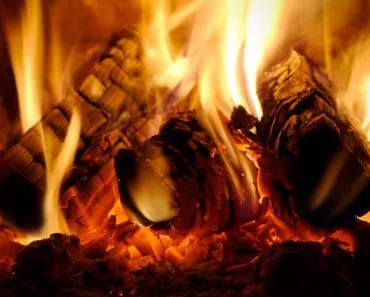
To get a better understanding of the science behind firewalking, we need to closely look at several facts that make it possible to walk on a bed of hot embers without sustaining serious burns or injuries. Firstly, the firewalkers light the fire with charcoal well ahead of time and let it burn down to non-flaming coals. Therefore, it must be noted that they are actually walking on embers, and not fire, per se.
Secondly, the hardwood and charcoal that are both typically used in such firewalking events are found to be a good thermal insulator. Wood continues to be a good insulator, even when on fire, and charcoal is roughly four times better as an insulator than dry hardwood.
The third thing is that the walking path of the firewalkers is often covered with ash. In bright daylight, this ash layer is clearly visible, but as most of the firewalk events are performed at night, these ashes appear to glow like fire. Ash is also a poor conductor of heat and helps in slowing down the heat transfer from the coal blocks to the feet.
The fourth important factor to consider is the length of time that the person’s foot is in contact with the embers. However, this doesn’t imply that you need to run to reduce the contact time; doing that may actually push the feet deeper into the embers, resulting in a burn on the top of the foot. The trick lies in taking a fluent brisk walk, with each step taking less than half a second of contact with the charcoal. During a 10-15 feet firewalk run, each foot will be in contact with the embers for a total time of only a few seconds.
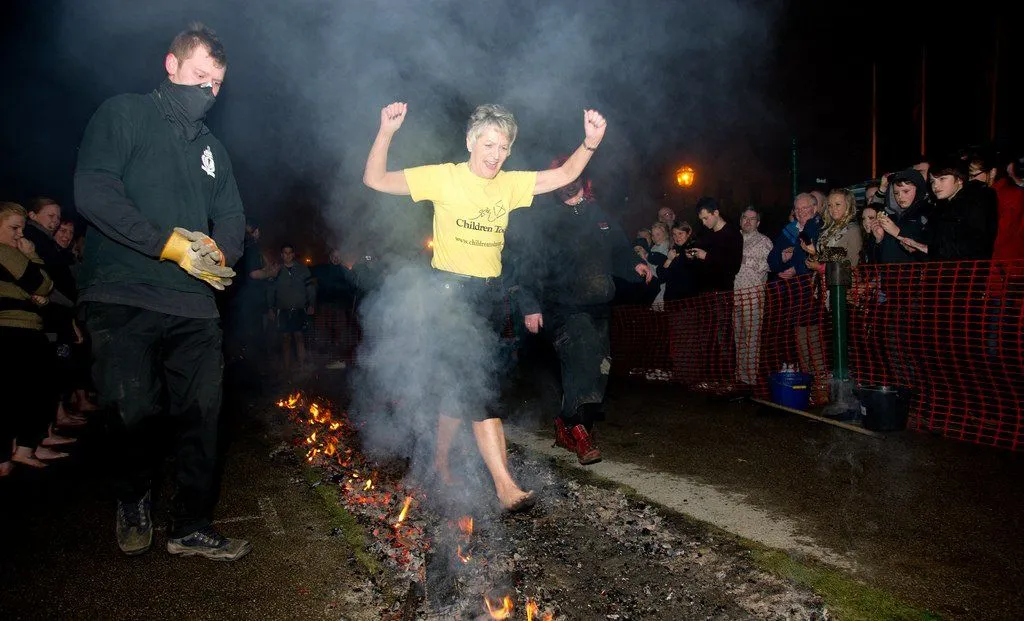
Even with this information, firewalking can still be dangerous if done without proper care and technique. Sometimes, a hot ember can cling to your feet and cause a severe burn. Even more dangerous is the risk of tripping and falling onto the hot pieces of ember, which can be extremely painful, and even fatal!
Is Firewalking Conduction, Convection, Or Radiation?
Heat can move in three ways: by conduction (through direct contact), by convection (carried away in moving air or liquid) and by radiation (beamed off as infrared energy). When your bare sole presses flat onto a solid bed of embers, the only one of these that can dump a burning dose of heat into your skin is conduction. The glow and the shimmering hot air rising off the pit are radiation and convection carrying heat upward, which is exactly why you can hold a hand a few centimeters above the coals far longer than you could rest it on them.
So firewalking is really a conduction problem, and conduction is precisely where the charcoal left when wood burns down fails as a heat source. Embers are poor conductors that hold very little internal energy to hand over in the first place. Water, by comparison, stores a large amount of heat for its temperature (a specific heat capacity of about 4.18 joules per gram per degree Celsius), whereas well-burnt coals store very little. On top of that, the instant your foot lands it chills the thin patch of coal it touches, and heat from the rest of the fire can only trickle back into that cooled spot through the same low-conductivity charcoal. In the roughly half a second your foot is down, only a small amount of heat crosses into the skin. The honest exam answer, then, is that the heat which could burn a firewalker travels by conduction, but conduction through low-conductivity embers is far too slow to do the damage.
Does The Leidenfrost Effect Explain Firewalking?
A popular explanation you will often hear is the Leidenfrost effect: the idea that sweat or moisture on the soles boils into a thin cushion of vapor that shields the skin, much like a water droplet skittering across a scorching frying pan instead of instantly boiling away. The physicist Jearl Walker originally floated the notion that damp feet might protect a firewalker this way. It is a neat story, but it does not hold up.

Walker himself later revised his view, and physicist David Willey, who has studied firewalking closely, concludes that the Leidenfrost effect does not appear to be involved. The clearest evidence is that many firewalkers deliberately wipe their feet dry before a walk (so that stray embers do not stick) and cross without harm, which would be impossible if a layer of steam were doing the protecting. If anything, wet feet make firewalking more dangerous, not less: water is a far better conductor of heat than dry skin, and damp soles let hot embers cling and lengthen the contact time. The protection comes from the poor conductivity of the coals and the brief contact of each step, not from a blanket of vapor.
Firewalking Festivals Around The World
Firewalking is not only a party trick or a motivational stunt; it survives as a living act of devotion in several cultures. In the Tamil Hindu festival of Theemithi (also spelled Thimithi), devotees walk barefoot across a pit of glowing embers to honor the goddess Draupadi, the heroine of the Mahabharata. It falls in the Tamil month of Aipasi, roughly mid-October to mid-November, about a week before Deepavali. Participants often cross wearing jasmine garlands, and after reaching the far side they step into a pit of milk to soothe their feet. The rite is performed across Tamil Nadu, and has been held at the Sri Mariamman Temple in Singapore since 1835.

Fire is walked in the West too. In the villages of northern Greece, Orthodox Christian firewalkers known as the Anastenarides dance barefoot over hot coals while carrying icons of Saints Constantine and Helen, a tradition called the Anastenaria (and, in neighboring Bulgaria, Nestinarstvo). Whether the ember bed is lit in a Tamil temple courtyard or a Greek village square, the physics underfoot is exactly the same: low-conductivity charcoal and a foot that never lingers.
References (click to expand)
- psychicinvestigator.com is coming soon - psychicinvestigator.com:80
- Page Not Found on the Users, Units, or Orgs Server | Miami University - www.units.miamioh.edu:80
- Firewalking Myth vs Physics - David Willey, University of Pittsburgh
- Firewalking - Wikipedia
- Come Firewalk With Me: The Physics of Hot Coals - Scientific American
- Theemithi: The Full Cycle of Rituals Behind the Festival of Firewalking - BiblioAsia (NLB Singapore)