A fire extinguisher works by taking away one of the things a fire needs: oxygen, heat or fuel, or by interrupting the chemical chain reaction that keeps it burning. Pressing the lever opens a valve, and stored pressure blasts the extinguishing agent (usually potassium bicarbonate, water, or a clean fluorocarbon) out through the nozzle and onto the flames.
Despite being one of the oldest discoveries of mankind, fire also happens to be one of our biggest threats. In a matter of minutes, fire can engulf an entire home, office or other structure that took years to build. For that reason, good strategies for putting out fires are critical. Most buildings constructed in the modern era come with fire extinguishers, but have you ever wondered how they work? Let’s find out!
What Is Fire?
When asking your friends or relatives what fire is, you’re likely to get the answer that it is some frightening stuff that can reduce giant structures to ashes. However, when you ask a professional, like a scientist or firefighter, their definition of fire is much more precise. Scientifically speaking, fire is the result of a chemical reaction called combustion. When combustion occurs, substances like wood, oil, coal, paper etc. combine with the oxygen in the air to generate carbon dioxide, water and waste gases, along with an enormous amount of heat.
Combustion is not an automatic process, i.e., stuff doesn’t burst into flames without an external trigger. This trigger is usually some form of energy, the so-called activation energy. When you spark a match, you are providing this ‘activation energy’ for combustion to kick in. However, once a fire is lit, it no longer needs that external trigger to keep going, as it can spread on its own. That’s why we sometimes witness such terrible fire-related tragedies, such as wildfires and massive conflagrations in office buildings.
Working Of A Fire Extinguisher
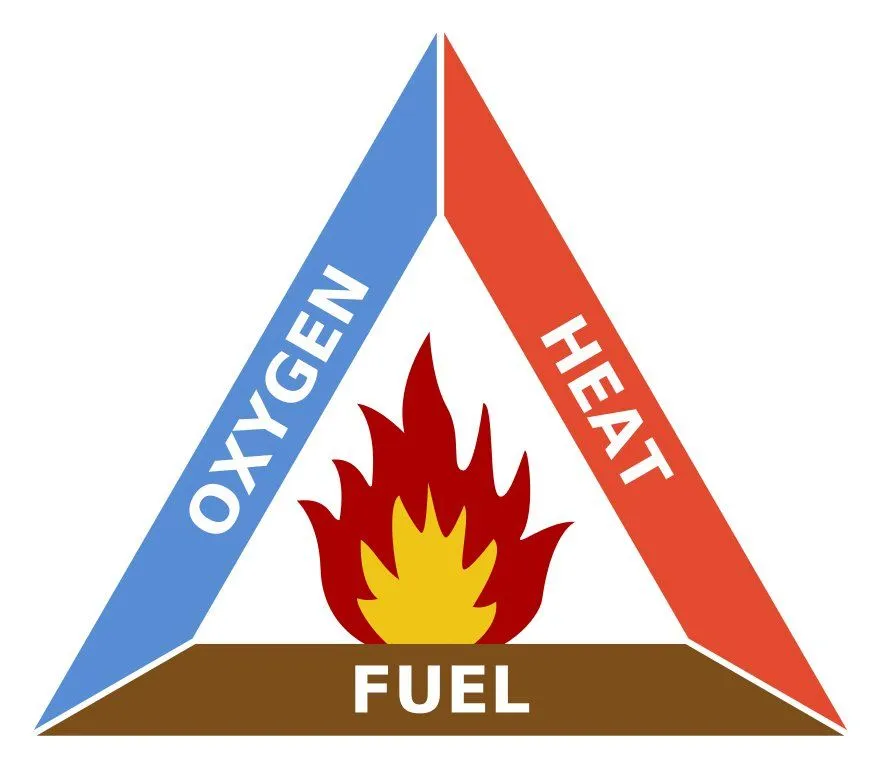
All fire extinguishers work on one basic principle: take away something a fire needs to keep burning. The classic ‘fire triangle’ names three of those things (oxygen, heat and fuel), and removing any one of them snuffs the fire out. Many modern extinguishers go after a fourth ingredient too: the chemical chain reaction that links the flames together, which is why fire scientists often talk about a ‘fire tetrahedron’ rather than a triangle. Since their creation roughly two centuries ago, fire extinguishers have played an integral part in saving lives threatened by a perilous fire.
Basically, there are two types of fire extinguishers: those with internal stored pressure and those where a cartridge system is used to deliver pressure. Cartridge-based systems are more common and are typically used in industrial premises.
Both variants work in more or less the same way, by knocking out one part of fire’s recipe (oxygen, heat, fuel or the chain reaction). This is accomplished by holding the contents under pressure, either from pressure stored inside the extinguisher tank or from an external cartridge, which can be released in a rapid burst of extinguishing agent when used. When you press the lever on the top of the extinguisher, a valve inside is forced open, releasing the pressurized gas and extinguishing agent through the nozzle.
Chemicals Inside The Extinguisher
Now, based on its intended application, a fire extinguisher will contain different chemicals. For example, the fire extinguishers (handheld) that you generally see in residential premises contain pressurized nitrogen or carbon dioxide (CO2) to propel a fire-extinguishing agent to blow out the fire. The active fire extinguishing agent is usually potassium bicarbonate (KHCO3), liquid water, or an evaporating fluorocarbon. The bicarbonate powder does more than just smother the flames; as it heats up it releases potassium ions that mop up the reactive free radicals feeding the fire, breaking the chain reaction. The fluorocarbon ‘clean agents’ used today work in a similar way, and have largely replaced the older halons that were phased out for damaging the ozone layer.
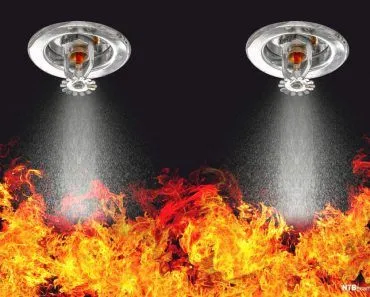
A water sprinkling extinguisher is common in a fixed system, such as a residential apartment tower, as they are inexpensive and safe for people. However, water as an extinguishing agent is not always useful. In a computer or a control room, for example, water could cause short-circuiting, whereas in a fuel storage system, water would barely be effective. Similarly, a water sprinkling extinguisher should not be used in an application where weight and space are limited, such as on an aircraft. In these situations, different chemicals are used. CO2 works well for a room full of computers and servers, but could be fatal if people are also trapped amidst a voracious fire.
Researchers are actively working to develop more chemical combinations that will not only inhibit flames, but also provide cleaner and safer alternatives to the extinguishing agents currently being used that are harmful to the environment. They are also toiling to develop new means of discharging conventional chemicals more effectively, so that the fire extinguishing process can be completed in even less time. One of the ideas making the rounds in the academic circles of fire extinguishing is the use of a solid propellant. This solid propellant would generate an inert gas mixture, an approach similar to the airbag system in your car. Such a system, upon activation, would extinguish fires as easily as we blow out a candle!
What Are The Different Classes Of Fire?
Here is the catch that surprises most people: there is no single extinguisher that is right for every fire. The reason is that fires are sorted into classes based on what is actually burning, and the agent that smothers one class can make another class far worse. Firefighters and safety codes in the United States, United Kingdom, Australia and Canada all sort fires roughly the same way.

According to the US Fire Administration and OSHA, the main classes are:
- Class A – ordinary combustibles like wood, paper, cloth, rubber and many plastics. Water and dry chemical both work here, mainly by cooling the fuel.
- Class B – flammable and combustible liquids such as gasoline, oil, grease, solvents and oil-based paints. These call for carbon dioxide (CO2) or dry chemical, which blanket the surface and cut off oxygen. Never use water, as it can splash burning liquid around.
- Class C – energized electrical equipment like wiring, fuse boxes and computers. The agent must not conduct electricity, so CO2 and dry chemical are the go-to choices.
- Class D – burning metals such as magnesium, titanium, sodium and potassium. These need special dry-powder agents; ordinary extinguishers can react violently with the metal.
- Class K – cooking oils and animal fats in kitchen appliances, handled by wet chemical extinguishers that cool the oil and form a soapy, smothering layer on top.
This is exactly why so many people search for an ABC extinguisher: the red multipurpose canister found in most homes carries a dry chemical that is rated for Classes A, B and C at once, which covers the everyday hazards of a house or office. If you have ever wondered why the chemistry of burning matters so much, our piece on whether oxygen itself is flammable is a good companion read.
What Is Inside A Fire Extinguisher?
Crack open a typical handheld extinguisher (figuratively, please) and you find two basic ingredients: an extinguishing agent and a propellant gas that shoves it out. The whole thing is essentially a strong steel cylinder holding both under pressure, with a valve, a lever and a small gauge on top.

The agent depends on the job. The familiar red household unit is filled with a dry chemical powder, most often monoammonium phosphate or sodium/potassium bicarbonate (KHCO3), pressurized by nitrogen. A CO2 extinguisher holds nothing but carbon dioxide, which is both the agent and its own propellant, stored as a liquid that flashes into a cold, oxygen-displacing gas when released. Water extinguishers hold plain water (sometimes with additives) driven out by compressed air, and wet chemical units carry a potassium-salt solution for kitchen grease fires.
So when someone asks what a fire extinguisher is "made of", the honest answer is: a pressure-rated metal bottle, a sealed valve and pin, and a charge of one of those agents matched to the fire class it is built to fight. The clean fluorocarbon agents in many modern units replaced the older halons, which were effective but were phased out under the Montreal Protocol for damaging the ozone layer.
How Do You Use A Fire Extinguisher? The PASS Technique
Knowing the science is useless in a real emergency if your hands fumble, so safety trainers boil the whole drill down to one word: PASS. The US Fire Administration and university safety offices all teach the same four steps.

- P – Pull the safety pin. This breaks the tamper seal and unlocks the lever.
- A – Aim low, pointing the nozzle or horn at the base of the fire. Aim at the flames and the agent sails straight through them; you have to hit the burning fuel.
- S – Squeeze the lever slowly and evenly to release the agent.
- S – Sweep the nozzle from side to side across the base of the fire until it is out, watching in case it flares back up.
Just as important is knowing when not to fight a fire at all. The US Fire Administration says you should only reach for the extinguisher when the fire department has already been called, the fire is small and contained to a single object such as a wastebasket or a pan, and you have a clear escape route behind you. If any of those is in doubt, the advice is blunt: get out, close the door, and let the professionals handle it.
Where Should Fire Extinguishers Be Placed?
A perfectly good extinguisher is worthless if you cannot reach it in the few seconds a fire gives you, which is why building codes are strict about spacing. Many people search for the "distance between two fire extinguishers", and the answer comes from the rule that no one should have to travel too far to grab one.
Under the US standard NFPA 10 (mirrored in OSHA regulation 1910.157), the maximum travel distance to reach an extinguisher is 23 metres (75 feet) for areas with Class A (ordinary combustible) hazards, and a tighter 15 metres (50 feet) where Class B flammable liquids are present, since liquid fires spread faster. Combustible-metal (Class D) hazards also use the 23 metre (75 foot) limit. Crucially, that figure is the walking distance a person actually covers, not a straight line through walls, so real-world spacing between units is usually closer than the number suggests.
Beyond spacing, extinguishers are mounted where people can see and grab them quickly, typically near exits and along escape routes rather than tucked in back corners, and at a height a person can lift them from comfortably. The goal is simple: when seconds count, the right extinguisher should be within a short, obvious dash of wherever a fire is most likely to start.
References (click to expand)
- Fire Extinguisher Use & Safety - Boston University. Boston University
- Carbon Dioxide Extinguishers. The University of South Carolina
- Choosing and Using Fire Extinguishers. U.S. Fire Administration (FEMA)
- Portable Fire Extinguishers – Extinguisher Basics. Occupational Safety and Health Administration (OSHA)
- 1910.157 – Portable fire extinguishers. Occupational Safety and Health Administration (OSHA)
- Substitutes in Fire Suppression and Explosion Protection. U.S. Environmental Protection Agency (EPA)