VR headsets carry official age limits because they’re not designed for young, still-developing eyes and balance systems. As of 2026: Meta Quest is 10+ on a parent-supervised child account (13+ for a standalone account), Sony’s PlayStation VR2 is 12+, Apple Vision Pro is 13+, and HTC Vive is officially “not designed for children.” The American Academy of Pediatrics recommends that kids under 6 not use immersive VR at all.
Virtual reality (VR) is a fast-growing technology, one that is becoming particularly popular amongst teens and kids. To experience virtual reality, you must put on a virtual reality (VR) headset, which recreates a virtual environment in which a person can look around 360 degrees, hear thrilling sounds, and move your body to interact with the world around you fantastically.
VR headsets are topping wishlists of kids and young children worldwide, but with several VR headsets coming with age restrictions, is the technology safe for young children to explore?
Let’s delve into the details of this fascinating new technology.
VR Headset Age Limit: No Consensus
There is still no single, industry-wide age cutoff, but the picture in 2026 is much clearer than it was a few years ago. HTC has taken the most cautious line and continues to advise that its VR headsets (the Vive line, including the Vive Focus Vision and XR Elite) are not designed for children—with no specific minimum age published.
Sony’s PlayStation VR2, which replaced the original PSVR in February 2023, should not be used by anyone under 12 according to Sony’s health and safety guide. The original Oculus Rift was discontinued in 2021 and Samsung Gear VR in 2020. Today the dominant consumer headsets are Meta’s Quest line (Quest 2, Quest 3, Quest 3S), and Meta now permits children aged 10–12 to use them through a parent-managed child account with supervision tools (time limits, content filters, real-time activity view, purchase approval); standalone accounts still require users to be 13 or older. Apple’s Vision Pro, launched in February 2024, is officially for ages 13 and up.
Manufacturers don’t always explain why they picked the numbers they did. Marientina Gotsis, co-founder and director of USC’s Creative Media & Behavioral Health Center (a joint unit of the School of Cinematic Arts and the Keck School of Medicine), has long pointed out that scientific data on kids and VR is still relatively thin because the technology is young.
Additionally, it is challenging to conduct research using children as subjects due to ethical and regulatory restrictions. Gotsis is uncomfortable with children using VR technology excessively as they may not be able to distinguish between reality and fantasy, which could lead to developmental issues.
In summary, caution should be taken when allowing young children to use VR technology. The American Academy of Pediatrics goes a step further and recommends that children under 6 should not use immersive VR headsets at all—their visual systems and sense of balance are still developing, and they’re less likely to report discomfort. For older kids, supervised use with strict time limits is the AAP’s preferred guidance.
Is There A VR Headset Made For Kids?
If you go looking for a "kids' VR headset," you'll quickly notice something: none of the major immersive headsets are actually built for young children. Meta's Quest line, Sony's PlayStation VR2 and Apple's Vision Pro are all designed for teens and adults, and their age floors (10–12 with a supervised account at the very lowest, otherwise 12 or 13 and up) reflect that. There is no mainstream standalone headset engineered specifically for under-10s.

The closest the industry ever came to a child-friendly product was the wave of cheap smartphone-based viewers from the mid-2010s, the most famous being Google Cardboard. You slotted a phone into a folded cardboard or plastic shell and looked through two lenses. Google itself pitched Cardboard at classrooms through its Expeditions program, but the company later wound the platform down, open-sourcing it in 2019 and ending official sales soon after. Most "VR headsets for kids" sold online today are simply these phone holders rebranded, not the high-powered headsets that generate genuinely immersive 3D worlds.
So what does that leave a parent who wants a real VR experience for a 10- to 12-year-old? Realistically, a parent-managed Meta Quest account is the only mainstream route that ships with built-in supervision tools, including time limits, content filters and an activity view. Even then, both Google and Meta stress the same point: a child should never use these devices unsupervised, no matter how kid-friendly the marketing looks.
Effect Of VR On The Brain
A 2015 UCLA study (Aghajan et al., published in Nature Neuroscience) on rats found that the behavior of neurons in the hippocampus—specifically the “place cells” that the brain uses to map space—was altered in virtual environments. More than half of these hippocampal place cells effectively shut down when the rats explored a VR world compared with a real one.
Whether or not these results can be extrapolated to humans remains questionable, but this study highlighted the dire need for more thorough research on the long-term effects of VR technology, especially on young children.
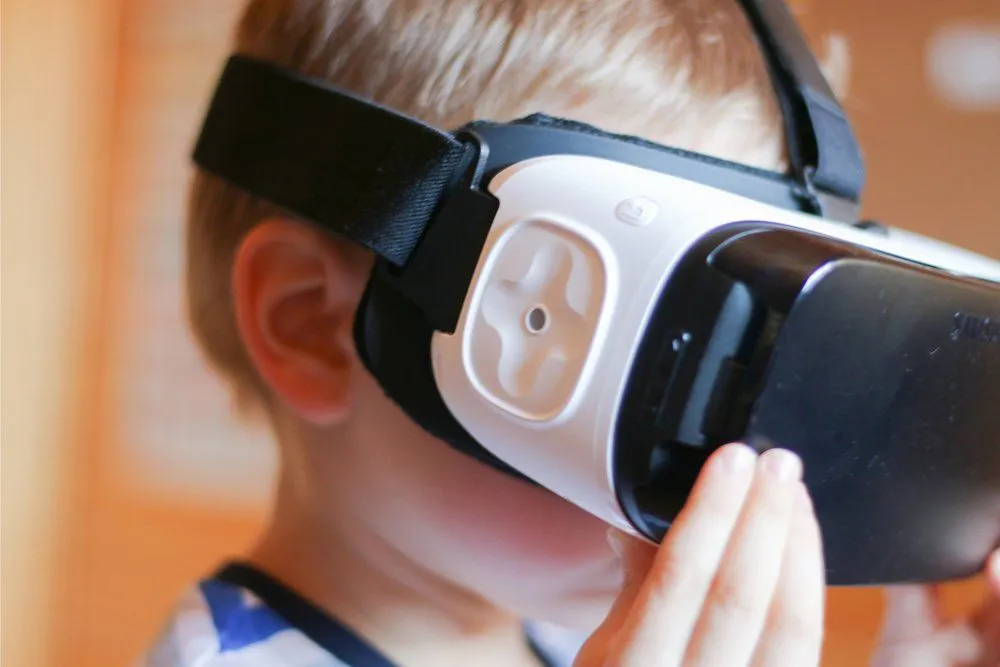
Gotsis believes that virtual reality (VR) could significantly impact young children’s developing brains. She explains that the brain is highly adaptable at young ages, and exposure to improperly fitting devices can affect its functioning.
Children may be unable to communicate eyestrain and may even lack the reflexes to remove the devices if they feel uncomfortable wearing them. Worse still, they might become too engrossed in gaming and ignore the discomfort.
Effect Of VR On Vision
One of the biggest concerns parents have about VR headsets is their impact on eyesight or vision. According to the American Academy of Ophthalmology, there is no evidence that VR headsets damage the eye or its development. However, staring continuously at a VR headset screen (or any digital device, for that matter) without breaks may cause eye strain or fatigue—the AAO recommends the same 20-20-20 rule it advises for any screen.
This is because when you use a VR headset, you tend to blink less than you normally do. This can lead to drying out of the eyes’ front surface, resulting in fatigue.
 VR can also cause dizziness and nausea—what researchers call cybersickness. The cause isn’t simply that the visuals “look like real motion”; it’s a mismatch. Your eyes report motion through the headset while the inner ear’s vestibular system, which actually senses movement, reports that the body is sitting still. The brain doesn’t love that contradiction. If your child is susceptible to motion sickness on a rollercoaster, they’ll likely be more susceptible to cybersickness, too.
Vergence-accommodation Conflict
Another issue with VR headsets is something known as the vergence-accommodation conflict. Now, when you normally see the world, your eye first points the eyeballs—vergence—and then focuses the lenses—accommodation—on an object; our brain then combines these two operations to construct a coherent picture.
Present-day VR headsets present each eye with a slightly different image on a flat screen to achieve the illusion of depth. This means that no matter how far an object appears, the eyes remain focused on a fixed point but converge on some object in the virtual distance. The newer pancake-optic headsets (Meta Quest 3, Apple Vision Pro) are smaller and lighter than older lenses but do not solve the vergence–accommodation conflict; varifocal prototypes that would actually fix it (Meta’s “Mirror Lake”/“Butterscotch” research devices) have not shipped to consumers.
How Long Should Kids Use A VR Headset?
Even a headset that fits well and runs age-appropriate content can cause trouble if a child stays in it for too long. There is no single official "safe" number of minutes, largely because the long-term research simply doesn't exist yet. What experts and manufacturers agree on instead is a pattern: short sessions, frequent breaks, and a watchful adult nearby.

Meta sets a two-hour daily limit as the default on its parent-managed child accounts, and advises that, whatever the total, kids should take regular breaks during play, with younger children breaking more often and for longer. The American Academy of Pediatrics recommends a substantial break of around 15 minutes between sessions to head off cybersickness, the nausea and dizziness that can follow VR use, which behaves much like ordinary motion sickness. For the eyes specifically, the same 20-20-20 rule applies: every 20 minutes, look at something about 6 metres (20 feet) away for 20 seconds.
Time on the clock matters less than watching the child. Because kids often won't say when something feels wrong, or are too absorbed to notice, parents should call a halt the moment they spot warning signs: blurry vision, rubbing or touching the neck, a change in posture or balance, headaches or nausea. And as the AAP points out, VR shouldn't crowd out the things growing bodies and brains actually need, including physical activity, homework and face-to-face time with family.
Ulterior Motives
When it comes to gizmos like VR headsets, it’s important to understand that they are designed by someone to manipulate your child, whether it’s for advertising, politics, or even religious reasons. Allowing your child to spend long periods in a VR environment where manipulation is present threatens their autonomy and may hinder their understanding of the world.
While virtual reality technology has the potential to supplement and improve education and healthcare, tech experts suggest that VR manufacturers need to work with scientists and researchers to carefully examine the long-term implications of this technology. Until then, it’s recommended that children use VR under their parents’ supervision.
As a vigilant parent, monitoring what your kids do with their VR headsets and controlling their usage time can help alleviate concerns about VR harming their health or behavior.
Last Updated By: Ashish Tiwari
References (click to expand)
- Brain's reaction to virtual reality should prompt further study ....
- Tychsen, L., & Foeller, P. (2020, January). Effects of Immersive Virtual Reality Headset Viewing on Young Children: Visuomotor Function, Postural Stability, and Motion Sickness. American Journal of Ophthalmology. Elsevier BV.
- Souchet, A. D., Philippe, S., Lourdeaux, D., & Leroy, L. (2021, September 30). Measuring Visual Fatigue and Cognitive Load via Eye Tracking while Learning with Virtual Reality Head-Mounted Displays: A Review. International Journal of Human–Computer Interaction. Informa UK Limited.
- Hirzle, T., Fischbach, F., Karlbauer, J., Jansen, P., Gugenheimer, J., Rukzio, E., & Bulling, A. (2022, March 31). Understanding, Addressing, and Analysing Digital Eye Strain in Virtual Reality Head-Mounted Displays. ACM Transactions on Computer-Human Interaction. Association for Computing Machinery (ACM).
- Virtual Reality Use and Children. American Academy of Pediatrics.
- Meta Quest Safety Information for Parents and Children. Meta.
- Open sourcing Google Cardboard. Google Developers Blog.