Hair is made up of the fibrous protein keratin (about 80% of hair by weight) and the pigment melanin, both arranged inside a layer called the cortex. The cortex’s shape is set by the follicle and gives hair its natural curl pattern. Heat styling temporarily rearranges keratin by breaking the weak hydrogen bonds between protein chains. Permanent treatments break the much stronger disulfide bonds between sulfur atoms, first by adding hydrogen (reduction), then removing it again with hydrogen peroxide (oxidation) to lock in the new shape. Both processes can damage the cuticle, the protective outer layer of the hair.
Hair is as much an indicator of your overall health as any other part of your body. The portion of your body that frames your crown also plays a huge role in determining your physical appearance and attractiveness. Nothing you do can change the way you look as much as changing the way you wear your hair.
Even men are experimenting with their tresses in recent years (the current man bun trend), which means that bad hair days are universal woes. However, new techniques of hair styling, such as straightening and curling, give you the opportunity to tame that grizzly mop on your head. This process of transformation is interesting, but what makes these techniques so effective? What’s the science behind hair styling?
What Determines The Natural Shape Of Hair?
The innermost part, or the root, of your hair is called a hair follicle. Hair follicles anchor each hair into the skin. The Hair bulb forms the base of the hair follicle. Inside the hair bulb are living cells that divide and grow to build the hair shaft. The part above the hair shaft is typically what we identify as hair. The hair shaft is composed mainly of a fibrous protein called keratin (about 80% of hair by weight) along with the pigment melanin, water, lipids and small amounts of trace minerals.
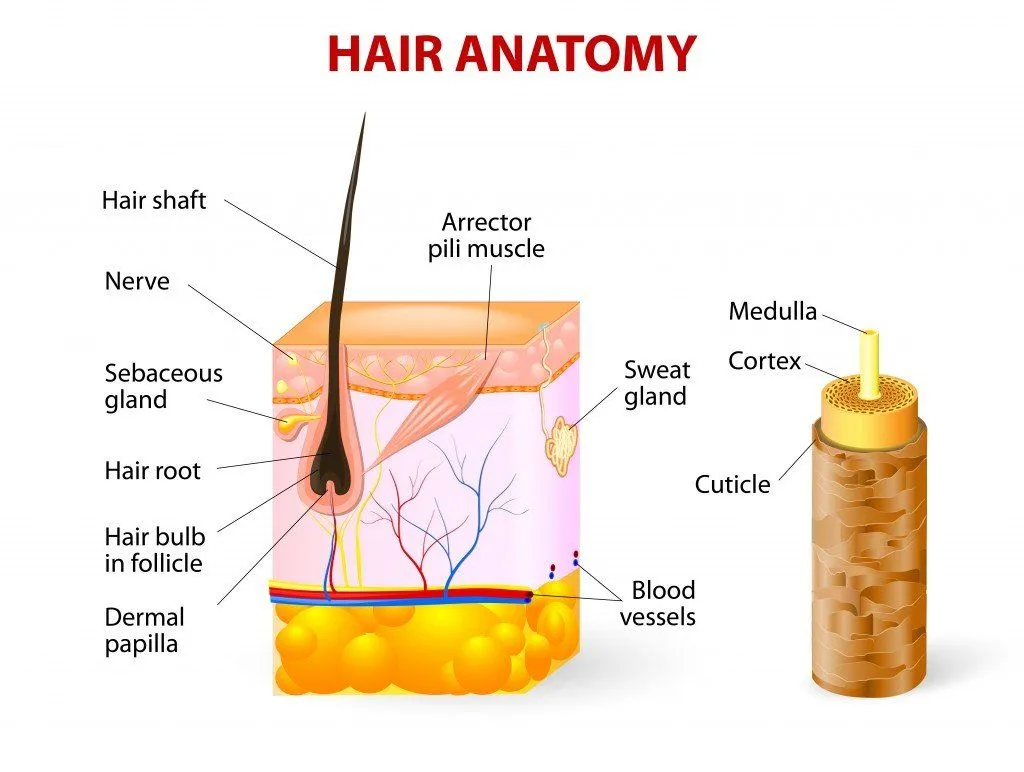
The hair shaft can be divided into three parts. For the purpose of understanding, think of a single hair as being a tube containing two more concentric tubes inside it. The outermost tube layer is called the cuticle, which is a protective exterior material made of downward-pointing scales. The middle layer is called the cortex, which contains tightly packed keratin fibres along with melanin granules and ovoid bodies, which together determine the hair’s strength, elasticity and color. The cortex makes up roughly 75–90% of a hair’s weight. The innermost layer is called the medulla (a soft, often air-filled core of loosely packed cells that runs through the centre of thick hairs and is missing entirely from very fine ones).
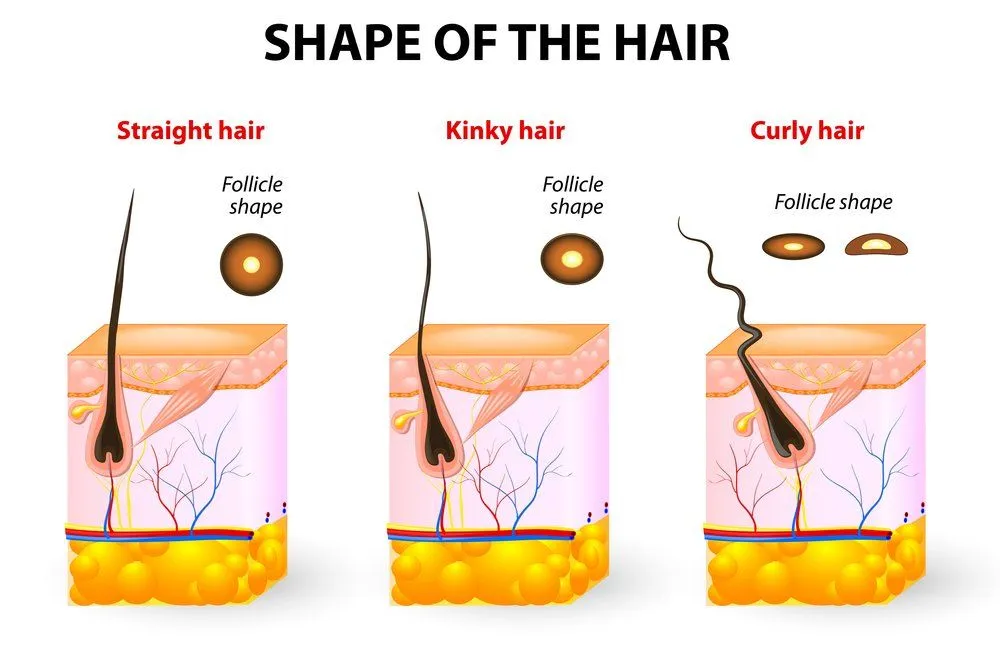
The follicle determines the shape that the cuticle will take, either circular or oval, which in turn determines the shape of your hair. A circular cuticle is even on all sides and gives rise to straight hair, while those with an oval-shaped cuticle will have curly or wavy hair.
How Does Heat Styling Change The Shape Of Hair?
The keratin chains inside the cortex are held in place by weak hydrogen bonds that link neighbouring protein strands. These bonds are responsible for maintaining the natural shape of your hair, and they can be disrupted in two ways: with heat or with water. A flat iron heats the hair to roughly 150–230°C (300–450°F), which both drives off moisture and supplies enough energy to break those hydrogen bonds. While the keratin is briefly free to slide, the plates physically force the strand into a straight (or curled) shape. As the hair cools, new hydrogen bonds form in that fresh configuration and hold the style, until humidity, sweat or your next wash adds water back, which is when the bonds reset to their original positions and your hair springs back to its natural shape.
In short, temporary styling works by altering the physical (hydrogen) bonds between keratin chains, not the chemistry of the protein itself.
How Does A Curling Iron Create A Curl?
A curling iron works on exactly the same physics as a flat iron, just bent into a different shape. Instead of pressing the strand flat between two plates, a curling iron has a heated cylindrical barrel, and you wrap a section of hair around it. The heat (and the loss of moisture that comes with it) breaks the weak hydrogen bonds holding the keratin chains in their natural alignment, and while those bonds are open the hair is free to take on the curve of the barrel.

The key step is what happens next: the curl is not set while the hair is hot, but as it cools. New hydrogen bonds form in the curved configuration as the strand drops back to room temperature, which is why stylists let a curl rest in a pinned loop for a few seconds before releasing it. A flat iron and a curling iron are therefore the same tool in spirit. One holds the keratin straight while it cools, the other holds it round.
Because the new bonds are still only hydrogen bonds, a heat-set curl is temporary. Water undoes it. Add humidity, sweat or a wash and the keratin chains slip back toward their original shape, which is why curls tend to drop on a muggy day. That is also why the title of this article pairs straighteners and curlers together: both are heat tools rearranging the same physical side bonds, just in opposite directions.
Can You Permanently Change The Shape Of Hair?
Permanent changes in hair shape are achieved by breaking and reforming the chemical side bonds in your hair. In this process, the disulphide bonds in the hair are broken through a process called ‘reduction’. In a reduction reaction (in this case, the addition of hydrogen), each S–S bridge linking two sulfur atoms is split into two separate S–H groups, freeing the polypeptide chains to move.
In the existing or untreated hair, the disulphide bonds join one sulfur atom in the polypeptide chain to another sulfur atom on another polypeptide chain. Reducing agents containing thiol compounds, most commonly ammonium thioglycolate in cold perms, or stronger alkalis such as sodium hydroxide and guanidine hydroxide in chemical relaxers, add a hydrogen atom to each sulfur atom in the disulfide bonds to break them. With these bonds broken, the polypeptide chains are ready to slip into a new shape. At this stage, the hair is either permed over the rod or straightened, depending on the desired treatment.
The broken disulphide bonds are then neutralized using hydrogen peroxide, the most common oxidizing agent, which strips off the added hydrogen atoms. This process removes the hydrogen atoms and reforms the disulphide bonds, and is called ‘oxidation’. The removal of the hydrogen atoms from the sulfur atoms forces them to reform their disulfide bonds in the new shape permanently (around the perm rods or straighteners).
Why Does Styling Damage Hair?
Heat styling creates cracks in the protective cuticle layer of hair, making it more vulnerable to damage from chemicals and sunlight. Excessive heat styling leads to the degradation of the cortex layer which results in dry, lackluster and frizzy hair. Subjecting hair to high temperatures sometimes causes the steam to be trapped in the hair, which leads to the loss of the cuticle layer protecting your hair. This, in turn, leads to hair breakage.
To summarize, temporary styling (changing hair shape) is achieved by modifying the physical side bonds of hair by exposing it to heat or water, while permanent changes in shape are achieved by breaking the chemical side bonds in the hair. Both processes lead to damage to the cuticle layer, and any use of these methods in excess will lead to more serious damage.
To minimise the damage from styling, hairdressers usually recommend lowering the iron temperature (fine and bleached hair tolerates 150–180°C far better than 200°C+), drying hair before flat-ironing instead of pressing it wet, and using a heat-protectant spray that forms a thin polymer film over the cuticle. And because hair is essentially a long strand of protein, eating enough protein, iron and B-vitamins also helps the new hair growing out of your follicles stay strong.
When Were Hair Straighteners And Curlers Invented?
Heat styling is older than electricity. In the 1870s, the French hairdresser Marcel Grateau popularized heated metal implements, including hot combs and curling tongs, which were warmed on a stove and used to press waves into hair. The deep "Marcel wave" he created with his tongs became the signature look of the era and kept his name attached to curling irons for decades.

The flat iron has a less familiar origin story. In 1893, an African American schoolteacher from Indianapolis named Ada Harris filed a patent for a "Hair-Straightener" (granted in 1895), describing a heated tool with a toothed comb to part the hair and flat pressing faces to straighten it. A few years later, in 1909, Isaac K. Shero patented a simpler version made of two heated plates pressed together, dropping the comb. Shero's design is the one usually credited as the first flat iron, even though Harris's patent came more than fifteen years earlier.
Around the same time, entrepreneur Madam C.J. Walker redesigned the hot comb with wider-set teeth and built a hugely successful business around it, popularizing heat straightening within the Black community in the early 1900s. The electric, temperature-controlled ceramic straighteners and curlers we use today are a much later refinement, but the underlying trick has not changed in 150 years: heat a metal surface, rearrange the keratin, and let it cool into a new shape.
References (click to expand)
- The Science of Curls | Helix Magazine - helix.northwestern.edu
- Straight to the Point: What Do We Know So Far on Hair Straightening? - National Library of Medicine
- Perm (hairstyle) - Wikipedia. Wikipedia
- Feathers - Biot - Molecular Expressions Photo Gallery. Florida State University
- Permanent Hair Wave - Chemistry LibreTexts
- Hair-Straightener (US Patent 536,802) - Ada Harris. Google Patents
- Hair-straightener (US Patent 943,321) - Isaac K. Shero. Google Patents
- Hair iron - Wikipedia. Wikipedia