Table of Contents (click to expand)
Turning off Wifi and Bluetooth does cut some radio-frequency (RF) exposure, but the difference is small: cellular signals are by far the largest source of RF exposure on a phone, and Wifi and Bluetooth both transmit at very low power. All three are non-ionizing radio waves, classified by WHO/IARC as "possibly carcinogenic" (Group 2B) as a precaution, and modern phones must stay below the FCC SAR limit of 1.6 W/kg.
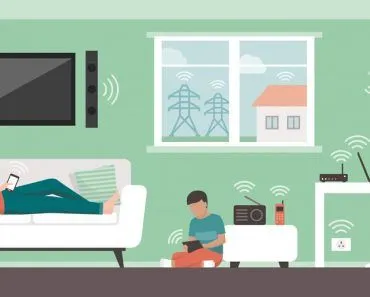
Since the turn of the millennium, interconnection between electronic devices has become increasingly wireless. This wireless interconnection primarily comes in the form of electromagnetic radiation, which in recent times has been subjected to many health concerns.
Wireless Technology And Radiation Conundrum
In this age of the internet, smartphones are nearly indispensable, and they primarily run on cellular networks. Besides cellular networks, we also use two other wireless technologies: Bluetooth and Wifi.
I recently saw one of my cousins who is expecting a baby. She was very jittery about electromagnetic radiation, especially for the child about to come into her life. She asked me if it would be better if she avoided using Wifi and Bluetooth. She wondered whether turning Wifi and Bluetooth off would exposed her to significantly less radiation.
Well, while the idea of cutting out Wifi and Bluetooth seems to be prudent, when you get into the technicalities and science of wireless communication, the answer isn’t that straightforward.
Wifi and Bluetooth both use radio frequency signals, which are part of the electromagnetic spectrum. The mobile network that you use by inserting a SIM card into your cellphone also works on radio frequencies. Now, how much you are exposed to electromagnetic radiation depends on a couple of factors, including the strength of the signal, the distance of the emitting device from your body, the mode of communication used, etc.
Wifi: Non-ionizing Form Of Radiation
Another important thing to consider is that the radio frequency signals that Wifi and Bluetooth work on are non-ionizing forms of radiation. What this simply means is that these radio waves don’t have enough energy to affect or alter your DNA—the building blocks of life. Altering one’s DNA is bad, as it can open the door for life-threatening diseases.
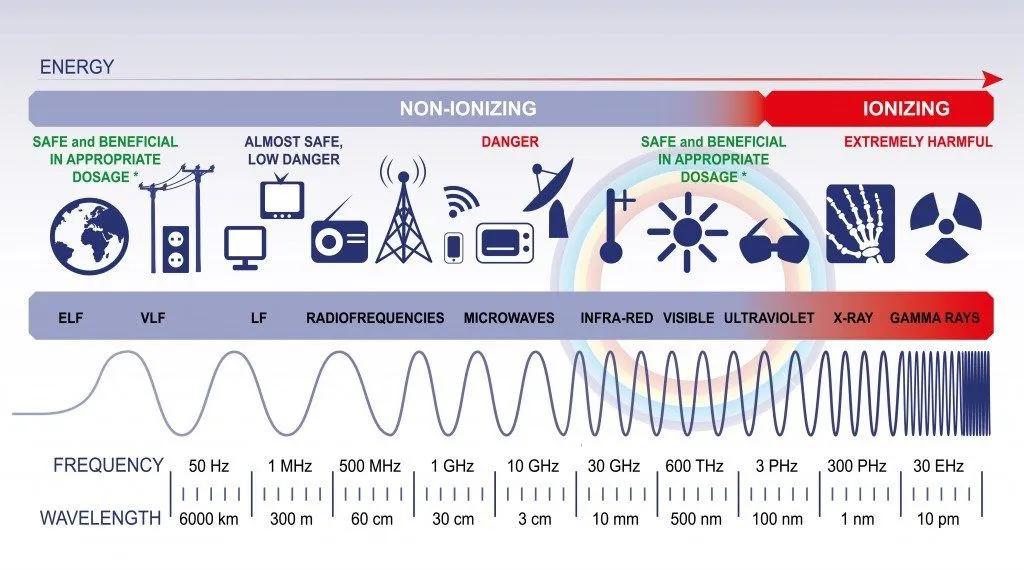
Now, a few studies have hinted that even non-ionizing radiation can have measurable effects on cells and tissues, but how serious they are is still subject to much debate.
One such study, conducted by the National Institutes of Health’s National Toxicology Program, found "clear evidence" that very high doses of cellular RF radiation caused malignant cardiac schwannomas (a rare nerve-sheath tumor) in about 6% of male rats, plus "some evidence" of glioma brain tumors. Female rats had no clearly elevated tumor risk.
So while the research has not been conclusive, the World Health Organization’s International Agency for Research on Cancer classifies radiofrequency electromagnetic fields as Group 2B (possibly carcinogenic to humans) as of 2011, a precautionary label that remains unchanged in 2026 pending an IARC re-evaluation. A 2024 WHO-commissioned review in Environment International (Karipidis et al.) found no clear link to brain tumors in humans, but animal studies continue to find tumor effects at very high exposures.
It’s All Radio Waves!
The point is that all three wireless communication methods—cellular network, Wifi, and Bluetooth—use radio waves. However, we generally keep our mobile phones ON most of the time, so our mobiles are incessantly transmitting radio waves (unless you put it on an airplane mode). This cellular network coverage is the major source of radiation. That being said, this does not mean that Wifi and Bluetooth don’t add more, but their contribution is less, given that their signal strength is weaker than cellular signals. Thus, their potential impact is also less. Now, this ‘weakness’ of signal is still debatable, considering that it’s not absolute and depends on a number of factors, including the strength of the signal and distance from the body.
What Kind Of Waves Does Bluetooth Use?
If you have ever wondered exactly what is zipping between your phone and your wireless earbuds, here is the short answer: Bluetooth uses radio waves in the 2.4 GHz band, running between 2.402 and 2.480 GHz (Source). This is the same globally shared, unlicensed slice of spectrum, known as the ISM (Industrial, Scientific and Medical) band, that Wifi's 2.4 GHz mode, cordless gadgets and even your kitchen microwave use. That crowded address is also why a running microwave oven can sometimes disrupt your Wifi.

So are Bluetooth waves radio waves or microwaves? Honestly, they are both, and the two labels just describe the same thing from different angles. Engineers file 2.4 GHz under ultra-high-frequency (UHF) radio, but that frequency also sits inside the microwave stretch of the radio spectrum, so calling it a microwave is not wrong either. What Bluetooth is definitely not is a light wave. Visible light vibrates at hundreds of terahertz, hundreds of thousands of times faster than Bluetooth, which is exactly why you can neither see nor feel these signals passing through you.
You can even estimate the wavelength yourself. Wavelength is simply the speed of light divided by frequency, and at 2.44 GHz that works out to roughly 12 centimeters (close to 5 inches). Since this is non-ionizing radiation, as we saw earlier, those chunky 12-centimeter waves carry far too little energy to knock electrons loose or tamper with your DNA. Bluetooth also sips power: most phones and headphones use Class 2 radios that peak at a mere 2.5 milliwatts, a tiny fraction of what your phone blasts toward a distant cell tower.
Inverse-square Law At Play
These radio waves obey the inverse-square law when it comes to distance. What this means is that exposure falls off as the square of the distance between you and the device. Doubling the distance, for example, reduces the radiation intensity to one quarter.
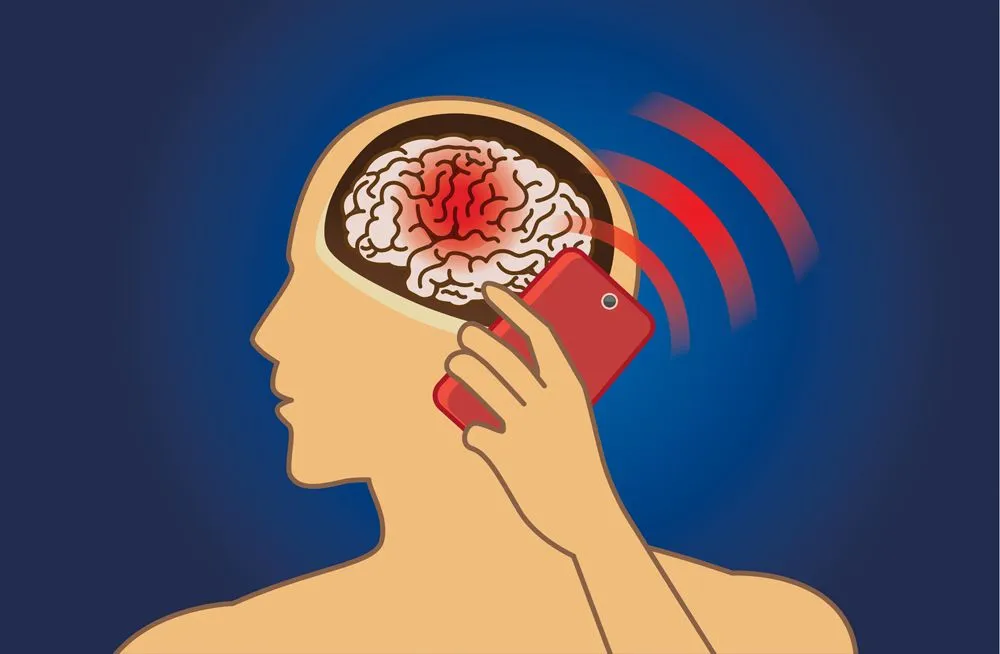
If you think about it in such terms, the most exposure you can get is when you talk over the phone. While on the phone, you are bringing your phone really close to your skull, and thus your brain. The surface area in touch with your body is at a maximum, so talking over the phone poses a greater radiation risk (Source) than simply keeping the phone in your pocket.
Similarly, when you use Bluetooth headphones and turn them on to listen to music, you are again making direct contact with the device.
Thus, you are better off not using a Bluetooth headset if minimizing exposure to electromagnetic radiation is your primary concern.
Similarly, doing video calls instead of phone calls with wired earphones is a good option.
The concern related to Bluetooth has now been addressed, but what about using Wifi? Well, it’s better to use Wifi than cellular data, because the power that WiFi signals carry is much lower. Cellular signals that your cellphone works on are emitted by cell towers, which transmit at around 20 to 50 watts per channel. Wifi routers, on the other hand, are capped by the FCC at 1 watt of conducted power (about 4 watts of effective radiated power once antenna gain is included), and most home routers actually transmit only 100 to 200 milliwatts.
Even so, remember that the absorption of these waves depends very much on the distance, i.e., the closer you are to a cell tower or a router, the higher the radiation density.
Do Bluetooth Headphones Like AirPods Emit Harmful Radiation?
Few gadgets have attracted as much radiation panic as wireless earbuds, and Apple's AirPods in particular. The worry spread widely after a 2019 online article claimed that tucking a transmitter inside your ear canal was dangerous. It is worth knowing where that fear actually came from. Back in 2015, more than 200 scientists signed an appeal urging the World Health Organization and the United Nations to tighten guidelines on electromagnetic fields, but that petition was a general warning about all wireless devices, not about AirPods, which had not even been released yet (Source).

So what does the evidence actually say? Bluetooth earbuds emit the same low-power, non-ionizing radio waves as any other Bluetooth device, and health agencies including the US Food and Drug Administration and the National Cancer Institute say there is no proven link between this kind of radiation and cancer (Source). Apple reports that AirPods sit more than two times below the FCC exposure limit of 1.6 W/kg, and one 2019 analysis found that Bluetooth headsets emit somewhere between 10 and 400 times less radiation than the phone they are paired with.
That said, the advice from the previous section still holds. Earbuds do sit right against your head, so if reducing exposure is genuinely your goal, plain wired earphones emit virtually no radio waves at all and remain the most cautious choice.
SAR: A Good Benchmark To Assess Radiation Intensity
The specific absorption rate is a good parameter to assess how much radiation our bodies absorb upon exposure to these wireless devices. The SAR value for a typical Wifi signal operating at least half a meter away from the router is less than 0.01 W/kg. Compare that to the SAR value of flagship smartphones: the iPhone 12 Pro sits at about 1.16 W/kg (head), and more recent models are similar, all well under the FCC limit of 1.6 W/kg averaged over 1 gram of tissue.
As you can see, the answer to whether turning off Wifi and Bluetooth would substantially help you in reducing radiation exposure isn’t that simple.
For example, if you turn off these two and continue to use the cellular network for calls and the internet, you are still exposed to substantial amounts of radiation. Also, since Bluetooth devices like headphones or smart bands are wearable gizmos, you are risking yourself more through this direct contact (Source).
Finally, when it comes to choosing between cellular data and Wifi, it’s definitely better to choose Wifi, as the intensity of Wifi signals in terms of SAR value is far less. Moreover, you’ll substantially save on your battery, which is always a good thing!
References (click to expand)
- YH Ahn. Hsd:Sprague Dawley SD Rats Exposed to Whole-Body Radio .... The National Institute of Environmental Health Sciences
- Delhi, N., & Behari, J. (n.d.). Electromagnetic pollution-the causes and concerns. Proceedings of the International Conference on Electromagnetic Interference and Compatibility (IEEE Cat. No.02TH8620). IEEE.
- Cellphones, wi-fi and electromagnetic radiation | NBR - www.nbr.co.nz
- IARC classifies radiofrequency EMF as possibly carcinogenic to humans (2011) - WHO IARC
- Cell Phones Study - NTP, NIH
- iPhone 12 Pro RF Exposure (SAR) - Apple
- Bluetooth (frequency band and power classes) - Wikipedia
- Do AirPods Cause Cancer? What To Know About this Viral Myth - Healthline
- No evidence that radiation from Apple AirPods harms your brain - PolitiFact